Library · Amusements in Mathematics · Chapter 9
Patchwork Puzzles
These puzzles are dissections on squared material: brocade, bunting, patchwork and linoleum, which may be cut only along the lines between the squares. That turns each of them into a question about shapes made of whole squares, and makes it possible to search every way of cutting.
One new rule matters. When the material carries a pattern, the pieces must fit together so that the pattern still runs properly across the joins. A chequered design is spoiled by a piece turned a quarter round if the chequers carry diagonal hatching or an upright figure, and a piece can then only be slid into place, or at most turned half round; and it must land so that its chequers fall on chequers of the same kind, which means sliding it an even number of squares in all. Plain patchwork may be turned freely, but not turned over unless the puzzle allows.
No. 170. The Cushion Covers
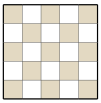
A square of brocade has twenty-five squares in a chequered pattern of two designs. A lady wants to cut it along the lines into four pieces, two of which make one square cushion top and the other two another, with the pattern matching properly and without any irregularity. There is only one way to do it. Can you find it?
No. 171. The Banner Puzzle
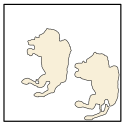
A square of bunting bears two lions. Cut it into as few pieces as possible, four as it happens, that fit together into two square banners with a lion on each. No cut may pass through either lion, nothing may be wasted, and the banners must be perfect squares, though not necessarily of the same size.
No. 172. Mrs Smiley’s Christmas Present
Mrs Smiley’s six granddaughters made her a patchwork quilt of 196 equal squares, fourteen on each side. Each girl made a perfect square of patchwork, all six of different sizes, but to join them into the quilt the work of one girl had to be unpicked into three pieces. Show how the joins might have been made. No piece may be turned over.
No. 173. Mrs Perkins’s Quilt
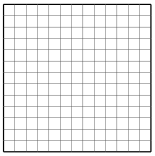
This square patchwork quilt has 169 pieces, thirteen on each side. What is the smallest number of square portions of which it could have been made, and how are they joined? Put the other way: divide the quilt into as few squares as possible by cutting stitches only.
No. 174. The Squares of Brocade
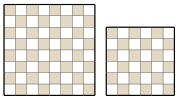
Two lovely squares of Eastern brocade, of the same chequered design, are to be joined into one large square cushion cover, cutting only along the lines and mutilating the material as little as possible. They were cut into four pieces that fit together into a larger square with the pattern matching, and two of the pieces happened to have exactly the same number of chequers. Show how.
No. 175. Another Patchwork Puzzle
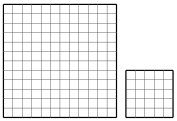
Two pieces of silk patchwork, one squares and the other , are to become one quilt , cutting only stitches. A friend says four pieces in all will do. Show how.
No. 176. Linoleum Cutting
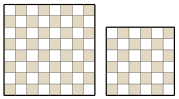
Two squares of linoleum with a chequered pattern that is not repeated on the back, so that no piece can be turned over, are to be cut into four pieces that make one perfect square with the pattern matching, cutting as small a portion as possible from the larger square.
No. 177. Another Linoleum Puzzle
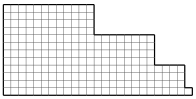
Cut this piece of linoleum, along the lines only, into four pieces that fit together to make a perfect square.
The Cushion Covers
Twenty-five squares make two square cushions only as , so the cushions are and . The pattern forbids turning (the bells must stay upright), and within each cushion the two pieces must keep the chequers alternating, so their positions differ by an even number of squares.
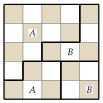
Cut as shown: the two pieces A slide together into the , and the two pieces B into the . A program tried every way of splitting a and a into two connected pieces each, 627 and 53 ways, and every way of sliding the four pieces into the brocade with the pattern matching.
It found eight cuttings, and they are the eight turnings and reflections of this one, so Dudeney is right that there is essentially only one way.
Answer Two pieces A make the , two pieces B the
The Banner Puzzle
Rule the bunting into squares, as Dudeney advises, because : the banners are and . The lions sit so that the line between the third and fourth columns runs clear of both, and the cuts can go round them.
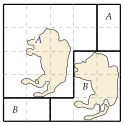
The large piece A with the first lion and the strip A beside it make the ; the piece B with the second lion and the little strip B, turned a quarter round, make the . The lions are not turned, only the plain strip. A program marked every unit of the ruled lines that crosses a lion in Dudeney’s drawing and searched every cutting into two banners that avoids them: there are four, of which this is one.
Answer Four pieces, cut round the lions on a ruling
Mrs Smiley’s Christmas Present
The first step is to write 196 as a sum of six different squares. Running through the squares below 196, largest first, and keeping only the choices that can still reach 196 with the squares left, finds exactly three ways: The rest needs ingenuity rather than rule. Dudeney shows quilts for the first two. With squares of 6, 7, 5, 2 and 1 left whole, the girl’s is unpicked into the three pieces marked A; with squares of 3, 5, 1, 2 and 6 whole, the is unpicked into the pieces B.
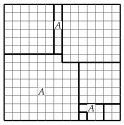
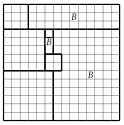
In each quilt the three lettered pieces go back together as their square, the long strip turned a quarter round but nothing turned over, as the fitting program confirms. Dudeney leaves the third set to the reader. A search shows it cannot be done by cutting one of its squares into three rectangles with two straight cuts, so any answer needs pieces with steps in them, like his.
Answer Squares 6, 7, 5, 2, 1 whole and the 9 in three pieces; or 3, 5, 1, 2, 6 whole and the 11 in three
Mrs Perkins’s Quilt
Eleven squares, of sides 7, 6, 6, 4, 3, 3, 2, 2, 2, 1 and 1, arranged as shown. Their areas add up to 169.
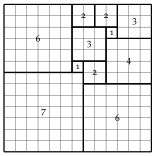
That eleven is the fewest, and that this is the only way, is settled by search. Fill the quilt from the bottom, always putting a square into the lowest gap at its left-hand end, and try every size that fits; every dissection is met this way, in some order.
No dissection uses ten squares or fewer, and the eleven-square dissections are just this one in its eight positions, turned and reflected. Dudeney believed there was practically only one solution, with the group of eight small squares free to be reflected; that reflection is one of the quilt’s own symmetries, so the solution is unique.
Answer Eleven squares
The Squares of Brocade
The squares are 8 and 6 chequers on a side, and , so the cushion is . Cut the larger square into pieces A and B and the smaller into C and D as shown; A and C have twenty chequers each, the two pieces of equal area.
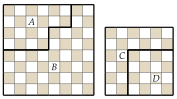
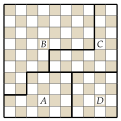
Each piece slides into the cushion by an even number of squares, so the chequers match everywhere, and no piece needs even a half turn. The fitting program assembles them, respecting the pattern. Dudeney adds that, so far as he could discover, this is the only solution; that has not been checked here, since it would mean searching every way of cutting both squares.
Answer A, B from the and C, D from the ; A and C have 20 chequers each
Another Patchwork Puzzle
Keep the whole, and unpick the along a staircase and a step into three pieces, as shown.
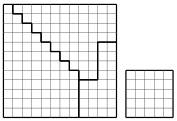
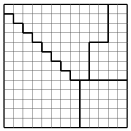
Slide piece 1 one square down and piece 2 one square to the left: the staircase opens by one step, and the quilt grows by a row and a column. Piece 3 moves up four squares and one to the right, and the fills the corner that is left. Nothing is turned; the program fits the four pieces by sliding alone.
Answer The whole and the in three pieces
Linoleum Cutting
The squares are and . Cut the small one into A and B and the large one into C and D as shown, keeping the piece D of 52 chequers.
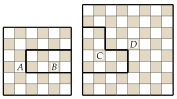
The four pieces make the with every chequer matching and none turned over, as the fitting program confirms. Dudeney states that 52 is the largest piece of the larger square that can be kept, and he is right. A second program let a solver choose freely which chequers go into each piece and how each piece is turned and placed, and asked for the largest possible D. It did not even insist that the pieces hang together, which could only help, and still the answer was 52.
Answer D keeps 52 of the 64 chequers
Another Linoleum Puzzle
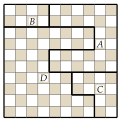
The piece is stepped: four rows of 12 squares, four of 20, three of 24 and one of 25, 225 squares in all, so the square is . Cut straight down at 15 and 17 squares from the left, from the step to the bottom, and cut off the last eight squares of the bottom row.
The large piece A, a block 15 wide and 8 deep with a strip 12 wide and 4 deep on it, is turned half round, so that its strip lies along the bottom. The stepped piece D sits over its block, the strip B, turned a quarter round, stands against it, and C completes the square, as a fitting program confirms.
Answer Cuts at 15 and 17 squares, and the bottom row’s tail