Library · Amusements in Mathematics · Chapter 17
Dynamical Chess Puzzles
On this page
- No. 320. The Rook’s Tour
- No. 321. The Rook’s Journey
- No. 322. The Languishing Maiden
- No. 323. A Dungeon Puzzle
- No. 324. The Lion and the Man
- No. 325. An Episcopal Visitation
- No. 326. A New Counter Puzzle
- No. 327. A New Bishop’s Puzzle
- No. 328. The Queen’s Tour
- No. 329. The Star Puzzle
- No. 330. The Yacht Race
- No. 331. The Scientific Skater
- No. 332. The Forty-Nine Stars
- No. 333. The Queen’s Journey
- No. 334. St George and the Dragon
- No. 335. Farmer Lawrence’s Cornfields
- No. 336. The Greyhound Puzzle
- No. 337. The Four Kangaroos
- No. 338. The Board in Compartments
- No. 339. The Four Knights’ Tours
- No. 340. The Cubic Knight’s Tour
- No. 341. The Four Frogs
- No. 342. The Mandarin’s Puzzle
- No. 343. Exercise for Prisoners
- No. 344. The Kennel Puzzle
- No. 345. The Two Pawns
Here the pieces move. A rook or a queen sweeps over the board in as few straight lines as possible, or as many; a knight leaps into every square once; counters and prisoners shuffle through a single empty place until they stand in order. Many of Dudeney’s answers here are a route drawn on a diagram, and a route can be checked square by square. His claims that a route is the shortest, or the only one, are harder, and some of them he could only believe. A program can often settle them by trying every route, and where it could not in reasonable time the text says so.
For the sliding puzzles the programs use a search that deepens step by step with a lower bound on the moves still needed, the sum of each counter’s distance from its place, so that the first solution found is a shortest one. For the tours they list every route, cutting off any that has left a square it can no longer reach.
No. 320. The Rook’s Tour
Move the rook from its square, the fourth of the fourth row, over the whole board so that it visits every square once and only once and ends on the square from which it started, in as few moves as possible. A square passed over counts as visited. Unless you are careful you will take one move too many.
No. 321. The Rook’s Journey
The rook starts in the top right corner and makes twenty-one moves, visiting every square once and only once, stopping at the end of its tenth move on the square marked 10 in the bottom row (the fifth from the right) and ending on the square marked 21 (the seventh from the right). It must turn after every move.
No. 322. The Languishing Maiden
A knight enters a dungeon of cells, eight by eight, all connected by open doors, at the top left corner, and must reach the maiden chained in the cell two up and two in from the bottom right corner after entering every cell once and only once. Find a route, and then one in twenty-two straight paths.
No. 323. A Dungeon Puzzle
A prisoner in the fourth cell from the right of the bottom row of an eight by eight dungeon visits every cell once and only once, ending where he likes, and wants as many turnings as possible. His first attempt had fifty-five straight lines. Can you get more?
No. 324. The Lion and the Man
In a Roman prison of sixty-four cells, all communicating, a man starts in one corner and a lion in the opposite one. Each visits every cell once and only once in the fewest possible straight lines, ending in the other’s corner. They start together and go at the same speed, and although they occasionally catch glimpses of one another they never meet. Show the routes.
No. 325. An Episcopal Visitation
The white squares are the parishes of a diocese. Place the bishop where you like and let him visit every parish, squares passed over counting, in the fewest bishop’s moves. He may visit a square more than once, but may not move twice between the same two neighbouring squares.
No. 326. A New Counter Puzzle
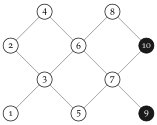
Two white counters stand on points 1 and 2 and two red on 9 and 10. Make the red and white change places, moving one at a time along the lines, with the one rule that a red and a white may never stand on the same straight line. The first move can only be from 1 or 2 to 3, or from 9 or 10 to 7.
No. 327. A New Bishop’s Puzzle
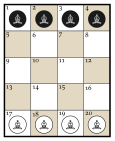
Four black bishops and four white stand on a board four squares wide and five deep. Make them change places, white and black moving alternately, white first, no bishop ever attacking one of the other colour. Then find the fewest moves. Played on the white squares alone, Dudeney says, this is the last puzzle turned on its side.
No. 328. The Queen’s Tour
Sam Loyd’s tour of the board with the queen, re-entrant, in fourteen moves, squares being passed over more than once, is drawn here. There are only ten differently placed squares on a chessboard, lettered A to J in the second diagram; every other square is a turning or reflection of one of them. Loyd’s tour turns on a D square, so turning the board gives tours starting from any D, and it can be made to start from any A, B, C, D, E, F or H. No fourteen-move tour can start from a G, I or J, but a path that need not return can start anywhere. Start from the central J and visit every square in fourteen moves.

No. 329. The Star Puzzle
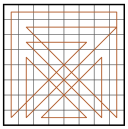
Sixty-four stars stand in eight rows of eight, two of them white: the third in the fourth row and the fourth in the fifth. Start at one white star and strike out all the stars in fourteen continuous straight strokes, ending at the other, every turn made on a star. Queen moves alone will not do, Dudeney says, so a stroke may run in any direction.
No. 330. The Yacht Race
From the yacht’s buoy, the first of the fifth row, touch all sixty-four buoys in fourteen straight courses and return to the start, the seventh course ending at the flag buoy, the last of the seventh row. Oblique courses are allowed.
No. 331. The Scientific Skater
A skater near one corner of sixty-four points on the ice must pass over every point in fourteen straight lines and return to where he started.
No. 332. The Forty-Nine Stars
Forty-nine stars stand in seven rows of seven, with black stars in two opposite corners. Starting at one black star, strike out all the stars in twelve straight strokes, ending at the other, the strokes running along the rows, columns and diagonals and every turn made on a star.
No. 333. The Queen’s Journey
Place the queen on her own square and find the greatest distance she can travel over the board in five queen’s moves without passing over any square a second time and without crossing her own track.
No. 334. St George and the Dragon
On a board of forty-nine squares, St George the knight starts on the centre square and must visit every square once and only once by knight’s moves, capturing the dragon, two up and one in from the bottom left corner, on his last move. Find a route that makes a pretty design.
No. 335. Farmer Lawrence’s Cornfields
A field of forty-nine square plots, seven by seven, is to be cut plot by plot, each a knight’s move from the last, the first cutting in the top left corner, the thirteenth in the bottom left, the twenty-fifth in the centre, the thirty-seventh in the top right and the last in the bottom right.
No. 336. The Greyhound Puzzle
Twenty kennels stand four wide and five deep. The greyhound leaves the top left kennel by visiting every kennel once and only once in knight’s moves, ending at the bottom right, which opens to the world. In how many different ways can he make his exit?

No. 337. The Four Kangaroos
A kangaroo in each corner of sixty-four fields goes for a morning hop: sixteen knight’s leaps, fifteen different fields and back to his corner, no field visited by two kangaroos. Show how they can do it with no kangaroo ever crossing the line that divides the board into top and bottom halves.
No. 338. The Board in Compartments
The board is divided into two compartments of twenty squares and two of twelve. Describe a re-entrant knight’s tour that visits every square of each compartment before passing into another. Dudeney adds some facts about boards in general: no re-entrant tour on a board with an odd number of squares; a re-entrant tour on any board with an even number of squares whose sides are at least six and five, the smallest being six by five; no complete path on a board with a side of two, nor on a square board smaller than five by five; and sixteen paths on a board four by three.
No. 339. The Four Knights’ Tours
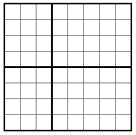
Cut into four quarters, the board allows no knight’s tour on any quarter. Cut it instead into four parts of the same size and shape so that a re-entrant tour can be made on each part.
No. 340. The Cubic Knight’s Tour
Vandermonde is said to have proposed a knight’s tour over the six faces of a cube, each face a chessboard. Find one.
No. 341. The Four Frogs
Eight toadstools stand joined by lines, white frogs on 1 and 3 and black frogs on 6 and 8. Move one frog at a time along the lines until they have changed places, never two frogs on a toadstool. It is easy; do it in seven plays, any number of successive moves by one frog counting as one play.
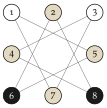
No. 342. The Mandarin’s Puzzle
Twenty-four numbered counters stand on a table of twenty-five squares, one square empty. Move them one at a time by knight’s moves into the empty square until they stand in order, reading the rows from the top. The counters on the shaded squares are already in their places. Do it in the fewest moves.
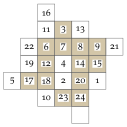
No. 343. Exercise for Prisoners
Fifteen prisoners stand numbered in order in sixteen cells, four by four, the bottom right cell empty; a prisoner may step through a doorway into the empty cell. They wish to stand as a knight’s path, each number a knight’s move from the one before, with the same corner empty, and to do it in the fewest moves while giving a complete rest to as many prisoners as possible.
No. 344. The Kennel Puzzle
Twenty dogs stand numbered in order in the top four rows of twenty-five kennels, five by five, the bottom row empty. Moving one dog at a time into an empty neighbouring kennel, arrange them as a knight’s string, each number a knight’s move from the one before, with the bottom row empty again, in the fewest moves.
No. 345. The Two Pawns
Two rook’s pawns stand on their second squares. In how many different sequences may they advance to the eighth square, either moving first and a pawn being free to take its first step as one square or two? A pawn that reaches the eighth square stays there.
The Rook’s Tour
Sixteen moves. The trap is to start in the middle of a straight line, which costs a seventeenth move to close the tour; the rook’s own square must be a corner of the route. A program listed every closed route over the board in sixteen or fewer straight moves. None has fewer than sixteen, 84 have exactly sixteen, and 8 of those turn on the rook’s square, which is 4 once a route and its reflection in the long diagonal through that square are counted together.
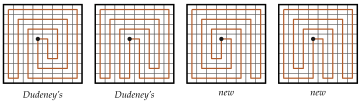
Dudeney calls his two, on the left, “the only possible minimum solutions”. The other two are just as short.
Answer Sixteen moves
The Rook’s Journey
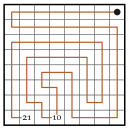
A program listed every route from the corner to the square 21 in twenty-one moves; there are fourteen, and this is the only one whose tenth move ends on 10.
Answer The route above
The Languishing Maiden
The knight’s cell and the maiden’s are the same colour on a chessboard, and a route that enters every cell once goes from one colour to the other at each step, so it must start and end on different colours when the cells are even in number. Dudeney’s way round is to step into the first neighbouring cell and straight back, then go on by the other; the dashed stroke below is that step.
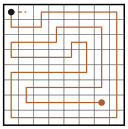
A program found that twenty-two straight paths are the fewest possible in this way, and that 56 routes take exactly twenty-two.
Answer Twenty-two straight paths
A Dungeon Puzzle
Fifty-seven straight lines.
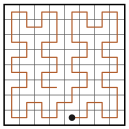
A program listed every route from the prisoner’s cell with fifty-seven lines or more: there are ten, all of exactly fifty-seven. Dudeney adds that no rook’s path over the chessboard can exceed this number, and the program confirms that too: from no square of the board does a route over every square have fifty-eight.
Answer Fifty-seven lines
The Lion and the Man
Each takes twenty-two straight lines, using the same trick of stepping into a neighbouring cell and back at the start, since their corners too are the same colour. A program listed the 28 shortest routes for each. Of the 784 ways of pairing a route for the man with one for the lion, 164 never bring them into the same cell or past each other in a doorway, and in 136 of those they see each other along a row or column at some moment. Here is one such pair, the man’s route solid and the lion’s dashed.
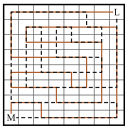
Dudeney’s own routes were not read from his diagram. His remark that giving the lion the man’s route turned half round means they never glimpse each other is right: then they are always in cells symmetrical about the centre, never in the same row or column. (Played backwards instead, a route always meets itself halfway.)
Answer As above
An Episcopal Visitation
Seventeen moves. The two corner squares lie each on a diagonal of one square, so the bishop can reach a corner only along the long diagonal and cannot turn there: each corner must be an end of the route. The first and last moves both run along the long diagonal’s direction, and moves change direction each time, so the number of moves is odd. A program searched every route from a corner and found none in fifteen, eight in seventeen, and none from any other starting square.
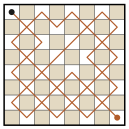
This route was found by the program; Dudeney’s is too faint to read with confidence.
Answer Seventeen moves
A New Counter Puzzle
Eighteen moves: 2–3, 9–4, 10–7, 3–8, 4–2, 7–5, 8–6, 5–10, 6–9, 2–5, 1–6, 6–4, 5–3, 10–8, 4–7, 3–2, 8–1, 7–10. A counter may slide any distance along a line through empty points, as 9–4 shows. A breadth-first search over every position, which lists all positions one move from the start, then all those two moves away, and so on, so that the first time it meets the goal is by a shortest route, proves eighteen the fewest.
Answer Eighteen moves
A New Bishop’s Puzzle
Eighteen moves each. Numbering the squares 1 to 20 row by row from the top left:
| White | Black | White | Black | ||
| 1. | 18–15 | 3–6 | 10. | 20–10 | 1–11 |
| 2. | 17–8 | 4–13 | 11. | 3–9 | 18–12 |
| 3. | 19–14 | 2–7 | 12. | 10–13 | 11–8 |
| 4. | 15–5 | 6–16 | 13. | 19–16 | 2–5 |
| 5. | 8–3 | 13–18 | 14. | 16–1 | 5–20 |
| 6. | 14–9 | 7–12 | 15. | 9–6 | 12–15 |
| 7. | 5–10 | 16–11 | 16. | 13–7 | 8–14 |
| 8. | 9–19 | 12–2 | 17. | 6–3 | 15–18 |
| 9. | 10–4 | 11–17 | 18. | 7–2 | 14–19 |
A program replayed every move, checking that no bishop ever attacks one of the other colour (a piece between them blocking the attack), and a breadth-first search over the 19,568 positions that can arise proves thirty-six moves, eighteen each, the fewest.
Answer Eighteen moves each
The Queen’s Tour
Dudeney’s second tour, with the J, I and G squares he mentions:
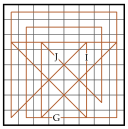
Break the tour inside a line at J, erase the shorter piece of that line, and what is left is a path of fourteen moves over the whole board starting from J. The same works at I and at G. Both his tours were read from his diagrams and checked by a program: each closes up in fourteen queen’s moves and passes over every square, and the breaks at J, I and G each leave a fourteen-move path covering the board. Loyd’s tour turns on squares of the kinds A, B, C, D, E, F and H and no others, exactly the starting points Dudeney claims for it. His statement that no fourteen-move tour turns on a G, I or J square, and that no other tour he knew served more than five kinds, would need every such tour to be listed, and was not checked.
Answer As above
The Star Puzzle
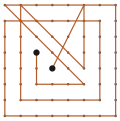
Thirteen of the strokes run along rows, columns and diagonals; the last runs obliquely from a star in the top row to the second white star. The program confirms that the fourteen strokes strike out every star.
Dudeney was wrong, though, to say that queen’s strokes alone cannot do it. In 2012 Alex Ravsky found this route by hand, every stroke along a row, column or diagonal:
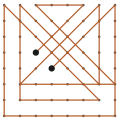
In chess notation it runs c5, f8, c8, h3, b3, g8, g3, b8, b2, g2, a8, a1, h1, h8, d4, from the upper white star to the lower. The same program confirms it: fourteen strokes, every star struck out, every turn on a star, and no oblique stroke.
Answer As above
The Yacht Race
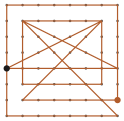
From the yacht’s buoy (black) the courses go to the second buoy from the right in the second row, along to the second from the left, down the long diagonal to the bottom right corner, round three sides of the edge and down the fourth to the flag buoy (the seventh course), along the seventh row, up a diagonal, round three sides of a rectangle, obliquely to the right-hand edge and back along the fifth row. The program confirms fourteen courses, every buoy touched, and the seventh course ending at the flag.
Answer As above
The Scientific Skater
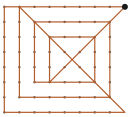
The skater stands just beyond the end of the top row. Two of his strokes run past the edge of the square, to his starting point and to the point beyond the bottom right corner, and otherwise every stroke is a queen’s move. He goes as far as he can in a straight line before turning, and returns to his start after fourteen strokes. The program confirms that every point is struck out.
Answer As above
The Forty-Nine Stars
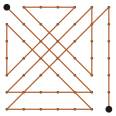
Twelve strokes, all along rows, columns and diagonals, every turn on a star, from one black star to the other, as the program confirms.
Answer As above
The Queen’s Journey
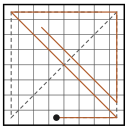
With the squares two inches apart, the solid route is 67.94 inches long and the dashed one, which most people suggest, 67.80. A program tried every journey of five moves from the queen’s square that never passes a square twice or crosses itself, counting two diagonal moves that cross between squares as a crossing. The solid route is the longest, and the dashed one is the next longest, as Dudeney says.
Answer The solid route
St George and the Dragon
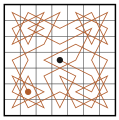
Both the centre and the dragon’s square have the colour of the board’s corners, which has one square more than the other colour, so a route between them is possible. This one was found by a program. Dudeney’s answer is a symmetrical design of lines, which was not copied here.
Answer A route as above
Farmer Lawrence’s Cornfields
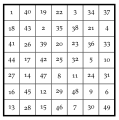
One order of cutting with the five given plots in their places, found by a program. Dudeney says there are numerous solutions and gives one with long parallel lines.
Answer As above
The Greyhound Puzzle
Twelve ways. Dudeney shows that the first ten kennels must be one set of squares, which he circles, and the last ten the others; there are eight ways through each half, and they link into twelve complete routes. Ten of these are five routes and the same routes turned upside down and reversed; the other two are their own reversals. A program listed every route and confirms all of it.
Answer Twelve ways
The Four Kangaroos
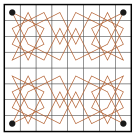
A program found that there is exactly one way of dividing the top half into the two kangaroos’ sets of sixteen fields, though each kangaroo can hop over his sixteen in eight different orders. The bottom half is the reflection of the top. Dudeney adds that the kangaroos could not keep to quarters of four by four, and indeed a board four by four has no circuit at all.
Answer As above
The Board in Compartments
A program counted the re-entrant tours that finish each compartment before leaving it, in two ways (by joining paths through the compartments, and by a direct search over the whole board), and both give 36.
The facts about other boards were checked as well. A board four by three has sixteen knight’s paths, reversals counted, and a board four by four has none. But the rule for re-entrant tours is not quite right. Of all the boards with thirty squares or fewer, two have a re-entrant tour: six by five, as Dudeney says, and also three by ten, which has the same number of squares and a side of only three.
Answer Thirty-six tours
The Four Knights’ Tours
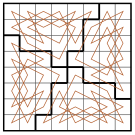
Each part is a quarter turn of the next about the centre of the board. A program confirms that each part has a re-entrant tour, and exactly one, as Dudeney says.
Answer As above
The Cubic Knight’s Tour
Dudeney’s answer is a folding diagram of all six faces, 384 squares, and his plan is the natural one: the knight tours one face completely, crosses an edge to the next face, and so on round all six and back to the start. The difficulty, he says, lay in the points of entry and exit on each board and the order of the boards. His diagram is too fine to read reliably, so the tour below is a fresh one built on his plan.
First the move across an edge, which Dudeney calls easily understood and does not define. Fold the cube out flat along the edge in question and the knight moves as on a board of 128 squares: two squares one way and one at right angles, the step that runs off one face carrying on down the next. Near a corner of the cube a move could run over two edges, and then going two squares first or one square first can end in different places; such moves are simply not allowed. That costs the squares near the corners of the cube a move or two: 24 squares have six moves and 48 have seven, and the other 312 keep all eight.
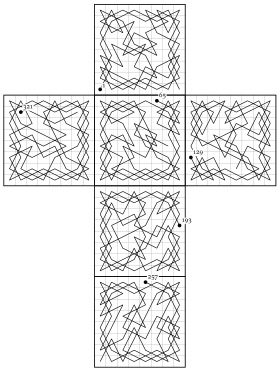
The cube is opened out as a cross, and the numbers mark where the knight enters each face. It starts at 1 on the top, tours the top, jumps to the front at 65, then to the right-hand face, the bottom, the back and the left, and from 384 on the left face a single move takes it back to 1. A program checked every move, in particular that each move across an edge is an ordinary knight’s move on the two faces folded flat, and found the path over each face by trying first the square with fewest onward moves, Warnsdorff’s old rule, backing up when it ran into a dead end or finished on a square with no move to the next face.
Answer A re-entrant tour taking the six faces in turn, as shown
The Four Frogs
Seven plays: (1–5), (3–7, 7–1), (8–4, 4–3, 3–7), (6–2, 2–8, 8–4, 4–3), (5–6, 6–2, 2–8), (1–5, 5–6), (7–1). The lines are knight’s moves on a three by three board without its centre, so this is Guarini’s problem of 1512. A breadth-first search confirms sixteen single moves as the fewest and seven plays as the fewest, and replays these.
Dudeney’s method is to untangle the lines like buttons on a string: the eight toadstools then lie in a ring, and the frogs simply move round it. He applies it also to a puzzle from Les Petites Aventures de Jerome Sharp (1789): eight points on a star, each joined to the points three places away, where seven counters are to be placed, each by touching a vacant point and sliding the counter along a line to the next vacant point. His rule, always move to the point you last moved from, works from every opening move, as the program confirms.
Answer Seven plays
The Mandarin’s Puzzle
Thirty moves: 2, 6, 13, 4, 1, 21, 4, 1, 10, 2, 21, 10, 2, 5, 22, 16, 1, 13, 6, 19, 11, 2, 5, 22, 16, 5, 13, 4, 10, 21. The trick is to move the 6, one of the counters already in place, on the second move and put it back on the nineteenth. A search for the shortest solution confirms thirty as the fewest, and thirty-two as the fewest if the shaded counters are left alone, both as Dudeney says.
Answer Thirty moves
Exercise for Prisoners
Two prisoners, 7 and 13, can be given a complete rest, and the arrangement below can be reached in sixty-six moves: 12, 11, 15, 12, 11, 8, 4, 3, 2, 6, 5, 1, 6, 5, 10, 15, 8, 4, 3, 2, 5, 10, 15, 8, 4, 3, 2, 5, 10, 15, 8, 4, 12, 11, 3, 2, 5, 10, 15, 6, 1, 8, 4, 9, 8, 1, 6, 4, 9, 12, 2, 5, 10, 15, 4, 9, 12, 2, 5, 3, 11, 14, 2, 5, 14, 11.

A program checked the whole of Dudeney’s analysis. There are 80 knight’s-path arrangements with the corner empty, and only the 40 of even arrangement can be reached, as in any sliding puzzle. Two is the most that can stay where they are, and the pairs that can are 7 and 13, 8 and 13, 5 and 7, and 5 and 15; Dudeney’s fourth pair, 5 and 13, is a slip for 5 and 15, since no arrangement keeps both 5 and 13. With the two resting men never moving, their cells are walls, and then only 7 and 13 work, in exactly his four arrangements.
Dudeney did not think the sixty-six moves could be beaten, but could not be sure. They cannot. A search for the shortest solution, bounded by each man’s walking distance round the walls, finds sixty-six the fewest to this arrangement (and returns exactly his moves), and shows that none of his other three can be reached in sixty-six or fewer. Mr R. Elrick’s solution in forty-five moves, with the bottom left cell empty instead, also checks, though every man moves.
Answer Sixty-six moves
The Kennel Puzzle
Dudeney chooses this knight’s string, in which five dogs, 1, 5, 10, 15 and 20, never leave their kennels:

and reaches it in forty-six moves (each written dog–kennel): 16–21, 16–22, 16–23, 17–16, 12–17, 12–22, 12–21, 7–12, 7–17, 7–22, 11–12, 11–17, 2–7, 2–12, 6–11, 8–7, 8–6, 13–8, 18–13, 11–18, 2–17, 18–12, 18–7, 18–2, 13–7, 3–8, 3–13, 4–3, 4–8, 9–4, 9–3, 14–9, 14–4, 19–14, 19–9, 3–14, 3–19, 6–12, 6–13, 6–14, 17–11, 12–16, 2–12, 7–17, 11–13, 16–18. A program replays them and finds the string reached. He believed it very hard to do better but could not say. A search for the shortest solution shows that his string cannot be reached in forty moves or fewer; since every move changes the parity of the dogs’ positions, it needs at least forty-two. Whether forty-four is possible would take the same search far longer, and it was not run; nor was every other knight’s string tried.
Answer Forty-six moves, at least forty-two
The Two Pawns
2,100 ways. Each pawn takes either five moves or six, depending on its first step. If both take six, the twelve moves can be interleaved in ways; if one takes six and the other five, in ways, twice over; if both take five, in . The sum is 2,100, and a program that lists the sequences directly agrees.
Answer 2,100 ways