Library · Amusements in Mathematics · Chapter 16
Statical Chess Puzzles
On this page
- No. 295. The Eight Rooks
- No. 296. The Four Lions
- No. 297. Bishops, Unguarded
- No. 298. Bishops, Guarded
- No. 299. Bishops in Convocation
- No. 300. The Eight Queens
- No. 301. The Eight Stars
- No. 302. A Problem in Mosaics
- No. 303. Under the Veil
- No. 304. Bachet’s Square
- No. 305. The Thirty-Six Letter-Blocks
- No. 306. The Crowded Chessboard
- No. 307. The Coloured Counters
- No. 308. The Gentle Art of Stamp-Licking
- No. 309. The Forty-Nine Counters
- No. 310. The Three Sheep
- No. 311. The Five Dogs Puzzle
- No. 312. The Five Crescents of Byzantium
- No. 313. Queens and Bishop Puzzle
- No. 314. The Southern Cross
- No. 315. The Hat-Peg Puzzle
- No. 316. The Amazons
- No. 317. A Puzzle with Pawns
- No. 318. Lion-Hunting
- No. 319. The Knight-Guards
In these puzzles the pieces stand still. Nothing is played; the question is only where the queens, rooks, bishops and knights may be put so that they attack every square, or attack nothing of their own kind, or leave as much of the board as possible untouched. Dudeney called the arrangements that differ only by turning the board round or holding it to a mirror the same “fundamental” arrangement, and most of his counts are of these.
One fact makes a program’s work simpler than it looks. If a square shares a line with a queen, the queen nearest to it along that line attacks it, whatever stands farther off; so when only one kind of line-moving piece is on the board, the question of which squares are attacked never depends on pieces getting in each other’s way. Where Dudeney mixes kinds of piece, blocking does matter, and in one place below it matters to his answer. Every count in this chapter was made again by listing the cases, and every one of Dudeney’s diagrams was read square by square and checked.
No. 295. The Eight Rooks
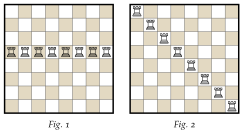
Eight rooks in one row attack or occupy every square, and each is guarded by another. Eight rooks on a long diagonal also attack or occupy every square, and none is guarded. In how many ways can the eight rooks be placed so that every square is occupied or attacked and no rook is guarded by another? Placings that are turnings or reflections of one another count as different.
No. 296. The Four Lions
In how many ways may four lions be placed on a board of sixteen squares, four by four, with never more than one lion in any row or column? Turnings and reflections do not count as different, so the lions on one long diagonal are the same arrangement as the lions on the other.
No. 297. Bishops, Unguarded
Place as few bishops as possible on the chessboard so that every square is occupied or attacked. By a diagonal Dudeney means not only the two long ones but every shorter line parallel to them.
No. 298. Bishops, Guarded
How many bishops are needed so that every square is occupied or attacked and every bishop is guarded by another? How may they be placed?
No. 299. Bishops in Convocation
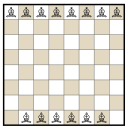
Fourteen bishops is the most that can stand on the chessboard with none attacking another, as here. In how many ways can the fourteen be placed? Dudeney promises a simple rule for a board of any size.
No. 300. The Eight Queens
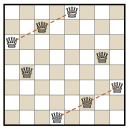
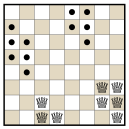
Eight queens can stand on the board with no queen attacking another in twelve fundamentally different ways, which give ninety-two in all. The arrangement shown is one of them, and it reproduces itself when the page is turned upside down. Place the eight queens so that no queen attacks another and no three queens stand in a straight line in any oblique direction. The dashed lines show why the arrangement here will not do. Only one of the twelve will.
No. 301. The Eight Stars
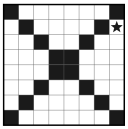
Place eight stars on the board so that no star is in line with another across, down or diagonally. One star is placed already and must not be moved, and no star may stand on a black square. There is only one way.
No. 302. A Problem in Mosaics
Sixty-two tiles of eight colours, violet, red, yellow, green, orange, purple, white and blue, pave the floor so that no tile is in line with a tile of its own colour across, down or diagonally; the two black squares are iron ventilators. The ventilators are to be moved to the third row, to the squares now holding W and R in that row, and tiles put in the two bottom corners. Rearrange the tiles so that still no two of a colour are in line.
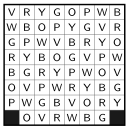
No. 303. Under the Veil
Eight V’s, eight E’s, eight I’s and eight L’s are placed so that no letter is in line with a like one. A line reading VEIL, VILE, LEVI, LIVE or EVIL, forwards or backwards, across, down or diagonally, scores a point, and every reading counts. This arrangement scores eight: the top and bottom rows and the second and seventh columns read VEIL, and the diagonals from the L in the fifth row and the E in the bottom row each read LIVE one way and EVIL the other. Find the arrangement with the greatest score.
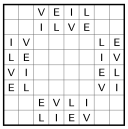
No. 304. Bachet’s Square
Arrange the sixteen court cards and aces in a square so that no row of four, across, down or on either long diagonal, holds two cards of the same suit or the same value. In how many ways can it be done, counting turnings and reflections as different, as Bachet did? Labosne, in his edition of Bachet, gives the answer wrongly.
No. 305. The Thirty-Six Letter-Blocks
A box holds thirty-six blocks, six each of A, B, C, D, E and F. Put as many as possible into the six by six box so that no letter is in line with a like one across, down or diagonally. All thirty-six cannot be got in.
No. 306. The Crowded Chessboard
Arrange eight queens, eight rooks, fourteen bishops and twenty-one knights, fifty-one pieces, so that no queen attacks a queen, no rook a rook, no bishop a bishop and no knight a knight. Pieces of another kind standing between do not count: two queens attack each other even with a rook between them.
No. 307. The Coloured Counters
Twenty-five counters come in five colours, red, blue, yellow, orange and green, five of each, numbered 1 to 5. Place them in a square so that no colour and no number is repeated in any row, column or long diagonal.
No. 308. The Gentle Art of Stamp-Licking
A card is divided into sixteen spaces, four by four, and there are plenty of stamps of 1d., 2d., 3d., 4d. and 5d. What is the greatest value that can be stuck on the card, one stamp to a space, if no stamp may be in line with another of the same value across, down or diagonally? The solver, Dudeney warns, will probably be twopence short.
No. 309. The Forty-Nine Counters
Forty-nine counters are lettered A to G and numbered 1 to 7, one counter for every letter and number. Arrange them in a square so that no letter and no number is in line with a like one across, down or along any diagonal line.
No. 310. The Three Sheep
A farmer has sixteen pens, four by four, and three sheep. In how many ways can he put the sheep in separate pens so that every pen is occupied or in line with a sheep across, down or diagonally? Turnings and reflections do not count as different. The sheep, in other words, are queens.
No. 311. The Five Dogs Puzzle
In 1863 C. F. de Jaenisch showed that five queens can occupy or attack every square with no queen attacking another in ninety-one fundamentally different ways. Here five dogs in five of sixty-four kennels keep every kennel in line with a dog. In how many ways can the five dogs be placed in a straight row so that every kennel is in line with at least one? Turnings and reflections count as different.
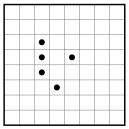
No. 312. The Five Crescents of Byzantium
A temple pavement of sixty-four tiles had five crescent tiles placed so that every tile was in line with a crescent. To cover a crescent was death, and a square carpet was to be laid; the largest that fits here is shaded. How might the architect have placed his crescents, keeping every tile watched, to leave room for the largest possible square carpet, covering no part of any crescent?
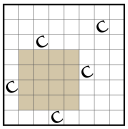
No. 313. Queens and Bishop Puzzle
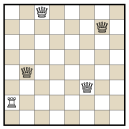
Every square of this board is occupied or attacked. Put a bishop in place of the rook, on the same square, and place the four queens on other squares so that every square is again occupied or attacked.
No. 314. The Southern Cross
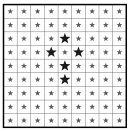
Five planets hide five of eighty-one stars, nine by nine, and every star but ten is in line with a planet across, down or diagonally. Move each planet once, in a straight line in one of those directions, so that every star is in line with a planet. The planets will then hide five other stars.
No. 315. The Hat-Peg Puzzle
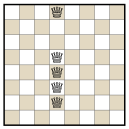
Five queens occupy or attack every square. Move one queen to another square, anywhere, so that every square is still occupied or attacked; then a second queen, then a third, then a fourth, each time keeping every square occupied or attacked. After the fourth move no queen may attack another.
No. 316. The Amazons
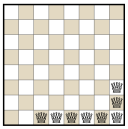
Remove three of these eight queens to other squares, anywhere, so that eleven squares of the board are not attacked. There is only one way.
No. 317. A Puzzle with Pawns
Place two pawns in the middle of the board, at Q4 and K5 (d4 and e5), and place the other fourteen so that no three of the sixteen are in a straight line in any direction at all, taking the pawns as points at the centres of their squares.
No. 318. Lion-Hunting
The desert has eighty-one spots, nine by nine, joined by paths that run diagonally, so that every spot but the four corners lies on two paths. In how many ways can a man and a lion be placed on two different spots not on the same path?
No. 319. The Knight-Guards
Twelve knights, the fewest possible, occupy or attack every square of this board, but only four of them are guarded by another knight. What is the smallest number of knights that will occupy or attack every square with every knight guarded, and how are they placed?
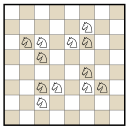
The Eight Rooks
40,320 ways. A rook that shares a row or column with another is guarded by it, so there must be one rook in each row and each column, and then every square is attacked. The first row’s rook has eight squares to choose from, the next row’s seven, and so on: . A program that tried every placing on the smaller boards found that the good placings are exactly these.
Dudeney left open how many of these are fundamentally different, calling it a difficult problem. Counting each family of turnings and reflections once, the program finds 5,282, which is the figure in the On-Line Encyclopedia of Integer Sequences.
Answer 40,320 ways
The Four Lions
Seven ways. Writing for each row, from the top, the column that holds its lion, they are 1 2 3 4, 1 2 4 3, 1 3 2 4, 1 3 4 2, 1 4 3 2, 2 1 4 3 and 2 4 1 3. A program sorted all 24 placings by turning and reflecting and found seven families, one for each of Dudeney’s seven.
Answer Seven ways
Bishops, Unguarded
Eight, in a row across the middle of the board.
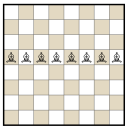
A bishop never leaves its colour, so the white squares and the black squares are two separate puzzles, each needing four bishops. A program tried every set of three bishops on the squares of one colour and found none that covers them all, so eight is the least.
Answer Eight
Bishops, Guarded
Ten. Again each colour is a puzzle of its own, and each needs five bishops if every bishop must be guarded; the program tried every set of four and found none that works.
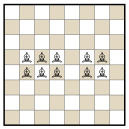
In Dudeney’s arrangement the two middle bishops of the left-hand group of six do nothing but guard their neighbours, so the upper one may be raised a square and the lower one dropped a square, which gives another solution. The program checks both.
Answer Ten
Bishops in Convocation
256 ways. The fourteen are the most possible. No diagonal can hold two bishops, since two neighbours along it would attack each other; there are fifteen diagonals running each way, and the two shortest of one direction, the single corner squares, lie on the same long diagonal of the other, so at most fourteen diagonals of that direction can each hold a bishop. How many ways the fourteen can go is a matter of search. A program listed the placings of the most bishops on every board from two squares wide to eight and found each time, on the chessboard, with every bishop on an edge.
Counting turnings and reflections once, Dudeney gives 1, 2, 3, 6, 10, 20 and 36 for these boards, with a rule: when is odd there are fundamentally different ways, and when is even . Both the numbers and the rule agree with the program.
Answer 256 ways
The Eight Queens
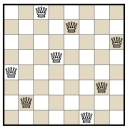
A program listed every placing of eight queens with none attacking another, 92 in twelve families, and tested every three queens for lying on a common straight line of any slope. Only this family passes.
The program also checks Dudeney’s table of the queens on other boards: 1 fundamental way and 2 in all for four queens on the board four by four, then 2 and 10, 1 and 4, 6 and 40, and 12 and 92 for five to eight queens, and 46, 92 and 341 fundamentally different ways for nine, ten and eleven. He thought a general formula probably undiscoverable, and none is known.
Answer The arrangement above
The Eight Stars
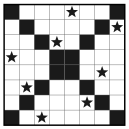
This is the only way with the first star where it is. Without it, the program finds twelve ways of placing eight stars off the black squares: the eight turnings and reflections of this one, and the four of a second, symmetrical arrangement, as Dudeney says.
Answer The arrangement above
A Problem in Mosaics
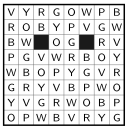
As before, one yellow and one purple tile are left out. Each colour with eight tiles is a solution of the eight queens, so the puzzle is to fit six such solutions and two sets of seven around the ventilators. A program tried every way of doing so. With the ventilators in the bottom corners there are just two ways, Dudeney’s and the one with the yellow and purple of the seventh row exchanged, which is his remark that no other arrangement is possible. With the ventilators moved there are nine, his among them.
Answer The paving above
Under the Veil
Twenty readings.
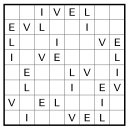
A line counts when it holds four letters, blanks passed over, that read one of the words; LIVE and EVIL are each other backwards, so a line reading one of them scores two. Here there are six readings across, six down and eight on the diagonals, as Dudeney says. The same scoring gives his eight for the example.
Each set of eight like letters is a solution of the eight queens, so an arrangement is four such solutions with no square in common. A program found 4,545 of these, and tried all 24 ways of lettering each. Twenty is the most, and only this arrangement reaches it, as Dudeney says. He adds that exchanging the V’s with the I’s and the L’s with the E’s gives a second way of scoring twenty from it; that board is the same as his own reflected in the diagonal from top right to bottom left, so there is really one answer. The least score is nought, as he also says.
Dudeney counts 604 arrangements of the four sets, not counting turnings and reflections. The program makes it 613, counting once by listing one of each family and again by Burnside’s lemma; his figure is nine short.
Answer Twenty, as above
Bachet’s Square
1,152 ways. One of them, Dudeney’s:
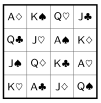
There are only two patterns for placing four letters four times each with none repeated in a line, and Dudeney notes that a quarter turn takes one into the other. Each can be lettered in 24 ways, so there are 48 squares of values and 48 of suits. A value square and a suit square combine into a good arrangement when they give sixteen different cards, and the program finds 1,152 such pairs, . Labosne had allowed only the values in one pattern and the suits in the other, which halves the count.
Two further facts come out of the count. With the diagonals left out, the rows and columns alone allow 6,912 arrangements. And the second diagonal takes care of itself: a square with no repeat in its rows, columns and one long diagonal never has a repeat on the other.
Answer 1,152 ways
The Thirty-Six Letter-Blocks
Thirty-two blocks, as in the second diagram: six each of C and D and five each of the others.
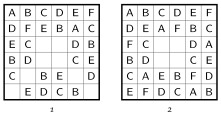
Six of one letter must be a solution of the six queens, and there is only one such solution with its turnings. Placing six of each of four letters, as in the first diagram, fills everything but the two long diagonals, where the last two letters can have only two each: twenty-eight.
Why no more than thirty-two? No letter can have more than six, one to a row. With at most one letter complete the box holds at most , and with two complete at most . Anything more needs three or four complete letters, and a program that tried every such case found no more than thirty.
Answer Thirty-two blocks
The Crowded Chessboard
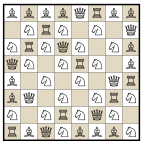
Eight queens, eight rooks and fourteen bishops is the most of each kind alone. Dudeney put his knights all on squares of one colour, of which the queens and bishops take many. He could not get more than twenty-one knights on, and believed it the most, though some ingenious reader might add another. None can: a solver that searches every arrangement of the four kinds together proves that twenty-one knights is the greatest number.
Answer Fifty-one pieces, as above
The Coloured Counters
Build the square by shifting. Write the first row in any order; make each row below it by sliding the colours three places to the right and the numbers two, wrapping round at the end. Every row and column then has each colour and number once. A diagonal steps one column to the right each row, so along it the colours slide places a row and the numbers , and on the other diagonal and ; none of these is a multiple of 5, so neither diagonal repeats. And the two slides differ by one place, so the 25 counters are all different.
| R1 | B2 | Y3 | O4 | G5 |
| Y4 | O5 | G1 | R2 | B3 |
| G2 | R3 | B4 | Y5 | O1 |
| B5 | Y1 | O2 | G3 | R4 |
| O3 | G4 | R5 | B1 | Y2 |
Every colour and every number appears once in each row, each column and each long diagonal.
Answer The square above
The Gentle Art of Stamp-Licking
Fifty pence, or 4s. 2d.:
| 4 | 3 | 5 | 2 |
| 5 | 2 | 1 | 4 |
| 1 | 4 | 3 | 5 |
| 3 | 5 | 2 | 1 |
The pitfall is to place four 5d. stamps and then four 4d.; after that only two each of the other values will go in, two spaces are lost, and the card holds forty-eight pence. A program that tried every card confirms fifty as the most, and forty-eight as the best once four 5d. and four 4d. are down.
Answer 50d., as above
The Forty-Nine Counters
The shifting of the Coloured Counters works again: each row is the one above with the letters slid two places to the right and the numbers four. Along any diagonal, long or short, the slides become and places a row, that is 1, 3, 3 and 5, none of them a multiple of 7, so no line repeats a letter or a number; and since is not a multiple of 7 either, all 49 counters differ.
| A1 | B2 | C3 | D4 | E5 | F6 | G7 |
| F4 | G5 | A6 | B7 | C1 | D2 | E3 |
| D7 | E1 | F2 | G3 | A4 | B5 | C6 |
| B3 | C4 | D5 | E6 | F7 | G1 | A2 |
| G6 | A7 | B1 | C2 | D3 | E4 | F5 |
| E2 | F3 | G4 | A5 | B6 | C7 | D1 |
| C5 | D6 | E7 | F1 | G2 | A3 | B4 |
The program checks every row, column and diagonal line, long and short.
Answer The square above
The Three Sheep
Forty-seven ways. Letter the pens A to P, row by row from the top left. Dudeney lists them by the first two sheep: with A and B the third may go in C, E, G, K, L, N or P; with A and C in I, J, K or O; A and D, M, N or J; A and F, J, K, L or P; A and G, H, J, K, N, O or P; A and H, K, L, N or O; A and O, K or L; B and C, N; B and E, F, H, K or L; B and F, G, J, N or O; B and G, K, L or N; B and H, J or N; B and J, K or L; F and G, J.
A program tried all 560 ways of putting three sheep in three pens. The forty-seven families that watch every pen are exactly Dudeney’s list, and the other thirty families leave a pen unwatched. His remarks check too: two sheep can watch every pen in three ways (F and G, E and H, F and P), each with the sheep in line with each other; three sheep not in line with one another watch every pen in two ways (A, H, J and A, L, N); and C, E, L is the only way of three sheep not in line with one another that leaves a pen unwatched.
Answer Forty-seven ways
The Five Dogs Puzzle
Twenty ways, from four fundamentally different lines.
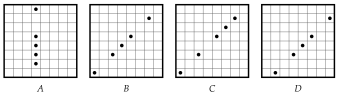
A may be turned end for end, moved to the next column, and laid along the two middle rows: eight ways. B and C each give four, turned end for end and laid on either diagonal, and D, which reads the same both ways, gives four. A program tried every five squares of every row, column and diagonal and found these twenty. Allowing straight lines of any slope adds none.
Jaenisch’s ninety-one is right as well: the program finds 728 ways of placing five queens that cover the board with none attacking another, which fall into ninety-one families.
Answer Twenty ways
The Five Crescents of Byzantium
Put three crescents in the top left corner and two in the bottom right, and a carpet whose corners are the middles of the four sides covers exactly half the pavement.
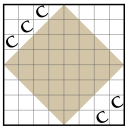
The carpet leaves six whole tiles in each corner. A program tried every five of these twenty-four and found that only four placings watch every tile, all turnings and reflections of Dudeney’s, so this answer is unique, as he says.
Is half the pavement the most? A carpet turned at 45 degrees cannot be larger, since its corners would leave the board, and the program shows that a carpet laid square to the tiles can cover at most 25 of them: no five crescents watching every tile leave room for a six by six. (In the original arrangement the four by four shaded is the largest such square.) Carpets at other angles were not searched, so on that point Dudeney’s word must stand.
Answer The arrangement above
Queens and Bishop Puzzle
Fig. 1 shows the bishop on the rook’s square with the four queens placed to cover the board. A program finds six fundamentally different ways of doing it.
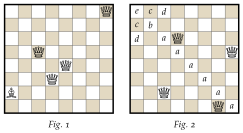
In the notes to this puzzle Dudeney gives Fig. 2: with its four queens, he says, a fifth queen may go on any of the twelve lettered squares, a rook on the two squares c, a bishop on the eight squares a, b and e, a pawn on b, or a king on the four squares b, c and e. Here, unlike the single-kind puzzles, the pieces really do get in each other’s way, and the program takes that into account. The queen, rook, pawn and king squares are right. The bishop works on only five of the eight: on the first, second and fifth of the a squares along the diagonal it stands on a queen’s row or column, cuts off the queen’s attack, and cannot attack along that line itself, leaving two squares uncovered. Dudeney’s eight are right only if the bishop is imagined not to stand in the queens’ way.
He also gives the only known arrangement of four queens and a knight, by J. Wallis, and a Dr C. Planck’s three queens and two rooks with every piece guarded, which he believed the only one; and his own three queens, a rook and a bishop with no piece guarding another.
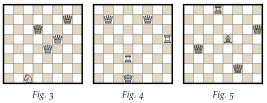
All three are correct. A program that tried every placing finds that Wallis’s is the only way with four queens and a knight, and Planck’s the only way with three queens and two rooks all guarded.
Answer As in Fig. 1
The Southern Cross
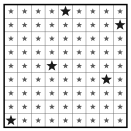
Each planet has moved once along a line, and every star is now in line with a planet. Five planets will do for eighty-one stars as well as for sixty-four, which is the pitfall Dudeney set; the program confirms that four are never enough for the larger board. It also tried every set of moves: forty-two different final positions satisfy the conditions, and there are eight more if one planet may stay where it is, the easier solution Dudeney ruled out.
Answer As above
The Hat-Peg Puzzle
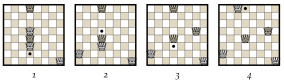
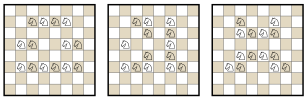
Each board shows the position after a move, with a dot on the square the queen left. The bottom queen goes to the bottom right corner, the top queen of the column to the left edge, the queen third from the top to the right, and the queen in the top row one square to the left. It could as well go two squares to the left. Dudeney believed this the only solution, and a program that tried every sequence of four moves finds exactly these two, differing only in that last step.
Answer As above
The Amazons
Three queens leave the bottom row, and the eleven dotted squares are attacked by none.
A program tried every choice of three queens to move and three new squares and found this the only way, as Dudeney says.
He went further: “I will hazard the statement that eight queens cannot be placed on the chessboard so as to leave more than eleven squares unattacked,” with at least five ways of leaving eleven. Both are now proved. A solver listed every placing of eight queens that leaves eleven or more squares unattacked: there are 48, none leaves twelve, and they fall into seven fundamentally different arrangements. Eleven is the figure in the On-Line Encyclopedia of Integer Sequences.
Answer As above
A Puzzle with Pawns
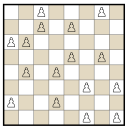
No three of these sixteen points lie on a straight line of any slope.
A program listed every way of placing sixteen points on the board with no three in line: there are 380, in 57 fundamentally different arrangements, the number in the On-Line Encyclopedia of Integer Sequences. Only one of the 57 has pawns on both Q4 and K5, so Dudeney’s answer is the only one.
Answer As above
Lion-Hunting
5,664 ways. The man may stand on any of 81 spots and the lion on any of the other 80, ways, and in 816 of these they share a path. The paths are the diagonals of a nine by nine chessboard, so the answer is the number of ways of placing two bishops, one of them marked, with no attack. Dudeney’s general form, , gives 5,664 for , and so does a direct count.
He gave with it a table of formulas for two queens, rooks, bishops or knights on a board squares wide, with and without attack, the two always adding up to . A program counted all four kinds on every board from two to ten squares wide. The formulas for queens, rooks and bishops are all right, and so is for two knights in attack. The formula printed for two knights not in attack is eight too large on every board; in place of the first it should read the second, which is what the other two formulas require.
Answer 5,664 ways
The Knight-Guards
Fourteen knights, in three fundamentally different arrangements.
Dudeney’s proof deals with the two colours separately. A knight always attacks squares of the other colour. So the knights on white squares must attack every black square: the empty black squares need attacking, and a knight on a black square needs guarding by a knight on a white one. In the same way the knights on black squares must attack every white square. Seven knights on white squares can attack every black square in two ways only, and the same holds the other way round. Combining the ways gives these three arrangements and their turnings and reflections, and no others.
A program repeats the whole argument. Six knights on one colour never attack every square of the other, and seven do so in four placings, two fundamentally different, as Dudeney says. The four placings on each colour combine into sixteen arrangements of fourteen knights, all good, which fall into three families.
That twelve knights are the fewest to cover the board when they need not be guarded is the figure in the On-Line Encyclopedia of Integer Sequences.
After this puzzle Dudeney gathered his results on guarding the board. They were checked in the same way.
Queens on small boards. His table gives, for example, two queens covering the four by four board in three ways, and three queens covering it in two ways with no queen attacking another. Eight of his ten figures are right. Two are not what they claim: “3 queens guard board in 37 fundamental ways (protected)” and “3 queens guard board in 1 fundamental way (protected)” count every way of covering the board. Only 15 of the 37 have every queen protected, and the single way on the six by six has a queen unprotected.
Five queens on the chessboard. Five queens cover the board in 4,860 ways, 638 fundamentally different. Of these, 91 have no queen attacking another (Jaenisch’s number), 56 have every queen protected (Dudeney had found at least 41), and the remaining 491 have some of each (he had recorded about 150).
The most knights with none attacking another. Dudeney says they can be placed in only one fundamental way: all on one colour, the colour of the centre square when the board is odd. That is true for every board from five squares wide to eight, but not for the smallest. The three by three board holds five knights in two ways, and the four by four holds eight in three.
Answer Fourteen knights