Library · Amusements in Mathematics · Chapter 2
Age and Kinship Puzzles
On this page
- No. 40. Mamma’s Age
- No. 41. Their Ages
- No. 42. The Family Ages
- No. 43. Mrs Timpkins’s Age
- No. 44. A Census Puzzle
- No. 45. Mother and Daughter
- No. 46. Mary and Marmaduke
- No. 47. Rover’s Age
- No. 48. Concerning Tommy’s Age
- No. 49. Next-Door Neighbours
- No. 50. The Bag of Nuts
- No. 51. How Old Was Mary?
- No. 52. Queer Relationships
- No. 53. Heard on the Tube Railway
- No. 54. A Family Party
- No. 55. A Mixed Pedigree
- No. 56. Wilson’s Poser
Age puzzles are the oldest trade in recreational algebra, and nearly all of them rest on one quiet fact: two people grow older at the same rate, so the gap between their ages never changes while every ratio does. Once that is seen, a tangle of “when he was” and “when she will be” turns into a few straight-line equations, and the only real work is in reading the words carefully. Dudeney knew this, and several of his puzzles are traps for the reader rather than for the algebra.
Ages here are exact, not birthday ages: a child of five years and ten months is years old, and Dudeney is happy to let the answers come out in fractions of a year. The kinship puzzles at the end of his section turn instead on what “uncle” or “mother-in-law” can mean, and each answer says which reading it uses.
No. 40. Mamma’s Age
Tommy asks his mother how old she is. She tells him only that the three of them, Tommy, mamma and papa, have ages that add up to exactly seventy years. Papa adds that he is just six times as old as Tommy. Will Tommy ever be half as old as papa? Yes, says papa, and on that day the three ages will add up to exactly twice what they add up to today. Then Tommy is packed off to bed.
Had Tommy been a few years older he could have worked out his parents’ ages from this. What is mamma’s age?
No. 41. Their Ages
A lady remarks that her husband’s age is written with the two digits of her own age in reverse order. He is the older of the two, and the difference between their ages is one eleventh of their sum. How old is each?
No. 42. The Family Ages
The Smileys’ five children are brought in one at a time to meet a visiting uncle. First come Billie and little Gertrude: the boy is exactly twice as old as the girl. Then Henrietta arrives, and the ages of Henrietta and Gertrude together are twice Billie’s. Then Charlie runs in, and the two boys together are exactly twice the age of the two girls together. Last comes Janet, who announces that it is her twenty-first birthday, and Mr Smiley adds that the three girls together are now exactly twice the age of the two boys together. How old is each child?
No. 43. Mrs Timpkins’s Age
When the Timpkinses married eighteen years ago, Mr Timpkins was three times as old as his wife. Today he is exactly twice as old as she is. How old was Mrs Timpkins on her wedding day?
No. 44. A Census Puzzle
Mr and Mrs Jorkins have fifteen children, born at regular intervals of a year and a half. Ada, the eldest, would not tell the census man her age, but she admitted that she was just “seven times older” than little Johnnie, the youngest. How old was Ada? Dudeney warns that the obvious answer may be a blunder.
No. 45. Mother and Daughter
A girl of twelve asks her mother for a bicycle. “When I am only three times as old as you are,” says the mother, “you shall have one.” The mother is forty-five. How long must the girl wait?
No. 46. Mary and Marmaduke
Marmaduke observes that in seven years’ time their two ages will add up to sixty-three. Mary replies that when Marmaduke was her present age, he was twice as old as she was at that time. How old are they?
No. 47. Rover’s Age
Asked how old the dog Rover is, young Tommy says: “Five years ago my sister Mildred was four times older than the dog, but now she is only three times as old.” How old is Rover?
No. 48. Concerning Tommy’s Age
Tommy Smart, asked his age by a new teacher, replies as follows. When he was born, his only sister Ann was exactly a quarter of their mother’s age at that time, and Ann is now a third of their father’s present age. Tommy himself is now a quarter of his mother’s present age, and in four years’ time he will be a quarter of his father’s age then. What is Tommy’s age?
No. 49. Next-Door Neighbours
Two families live next door to each other at Tooting Bec: the Jupps and the Simkins. Each family is a father, a mother and two children, and the four ages in each family add up to one hundred years. In each family the squares of the two children’s ages, added to the square of the mother’s age, make the square of the father’s age. Julia Jupp is one year older than her brother Joe; Sophy Simkin is two years older than her brother Sammy. All ages are whole numbers of years. What is the age of each of the eight people?
No. 50. The Bag of Nuts
Three boys are given a bag of 770 nuts, to be shared in proportion to their ages, which add up to years. As often as Herbert takes four nuts, Robert takes three; and as often as Herbert takes six, Christopher takes seven. How many nuts does each boy get, and how old is each?
No. 51. How Old Was Mary?
This one is Sam Loyd’s. The ages of Mary and Ann add up to forty-four years, and Mary is twice as old as Ann was when Mary was half as old as Ann will be when Ann is three times as old as Mary was when Mary was three times as old as Ann. How old is Mary?
No. 52. Queer Relationships
At a dinner party the Parson tells of a man in his parish who married the sister of his widow. “Do you marry dead men in your parish?” asks the Professor. The Parson promises to explain, and goes on. This man, Stephen Brown, has a sister, Jane Brown. Last week Stephen introduced a young man to the Parson as his nephew. The Parson naturally spoke of Jane as the young man’s aunt, but the youth corrected him: he is Stephen’s nephew, but he is not the nephew of Jane, Stephen’s sister. The Parson assures the company that all of this is quite correct. How can a man marry his widow’s sister, and how can the youth be Stephen’s nephew but not Jane’s?
No. 53. Heard on the Tube Railway
One lady asks another whether a certain gentleman is related to her. “Oh, yes,” says the second. “That gentleman’s mother was my mother’s mother-in-law, but he is not on speaking terms with my papa.” How is the gentleman related to her?
No. 54. A Family Party
A family party contained 1 grandfather, 1 grandmother, 2 fathers, 2 mothers, 4 children, 3 grandchildren, 1 brother, 2 sisters, 2 sons, 2 daughters, 1 father-in-law, 1 mother-in-law and 1 daughter-in-law. That looks like twenty-three people, but only seven were present. How can this be?
No. 55. A Mixed Pedigree
John Snoggs tells Joseph Bloggs that Joseph is at once John’s father’s brother-in-law, John’s brother’s father-in-law, and John’s father-in-law’s brother. Mr Bloggs finds this makes him dizzy and refuses to hear the explanation. Show how this triple relationship could come about.
No. 56. Wilson’s Poser
Four commercial travellers spend Christmas Eve at a hotel in Grassminster, and Mr Wilson tells a story about a flying machine that carries only two people. Its owner, Parker, took up Wilson’s uncle, and then, to his friends’ confusion, Wilson starts talking about his nephew on board. The machine carried two; Parker is no relation of Wilson’s; and yet both Wilson’s uncle and his nephew were aboard. The explanation is that the uncle and the nephew are the same man, David George Linklater, so that Wilson is also both uncle and nephew to Linklater. Wilson insists that this happens without any marriage within the prohibited degrees. How can it come about?
Mamma’s Age
The useful clue is the doubling of the total: it fixes how many years pass, and the rest follows. Let Tommy be now, so papa is . Tommy is half papa’s age when , that is, after years. In years each of the three ages grows by , so the total grows by ; doubling seventy means , so years. Then , papa is , and mamma is .
So Tommy is 5 years 10 months, papa 35, and mamma 29 years 2 months. In 23 years 4 months Tommy will be 29 years 2 months, exactly half of papa’s 58 years 4 months. The four conditions are four independent linear equations, so this is the only answer, and it is Dudeney’s.
Answer Mamma is 29 years 2 months old
Their Ages
Reversing two digits changes a number by a multiple of nine, and that multiple is the whole puzzle. Let the wife be and the husband , with . The difference is and the sum is , so the condition says , or . Since 4 and 5 share no factor, is a multiple of 4 and the same multiple of 5; any multiple beyond the first makes at least 10, which is not a digit. So , : the wife is 45 and the husband 54. The difference, 9, is indeed one eleventh of the sum, 99. The answer is unique and agrees with Dudeney.
Answer Husband 54, wife 45
The Family Ages
Each remark ties one new child to those already in the room, so everything can be written as a multiple of Gertrude’s age , and Janet’s birthday then fixes the scale. Billie is . Henrietta and Gertrude together make , so Henrietta is . The boys together make twice the two girls, , so Charlie is . Finally the three girls, , equal twice the two boys, ; hence and .
Gertrude is , Billie , Henrietta , Charlie and Janet 21. Each step was forced, so the answer is unique, and it is Dudeney’s.
Answer Billie , Gertrude , Henrietta , Charlie , Janet 21
Mrs Timpkins’s Age
The gap between husband and wife never changes, so measure everything in it. On the wedding day he was and she , a gap of . When he is twice her age, the gap equals her age, so she is then , having aged by exactly years. That took eighteen years, so . She was 18 on her wedding day and he was 54; today they are 36 and 72.
Dudeney points out the pleasant general rule hiding here: if one partner is three times the other’s age at the start, the number of years until the ratio falls to two equals the younger one’s starting age. The answer is unique and agrees with his.
Answer 18 years old
A Census Puzzle
The arithmetic is trivial; the puzzle is the phrase “seven times older”. Fifteen children at intervals of a year and a half span fourteen intervals, so Ada is 21 years older than Johnnie, whose age is .
Dudeney insists that “seven times older” means older by seven times Johnnie’s age, so that Ada is eight times as old. Then , , and Ada is 24. If the phrase means “seven times as old”, then , , and Ada is .
Dudeney calls the second answer a blunder, but his words do not force his reading. His own answer concedes that “some of the best writers” use “seven times older” to mean seven times as old, and a usage shared by the best writers is hard to call wrong. His reading is defensible and is the one the puzzle was built to reward, so it is the answer given here; the other reading gives just as cleanly, and a solver who chose it has made no arithmetical mistake.
Answer 24 (Dudeney’s reading); if “seven times older” means seven times as old
Mother and Daughter
Today the mother is times her daughter’s age, and the ratio falls towards one as both grow older, so the day she is only three times as old lies ahead. The gap is 33 years, and when the mother is three times the daughter’s age that gap is twice the daughter’s age. So the daughter will then be , which is years from now, and the mother will be . This agrees with Dudeney.
Answer In years
Mary and Marmaduke
Again the gap does the work. Let Marmaduke be and Mary , with gap . Marmaduke was Mary’s present age years ago, and Mary was then . Mary says , so and . Seven years on, the two ages add up to , so .
Marmaduke is and Mary . When Marmaduke was , Mary was , half his age then. The answer is unique and agrees with Dudeney’s.
Answer Marmaduke , Mary
Rover’s Age
This is No. 44 again, with the same trap set on purpose. Let Rover be now, so Mildred is and the gap is .
On Dudeney’s reading, “four times older” means five times as old, so five years ago , giving : Rover is 10 and Mildred 30, and five years ago they were 5 and 25. On the plain reading, four times as old, gives : Rover 15 and Mildred 45, and five years ago 10 and 40.
Dudeney is at least consistent: he chose his reading in No. 44 and keeps to it. As there, both readings give a clean answer, and a fifteen-year-old dog is no more absurd than a ten-year-old one.
Answer 10 years (Dudeney’s reading); 15 if “four times older” means four times as old
Concerning Tommy’s Age
There are four people and four facts, and the trick is to take the facts in the order that lets each one name a new age in terms of Tommy’s age . His mother is now. At Tommy’s birth, years ago, she was , so Ann was then and is now . Their father is three times Ann, . The last fact, , gives , so .
Tommy is , Ann , the mother and the father . In four years Tommy will be , a quarter of his father’s . The answer is unique and matches Dudeney’s.
Answer years
Next-Door Neighbours
The key is to write the Pythagorean condition as a difference of two squares, which turns it into a divisibility statement about the parents’ combined age. Take the Jupps first. Let Joe be and Julia , and let the parents’ ages add up to and differ by . The total of one hundred gives , and the squares condition says Substituting , the right-hand side becomes , so Every term except is a multiple of , so must divide . The parents together are less than 100, so is 1 or 73, and is absurd (it would give , far more than ). So , and : the father is 39, the mother 34, Julia 14 and Joe 13. Check: .
The Simkins go the same way. With Sammy and Sophy , now and , so divides . Here is even and below 98, so it is 2, 4 or 82. For the difference is 2402, and for it is not a whole number; only survives, giving and . The father is 42, the mother 40, Sophy 10 and Sammy 8, and .
Both families are therefore unique among whole-number ages, even without assuming that parents are older than their children, and Dudeney’s answer is the only one.
Answer Jupps 39, 34, 14, 13; Simkins 42, 40, 10, 8
The Bag of Nuts
Put the two exchange rates on a common footing: if Herbert takes twelve, Robert takes nine and Christopher fourteen, so the nuts go in the proportion , which is 35 nuts per round. The bag holds nuts, so Herbert gets 264, Robert 198 and Christopher 308. The ages are in the same proportion and add up to , so each age is half the corresponding share of 35: Herbert 6, Robert , Christopher 7. The ratios fix the division, so it is unique, and it agrees with Dudeney.
Answer Herbert 264 nuts, age 6; Robert 198, ; Christopher 308, 7
How Old Was Mary?
Loyd’s sentence has to be read backwards, and it becomes easy once every age is measured in the fixed gap between the two women. Mary is the elder throughout, since she was once three times Ann’s age. Unwinding from the end:
When Mary was three times as old as Ann, the gap was twice Ann’s age, so Ann was and Mary . Ann will be three times that, . Mary was half of that, , at a moment when Ann was . Mary now is twice that, , and Ann now is .
Their ages add up to , so : Mary is and Ann . Reading the sentence forwards with the ages filled in: Mary () is twice as old as Ann was () when Mary was () half as old as Ann will be () when Ann is three times as old as Mary was () when Mary was three times as old as Ann (). Every clause scales with , so the answer is unique, and it agrees with Dudeney.
Answer Mary is
Queer Relationships
Both riddles are about when a word applies, and neither has any arithmetic in it. A man’s widow is whoever is married to him when he dies. If a man marries a woman who dies, then marries her sister, and then dies himself, the second sister is his widow and the first was her sister. So the man did marry the sister of his widow, though at the time of the wedding she was not yet his widow.
For the second riddle, the youth is Stephen’s nephew because he is the son of Stephen’s sister. He is not Jane’s nephew because Jane is that sister: she is his mother. The one remaining snag is the surname, since a married Jane would normally no longer be a Brown; she kept it because she had married a man who was also called Brown. This is Dudeney’s answer, and it is the only natural one: a son of any other sibling of Stephen’s would be Jane’s nephew too.
These are purely verbal puzzles, so there is no program for this one.
Answer He married his first wife’s sister after she died; the youth is Jane’s son
Heard on the Tube Railway
A mother-in-law is the mother of one’s husband or wife, so “my mother’s mother-in-law” is simply papa’s mother, the lady’s paternal grandmother. The gentleman is a son of that grandmother, and he cannot be papa himself, since he and papa are not on speaking terms. So he is papa’s brother (or half-brother), and the lady’s uncle, as Dudeney says.
That reading assumes the lady’s mother has had only one husband. If she was married before, her mother-in-law might be the mother of the earlier husband, and the gentleman could be that earlier husband himself or his brother. If the earlier husband is the lady’s real father and “papa” a stepfather, the gentleman is then her own father, or her uncle once more; if not, he is her mother’s former husband or his brother, which is a thin sort of relation. Dudeney’s reading is the plain one, and on it the answer is forced.
Answer He is her uncle (her father’s brother)
A Family Party
The saving comes from giving each person several parts at once.
Take a grandfather and grandmother, their son and his wife, and the son’s three children, one boy and two girls. The old couple are the grandfather and grandmother; they and the younger couple are the two fathers and two mothers. The four children are the son and his three children, the three grandchildren are those three, the brother is the boy and the two sisters are the girls. The sons are the middle man and the boy, the daughters are the two girls, and the old couple are the father-in-law and mother-in-law of the son’s wife, who is the daughter-in-law. That is all thirteen roles with seven people, which is Dudeney’s answer.
Among families of this shape it is the only one that fits: the middle man must be a son, not a daughter, because the list has a daughter-in-law and no son-in-law, and the children must be one boy and two girls to give one brother and two sisters.
Answer Grandparents, their son and his wife, and one boy and two girls
A Mixed Pedigree
Each of the three relations links Joseph to John through a different marriage, so the trick is to supply three marriages that meet at Joseph. Dudeney’s tree uses the Bloggs family: Thomas Bloggs has children Kate, Henry and Joseph.
Kate Bloggs marries William Snoggs, and their sons are John and Alfred. Joseph is Kate’s brother, so he is John’s father’s brother-in-law.
Alfred Snoggs marries Joseph’s daughter Mary, so Joseph is John’s brother’s father-in-law.
John marries Jane, daughter of Joseph’s brother Henry, so Joseph is John’s father-in-law’s brother.
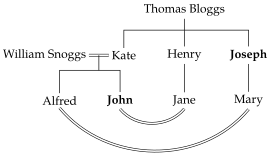
Single lines join parents to children and double lines join husbands to wives.
Mr Bloggs might have felt less dizzy had he noticed that both Snoggs brothers married first cousins: Jane and Mary are daughters of their mother’s brothers. That was perfectly legal, but it is not needed. If John and Alfred are sons of William’s first wife, and Kate Bloggs is his second wife, all three relations survive (Joseph is still the brother of John’s father’s wife) and no one marries a blood relative.
Answer Joseph’s sister married John’s father, Joseph’s daughter married John’s brother, and Joseph’s niece married John
Wilson’s Poser
An uncle is a brother of a parent, and the crux is that a half-brother counts: two men who each marry the other’s mother make each man’s new son a half-brother of the other man. Let the two men be A and B, both widowers or bachelors, and let A marry B’s mother and B marry A’s mother. Wilson is the son of A and B’s mother; Linklater is the son of B and A’s mother.
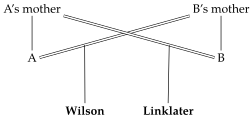
Wilson and B share a mother, so Wilson is B’s half-brother, and since B is Linklater’s father, Wilson is Linklater’s uncle. In the same way Linklater and A share a mother, and A is Wilson’s father, so Linklater is Wilson’s uncle. Each is therefore both uncle and nephew of the other. No one has married a relative: A and B’s mother are strangers by blood, as are B and A’s mother. This is Dudeney’s answer; he notes that there are other ways to bring it about and that this is the simplest.
Answer Two men each marry the other’s mother; the son of each marriage is uncle and nephew of the other