Library · Amusements in Mathematics · Chapter 18
Various Chess Puzzles
On this page
- No. 346. Setting the Board
- No. 347. Counting the Rectangles
- No. 348. The Rookery
- No. 349. Stalemate
- No. 350. The Forsaken King
- No. 351. The Crusader
- No. 352. Immovable Pawns
- No. 353. Thirty-Six Mates
- No. 354. An Amazing Dilemma
- No. 355. Checkmate!
- No. 356. Queer Chess
- No. 357. Ancient Chinese Puzzle
- No. 358. The Six Pawns
- No. 359. Counter Solitaire
- No. 360. Chessboard Solitaire
- No. 361. The Monstrosity
These last chess puzzles are a mixed lot. Some count: the ways of setting up the men, the rectangles on the board. Some are games to be built backwards from a strange position, or forwards to a stated end in as few moves as possible. Two are games of solitaire played with counters on the squares. A few break the rules on purpose, and Dudeney is careful to say so.
Squares are named here in the modern way, with files a to h from White’s left and ranks 1 to 8 from White’s side, and moves are written in modern notation. Dudeney used the older descriptive notation, in which each side counts the ranks from its own end of the board; his moves were translated and every game was replayed by a program that knows the rules of chess, so that an illegal move, or a reading of his notation that could not be played, would have been caught. His claims that a game is the shortest possible are another matter. Proving them means searching every game of that length, which was not done, and the text says so each time.
No. 346. Setting the Board
With a single chessboard and a single set of chessmen, in how many different ways may the men be correctly set up for the beginning of a game? Most people slip at one particular point in the calculation.
No. 347. Counting the Rectangles
How many squares and other rectangles does the chessboard contain? That is, in how many different ways can a square or other rectangle be marked out by the lines that separate the squares of the board?
No. 348. The Rookery
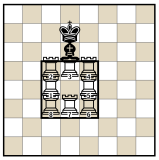
The White rooks may not move outside the little square in which they are enclosed, except on the final move, in giving checkmate. Checkmate Black in the fewest possible moves with rook 8, the other rooks being left in numerical order round the sides of their square, with the break between 1 and 7.
No. 349. Stalemate
Some years ago the puzzle was set of constructing an imaginary game of chess in which White is stalemated in the fewest possible moves with all thirty-two men still on the board. Can you build such a position in fewer than twenty moves?
No. 350. The Forsaken King
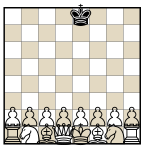
White to play and checkmate in six moves. For all the complexities, the manner of play can be put in a few lines; and the first two moves of White cannot be varied.
No. 351. The Crusader
Produce a game of chess which, after sixteen moves, leaves White with all his sixteen men on their original squares and Black with his king alone, not necessarily on its own square. White is then to force mate in three moves.
No. 352. Immovable Pawns
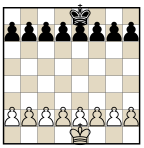
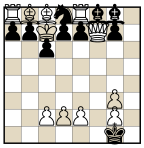
Starting from the usual opening position, what is the smallest number of moves, played strictly by the rules, needed to reach this position? The result will be a very weird kind of chess.
No. 353. Thirty-Six Mates
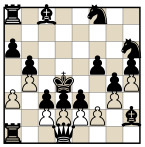
Place the remaining eight White pieces so that White has the choice of thirty-six different mates on the move. Every move that checkmates and leaves a different position counts as a different mate. The pieces already placed must not be moved.
No. 354. An Amazing Dilemma
Mr Black, in difficulties and obliged as usual to catch a train, proposed that Mr White finish the game alone, making no moves for Black at all, only for White. Mr White agreed, and found to his dismay that he could never checkmate. White may leave Black in check as often as he likes; the king takes no notice and never moves. The other men stand as in the diagram. On which square did Mr Black leave his king?
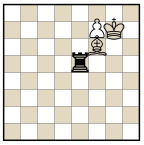
No. 355. Checkmate!
In a London club Dudeney found this position left by two players who had gone. White has plainly checkmated Black. But how did he do it?
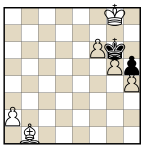
No. 356. Queer Chess
Place two White rooks and a White knight so that the Black king, on one of the four middle squares of the board, is in check with no possible move. Dudeney avoids calling it checkmate; the absence of a White king would be reason enough, but it is not his only reason.
No. 357. Ancient Chinese Puzzle
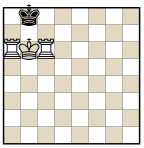
White to play and mate, moving each of his three pieces once, and once only.
No. 358. The Six Pawns
In how many ways may six pawns be placed on the chessboard so that every row and every column has an even number of empty squares? The diagonals do not count, and every different set of six squares is a different solution, reversals and reflections included.
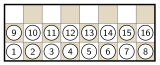
No. 359. Counter Solitaire
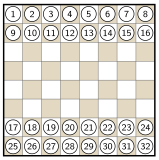
Remove all the counters but one, and that one must be No. 1. A counter is removed by jumping over it with another into the vacant square beyond; no jump may be made diagonally. For example, 1–9, 2–10, 1–2: 1 jumps over 9, which is removed, 2 jumps over 10, and 1 jumps over 2. Every move is a capture, and the last capture of all is made by No. 1.
No. 360. Chessboard Solitaire
The same game on the whole chessboard with thirty-two counters. Remove all but two, and these two must have started on the same side of the board: both from 1 to 16, or both from 17 to 32. Jumps are made as before, never diagonally; for example, 3–11, 4–12, 3–4, 13–3.
No. 361. The Monstrosity
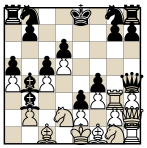
On a crowded train one Christmas Eve, Dudeney’s neighbour was studying this position on a pocket board. “Problem? No; a game,” he said: a correspondence game, and his friend’s last move, written on a postcard, was 43. K to Kt 8. He and his friend did not play for results of that antiquated kind, he explained; they sought in chess the wonderful, the whimsical, the weird. A note from the man opposite, pencilled in the margin of a newspaper, read “Insane, but quite harmless. He is in my charge.” The position stayed in Dudeney’s mind, and he later found that it can be reached in forty-three moves, with Black’s move 43. K to Kt 8 last. Can you construct such a game? How did White get his rooks and his king’s bishop to where they stand, given that Black can never have moved his king’s bishop? No odds were given, and every move was legitimate.
Setting the Board
208,089,907,200 ways. Every man in a real set is a separate object, so the eight White pawns can stand in orders on their rank, and each pair of rooks, bishops and knights can change places, which gives ways for the White men. The Black men can be placed in as many ways, so there are ways for the two armies together.
The point nearly everybody overlooks, Dudeney says, is that the board itself can be put down in two ways. The rule that each player has a white square at his right-hand corner still holds when the board is turned half round, but the men then stand on different pieces of wood. So the answer is doubled. A program repeats the arithmetic; the doubling is a matter of treating the board as an object in its own right, like the men.
Answer 208,089,907,200 ways
Counting the Rectangles
1,296 rectangles, of which 204 are squares (the whole board among them) and 1,092 are not. A rectangle is fixed by choosing two of the nine lines that run across the board and two of the nine that run up it, so there are . That is why, as Dudeney noticed, the total is always the square of a triangular number. On a board of squares his formulas are A program that counts the rectangles one by one agrees with all three for every board from one square up to twelve by twelve.
Answer 1,296, of which 204 are squares
The Rookery
Dudeney’s answer takes thirty-two moves, but it can be done in twenty-eight.
The rooks move like the counters of a sliding puzzle, each into the one empty square of the enclosure, and Black’s replies are all forced: the king steps between d7 and d8, and the bishop is pinned to it by a rook on the d-file. Dudeney’s key point is that the rooks must end in the reverse of their first order round the sides, or the puzzle cannot be solved. That is right: the arrangements of a sliding puzzle fall into two halves that cannot be reached from each other, and the order he gives is the one in the right half. His play is the rooks in the order 5, 6, 7, 5, 6, 4, 3, 6, 4, 7, 5, 4, 7, 3, 6, 7, 3, 5, 4, 3, 1, 8, 3, 4, 5, 6, 7, 1, 8, 2, 1, after which rook 8 stands in the centre of the enclosure with d5 empty, and it takes the bishop through d5 with mate. A program replays it: every rook move is legal, every Black reply is the only move he has, and the last move is mate.
He calls these the fewest possible moves. They are not. A search through every arrangement of the rooks, ignoring Black, shows that his final arrangement can be reached in twenty-seven rook moves instead of thirty-one, and that it cannot be reached in fewer. Black cannot spoil this, because the following line leaves him no choice at any move: 7, 8, 1, 7, 5, 6, 8, 5, 3, 4, 6, 8, 5, 3, 4, 2, 7, 1, 3, 4, 2, 7, 1, 2, 8, 6, 7, and rook 8 takes the bishop with mate. Both lines end in the position below, just before the capture.
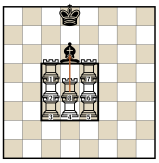
Had rook 8 been required to make its capture from d5, as it might seem natural to read the puzzle, it would take twenty-eight rook moves to arrange, and a second search, over every position of the rooks and the king with each of Black’s legal replies, shows that White can then force mate in twenty-nine moves. Either way Dudeney’s thirty-two can be beaten.
Answer Twenty-eight moves, not thirty-two
Stalemate
Twelve moves each. Dudeney says that Sam Loyd, E. N. Frankenstein, W. H. Thompson and he himself reached the same position working independently:
1. d4 e5 2. Qd3 Qh4 3. Qg3 Bb4+ 4. Nd2 a5 5. a4 d6 6. h3 Be6 7. Ra3 f5 8. Qh2 c5 9. Rg3 Bb3 10. c4 f4 11. f3 e4 12. d5 e3, and White is stalemated.
A program plays the game move by move: it is legal, all thirty-two men are still on the board, White has no legal move and is not in check, and the position is the one in his diagram. Dudeney offers it as the best solution possible. That the stalemate cannot be reached in fewer moves was not checked.
Answer Twelve moves
The Forsaken King
White plays 1. e4 and 2. Qg4. Then:
If Black’s second move was not on the f-file, 3. Qg7, and then 4. Bb5 if the king has gone to its back rank, 4. d4 if it has not.
If it was on the f-file, 3. Qd7, and then 4. b3 or 4. d4 in the same way.
Whatever Black plays next, White mates in two more moves.
To test the scheme against every defence, a program follows each line of Black’s play through his fourth move, 107 lines in all, playing White’s moves as Dudeney prescribes, and in every one of them finds a forced mate in two, so the king is mated by White’s sixth move at the latest whatever Black does. Dudeney also says that White’s first two moves cannot be varied; the search that would prove it, through every first and second move by White, was not run.
Answer As above
The Crusader
White’s queen’s knight does all the work, taking fifteen men and going home:
1. Nc3 d5 2. Nxd5 Nc6 3. Nxe7 g5 4. Nxc8 Nf6 5. Nxa7 Ne4 6. Nxc6 Nc3 7. Nxd8 Rg8 8. Nxf7 Rg6 9. Nxg5 Re6 10. Nxh7 Nb1 11. Nxf8 Ra3 12. Nxe6 b5 13. Nxc7+ Kf7 14. Nxb5 Kg6 15. Nxa3 Kh5 16. Nxb1 Kh4.
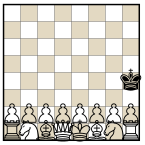
White now mates in three: 17. d4, and if 17...Kh5 then 18. Qd3 and 19. Qh3 mate; if 17...Kg4 then 18. e4, discovered check from the queen, and 19. g3 mate. Dudeney credits the final position, with the mate in three, to Sam Loyd’s Chess Nuts.
A program replays the sixteen moves and confirms that White’s men are all at home and Black has only his king. A search then shows that White can force mate in three and cannot in two, so the puzzle is exact.
Answer As above; mate in three is forced
Immovable Pawns
Seventeen moves. White plays 1. Nf3 2. Nh4 3. Ng6 4. Nxh8 5. Ng6 6. Nxf8 7. Kxf1 8. Nc3 9. Na4 10. Nb6 11. Nxa8 12. Nb6 13. Nxc8 14. Nd6 15. Qe1 16. Nxe8 17. Kxe1, and Black plays the same moves reflected in the middle of the board, 1...Nf6 2...Nh5 and so on, ending 17...Kxe8. Each king’s knight takes a rook and then the king’s bishop, and the enemy king takes it on the bishop’s square. Each queen’s knight takes the other rook and bishop and then the enemy queen, which has moved to her king’s square, and is taken there by the king in the last move.
A program plays all thirty-four moves and reaches the position in the diagram. Dudeney calls seventeen the fewest possible; that was not checked.
Answer Seventeen moves
Thirty-Six Mates
White’s king on f4, queen on b6, rooks on d6 and g7, bishops on d5 and h8, and knights on a5 and c5, ringed below.
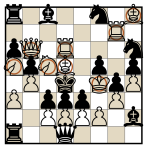
The mates come in five groups. The knight on c5 has eight moves, each opening the queen’s line to the king; the bishop on d5 has thirteen, each opening the rook’s line from d6; the rook on g7 has eleven, each opening the bishop’s line from h8; the knight on a5 mates in two ways; and the pawns on d2 and f2 each take on e3. That is . A program lists every mate on the move from this position and finds exactly thirty-six, grouped as Dudeney groups them.
He asks whether any position allows more than thirty-six different mates on the move. No search for one was made here.
Answer The position above
An Amazing Dilemma
On b2, Black’s queen’s knight’s seventh.
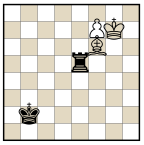
With the king there, White may make a new queen or anything else of his pawn, take the rook and bring all his men up, and still no mate is possible. Dudeney adds that on any other square the king could be mated, and credits Sam Loyd with the idea.
Both halves were checked by a program. For the king on b2 it tried every placement of White’s men: his king anywhere it is not itself in check, his bishop on any dark square (the only squares it can reach), and his pawn on f7 or made into any piece on any square, with Black’s rook still on e5 or taken. None of these positions is mate, so White can never mate, however he plays. For each of the other fifty-three squares where the king could stand, not next to White’s king, a search through White’s moves (Black passing each time) found a mate that White can actually reach.
Answer On b2
Checkmate!
The last moves were 1. e5+ f5 2. exf6, taking the pawn en passant, mate. Before them White’s pawn stood on e4 and a Black pawn on f7.
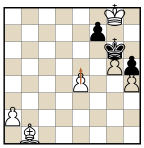
The pawn’s step to e5 opens the bishop’s line from b1 to the king, which is check. Black must block with the pawn from f7 to f5, and the pawn on e5 takes it in passing, landing on f6; the bishop’s line is open again, and it is mate. A program plays the three moves from this position and reaches Dudeney’s diagram with Black mated. He says it is the only possible solution; that was not checked.
Answer 1. e5+ f5 2. exf6 en passant mate
Queer Chess
Rooks on c5 and e5, knight on f5, and the Black king on d5.
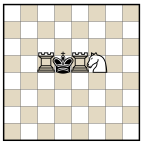
Both rooks give check. The rooks cover c4, c6, e4 and e6, the knight covers d4 and d6, and neither rook can be taken, because each is guarded by the other along the rank once the king has left d5. A program confirms that the king is in check with no move. The position could never arise in a game: no single move gives check with both rooks at once, and Black could not have moved into it. That, as well as the missing White king, is why Dudeney would not call it checkmate. He believed the position was first published by Sam Loyd.
Answer Rooks c5 and e5, knight f5, king d5
Ancient Chinese Puzzle
1. Rcd6 Kc8 2. Ka7 Kc7 3. Rac6 mate. A program plays it and finds that each of Black’s replies is his only legal move, and that the last move is mate.
Answer 1. Rd6, 2. Ka7, 3. Rac6 mate
The Six Pawns
18,816 ways. A row with one pawn has an odd number of empty squares, so every row that holds a pawn holds two, and the same goes for the columns. A row of four would need four columns with two pawns each, eight pawns in all, so the six pawns stand two to a row in three rows and two to a column in three columns. Within those three rows and three columns the empty squares form one of six patterns:
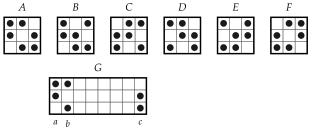
A and F are one pattern given a quarter turn, and B, C, D and E are another, but for counting all six are different. The rows and the columns can be spread over the board in any way, as in G, which is A spread over the top three rows. The three columns can be chosen in ways and the three rows in 56 ways, so each pattern gives placings and the six patterns give 18,816. (Dudeney’s text has , a slip for .) For a board of side the rule is .
A program counts the placings directly, trying every set of six squares, and finds 18,816; it also confirms the rule for every board from three by three to eight by eight. This is the “Dyer’s Puzzle”, No. 27 in The Canterbury Puzzles, in another form.
Answer 18,816 ways
Counter Solitaire
3–11, 9–10, 1–2, 7–15, 8–16, 8–7, 5–13, 1–4, 8–5, 6–14, 3–8, 6–3, 6–12, 1–6, 1–9. Each move is written as the counter that jumps and the counter it jumps over. A program plays the fifteen moves and finds each jump legal, with No. 1 the only counter left.
Answer As above, fifteen moves
Chessboard Solitaire
7–15, 8–16, 8–7, 2–10, 1–9, 1–2, 5–13, 3–4, 6–3, 11–1, 14–8, 6–12, 5–6, 5–11, 31–23, 32–24, 32–31, 26–18, 25–17, 25–26, 22–32, 14–22, 29–21, 14–29, 27–28, 30–27, 25–14, 30–20, 25–30, 25–5. The two counters left are 25 and 19, both from the second group, and 19 never moves at all. A program plays the thirty moves and confirms all of this.
Dudeney did not think a solution leaving a single counter was possible. It is not, and the reason is short. Colour the squares with three colours in turn along each row, shifting the pattern one place at each new row, so that any three squares in a line across or down have three different colours. At the start the thirty-two counters stand on 10, 12 and 10 squares of the three colours, all even numbers. A jump uses three squares in a line: one counter leaves the first, the counter on the second is removed, and the jumper arrives on the third. So every jump changes each of the three counts by one, and the three counts are always all even or all odd. A single counter would leave counts of 1, 0 and 0, which are neither. The same program checks the counts and confirms that no square could hold a lone last counter.
Answer As above, thirty moves
The Monstrosity
Dudeney’s game, in modern notation:
1. f4 c6 2. Kf2 Qa5 3. Ke3 Kd8 4. f5 Kc7 5. Qe1 Kb6 6. Qg3 Na6 7. Qb8 h5 8. Nf3 Rh6 9. Ne5 Rg6 10. Qxc8 Rg3+ 11. hxg3 Kb5 12. Rh4 f6 13. Rd4 fxe5 14. b4 exd4+ 15. Kf4 h4 16. Qe8 h3 17. Nc3+ dxc3 18. Ba3 h2 19. Rb1 h1=Q 20. Rb2 cxb2 21. Kg5 Qg1 22. Qh5 Ka4 23. b5 Rc8 24. b6 Rc7 25. bxc7 b1=B 26. c8=R Qc7 27. Bd6 Nb4 28. Kg6 Ka3 29. Ra8 Kb2 30. a4 Qgb6 31. a5 Kc1 32. axb6 Kd1 33. bxc7 Ke1 34. Kf7 Nh6+ 35. Ke8 Ba2 36. f6 Bg8 37. f7 Kxf1 38. c8=B Nd5 39. Bb8 Nf6+ 40. Kd8 Ne8 41. fxe8=R Nf7+ 42. Kc7 Nd8 43. Qf7+ Kg1.
Both of White’s rooks were lost early, on d4 and b2. The rooks now on a8 and e8 are pawns made into rooks on moves 26 and 41, and the bishop on c8 is a pawn made into a bishop on move 38. The bishop on b8 is White’s queen’s bishop, which came round by a3 and d6. White’s king’s bishop never left f1, where the Black king took it on move 37. On Black’s side the bishop on g8 is a pawn made into a bishop on move 25, and the king’s bishop on f8 has indeed never moved.
A program plays all eighty-six moves: each is legal, the final position is the one in the diagram, and Black’s king’s bishop never leaves f8. Two of Dudeney’s descriptive moves can be read in two ways, and only one reading can be played. On move 38, “P to B 8 (B)” must be the pawn going to c8, since f8 is occupied by the bishop that never moves; on move 43, “Q to B 7” must be f7, since White’s own king stands on c7. The order of the moves can be varied a great deal, he says, but nobody had managed to reduce their number. That forty-three is the least was not checked.
Answer The game above, forty-three moves