Library · Amusements in Mathematics · Chapter 25
Unclassified Problems
On this page
- No. 414. Who Was First?
- No. 415. A Wonderful Village
- No. 416. A Calendar Puzzle
- No. 417. The Tiring Irons
- No. 418. Such a Getting Upstairs
- No. 419. The Five Pennies
- No. 420. The Industrious Bookworm
- No. 421. A Chain Puzzle
- No. 422. The Sabbath Puzzle
- No. 423. The Ruby Brooch
- No. 424. The Dovetailed Block
- No. 425. Jack and the Beanstalk
- No. 426. The Hymn-Board Poser
- No. 427. Pheasant-Shooting
- No. 428. The Gardener and the Cook
- No. 429. Placing Halfpennies
- No. 430. Find the Man’s Wife
Dudeney ends the book with puzzles that fit none of his headings: catches, a mechanical puzzle or two, a bookworm, a staircase, a stolen ruby and a hymn board. Some need only a moment’s thought and some a good deal of arithmetic; one, the hymn board, is the hardest problem in the chapter and perhaps in the book. Where a puzzle turns on physics or botany, the facts have been checked against modern sources, and on two of them Dudeney’s physics does not survive.
Money is in pounds, shillings and pence: twelve pence (d.) make a shilling (s.), twenty shillings a pound (£), and a farthing is a quarter of a penny. So 2s. 2d. is 26 pence.
No. 414. Who Was First?
Anderson, Biggs and Carpenter were in a boat a mile out at sea when a rifle was fired from the shore in their direction. Anderson only heard the report, Biggs only saw the smoke, and Carpenter only saw the bullet strike the water near them. Which of them first knew of the shot?
No. 415. A Wonderful Village
A village in Japan lies in a very low valley, and yet the sun is nearer to its people every noon, by 3,000 miles and more, than when he rises or sets. Where in the country is the village?
No. 416. A Calendar Puzzle
If the end of the world should come on the first day of a new century, what are the chances that it will be a Sunday?
No. 417. The Tiring Irons
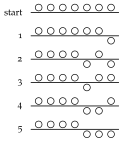
This ancient puzzle, known to Cardan in 1550 and to Wallis in 1693, and sold as the Chinese rings, has a loop on a handle and a row of rings, each held by a wire through a bar. Ring 1, at the free end, can be put on or taken off the loop at any time. Any other ring can be put on or taken off only when the ring next to it on the right is on the loop and all the rings to the right of that are off. Take one ring at a time. One ring comes off in 1 move, two in 2, three in 5, four in 10, five in 21, and seven in 85; the diagram shows the first five moves with seven rings, rings on the loop drawn above the line. With fourteen rings, taken off in the fewest moves, where are the rings after the 9,999th move?
No. 418. Such a Getting Upstairs
A staircase has eight treads below the landing. Start on the ground floor, land twice on the floor above, finishing there, and return once to the ground floor on the way. Every tread must be trodden the same number of times, and no step may take more than one riser. In how few steps can it be done?
No. 419. The Five Pennies
Four pennies can be placed so that each touches every other: three flat on the table touching in a triangle, and the fourth on top in the middle. Place five pennies so that every one touches every other.
No. 420. The Industrious Bookworm
Professor Rackbrane’s three volumes stand in order on the shelf. The leaves of each are three inches thick, and every cover is an eighth of an inch thick. A bookworm has bored straight from the first page of the first volume to the last page of the third. How long is its tunnel?
No. 421. A Chain Puzzle
A man has nine pieces of chain, fifty links in all, which he wants joined into one endless chain. It costs a penny to open a link and twopence to weld it again, and a new endless chain of the same kind would cost 2s. 2d. What is his cheapest course?

No. 422. The Sabbath Puzzle
From an old book:
Christians the week’s first day for Sabbath hold;
The Jews the seventh, as they did of old;
The Turks the sixth, as we have oft been told.
How can these three, in the same place and day,
Have each his own true Sabbath? tell, I pray.
No. 423. The Ruby Brooch
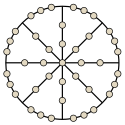
Lady Littlewood’s brooch has rubies on eight spokes and round the rim. Counting from the centre up one spoke, along the rim and down the next spoke, there are always eight. Her brother, back from India, saw that four were gone: the brooch had held forty-five and now held forty-one, and the jeweller who had it for repair had stolen four and reset as few of the rest as possible so that the count was still eight every way. The brooch now looks like this. How were the forty-five arranged?
No. 424. The Dovetailed Block
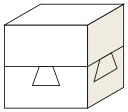
Two solid blocks of wood are securely dovetailed together, and the two hidden sides look exactly like the two shown. How were they put together?
No. 425. Jack and the Beanstalk
A British artist drew Jack climbing the beanstalk, with the stem winding round the stalk from lower right to upper left across its front. He made a serious blunder. What is it?
No. 426. The Hymn-Board Poser
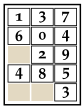
A church has three hymn-boards, each showing the numbers of the same five different hymns at a service, from a book of 700 hymns. Each figure is painted on a metal plate that slides into a board; the picture shows a board with twelve plates. A parishioner will pay for the fewest plates that will do for every possible service. Each plate costs 6d., and painting costs 1s. a plate, or d. each for two plates painted alike, d. each for three alike, and so on, a farthing a plate less for every plate painted alike. Using every legitimate and practical economy, what is the lowest cost? The figures are drawn as shown, so a 6 turned upside down makes a 9, and no other figure can be turned into another.
No. 427. Pheasant-Shooting
A boastful friend was out with a duke when twenty-four pheasants rose. He fired, and two-thirds of them dropped dead at his feet. The duke fired at the rest and brought down three twenty-fourths of them, wounded in the wing. Out of the twenty-four, how many still remained?
No. 428. The Gardener and the Cook
Set for All Fools’ Day, 1900. The gardener and the cook at a country house ran a race to a point 100 feet away and back. The gardener ran 3 feet at every bound and the cook only 2, but she made three bounds to his two. They took the same time in turning. What was the result?
No. 429. Placing Halfpennies
Mark out a rectangle 5 inches by 3. Halfpennies are an inch across. Place the first anywhere inside it, the second an inch from the first (an inch of paper between them), the third an inch from the second, and so on; no coin may touch another or cross the boundary. Dudeney’s example got stuck after ten coins. How many can you place?
No. 430. Find the Man’s Wife
On the Brighton front, twelve people are strolling about: six married couples, all strangers to one another. The ladies are Nos. 1, 3, 5, 7, 9 and 11, the men Nos. 2, 4, 6, 8, 10 and 12. In the picture:
No. 2 is paying a newsboy but has not taken a paper; No. 9 is reading one.
No. 4 carries a coat over his arm, buttoned on the left; No. 1 is wearing a coat, and No. 7 is very lightly dressed.
No. 6 has a dog; No. 11 carries a dog chain.
No. 8 carries a lady’s parasol with his stick; every lady has a parasol except No. 3.
No. 10 wears a straw hat.
No. 12 holds a bicycle with a dress-guard; only No. 5 wears a cycling skirt.
Which lady is No. 10’s wife?
Who Was First?
Biggs, who saw the smoke, was first: light crosses a mile in about five millionths of a second. Dudeney puts Carpenter, who saw the bullet strike, second and Anderson, who heard the report, last. That depends on the bullet averaging more than the speed of sound over the mile, about 1,100 feet a second, since the report takes about 4.7 seconds to arrive. A rifle bullet starts at more than twice that speed but slows all the way. A modern .303 load leaves the muzzle at 2,460 feet a second and is down to 905 feet a second, below the speed of sound, at 1,000 yards.
Those figures show only that the bullet takes at least 3.7 seconds, so the race between bullet and sound over a mile is close, and a heavier, slower bullet of 1900 could well lose it. Biggs was certainly first; the order of the other two is not certain.
Answer Biggs, who saw the smoke
A Wonderful Village
Dudeney’s answer is that the village can be anywhere. When the sun is on the horizon, he says, it is further from the place by half the earth’s diameter than it is at noon, and the earth’s radius is nearly 4,000 miles; no valley is a thousandth of that deep.
The idea is sound, but the “every noon, by 3,000 miles” is not, for two reasons. The first is the height of the noon sun. The earth turns the village towards the sun and away again, and at noon it is nearer by the earth’s radius times the sine of the sun’s height. Only a sun overhead gives the full radius. In winter the noon sun at Japan’s southernmost point, 20°25’ north,
stands only 46° high, and the gain is 2,854 miles. A gain of 3,000 miles every noon of the year needs a place south of latitude 17.3°, which leaves out all of Japan.
The second reason is larger. The earth’s orbit is an ellipse, and for half the year the earth is moving away from the sun. At its fastest, about three months after the earth is nearest the sun, the distance grows by half a kilometre a second, some 6,700 miles in six hours.
That swamps the turning of the earth. A calculation through the year with these figures finds that everywhere in Japan there are mornings when the noon sun is not nearer at all, but farther than the rising sun: by about 3,000 miles at the southern tip and 4,100 in the far north. In the other half of the year, when the earth is closing on the sun, the same effect makes the setting sun the nearer one. Dudeney’s village exists only if the motion of the earth round the sun is left out.
Answer Anywhere, by Dudeney’s reckoning; but no place in Japan gains 3,000 miles every noon
A Calendar Puzzle
There is no chance at all. A century begins with a year ending in 01, and under the Gregorian calendar the first day of such a year can only be a Monday, Tuesday, Thursday or Saturday, never a Sunday, Wednesday or Friday. A century of 100 years with 24 leap years has 36,524 days, five days more than a whole number of weeks, so each century starts five weekdays later than the last; the one century in four whose last year is a leap year (1901 to 2000, say) has a day more and moves six. From Monday, 1 January 1601, that gives Saturday for 1701, Thursday for 1801, Tuesday for 1901 and Monday again for 2001, and the cycle repeats every 400 years. A program reading the weekdays confirms the four. Anyone who counts centuries from the years ending in 00 fares no better: those first days are Monday, Wednesday, Friday and Saturday, and again never Sunday.
Answer None: a century never begins on a Sunday
The Tiring Irons
Count the moves first. To free ring the rings below it must be cleared except ring , which must stay on; so take off the first , slip off ring , put the back, and then deal with the that remain. If moves clear rings, , and from , this gives 1, 2, 5, 10, 21, 42, 85, …, each about double the last. With an even number of rings it comes to moves, so fourteen rings take 10,922 moves, and after the 9,999th there are 923 still to come. Dudeney then uses a rule of L. Gros, which he found in Rouse Ball’s Mathematical Recreations. Write 923 in binary with fourteen figures, 00001110011011. Mark every figure that repeats the figure on its left, the first figure being marked if it is 0. Marked figures are rings off the loop and unmarked figures rings on it, ring 14 at the left. The position is this, with rings 10, 7, 5, 3 and 2 on the loop.

A program took the rings off by the fewest moves from all fourteen on, and after the 9,999th move rings 10, 7, 5, 3 and 2 are on, as Gros’s rule says. It confirms the counts 1, 2, 5, 10, 21, 42 and 85, and for an odd number the rule .
Dudeney adds a table of the positions used on the way off, counting all on, and of those never used. The program confirms it. With 7 rings, 86 of the 128 positions are used and 42 are not, and 42 is the number of moves needed for 6 rings: the unused positions are exactly those that a wrong start would force the solver to undo. His formula for the positions used with an even number of rings is printed as ; it should be , as his own table shows, with 3 for two rings and 683 for ten.
Answer Rings 10, 7, 5, 3 and 2 on the loop, the rest off
Such a Getting Upstairs
Nineteen steps. Number the treads 1 to 8 and call the landing L. Step on to 1 and back to the floor, then go three steps forward and one back all the way up:
1, floor, 1, 2, 3, (2), 3, 4, 5, (4), 5, 6, 7, (6), 7, 8, L, (8), L
the treads in brackets being backward steps. Every tread is used twice. A search over every route confirms that nineteen is the fewest. If the return to the floor had to come between the two visits to the landing, the best would be 27 steps, straight up, straight down and up again; Dudeney’s trick is to make the return at once.
Answer Nineteen steps
The Five Pennies
Lay three pennies flat so that each touches the others, one lying partly on the other two: the two lower pennies touch edge to edge, and the third rests across both. Then stand the other two pennies on their edges on this group, leaning against each other so that they touch at the top, each resting at its foot on the coins below so that it touches all three. Every one of the ten pairs of pennies is then in contact. No program was written for this one, which depends on the thickness of real coins.
Answer Three flat, overlapping; two standing on them, leaning together
The Industrious Bookworm
Three and a half inches. The hasty reader counts all three volumes and four covers, inches. But look at three volumes standing in order on a shelf. The first page of Volume I lies at its right-hand side, next to Volume II, and the last page of Volume III at its left-hand side, also next to Volume II. The worm goes through the front cover of I, both covers and all the leaves of II, and the back cover of III: inches.
Answer inches
A Chain Puzzle
The pieces have 7, 8, 6, 3, 4, 5, 6, 5 and 6 links, counting rings and bars alike. Opening and welding a link costs 3d., so joining the nine pieces end to end at nine links costs 2s. 3d., more than a new chain. Breaking up the piece of 8 gives eight links to join the other eight pieces, for 2s. Better still, break up the pieces of 3 and 4. Their seven links join the remaining seven pieces into a ring for 1s. 9d.
That is the cheapest. Every piece is either broken up entirely or kept as one length, and lengths need opened links to close the ring. Opening a link from the end of a kept piece adds a link without adding a length. So if pieces with links in all are broken up, leaving lengths, the links opened must be at least both and . A search over every choice of pieces finds seven the least, from the pieces of 3 and 4 alone.
Answer Open the pieces of 3 and 4 links and use their seven links: 1s. 9d.
The Sabbath Puzzle
The old author’s answer: from the Jew’s house, let the Christian set out round the world going east, and the Turk going west. The Christian sees one more sunrise than the Jew who stays at home, and the Turk one fewer, as in Poe’s story Three Sundays in a Week and Verne’s Round the World in Eighty Days. When they meet again at the Jew’s house, the Christian’s reckoning is a day ahead and the Turk’s a day behind, so the Christian’s first day, the Jew’s seventh and the Turk’s sixth fall on the same day. Dudeney calls it an old quibble, sound enough for a puzzle, that depends on a day meaning the time from one sunrise to the next. Properly, a traveller changes his reckoning on crossing the date line; otherwise, as he says, at the North or South Pole, where the sun rises once a year, there would be only one Sabbath in seven years.
Answer The Christian goes round the world eastward and the Turk westward, and all three keep the same day
The Ruby Brooch
The brooch now has a centre stone, 2 stones on every spoke and 3 on every arc of the rim, so every count is , with 41 stones. The brother said the thief reset as few stones as possible, and one is enough. Work backwards from the present brooch. Take the centre stone back to where it came from, and every count drops to seven; the five stones missing from the old places, the four stolen and the one moved, must then bring every count back to eight. A stone on a spoke serves two counts and a stone on an arc serves one, so the five must be three spoke stones, on spokes that share no count, and two arc stones for the two counts left over. Before the theft there was no centre stone. Dudeney’s original is this, a little lopsided, which is why the brooch was called eccentric.
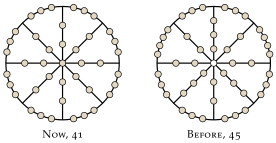
A program listed every arrangement of 45 stones that counts eight all round, 217,860 of them, and asked of each how many stones must be moved to turn it into the present brooch. At least one must be moved in every case. Exactly sixteen arrangements need only one, all of them without a centre stone, and Dudeney’s is one of the sixteen: the stones could have been taken from any of these, so the answer is not unique.
Answer No centre stone; three spokes of 3, two arcs of 4, the rest as now; one stone reset to the centre
The Dovetailed Block
The dovetails run diagonally. Seen from above, the tails cross the block in two parallel strips, each entering one face at its middle and leaving by the next face at its middle, all in the same diagonal direction. The upper block slides on to the lower one along that diagonal, and on each of the four sides the cut shows as the same dovetail.

A tail runs straight in its own direction, so it can slide along that direction and no other; the joint holds against lifting and against every push square to a face.
Answer The pieces slide together diagonally
Jack and the Beanstalk
The artist made the bean twine the wrong way.
Dudeney says a bean always twines as at B below and the hop as at A, and the artist drew A.
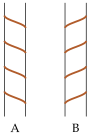
Seen from above, the stem in A goes round clockwise as it climbs, and in B anticlockwise. Hops twine clockwise. For the runner bean modern sources disagree, which says something about how easily the direction is misdescribed. The Wikipedia article on vines lists the runner bean as twining clockwise.
A gardener’s survey of photographs and growers found runner beans, and every other bean, twining anticlockwise seen from above, as in Dudeney’s B.
The survey rests on looking at real plants, and it agrees with Dudeney. What is not in doubt is that a species always twines the same way, so a beanstalk drawn like a hop is drawn wrong.
Answer The stem twines the way a hop twines, not a bean
The Hymn-Board Poser
First the figures.
The three boards show the same five hymns, so the most 1s a service can need is three times the most in five different hymn numbers: 111 and four numbers with two 1s, such as 11, 110, 112 and 113, give 11 figures and 33 plates’ worth. The same holds for 2, 3, 4 and 5. For 7 and 8 the most is 30, since 777 and 888 are beyond 700, and for 0 also 30, from numbers such as 100 and 200. The 6 and 9 share plates, since one turns into the other: 666, 669, 696 and 699 and one more number with two of them give 14 figures, so 42 plates’ worth. That is 297 figures in all, and since each plate has two sides, at least 149 plates.
Next, painting both sides is not enough; the pairs on the plates must also allow every service. If too many plates carry a 1 on one side and a 2 on the other, the hymns 111, 112, 121, 122 and 211 cannot all be put up, since they need 45 plates showing 1 or 2. In general, for every set of figures, the plates bearing at least one of them must be as many as any service can ask for. By Hall’s marriage theorem that condition is also enough. The last economy is the quantity discount: plates painted alike are cheaper by a farthing each for every plate in the group, so the groups should be as large as the service allows. Dudeney’s set, where means a 5 on one side and a 9 on the other:
| plates | painted | each | cost |
|---|---|---|---|
| 31 | d. | 11s. d. | |
| 30 | d. | 11s. d. | |
| 21 | 7d. | 12s. 3d. | |
| 21 | 7d. | 12s. 3d. | |
| 12 | d. | 9s. 3d. | |
| 12 | d. | 9s. 3d. | |
| 12 | d. | 9s. 3d. | |
| 8 | d. | 6s. 10d. | |
| 1 | 1s. | 1s. | |
| 1 | 1s. | 1s. | |
| 149 | plates at 6d. | £3 14s. 6d. | |
| £7 19s. 1d. |
He notes the neat point that the odd plate, which might have had one side blank, is better painted on both: making the 31st plate puts 31 in the group and takes a farthing off each of the other thirty.
A program checked all of this. It computed, for each of the 511 sets of figures, the most that a service can need, and found 149 plates to be the fewest that satisfy every one of them. Dudeney’s set satisfies them all and costs £7 19s. 1d. as he says.
That it is also the cheapest takes more work, since the number of possible sets is enormous. The key is that painting a group of plates alike costs farthings, so for 149 plates the painting costs farthings less the sum of the squares of the group sizes: the cheapest set is the one with the largest sum of squares. And since 149 plates have 298 faces for 297 figures, every figure is on exactly as many plates as it needs, except for a single spare face. The plates then form a network on the nine figures in which each figure has a known number of plates, and a program searched every such network exactly, discarding a branch as soon as the best it could still reach fell short of Dudeney’s set. None beats it. The same search, asked for anything as good as Dudeney’s, finds a set costing exactly £7 19s. 1d., as a check. So £7 19s. 1d. is the least possible cost, and Dudeney’s solution, like that of the one correct competitor, is optimal.
Answer 149 plates for £7 19s. 1d., both proved least
Pheasant-Shooting
Sixteen were shot dead, one was wounded in the wing and seven flew away. Seven did not remain, since they flew off, and the wounded bird struggled hard to run. The question asks how many “still remained”: the sixteen dead birds, which remained still.
Answer Sixteen, which remained still
The Gardener and the Cook
The puzzle was an All Fools’ joke, and nobody solved it. Most took the gardener to be the man. Then both cover 6 feet in the same time, but the gardener, bounding 3 feet, must go to 102 feet to pass the mark, as 100 is not a multiple of 3. He runs 204 feet to the cook’s 200 and loses by 4 feet.
But the gardener was a woman, a pupil of the horticultural college for lady gardeners at Swanley, and the cook a man, a French chef. So “she made three bounds to his two” means the gardener made three bounds of 3 feet while the cook made two of 2. The gardener runs her 204 feet in 68 bounds; in that time the cook makes bounds, feet, and is caught in the air a third of the way through his 46th bound, still on the way out. The gardener wins by 109 feet 4 inches. The prize answer was both: if the gardener is the man, the cook wins by 4 feet; if the gardener is the woman, she wins by 109 feet 4 inches. Exact arithmetic confirms both results.
Answer Gardener a man: the cook wins by 4 ft; gardener a woman: she wins by 109 ft 4 in
Placing Halfpennies
Use right triangles with legs and to set most of the two-inch spacings between successive centres, and horizontal or vertical links for the rest. This gives Dudeney’s thirteen-coin arrangement, placed and numbered below.
Measure from the rectangle’s top left corner in inches. Coins 11 and 12 sit in the two left corners, 4 and 6 against the top edge at and across, and 2 and 8 against the bottom edge at the same places (these are the centres). Then 1, 7 and 3 lie on the middle line at , and across, and 9, 10, 13 and 5 are a little in from the edges, at or down. Every coin is exactly an inch from the one before (2 inches centre to centre), and the closest two coins not in sequence have centres , about 1.035 inches, apart, so they miss touching by a thirtieth of an inch. All of this was checked in exact arithmetic. Whether fourteen coins can be placed was not settled here.
Answer Thirteen
Find the Man’s Wife
No guessing is needed; pair off the other five ladies. No. 8 carries a lady’s parasol, and only No. 3 has none, so she is his wife. No. 12’s bicycle is a lady’s, and No. 5 is the only lady in a cycling skirt. No. 6 has the dog, and No. 11 its chain. No. 2 has paid the newsboy without taking a paper, and No. 9 is reading one: she sent the boy to her husband for the penny. That leaves ladies 1 and 7 for men 4 and 10. The coat on No. 4’s arm buttons on the left, so it is a lady’s, and it is not No. 1’s, since she is wearing her own; it belongs to No. 7, who is lightly dressed. So No. 1 is No. 10’s wife. A check over all 720 ways of pairing the couples finds exactly one that fits the clues, with No. 1 married to No. 10. Without the coat, No. 7 would be possible as well: the coat is the clue that decides it.
Answer No. 1