Library · Amusements in Mathematics · Chapter 10
Various Geometrical Puzzles
On this page
- No. 178. The Cardboard Box
- No. 179. Stealing the Bell-Ropes
- No. 180. The Four Sons
- No. 181. The Three Railway Stations
- No. 182. The Garden Puzzle
- No. 183. Drawing a Spiral
- No. 184. How to Draw an Oval
- No. 185. St George’s Banner
- No. 186. The Clothes Line Puzzle
- No. 187. The Milkmaid Puzzle
- No. 188. The Ball Problem
- No. 189. The Yorkshire Estates
- No. 190. Farmer Wurzel’s Estate
- No. 191. The Crescent Puzzle
- No. 192. The Puzzle Wall
- No. 193. The Sheepfold
- No. 194. The Garden Walls
- No. 195. Lady Belinda’s Garden
- No. 196. The Tethered Goat
- No. 197. The Compasses Puzzle
- No. 198. The Eight Sticks
- No. 199. Papa’s Puzzle
- No. 200. A Kite-Flying Puzzle
- No. 201. How to Make Cisterns
- No. 202. The Cone Puzzle
- No. 203. Concerning Wheels
- No. 204. A New Match Puzzle
- No. 205. The Six Sheep-Pens
The last of the geometry before the puzzles of points and lines is a miscellany: boxes, ropes, estates, gardens, flags, cones and wheels. Most of them turn on a handful of old theorems, Pythagoras above all, and on a few facts about greatest and least quantities. Several are Dudeney catching out an accepted answer, and in a few the accepted answer can be improved further still.
The units are the old ones: twelve inches to the foot, three feet to the yard, 4,840 square yards to the acre, and 5,280 feet to the mile.
No. 178. The Cardboard Box
A rectangular cardboard box has a top of 120 square inches, a side of 96 square inches and an end of 80 square inches. What are its exact dimensions?
No. 179. Stealing the Bell-Ropes
Two thieves climbed the bell-ropes of a church tower to steal them. One cut his rope above his head and fell; the other, calling him a fool, cut his below his hands, and after hanging on as long as he could, fell too. Both were found next morning with broken limbs. One rope, when found, just touched the floor, and pulled taut to the wall, four feet away, it touched the wall three inches above the floor. How long was the rope from floor to ceiling, and how far did they fall?
No. 180. The Four Sons
A man left the shaded quarter of his square estate to his widow, and the rest to be divided among his four sons in pieces of the same area and shape, as shown. But there is a well at the centre, and Benjamin, Charles and David complain that only Alfred can reach it without trespassing. Divide the land so that each son has land of the same shape and area and can reach the well without leaving his own ground.

No. 181. The Three Railway Stations
A squire lives the same distance from three stations, Appleford, Bridgefield and Carterton. Bridgefield is fifteen miles beyond Appleford, Carterton thirteen miles from Appleford, and Bridgefield fourteen miles from Carterton. How far must he drive home from whichever station he uses?
No. 182. The Garden Puzzle
A garden enclosed by four straight walls of 80, 45, 100 and 63 yards has a tree the same distance from all four corners. Find the area of the garden.
No. 183. Drawing a Spiral
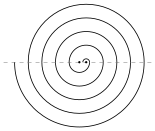
How can this spiral be drawn exactly with nothing but a pair of compasses and the sheet of paper it is drawn on?
No. 184. How to Draw an Oval
Can you draw a perfect oval on a sheet of paper with one sweep of the compasses?
No. 185. St George’s Banner
St George’s banner is a red cross on a white ground. If the flag is four feet by three, how wide must the arms of the cross be for the red and the white to use exactly the same amount of bunting?
No. 186. The Clothes Line Puzzle
A clothes line is tied from the top of each of two poles to the foot of the other. One pole is seven feet high and the other five. How high above the ground do the two lines cross?
No. 187. The Milkmaid Puzzle
A milkmaid milking in a corner of a field always goes down to the river with her pail before taking it to the dairy door. Draw the shortest route from the milking-stool to the river and then to the door.
No. 188. The Ball Problem
A stonemason cutting a stone ball asks a schoolboy how many equal balls could be laid on the level ground round it, each touching it. The boy answers at once, and asks in return: if the surface of the ball contained as many square feet as its volume contained cubic feet, what would its diameter be?
No. 189. The Yorkshire Estates
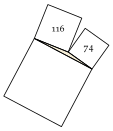
Three square estates meet corner to corner, enclosing a triangular piece of land between them. Estate A contains exactly 370 acres, B 116 and C 74. How many acres are in the triangle?
No. 190. Farmer Wurzel’s Estate
Farmer Wurzel owns three square fields of 18, 20 and 26 acres, arranged round a triangle. To get a ring-fence round his property he buys the four triangular fields between them. What is now the whole area of his estate?
No. 191. The Crescent Puzzle
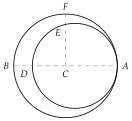
A crescent is formed by two circles, C being the centre of the larger. The width of the crescent between B and D is 9 inches, and between E and F 5 inches. What are the diameters of the two circles?
No. 192. The Puzzle Wall
Four poor men built cottages round a small lake, and four rich men afterwards built mansions farther out, each beyond a cottage. The rich men want the shortest possible wall that shuts the cottagers out but gives themselves free access to the lake. How should it be built?
No. 193. The Sheepfold
A farmer has a pen of fifty hurdles that holds a hundred sheep. How many more hurdles must he have to hold twice as many? The accepted answer is two.
No. 194. The Garden Walls
A builder has a round field, walled round, with four cottages on it. He is to build three more brick walls so that the four tenants have gardens of exactly the same area and exactly the same length of wall for their fruit trees. Each garden must be entirely enclosed, and it must be possible to prove that the lengths of wall are equal.
No. 195. Lady Belinda’s Garden
An oblong garden, enclosed by a thick hedge, is to have a rose bed covering exactly half its area, with a path of equal width all round it. Lady Belinda has only a plain tape, as long as the garden, and must measure inside the hedge. How does she mark out the bed? No dimensions are needed.
No. 196. The Tethered Goat
A goat is tethered to a post at one corner of a half-acre meadow in the shape of an equilateral triangle. How long must the tether be, to the nearest inch, for the goat to eat exactly half the grass?
No. 197. The Compasses Puzzle
Show how to find exactly the middle of a given straight line with the compasses only: no ruler, no pencil, no folding of the paper, only the compasses used in the ordinary way.
No. 198. The Eight Sticks
I have eight sticks, four of them exactly half the length of the others. Lay every one of them on the table so that they enclose three squares, all the same size, with no loose ends.
No. 199. Papa’s Puzzle
Papa has cut a triangle off a rectangular card so that, hung by a thread from a point A on its top edge, the rest hangs with its long side horizontal. He asks his little daughter to find the point A on another card, of a different size, without trial clippings. A curious point is hidden in the setting.
No. 200. A Kite-Flying Puzzle
A kite’s wire is wound into a solid ball two feet in diameter. The wire is a hundredth of an inch thick. How long is it, within a mile? Assume the ball is solid throughout and ignore the axle.
No. 201. How to Make Cisterns
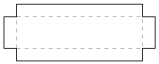
From a sheet of zinc eight feet by three a man cuts equal squares from the four corners and folds up the sides to make a cistern. What size should the squares be for the cistern to hold as much as possible?
No. 202. The Cone Puzzle
How should I cut the largest possible cylinder out of a wooden cone? A child could do it if he knew the rule.
No. 203. Concerning Wheels
When a train runs from London to Crewe, some parts of it are always moving from Crewe towards London. Which? And if one wheel rolls once round another of the same size, fixed, how many times does it turn about its own axis?

No. 204. A New Match Puzzle
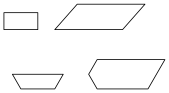
Rearrange eighteen matches to enclose (1) two four-sided spaces, one exactly three times as large as the other, and (2) two five-sided spaces, one three times the other. All eighteen matches must be used, the two spaces must be quite separate, and there must be no loose ends or doubled matches.
No. 205. The Six Sheep-Pens
Thirteen matches, standing for hurdles, enclose six pens of the same size. One hurdle is stolen. Enclose six equal pens with the remaining twelve, using all of them, with no loose ends or doubled matches.

The Cardboard Box
If the box is long, broad and deep, the faces are , and . Multiply the first two and divide by the third: , so , and then and . The rule is Dudeney’s: the product of any two faces divided by the third is the square of the edge they share. The three faces multiplied together give the square of the volume, here .
Answer 12 by 10 by 8 inches
Stealing the Bell-Ropes
The rope hangs straight down to the floor from a point on the ceiling. Pulled out to the wall, 48 inches away, it reaches 3 inches up, so it forms the long side of a right-angled triangle whose other sides are 48 and the rope’s length less 3. With for the length, The rope, and the height of the ceiling, is 32 feet inches. Both thieves had climbed to the top, so each fell practically that whole height. Dudeney’s general rule is the same sum: with one side of a right-angled triangle and the difference between the other side and the long side, the long side is .
Answer 32 feet inches
The Four Sons
Take the estate as 4 on a side, so that the widow has the corner and each son is owed an area of 3. Cut each of the other three quarters along a diagonal, and cut one of the halves of each again into two small triangles, as shown.

Each son gets one large triangle (half of a quarter, area 2) and one small one (a quarter of a quarter, area 1), placed apart so that they cannot be taken for one piece. All four sons’ land is therefore the same in shape and area, and every large triangle has a corner at the well in the middle. Dudeney notes that the conditions do not ask for each son’s land to be in one piece; they do ask for the same shape, which is why the two parts must not touch.
Answer Each son a large and a small half-square triangle, the large one at the well
The Three Railway Stations
The point the same distance from all three stations is the centre of the circle through them, so the answer is the radius of that circle for a triangle with sides 13, 14 and 15 miles. With 14 as the base the height is 12, since , and the area is 84. For any triangle the radius of the circle through its corners is the product of the sides divided by four times the area: The triangle is acute, so the centre, and the squire’s house, lies inside it.
Answer miles
The Garden Puzzle
A tree the same distance from all four corners is the centre of a circle through them, so the garden is a quadrilateral inscribed in a circle. For such a quadrilateral a formula of the Indian mathematician Brahmagupta (seventh century) gives the area from the sides alone; it is Heron’s formula for a triangle with a fourth side added, and reduces to Heron’s when that side shrinks to nothing. With half the perimeter, The garden contains 4,752 square yards. The order of the walls round the garden does not matter, and building the inscribed quadrilateral from the four walls confirms the figure.
Answer 4,752 square yards
Drawing a Spiral
Fold the paper to make a straight crease through the middle, and pick two points A and B on it. Draw a half circle on one side of the crease about B, starting midway between A and B, then a half circle on the other side about A, starting where the first ended, and so on alternately. Each half circle ends on the crease exactly where the next one begins, and each is larger than the last by the distance AB, so the curve winds steadily outwards. As Dudeney says, it is not a true spiral, but it is the spiral in the picture.
Answer Half circles drawn alternately about two points on a fold
How to Draw an Oval
Wrap the paper round a cylindrical bottle or tin and draw a circle on it with the compasses. Unwrapped, the curve is an oval, symmetrical both ways, wider across the wrap than along the tin. It is worth adding that it is not an ellipse: on a tin of radius 1 with the compasses opened to 1.2, the flattened curve differs from the ellipse with the same length and breadth by up to 0.03, or three per cent.
Dudeney asked only for an oval, so his answer stands.
Answer Draw the circle on paper wrapped round a cylinder
St George’s Banner
Let the arms be wide. The red cross covers , the square where the arms cross being counted once, and it must be half the flag, 6 square feet: So the arms are 1 foot wide. Dudeney’s rule, half the perimeter halved less half the diagonal, , is the same root in general: for a flag by the width is .

Answer 1 foot
The Clothes Line Puzzle
Let the poles be and feet high and apart, and let the lines cross at height , a distance from the taller pole. By similar triangles and ; adding and gives , so The distance has cancelled: that is why the puzzle need not give it.

Answer 2 feet 11 inches
The Milkmaid Puzzle
Reflect the stool in the near bank of the river to the point A, as far beyond the bank as the stool is in front of it. Every point of the bank is as far from A as from the stool, so a route stool, bank, door is as long as A, bank, door, and that is shortest when it is straight. Join A to the door; where the line crosses the bank, at B, is where she should go.
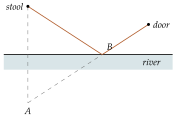
Answer Aim at the point where the line from the stool’s reflection to the door meets the bank
The Ball Problem
Six. Equal balls resting on the ground have their centres at the same height, so this is the question of how many equal circles can touch one circle in a plane. Their centres lie on a circle of twice the radius, and two neighbours, which may not overlap, have centres at least two radii apart, so they are at least apart round that circle, the angle of an equilateral triangle; six fit exactly, as with the pennies of No. 28. For the boy’s question: a sphere’s surface is and its volume , so they are equal in number when , that is . The ball is 6 feet across, with square feet of surface and cubic feet of stone.
Answer Six balls; 6 feet
The Yorkshire Estates
The sides of the triangle are the sides of the three squares, so their squares are 370, 116 and 74. Each of these is a sum of two squares: , and . So the triangle can be drawn with its corners on the points of a square grid, as Dudeney does, and its area found by counting off right-angled triangles from an enclosing rectangle. Or use Heron’s formula, rewritten in terms of the squares , , of the sides (multiply out and only squares of the sides survive):
Answer 11 acres
Farmer Wurzel’s Estate
The middle triangle has area The other three triangles have the same area, and the reason is a quarter turn: each outer triangle has two sides equal to two sides of the middle one, meeting at an angle that makes up two right angles with the middle triangle’s angle, and triangles with two sides equal and those angles adding to have equal areas, since the sine of an angle equals the sine of its supplement.
So the estate is acres. On a grid, with , and , all four triangles come out at 9 acres, as the program confirms.
Answer 100 acres
The Crescent Puzzle
Let the large circle have radius . The small circle touches it at A, and across the diameter BA the crescent is 9 wide, so the small circle’s radius is and its centre lies from C. On the radius CF the small circle crosses at E, at height above C; that point is on the small circle, so by Pythagoras which reduces to . That is Dudeney’s statement that is the mean proportional between and . So : the diameters are 50 inches and 41 inches.
Answer 50 inches and 41 inches
The Puzzle Wall
Each cottage stands between the lake and a mansion, so a single wall that keeps the cottages out and lets every mansion reach the lake must wind round them like a pinwheel. The old books drew a curving wall; most people now draw straight lines from mansion to cottage to mansion; Dudeney’s better wall runs straight from the far end of each mansion to the near end of the next, and cuts inwards round the cottages only where it must.
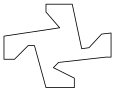
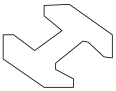
Measured on his own drawings, the straight-line wall is about 4.1 times the distance between two opposite mansions and his is about 3.8, some eight per cent shorter.
Dudeney made the same comparison by measurement, and nothing here proves his wall the shortest possible.
Answer The pinwheel wall of the second drawing, about 8 per cent shorter than the straight-line one
The Sheepfold
The accepted answer supposes the pen is 24 hurdles by 1, and widens it to 24 by 2 with one extra hurdle at each end. Dudeney’s objection is that nothing fixes the shape, and even granting it the answer fails. The same fifty hurdles set out 13 by 12 enclose 156 squares instead of 24, room for 650 sheep. A pen of exactly twice the area, 48, needs only twenty-eight hurdles, 8 by 6. And if all fifty must be used for exactly 48, set them as a parallelogram with sides of 12 and 13, leaning over until its height is 4, when the sine of its angle is .
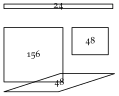
His point goes further than his figures. If the pen may be any shape, a ring of equal hurdles encloses most when it is a regular -sided figure, with area . Twenty-five hurdles enclose up to 49.5 and so can be set to enclose exactly 48; twenty-four enclose at most 45.6. So 25 hurdles are enough to double the fold, not 28, and all fifty could enclose nearly 199 squares rather than 156.
Answer None are needed; the same fifty can hold far more, and 25 can hold exactly double
The Garden Walls
Dudeney’s answer turns on two words. The walls are brick, so they have thickness and the solution must work whatever it is; and they must be three walls, not walls that cross or join, since two walls built into each other become one. That rules out the obvious answers: two diameters crossing make one wall or four, and any wall that divides the field by a curve drawn with no thickness comes out only approximately right.
His answer is a straight wall across one diameter and, on either side of it, a wall that runs from the boundary wall to the first along the other diameter, the line of the cottages. Each side wall dips in a half circle under its outer cottage and arches in a half circle over its inner one, so the outer cottage goes with the garden above and the inner one with the garden below. The three walls touch but are not built into one another.
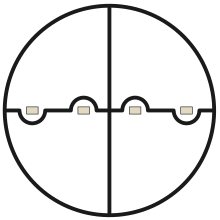
The proof needs no measuring. Take the left-hand side wall. Its curved part, the dip and the arch with the straight piece between them, is carried to itself by a half turn about the point midway along the radius: the dip becomes the arch and the arch the dip. That half turn changes above into below. So the ground the dip adds to the upper garden is exactly the ground the arch gives the lower, and the upper face of the curved wall, which is the outer face of the arch and the inner face of the dip, has exactly the same length as the lower face, the inner face of the arch and the outer face of the dip. Thicker bricks make the outer faces longer and the inner shorter, but each garden has one of each. The straight ends, at the boundary wall and at the first wall, are the same above and below, and so is the rest of each half of the field. The two gardens on the left are therefore equal in area and in length of wall, and the right-hand side is their mirror image. A program built the walls with bricks of three different thicknesses and measured the four gardens: equal areas and equal lengths of wall in every case, and one cottage in each.
Answer A diameter and two side walls, each dipping and arching in half circles, touching but not built into one another
Lady Belinda’s Garden
With the garden by and the path wide, the bed is , and it must be half of . That is a quadratic whose useful root is The tape does it without numbers. From the corner A mark E a quarter of the way along one side (fold the tape in four) and F a quarter of the way along the other. Then EF is a quarter of the diagonal. Lay off EG along the side equal to AF, so that AG is a quarter of , and then GH back towards A equal to EF: AH is the width of the path. For a garden 12 by 5, where the diagonal is 13, the path is .
Answer AH, found as a quarter of the sides less a quarter of the diagonal
The Tethered Goat
The goat grazes a sector of a circle with its angle at the corner, , a sixth of the whole circle. It must be a quarter of an acre, so the whole circle would be acres, or 9,408,960 square inches. The radius is inches, so the tether is 1,731 inches, 48 yards 3 inches, to the nearest inch. The sector lies wholly inside the field, since the tether is shorter than the height of the triangle, about 2,331 inches.

Answer 48 yards 3 inches
The Compasses Puzzle
Dudeney’s construction, with AB the given length. Draw circles of radius AB about A and B, meeting at D. Round the circle about B mark E and F with DE and EF equal to AB; F is then as far beyond B as A is before it. With centres A and F and radius DF draw arcs meeting at G. With radius BG draw an arc about B through G, cutting the circle about A at H, and an arc about A cutting the circle about B at N; mark K on the arc about B with HK equal to AB, and L on the circle about B with HL equal to HB. Arcs of radius AB about K and L meet at I. Mark M on the circle about A with BM equal to BI. Finally the arc about M through B cuts the line at C, the middle of AB.
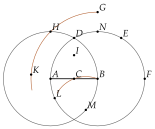
Why it works: with AB as 1, DF is , so G is at height above B and , twice . That makes H, A, B, N the corners of a square, and K and L are placed so that I is its centre. Then , and the circle about M through B meets AB again exactly halfway along. The program follows every step with coordinates and lands on . Dudeney remarks that this is not the shortest construction; the problem belongs to the geometry of Mascheroni, who showed that every construction with ruler and compasses can be done with compasses alone.
Answer The construction above; C is the middle of AB
The Eight Sticks
The answer nearly everyone gives, three squares tilted like diamonds, fails the conditions: two of the sticks would rest on the table at one end only, and every stick must lie on the table. The honest answer needs sticks of the right thickness. With long sticks of 2 feet and short ones of 1 foot, lay the long ones end to end in two rows, 4 feet long, and stand the four short ones between them as uprights. The spaces are 1 foot high, and inches wide if the sticks are inches thick; they are squares when .

With matches, about twenty-one times as long as they are thick, the spaces would be oblongs, which is why Dudeney said sticks.
Answer Sticks of 2 feet and 1 foot, 3 inches thick, laid flat as shown
Papa’s Puzzle
The card, cut from A on the top edge to the bottom corner D, hangs with its top level when its centre of gravity lies straight below A. Many people take BA as a third of BC, to make the areas on either side equal; but the triangle’s point sticking out to D pulls harder, so balance turning effects, not areas. Let the card be long and high, and BA . Below A, the piece is a rectangle by to the left of the thread and a right-angled triangle with legs and to the right. The rectangle’s weight acts to the left of the thread; the triangle’s weight acts at its centroid, a third of the way along its base, to the right. Balance needs so and . BA is of the length of the card.
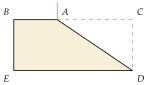
The curious point is that this does not depend on the height of the card at all: cancelled from the balance, and the program finds the balance point for cards of several heights and gets 0.366 of the length every time. Pappus’s two cards were the same length, so the little girl had only to lay the cut card on the other and mark A at the same place.
Answer BA of the length; since the cards are equally long, copy A from the first
A Kite-Flying Puzzle
Put the ball in a cylindrical hat-box that just fits it, 24 inches across and 24 high. The ball fills exactly two-thirds of it, a fact known since Archimedes, so the ball holds as much as a cylinder 24 inches across and 16 high. Think of that cylinder as made of wires a hundredth of an inch thick standing side by side with no gaps. Circles go as the squares of their diameters, so there are wires, each 16 inches long: 92,160,000 inches, which is 1,454 miles 2,880 feet. The text as printed calls the square of one hundred-thousandth, a slip for ten-thousandth; the arithmetic that follows uses the right value.
Answer 1,454 miles 2,880 feet
How to Make Cisterns
Cut squares of side from an by sheet and the cistern holds . The volume is greatest where its rate of change is zero, , and the smaller root is Dudeney’s for the 8 by 3 foot sheet: squares of 8 inches, and a cistern of cubic feet. A search over sizes to a thousandth of a foot agrees.
Answer Squares of 8 inches
The Cone Puzzle
A cylinder standing inside a cone of height and base radius , reaching a height , has radius and volume . Its derivative with respect to is , which is zero at the tip (, no cylinder) and at , where the volume is greatest: cut at one-third of the altitude.

Answer Cut at one-third of the height
Concerning Wheels
The flange of a railway wheel reaches below the top of the rail, beyond the circle that rolls. A point there traces a looped curve, and at the bottom of each loop it is moving backwards: a point one-tenth of a radius below the rail moves at a tenth of the train’s speed towards London. At every moment some points of every flange are doing this.
The rolling wheel turns twice. A mark at its top is at the bottom, touching the fixed wheel, after half the journey, and so has already made one turn; it makes another in the second half. In general a wheel rolled round another turns times, the fixed wheel’s radius being .
Answer Points on the flanges below the rail; two turns
A New Match Puzzle
(1) Six matches make a rectangle 2 by 1, area 2, and the other twelve a parallelogram with sides of 4 and 2 matches, leaning until its height is , area 6: three times as large.
(2) On a grid of equilateral triangles of side one match, take a parallelogram 3 by 1 and cut off the small triangle at one of its sharp corners: a five-sided figure of 5 triangles, with a boundary of 7 matches. Do the same with a parallelogram 4 by 2: 15 triangles, a boundary of 11 matches. Seven and eleven make eighteen, and the second figure is three times the first.
Answer (1) a 2 by 1 rectangle and a slanted 4 by 2 parallelogram; (2) two cut parallelograms of triangles
The Six Sheep-Pens
Lay six matches as a regular hexagon and the other six as spokes from its centre to its corners. The spokes are as long as the sides, so the hexagon falls into six equal equilateral triangles: six pens of the same size from twelve hurdles.

Answer A hexagon with six spokes