Library · Amusements in Mathematics · Chapter 12
Moving Counter Problems
On this page
- No. 214. The Six Frogs
- No. 215. The Grasshopper Puzzle
- No. 216. The Educated Frogs
- No. 217. The Twickenham Puzzle
- No. 218. The Victoria Cross Puzzle
- No. 219. The Letter Block Puzzle
- No. 220. A Lodging-House Difficulty
- No. 221. The Eight Engines
- No. 222. A Railway Puzzle
- No. 223. A Railway Muddle
- No. 224. The Motor-Garage Puzzle
- No. 225. The Ten Prisoners
- No. 226. Round the Coast
- No. 227. Central Solitaire
- No. 228. The Ten Apples
- No. 229. The Nine Almonds
- No. 230. The Twelve Pennies
- No. 231. Plates and Coins
- No. 232. Catching the Mice
- No. 233. The Eccentric Cheesemonger
- No. 234. The Exchange Puzzle
- No. 235. Torpedo Practice
- No. 236. The Hat Puzzle
- No. 237. Boys and Girls
- No. 238. Arranging the Jampots
Every puzzle in this chapter is a set of counters and a rule for moving them, with a target position and, usually, a demand for the fewest moves. That is the kind of question a patient machine answers completely. Start from the given position, list every position one move away, then every position two moves away that has not been seen, and so on; the first time the target appears, its distance is the fewest possible, and no cleverer route can exist, because every route has been counted. Where the positions are few enough this settles Dudeney’s claims outright, and often counts his rivals too.
A few puzzles are too large for that, or are not about fewest moves at all, and for those the answers say what was checked and how.
No. 214. The Six Frogs
Six frogs sit in a row of seven squares, the first square empty. A frog may move to the next square if it is empty, or leap over one frog to an empty square beyond, backwards or forwards. Reverse their order, so that they read 6, 5, 4, 3, 2, 1 with the empty square where it is now, in the fewest moves. Then add a seventh frog, and more, until you can give the shortest solution for any number.

No. 215. The Grasshopper Puzzle
Twelve numbered grasshoppers sit on twelve of thirteen discs in a circle. Reverse their order, so that they read 1, 2, 3 and so on the opposite way round, with the empty disc where it is now. Move one at a time, to the next disc if it is empty or by leaping over one grasshopper, in either direction. What are the fewest moves?
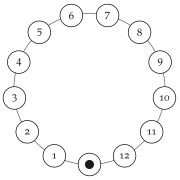
No. 216. The Educated Frogs
Six frogs sit on seven tumblers, three white on Nos. 2 to 4 and three black on Nos. 5 to 7. They are to change sides, the black to the left and the white to the right, with No. 7 empty. A frog may jump to the next tumbler if it is empty, or over one or two frogs of either colour to an empty tumbler. For instance: 4 to 1, 5 to 4, 3 to 5, 6 to 3. Do it in ten jumps.
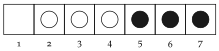
No. 217. The Twickenham Puzzle
Eleven discs stand in a circle, the bottom one empty. Five white counters and five black carry the letters shown. Get them to spell TWICKENHAM clockwise, the empty disc back at the bottom. Black counters move clockwise and white anticlockwise; a counter moves to the next disc if it is empty, or jumps one counter of the other colour into an empty disc beyond. It can be done in twenty-six moves.
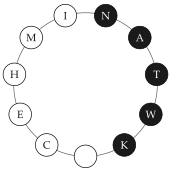
No. 218. The Victoria Cross Puzzle
Place the letters of VICTORIA as shown on a cross of nine divisions and slide one letter at a time into the empty division, from dark to light and light to dark alternately, until the word reads round the same way with the V on one of the dark arms. No two letters may share a division, and there is no leaping. Find the shortest way.
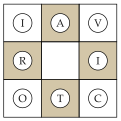
No. 219. The Letter Block Puzzle
Eight lettered blocks lie in a box as shown. Slide them one at a time into the space until they read A B C, D E F, G H, in the fewest moves.

No. 220. A Lodging-House Difficulty
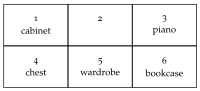
Six small rooms open into one another as the plan shows, and five big pieces of furniture stand in them, one room being empty. No room will hold two pieces. Mr Dobson insists that the piano and the bookcase change rooms. How is it done in the fewest removals?
No. 221. The Eight Engines
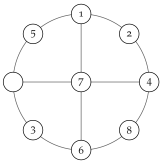
In this yard engines may stand only at the nine points shown, one of which is empty. Move them one at a time, from point to point, in seventeen moves, so that their numbers run in order round the circle with the middle point empty. But one engine has had its fire drawn and cannot move. Which is it, and how is the thing done?
No. 222. A Railway Puzzle
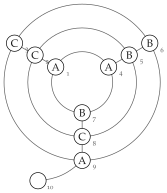
Nine stopping-places lie where three circles cross three straight lines, and a tenth hangs from the outer circle like the tail of a Q. Three engines marked A, three B and three C stand as shown. Move them one at a time along the lines, from place to place, until every circle and every straight line has an A, a B and a C. How few moves do you need?
No. 223. A Railway Muddle
A single line has a loop between B and C, and each side of the loop holds eight wagons, or seven wagons and an engine. Two goods trains, each an engine and sixteen wagons, meet head on, one travelling from A to D and the other from D to A. Pass them, and send each on its way with its engine in front, reversing the engines as few times as possible. A reversal is any change of direction. How many are needed?
No. 224. The Motor-Garage Puzzle
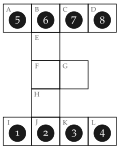
A garage holds twelve cars in the squares shown. Cars 5 to 8 stand along the top and 1 to 4 along the bottom. Exchange the two rows, the numbers still running from left to right, in the fewest moves. A car moves any distance at a time, one car to a square.
No. 225. The Ten Prisoners
Ten prisoners occupy a prison of sixteen cells as shown. The jailer wants as many even rows as possible, rows of two or four men, across, down and diagonally. There are twelve now, and the greatest possible is sixteen. He allows only four men to be moved, and the man in the bottom right-hand corner, being infirm, must stay. How are the sixteen rows obtained?

No. 226. Round the Coast
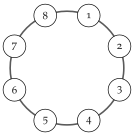
Eight circles form a ring, and circle 8 stays blank. Write a seven-letter port of the United Kingdom in the other seven: touch an empty circle, jump over two circles either way round, and write the next letter in the circle reached. “Glasgow” sticks after five letters. What is the mystery?
No. 227. Central Solitaire
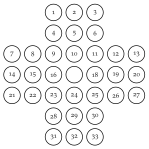
Fill every hole of the thirty-three-hole board but the centre, 17. Jump one counter over the next into an empty hole beyond, removing the one jumped, along the lines only. Clear the board except for one counter in the centre. A run of jumps by one counter counts as one move. Find the fewest moves.
No. 228. The Ten Apples
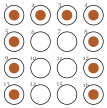
Sixteen plates stand in a square with an apple on ten of them, and as they stand no jump is possible. Move any one apple to an empty plate, and then remove all the apples but one by jumping one over another to the vacant plate beyond, as in solitaire, never diagonally.
No. 229. The Nine Almonds
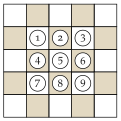
Nine almonds lie on the middle squares of a board of twenty-five. Remove eight of them, leaving the ninth in the centre, by jumping one over another to the vacant square beyond and taking off the one jumped, as in draughts, but in any direction. A run of jumps by one almond is one move. Do it in the fewest moves.
No. 230. The Twelve Pennies
Twelve pennies lie in a circle. Take up one penny, pass it over two pennies either way round, and place it on the third. Repeat until, in six moves, the coins lie in six pairs on places 1 to 6. It does not matter whether the two passed over are separate or a pair.
No. 231. Plates and Coins
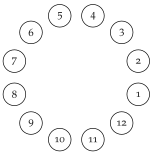
Twelve plates stand round a table with a coin in each. Going always in one direction, take up a coin, pass it over two coins and put it in the next plate; do this six times, so as to leave two coins in each of six plates. It does not matter how many empty plates you pass. The hand must never go backwards and must end where it began. Do it in as few revolutions as possible.
No. 232. Catching the Mice
A cat must go round and round a circle of thirteen mice, always the same way, eating every thirteenth mouse and leaving the white mouse till last. At which mouse should the count start? Next, starting at the white mouse, what is the smallest number the cat can count by and still eat the white mouse last? And the smallest that makes the white mouse the third eaten?
No. 233. The Eccentric Cheesemonger
Sixteen cheeses stand in a row, numbered 1 to 16. Make four piles of four in twelve moves, always carrying a cheese over four others, piled or not, either way. Leave the piles on Nos. 1, 2, 15 and 16; then with three piles on 13, 14 and 15; then on 3, 5, 12 and 14.
No. 234. The Exchange Puzzle
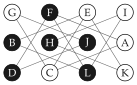
Twelve counters, A, C, E, G, I, K white and the rest black, stand on the diagram. An exchange swaps two counters of opposite colours standing on the same line. Bring them into the order A B C D, E F G H, I J K L in seventeen exchanges. It cannot be done in fewer.
No. 235. Torpedo Practice
Sixteen men-of-war lie at anchor, surrounded. Each torpedo, fired in a straight line, passes under three vessels and sinks the fourth, each ship sinking before the next torpedo is launched, and every torpedo going a different way. In a square formation seven can be sunk. Anchoring the fleet as we like, how many can we sink?
No. 236. The Hat Puzzle
Ten hats hang on twelve pegs, silk and felt alternately, the two end pegs empty. Move two neighbouring hats together to the empty pegs, one in each hand, without crossing hands, then two more, and so on until five pairs have moved and the hats hang in an unbroken row, silk together and felt together, with the empty pegs at one end.
No. 237. Boys and Girls
Ten chairs stand in a row, the first two empty and eight children, numbered 1 to 8, on the rest; odd numbers are boys and even numbers girls. Move two children from neighbouring chairs to the two empty chairs, making them change sides, and so on, until in five moves the boys are all together and the girls together, with the two empty chairs at one end.
No. 238. Arranging the Jampots
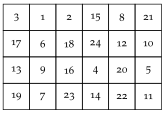
Twenty-four jampots stand in twenty-four pigeon-holes as shown. Dorothy wants them in order, 1 to 6 on the top shelf, 7 to 12 on the next and so on, always exchanging two pots, one in each hand. How many exchanges are needed?
The Six Frogs
Watch the empty square rather than the frogs. In the shortest play it sweeps along the row a leap at a time, from one end to the other, and turns round at each end with a single step; every leap carries one frog past another, and the steps only turn the sweep. Move the frogs in the order 2, 4, 6, 5, 3, 1, three times over, then 2, 4, 6: twenty-one moves. Each frog has only one possible move at any time, so naming the frog names the move.
Dudeney’s general rule is that frogs need moves when is even and when is odd. For the even case, write the even numbers up and the odd numbers down, repeat that times, and finish with the even numbers up once more; for fourteen frogs this gives 105 moves. The odd case is a little more intricate: for eleven frogs, five times, then , then to in order, 73 moves in all.
A complete search of every position confirms that his formula gives the fewest moves for every number of frogs from two to nine, and his recipe, played out, is legal and exactly that long for every number from two to fourteen.
He calls this complete general solution “published here for the first time.”
Answer Twenty-one moves; for even, for odd
The Grasshopper Puzzle
Replay the proposed moves first, then separate the construction from the claim that it is shortest. Dudeney reverses the twelve grasshoppers in forty-four moves: 12, 1, 3, 2, 12, 11, 1, 3, 2, then 5, 7, 9, 10, 8, 6, 4 four times over, then 3, 2, 12, 11, 2, 1, 2. The program plays it through and the grasshoppers end reversed.
He gives a general answer. Two, three and four grasshoppers need 3, 3 and 6 moves; beyond that, grasshoppers need moves when is even and when it is odd. For twelve that is 44. A complete search confirms the formula for every number from two to eleven.
Twelve grasshoppers have 6.2 billion positions, and that search has not been run here, so for twelve the formula and the forty-four moves are Dudeney’s, with every smaller case behind them.
Answer Forty-four moves
The Educated Frogs
This is a puzzle of order rather than principle, and the tool that makes ten jumps possible is the long jump over two frogs: five of the ten below use it. Jump 2 to 1, 5 to 2, 3 to 5, 6 to 3, 7 to 6, 4 to 7, 1 to 4, 3 to 1, 6 to 3, 7 to 6. A search of every position shows that ten jumps is the fewest, and that there are just two ways of doing it in ten.
Answer 2–1, 5–2, 3–5, 6–3, 7–6, 4–7, 1–4, 3–1, 6–3, 7–6
The Twickenham Puzzle
Black counters go only clockwise and white only anticlockwise, so no counter can ever undo a move; the puzzle is to find an order in which the gap is always where the next counter needs it, and only a search can say how short that order can be. Play the counters in this order: K C E K W T C E H M K W T A N C E H M I K C E H M T. The position always settles whether a counter steps or leaps. Twenty-six moves is the fewest, and the search finds that this is the only way to do it in twenty-six.
Answer K C E K W T C E H M K W T A N C E H M I K C E H M T
The Victoria Cross Puzzle
The word could not be made to read round with the V moved one place if every letter were different: the two I’s must change places, the first travelling to the seventh place and the second to the second. Moving the letters in the order of the words “A VICTOR! A VICTOR! A VICTOR I!” solves it in twenty-two moves, and the program confirms that this works.
The fewest moves is eighteen, and a search of every position finds exactly six solutions of that length, as Dudeney says. One of them, the two I’s being numbered by their starting places, is I(1), V, A, I(2), R, O, T, I(1), I(2), A, V, I(2), I(1), C, I(2), V, A, I(1). His remarks about all six hold: C, T, O and R each move once, one of the I’s moves four times, and the V always ends on the right arm of the cross.
Answer Eighteen moves, in just six ways
The Letter Block Puzzle
Here there is no shortcut: the box is a small cousin of the fifteen puzzle, and the fewest moves can only be found by trying them. Move the blocks A, B, F, E, C, A, B, F, E, C, A, B, D, H, G, A, B, D, H, G, D, E, F. Twenty-three moves is the fewest, and a search of all the positions finds that this is the only way to do it in twenty-three.
Answer Twenty-three moves, in one way only
A Lodging-House Difficulty
Move piano, bookcase, wardrobe, piano, cabinet, chest of drawers, piano, wardrobe, bookcase, cabinet, wardrobe, piano, chest of drawers, wardrobe, cabinet, bookcase, piano: seventeen removals. That is the fewest, and there are two ways of doing it in seventeen.
Dudeney adds that the landlady could then move the chest, the wardrobe and the cabinet back, leaving only the wardrobe and the chest of drawers exchanged, which Mr Dobson did not mind. He could not have had everything else back in place. Colour the rooms like a chessboard; the empty room changes colour at every removal, so it can return to room 2 only after an even number of removals. Each removal swaps a piece with the gap, and an even number of swaps can never add up to a single exchange of two pieces. Some other pair must be exchanged too.
Answer Seventeen removals
The Eight Engines
The question hides a second one: which engine can be left out of the play at all. The only way to answer it is to try each engine as the fixed one and search for the fewest moves. The engine that cannot move is No. 5. Move the others in the order 7, 6, 3, 7, 6, 1, 2, 4, 1, 3, 8, 1, 3, 2, 4, 3, 2, and the engines stand in order round the circle with the middle empty. A search finds that with No. 5 fixed there are just three ways in seventeen moves, Dudeney’s and the “two other slightly different solutions” he mentions. No other engine will do: with No. 2 fixed the fewest is nineteen, with No. 8 twenty-five, with No. 3 twenty-three, and with any of the rest it cannot be done.
Answer No. 5 stays; seventeen moves
A Railway Puzzle
With nine engines on ten places there is only ever one empty place, so every move fills it and opens another, and a search of every position settles how few will do. Nine moves: from 9 to 10, 6 to 9, 5 to 6, 2 to 5, 1 to 2, 7 to 1, 8 to 7, 9 to 8 and 10 to 9. A search confirms that nine is the fewest and that this is the only way to do it in nine.
Answer Nine moves
A Railway Muddle
Dudeney needs six reversals. The train going from A to D is divided into three parts: the engine with seven wagons, eight wagons, and one wagon. The other train never uncouples. The black train runs forward past the loop, then backs, leaving the eight wagons on the loop, and the white engine goes on towards D with its seven (the first reversal). The black train returns to fetch the single wagon (the second), pushes the eight off the loop and leaves the single wagon there, going on its way (the third and fourth). The white train then backs onto the loop, picks up the single wagon and goes right away to D (the fifth and sixth).
A program replayed these moves on a plain model of the line: a loop whose sides each hold eight vehicles, single line beyond it at both ends, an engine moving only what is coupled to it, and nothing allowed to run into or through anything else. Every move is legal, both trains leave with their engines in front, and the black engine reverses four times and the white twice. The loop’s size matters: with room for only seven, the white engine and its seven wagons would stick out past B, and the black train could not get by. The replay confirms that six reversals suffice. That six is the fewest, as Dudeney claims, it does not show.
Answer Six reversals
The Motor-Garage Puzzle
Each car must cross from one row to the other, and the cars can only pass one another in the few spare squares, so the puzzle is one of traffic; the fewest moves comes only from a search. Forty-three moves: 6–G, 2–B, 1–E, 3–H, 4–I, 3–L, 6–K, 4–G, 1–I, 2–J, 5–H, 4–A, 7–F, 8–E, 4–D, 8–C, 7–A, 8–G, 5–C, 2–B, 1–E, 8–I, 1–G, 2–J, 7–H, 1–A, 7–G, 2–B, 6–E, 3–H, 8–L, 3–I, 7–K, 3–G, 6–I, 2–J, 5–H, 3–C, 5–G, 2–B, 6–E, 5–I, 6–J. Here “6–G” means that car 6 goes to square G.
The garage has almost twenty million positions, and a complete search confirms that forty-three is the fewest. Dudeney says there are other ways in forty-three; there are 99,264 sequences of that length.
Answer Forty-three moves
The Ten Prisoners
Move the four men as the arrows show.

That gives sixteen even rows: all four across, all four down, five diagonals one way and three the other. A program tried every placing of ten men in the sixteen cells. At the start there are twelve even rows, as Dudeney says, and sixteen is the most possible, reached by just four arrangements. Only one of them keeps the corner man and moves no more than four, and it is this one.
Answer Move the four men as shown
Round the Coast
The word must have repeated letters in the right places, because a letter can then be written in a circle belonging to its twin. The answer is “Swansea”, whose first and fifth letters are the same and whose third and seventh are the same: 2–5, 7–2, 4–7, 1–4, 6–1, 3–6, 8–3, the first number in each pair being the circle touched and the second the circle written in.
A program tried every order of writing. No word of seven different letters can be placed, nor one with a single repeated pair, which is the trouble with “Glasgow”. With two repeated pairs, just three patterns work: the first letter repeated as the fifth and the third as the seventh, as in Swansea; the second as the fourth and the third as the seventh, as in Dudeney’s other example, “Tarapur”; and the second as the sixth and the fifth as the seventh, which he does not mention. He believed Swansea to be the only port that fits.
Answer Swansea
Central Solitaire
Dudeney’s solution takes nineteen moves: 19–17, 16–18, (29–17, 17–19), 30–18, 27–25, (22–24, 24–26), 31–23, (4–16, 16–28), 7–9, 10–8, 12–10, 3–11, 18–6, (1–3, 3–11), (13–27, 27–25), (21–7, 7–9), (33–31, 31–23), (10–8, 8–22, 22–24, 24–26, 26–12, 12–10), 5–17. The jumps in brackets make one move. The program plays it and the last counter stands in the centre.
“I do not think the number of moves can be reduced,” he wrote. It can, by one. Ernest Bergholt published an eighteen-move solution in 1912, and John Beasley proved in 1964 that eighteen cannot be beaten.
In the numbering here Bergholt’s moves are 5–17, 8–10, 1–9, 16–4, 11–9, 28–16, 21–23, 24–22, 13–11, (7–21, 21–23), (26–24, 24–22, 22–8, 8–10, 10–12), 33–25, 18–30, (27–13, 13–11), (31–33, 33–25), (3–1, 1–9, 9–23), (6–18, 18–16, 16–28, 28–30, 30–18), 19–17.
The program plays these too, and they finish in the centre.
Answer Nineteen by Dudeney; eighteen is the fewest possible
The Ten Apples
Number the plates 1 to 16 in rows from the top. The apples stand on the border plates except 14 and 15. Move the apple from 8 to 10 and jump 9–11, 1–9, 13–5, 16–8, 4–12, 12–10, 3–1, 1–9, 9–11, leaving one apple, on plate 11. A program tried every first transfer and every sequence of jumps. Eight transfers lead to a clearance, in four mirror-image pairs: 2 to 7 or 3 to 6, 8 to 10 or 5 to 11, 13 to 10 or 16 to 11, 13 to 11 or 16 to 10.
Answer Move 8 to 10, then nine jumps
The Nine Almonds
The almond that ends in the centre starts there too, so let it do most of the work: one long run of jumps clears half the board in a single move. Four moves: 5 over 8, 9, 3 and 1; 7 over 4; 6 over 2 and 7; 5 over 6. Almond 5 is left alone on the centre square where it began. A search of every position confirms that four moves is the fewest.
Answer Four moves
The Twelve Pennies
Six moves must make six pairs, so every move puts a single penny on another single one and no pair is ever disturbed; the art is to leave the single pennies spaced so that the later moves still have two coins to pass over. Move 12 to 3, 7 to 4, 10 to 6, 8 to 1, 9 to 5 and 11 to 2. This is, as Dudeney says, one of several solutions: a program finds twelve ways of making the six pairs on places 1 to 6, among 14,592 six-move sequences that pair all twelve pennies somewhere.
Answer 12–3, 7–4, 10–6, 8–1, 9–5, 11–2
Plates and Coins
The hand may only go forwards, so every pass round the table costs a revolution, and the question is how many coins can be paired on each pass. Number the plates 1 to 12 in the direction of travel and start at 1: move the coin in 1 to 4, 5 to 8, 9 to 12, 3 to 6, 7 to 10 and 11 to 2, then go on round to 1. That takes three revolutions. Or start at 4: 4 to 7, 8 to 11, 12 to 3, 2 to 5, 6 to 9, 10 to 1. A program tried every starting plate and every choice of moves; three revolutions is the fewest, and there are 324 ways to do it in three, Dudeney’s two among them.
Answer Three revolutions
Catching the Mice
Number the mice in the direction the cat goes, the white mouse being 1. Counting by thirteen, the cat must start at mouse 7, and the program confirms that no other start works. Dudeney points out that no trial is needed: start anywhere, see where the last mouse eaten stands, and shift the start to match.
Starting at the white mouse, the smallest count that eats it last is 21, and the smallest that makes it the third eaten is 100. Dudeney adds that 1,000 also works, and that seventy-two numbers between them do so as well; the program confirms both. Any multiple of 360,360, the least common multiple of 1 to 13, simply eats the mice from the thirteenth backwards.
Answer Start at mouse 7; count 21; count 100
The Eccentric Cheesemonger
The numbers are the cheeses, and “7–2” puts cheese 7 on cheese 2. For piles on 1, 2, 15 and 16: 7–2, 8–7, 9–8, 10–15, 6–10, 5–6, 14–16, 13–14, 12–13, 3–1, 4–3, 11–4. For three piles on 13, 14 and 15: 9–4, 10–9, 11–10, 6–14, 5–6, 12–15, 8–12, 7–8, 16–5, 3–13, 2–3, 1–2, the fourth pile ending on 4. For piles on 3, 5, 12 and 14: 8–3, 9–14, 16–12, 1–5, 10–9, 7–10, 11–8, 2–1, 4–16, 13–2, 6–11, 15–4. The program checks every move carries a single cheese over exactly four others, and that each game ends with four piles of four where stated.
Answer The three games above
The Exchange Puzzle
The fourteen lines of the diagram join exactly the pairs of places a knight’s move apart on a board of three rows of four, and every exchange moves one black counter and one white counter one knight’s move each. The black counters have to travel seventeen knight’s moves in all to reach their places, so seventeen exchanges is the least possible; the white counters need only eleven, and waste the rest. Seventeen are enough: H–K, H–E, H–C, H–A, I–L, I–F, I–D, K–L, G–J, J–A, F–K, L–E, D–K, E–F, E–D, E–B, B–K. This is Dudeney’s argument, and the program checks both the distances and the exchanges.
Answer Seventeen exchanges
Torpedo Practice
Anchor the fleet as shown, on the points of a lattice, and fire the torpedoes in the order numbered; each numbered ship is the one sunk by that torpedo.
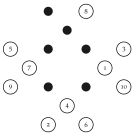
Ten ships go down. Taken literally, though, Dudeney’s rule is broken by his own answer: torpedoes 2 and 7 travel in the same direction along parallel lines, so do 4 and 10, and 1 and 2 run along one line from opposite ends. What his answer does keep is that no two torpedoes follow the same course, the same line in the same direction, and that is enough to rule out his thirteen ships in a row. Under that reading a program that tried every order of firing finds ten to be the most this fleet allows. If every direction must really differ, the same fleet gives only eight.
Answer Ten ships
The Hat Puzzle
Using S for silk and F for felt, move the pairs on pegs 2–3, 7–8, 4–5, 10–11 and 1–2:
| S F S F S F S F S F . . |
| S . . F S F S F S F F S |
| S S F F S F . . S F F S |
| S S F . . F F S S F F S |
| S S F F F F F S S . . S |
| . . F F F F F S S S S S |
Dudeney says there are other ways. There are not, in five moves: a complete search finds that this is the only one. There are forty-one ways in six moves.
Answer Move the pairs from pegs 2, 7, 4, 10 and 1
Boys and Girls
Each line shows the chairs after one move, a dot being an empty chair:
| . . 1 2 3 4 5 6 7 8 |
| 4 3 1 2 . . 5 6 7 8 |
| 4 3 1 2 7 6 5 . . 8 |
| 4 3 1 2 7 . . 5 6 8 |
| 4 . . 2 7 1 3 5 6 8 |
| 4 8 6 2 7 1 3 5 . . |
There are thirteen solutions in five moves, and five is the fewest. Dudeney’s remark that any neighbouring pair except 7–8 may be moved first is exactly right: the first move can be 1–2, 2–3, 3–4, 4–5, 5–6 or 6–7.
Answer Five moves, as shown
Arranging the Jampots
Pots 13 and 19 are already in place, so twenty-two exchanges would certainly do, one pot put right each time. But the others fall into closed groups, each a set of pots that must go round among themselves: the pots on the holes of 1, 2, 3; of 4, 15, 16; of 7, 17, 20; of 10, 11, 12, 24; and the nine on the holes of 5, 6, 8, 9, 14, 18, 21, 22, 23. A group of pots needs exchanges, and no exchange can do better than split a group in two, so the fewest is . In Dudeney’s order: 3–1, 2–3; 15–4, 16–15; 17–7, 20–17; 24–10, 11–24, 12–11; 8–5, 6–8, 21–6, 23–21, 22–23, 14–22, 9–14, 18–9.
Answer Seventeen exchanges