Library · Amusements in Mathematics · Chapter 24
The Paradox Party
Dudeney sets his paradoxes at a Christmas dinner of the Allgood family and a few local friends, ordinary folk rather than mathematicians, who pass an evening capping one another’s posers. Most are catches rather than puzzles, and several turn on words. They are worth a short tour, because each hides a small piece of honest reasoning, and the last of them is a proper puzzle.
Mr Allgood opens with a square house whose windows all face south. The house stands at the North Pole, where every direction is south. His wife then reports her hairdresser’s claim that, since there are more people in the world than hairs on any one head, two people at least must have exactly the same number of hairs. Mr Filkins explains it with a world of a million people, none with a million hairs or more: there are fewer possible numbers of hairs than people, so some number must be shared. This is the pigeonhole principle, and with the real population it forces a great many repetitions.
George, the son, observes that of a thousand soldiers drawn up on a plane, only one can stand upright, since a plane touches the round earth at a single point; and that a perfectly flat billiard table would send the balls rolling to its middle. His point is that a level surface is curved like the earth, and a true geometrical plane is not level. Young Willie asks for an island between England and France that is farther from France than England is. He names Guernsey, about twenty-six miles from France, while England, he says, is only twenty-one miles from France between Dover and Calais.
George then attacks the axiom that equals multiplied by equals give equals. A glass half full equals a glass half empty, so twice the one should equal twice the other, and a full glass should equal an empty one. And one mile square is one square mile, yet two miles square is four square miles, not two. The trouble lies in the words, not the axiom. “Half empty” describes the glass, not a quantity of water; doubling the water in a half-full glass fills it, but there is no quantity in “half empty” to double. “Two miles square” names a square whose side is doubled, so its area is multiplied by four.
His cousin Reginald asks by what fraction four-fourths exceed three-fourths. Everybody says one-fourth, but measured as a part of three-fourths, the excess is one-third, since three of anything increased by a third of itself make four. Mr Allgood asks for “twelve thousand twelve hundred and twelve pounds” in figures, which is £13,212. Mr Smoothly, the curate, asks what happens if a steel girdle fitting the earth’s equator is lengthened by six yards and held at the same height all round. Everyone expects a tiny fraction of an inch; the answer is very nearly a yard. The circumference of a circle is times its radius, so six extra yards of girdle raise it by yards, about 34.4 inches, whether the girdle goes round the earth or round an orange.
George’s telegraph posts are to cross a hill by a road five miles long, or run beside a level railway cutting only four and a half miles long, a hundred yards apart either way. Mr Filkins works out the posts saved by the cutting, and George says none are saved. The posts stand upright, so the hundred yards between them is measured level, from post to post, and not along the slope of the ground; the hill road, seen from above, covers the same four and a half miles as the cutting. As George puts it, he is no nearer his mother standing on a chair than standing on the carpet beneath it.
Mildred’s asparagus bundles measured twelve inches round, and the greengrocer sold her two of six inches round as more than the same. A bundle’s content goes with its cross-section, which varies as the square of its girth: each small bundle holds a quarter of a large one, and the two together only half. The old tale is of a sack of corn that Sempronius borrowed from Caius.
The rest are catches. A coin dated 51 B.C. cannot be genuine, since nobody before Christ counted the years back from his birth; and a coin marked “George I” would not have been struck in that king’s lifetime, since he was not the first of anything until there was a second. A father and son of the same name, killed in the same battle, cannot strictly be buried as “Senior” and “Junior” if the father died first, for the son was then no longer junior. A dying infant of three months who “said absolutely nothing” said what any infant says. And the man who never buys, borrows, begs, steals or finds his breakfast eggs keeps ducks, not hens, and his servant collects them. Then Uncle John closes the evening with a fallacy on the chessboard.
No. 413. A Chessboard Fallacy
Uncle John draws a straight line on a chessboard from the top edge, where the first and second squares meet, to the bottom right-hand corner, and cuts along it. He slides the piece B up along the cut, clips off the little corner C along the first upright line, and fits it into the gap at the top. The pieces fit, and they make an oblong seven squares by nine: sixty-three squares where there were sixty-four. Reginald suspects the pieces do not really fit, but they do. Where has the lost square gone?
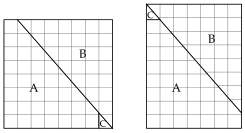
A Chessboard Fallacy
The mistake is to suppose that the little triangle C is exactly one square high. Take the squares to be an inch across. The cut falls 8 inches while it runs 7 inches across, so over the last inch, the width of C, it falls of an inch: C is inches high. Sliding B one column along the cut lifts it by the same inches. The oblong is therefore 7 inches by inches, and its area is square inches, the same as before. No square is lost.
The pieces do fit exactly, as Uncle John says. What gives the illusion is the ruling: the lines on B, raised by , lie a seventh of an inch above the lines on A, so the rows no longer run straight across the oblong, and a strip of the height is hidden in the mismatch.
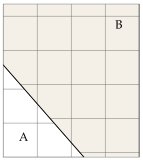
A check with exact fractions puts the three pieces, with areas , 28 and , inside the oblong 7 by , and they add up to 64.
Answer The oblong is really 7 by , still 64 squares; the lines on B are a seventh out