Library · Amusements in Mathematics · Chapter 8
Various Dissection Puzzles
On this page
- No. 146. An Easy Dissection Puzzle
- No. 147. An Easy Square Puzzle
- No. 148. The Bun Puzzle
- No. 149. The Chocolate Squares
- No. 150. Dissecting a Mitre
- No. 151. The Joiner’s Problem
- No. 152. Another Joiner’s Problem
- No. 153. A Cutting-Out Puzzle
- No. 154. Mrs Hobson’s Hearthrug
- No. 155. The Pentagon and Square
- No. 156. The Dissected Triangle
- No. 157. The Table-Top and Stools
- No. 158. The Great Monad
- No. 159. The Square of Veneer
- No. 160. The Two Horseshoes
- No. 161. The Betsy Ross Puzzle
- No. 162. The Cardboard Chain
- No. 163. The Paper Box
- No. 164. The Potato Puzzle
- No. 165. The Seven Pigs
- No. 166. The Landowner’s Fences
- No. 167. The Wizard’s Cats
- No. 168. The Christmas Pudding
- No. 169. A Tangram Paradox
After the Greek cross Dudeney gives a mixed bag of cutting-out puzzles, some very easy and some hard. The rules are the ones he laid down before: cuts must be exact, the fewest pieces is the aim, and pieces may be turned over unless the puzzle says otherwise.
Two tools do most of the work. The first is counting area, which fixes the size of the square or cross to be made and often shows that a piece must be cut. The second is Pythagoras’s theorem, which turns an area into a length that can be drawn with ruler and compasses. Every dissection below has been checked by a program that cuts the pieces exactly and then, without being told where they go, fits them into the target shape.
No. 146. An Easy Dissection Puzzle
Cut out of paper a square with half of another equal square, cut along its diagonal, attached to one side. Cut the figure into four pieces all of precisely the same size and shape.
No. 147. An Easy Square Puzzle
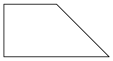
Cut a piece of card twice as long as it is broad in half along a diagonal, and you have two triangles like the one shown. Make a square from five such triangles, all the same size. One of them may be cut in two; the others must be used whole.

No. 148. The Bun Puzzle
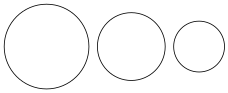
Three buns of these sizes are to be shared equally among four boys. The buns are of the same thickness all through and as thick as each other, and they are to be cut into as few pieces as possible. As a hint: five pieces are enough, so one boy gets his share in two pieces and the other three in one piece each.
No. 149. The Chocolate Squares
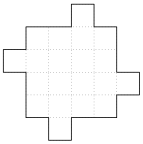
A slab of chocolate is scored into twenty squares as shown. Copy it on paper and cut it into nine pieces that will make four perfect squares, all of exactly the same size.
No. 150. Dissecting a Mitre
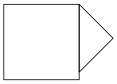
The mitre that is puzzling the carpenter is a square with a quarter taken out: the triangle on its top side whose point is the centre of the square. Cut it into five pieces that will make a perfect square. A four-piece answer using the “step” method has been published in America, but it is a fallacy.

No. 151. The Joiner’s Problem
The joiner wants to cut this board into as few pieces as possible to make a square table-top, with no waste. It is a square with a triangle on top whose point stands over the middle; the triangle is a quarter of the square. How should he go to work, and how many pieces are needed?

No. 152. Another Joiner’s Problem
A joiner has two boards, a square and half of a smaller square cut along its diagonal. He wants to cut them into as few pieces as possible that will fit together, without waste, into a square table-top. The exact sizes do not matter, so long as the half-square is not the larger in area.
No. 153. A Cutting-Out Puzzle
A strip of paper five inches by one can be cut into five pieces that make a square: cut off four halves of unit squares along their diagonals and the last square whole, and arrange them. Do it in only four pieces.
No. 154. Mrs Hobson’s Hearthrug
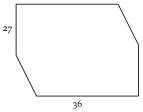
Mrs Hobson’s boy burnt two corners of her hearthrug, and the damaged corners have been cut away. The rug was 36 by 27, and each piece cut off was a right-angled triangle measuring 12 and 6 along the edges. Cut the rug into the fewest possible pieces that will make a perfectly square rug.
No. 155. The Pentagon and Square
To draw a regular pentagon: describe a circle and draw two diameters at right angles, HB across and DG up and down, meeting at the centre C. Find A, midway between C and B. With the compasses at A and radius AD, cut HB at E; with the compasses at D and radius DE, cut the circle at F. DF is a side of the pentagon. Having drawn it, cut the pentagon into the fewest possible pieces that will fit together to make a perfect square.

No. 156. The Dissected Triangle
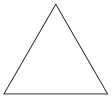
Cut an equilateral triangle into five pieces that will fit together to make either two or three smaller equilateral triangles, using all the material each time. The same five pieces must also go back together as the original triangle.
No. 157. The Table-Top and Stools
A thrifty schoolmaster had his carpenter cut a round table-top into eight pieces and join them into the seats of two oval stools, each with a hand-hole in the middle. A clever pupil suggested that the holes were so big a small boy might fall through, and proposed another way. Cut the round table-top into eight pieces that make two oval seats of exactly the same size and shape, each with a similar hand-hole, smaller than the schoolmaster’s. All the wood must be used.
No. 158. The Great Monad
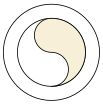
The Great Monad, the ancient Chinese symbol of the Yin and the Yan, is a circle divided by an S made of two half-circles, drawn here inside a ring. Three questions. (I) Which has the greater area, the inner circle holding the Yin and the Yan, or the outer ring? (II) Divide the Yin and the Yan into four pieces of the same size and shape with one cut. (III) Divide them into four pieces of the same size but different shapes with one straight cut.
No. 159. The Square of Veneer
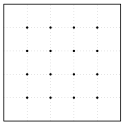
A piece of veneer 5 inches square is marked into twenty-five square inches, and at each of the sixteen points where the lines cross inside it a small nail has been driven. Cut it into the fewest possible pieces that make two squares of different sizes, of known dimensions, without the fret-saw touching any of the nails. The exact sizes of the two squares must be given.
No. 160. The Two Horseshoes
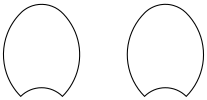
Dudeney suspected some lost mathematical mystery in the shape of a horseshoe, and found that a pair of them is related in a striking way to the circle. Cut out the two shoes round their outlines, counting the hoof inside each outline as part of its area, and cut them into four pieces, each shoe into two, all four different in shape, that fit together to form a perfect circle. His own drawing was freehand; the two shoes below are drawn exactly. They are the same shape, each symmetrical, and each is bounded by four arcs: its two long sides are arcs of equal circles, and its toe and the notch at its heel are arcs of circles half as large.
No. 161. The Betsy Ross Puzzle
An old puzzle, said to have been shown by Betsy Ross of Philadelphia to George Washington: fold a round piece of paper so that one cut of the scissors produces a perfect five-pointed star.
No. 162. The Cardboard Chain
Can you cut a chain like the one in the picture out of a single piece of cardboard, with no join anywhere? Every link is solid, never split and joined again.
No. 163. The Paper Box
Not strictly a puzzle, but an ingenious way to make a paper box. Take a square of stout paper and, by successive foldings, crease it along lines running at forty-five degrees to its sides. Cut away eight small triangles at the edges and cut along a few short lines, and the square folds up into a box. With a round hole cut in one face, the box blows beautiful vortex rings: fill it with tobacco smoke through the hole, hold it level and tap the opposite face. Such rings, which Helmholtz discussed in 1858, form even without smoke, and a well-aimed one will cross a room and put out a candle.
No. 164. The Potato Puzzle
Lay a round slice of potato on the table. Into how many pieces can you divide it with six straight cuts of a knife, without moving or piling the pieces between cuts? The drawing shows sixteen, which can easily be beaten. What is the greatest number?
No. 165. The Seven Pigs
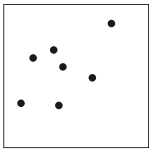
A square pen holds seven pigs, placed as shown. Put up three straight fences across the pen so that every pig is in a sty of its own. The pigs stand still for the purpose, and no fence may pass through a pig.
No. 166. The Landowner’s Fences
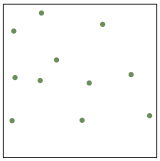
A landowner has eleven trees in one of his fields and wants to divide it with straight fences into exactly eleven enclosures, each with a tree for shelter. Fences may cross one another. What is the fewest number of fences that will do it, and how?
No. 167. The Wizard’s Cats
A wizard has hypnotised ten cats inside a magic circle so that they stay where they are. Draw three more circles inside the large one so that every cat has an enclosure of its own and no cat can reach another without crossing a line.
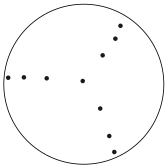
No. 168. The Christmas Pudding
Cut this pudding into two parts of exactly the same size and shape without touching any of the plums. The pudding is to be treated as a flat disc, not a ball. It is not easy unless you know the principle on which such puddings are made.
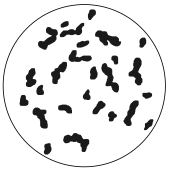
No. 169. A Tangram Paradox
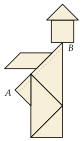
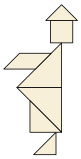
The seven Tangram pieces come from a square: mark the midpoints of two adjoining sides and the cuts follow. Here are two figures, each made from all seven pieces. The head, hat and arm are exactly alike, and so is the width at the foot of the body, yet one figure has a foot and the other has none. Where does the second figure find its foot?

An Easy Dissection Puzzle
The figure has area 6 if the square has side 2, so each piece has area . Dudeney’s hint is to divide it into twelve equal right-angled triangles of area : draw both diagonals and both midlines of the square, and the three midlines of the attached half-square. Each piece is then three of these triangles.
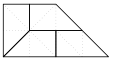
Each piece is a right-angled trapezium with parallel sides 1 and 2 and height 1: a unit square with half of another attached. The four are copies of the whole figure at half the size, which is why the puzzle works. A search of every way to split the twelve triangles into four connected pieces of the same shape finds exactly one, this one.
Answer Four right-angled trapeziums, each a half-size copy of the figure
An Easy Square Puzzle
With a triangle of legs 1 and 2, each has area 1, so the square has area 5 and side , the long side of a triangle. That is the crux: put four triangles round the edge of the square, each with its long side along one side of the square, turned like the sails of a windmill. Their right angles leave a square hole in the middle of side .

The fifth triangle, of area 1, must fill the unit hole. Cut it across the middle of its longer leg, at right angles to that leg, and turn the small triangle round: the two pieces make a unit square. Some piece must be cut, because a program that tries every way of fitting pieces into the square finds no arrangement of the five whole triangles.
Answer Four whole triangles round the edge; the fifth cut in two fills the middle
The Bun Puzzle
The diameters are in the proportion 3, 4 and 5, and that is the secret: a triangle with those sides is right-angled, so by Pythagoras the squares on its sides satisfy , and so do any similar figures drawn on them: the semicircles B and C in the figure together equal A, and the circles, whose areas go as the squares of their diameters, likewise. The two small buns together equal the large one.
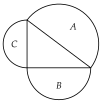
In units where the buns have areas 9, 16 and 25, the whole is 50 and each boy’s share is . Cut the large bun in half, D and E: two boys are served. From the middle bun cut a round piece F with the same centre and half the area of the large bun, ; its diameter is the large bun’s diameter divided by , the side of the square inscribed in the large bun. F serves the third boy. The ring G left over has area , and with the small bun H, area 9, it serves the fourth.
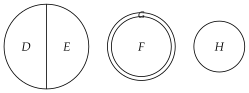
Five pieces is the fewest possible. The large bun and the middle bun are each bigger than a share, so each must be cut into at least two pieces, and the small bun is at least one.
Answer Five pieces: the large bun halved, a disc of half its area cut from the middle bun, the ring with the small bun
The Chocolate Squares
The slab has twenty squares, so each of the four squares has area 5 and side : a square tilted so that its sides run two squares along and one across. Put one such square A in the middle, with its corners at the middles of squares of the slab, and extend its four sides right across the slab.
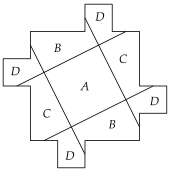
The four lines cut the slab into nine pieces, like a noughts-and-crosses board. A is one square. The two pieces marked B lie on opposite sides of A, and fitted together they make a second square; the two C pieces make a third. The four corner pieces D, each including one of the projecting squares, make the fourth. Each group has area 5, and the fitting program assembles each into a square.
Answer Nine pieces: A, two B, two C and four D, as in the figure
Dissecting a Mitre
With the square of side 2, the mitre has area 3, so the new square has side , and the difficulty is to find the two points C and F. Dudeney’s construction: extend the base BD to A with AB half of BD, raise AE parallel to BH, and swing the arc from B through H to meet it at E. Then , so AE is , and C is placed on the base with BC equal to AE. F lies on the line across the mitre at the height of the notch, with FG equal to BC less AB, that is .
Cut off the two triangles 1 and 2 above that line, cut from its left end down to C, and cut down from F to meet that cut.
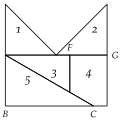

The five pieces make the square of side , as the fitting program confirms.
Dudeney’s objection to the four-piece “step” answer is right, and his arithmetic checks. With the long sides 84 inches, packing the two horns into the notch leaves an 84 by 63 rectangle, area 5292. Steps inches high and 12 wide turn it into 72 by , still a rectangle. The step method needs the sides in a special ratio: with the short side it would work, since . Whether a four-piece dissection exists at all Dudeney left open, saying he did not believe one possible; nothing here settles it.
Answer Five pieces, with BC and FG when the side is 2
The Joiner’s Problem
Let the square BCDF have side 2. The triangle BEF, a quarter of it, has area 1 and its point E is 1 above the middle of BF, so the board has area 5 and the table-top must have side . Find A, the middle of BC, and cut from A to D and from A to E: three pieces.
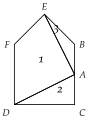

The crux is that the two cuts are exactly right for a corner of the square. Each is long, since and , and they meet at A at a right angle, because AD goes 2 across for every 1 down and AE goes 1 across for every 2 up. So A becomes one corner of the table, AD and AE two of its sides, and pieces 2 and 3 swing round to fill the rest, as the right-hand figure shows. No piece is turned over.
Dudeney says three is the fewest, and the solution here meets it. A proof that two pieces could never do cannot come from a search, since a single cut could wander anywhere, and none is given.
Answer Three pieces: cut from the middle of BC to D and to E
Another Joiner’s Problem
Let the square ACLF have side , and put the half-square CED against its side, with its long side CD, of length , along CL. Mark B on AC with AB half of CD, and make two cuts right through both boards, from B to F and from B to E.
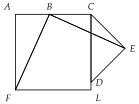

The same idea as in the last puzzle does all the work. BF and BE are both long, since BF runs down and across, and BE runs across and down; and for the same reason they are at right angles. The area to be made is , the square plus the half-square, so B is a corner of the new square and BF and BE two of its sides. The two cuts and the join between the boards make five pieces: the triangle cut off at A, the corner of the square at C above BE, the two parts of the half-square, and the rest. The small pieces move round to complete the square BEKF, none of them turned over.
The fitting program confirms it for half-squares of many sizes relative to the square, up to nearly the same area, which is Dudeney’s point that the proportions do not matter.
He adds that when the two areas are equal, cutting the square along its diagonal gives three pieces, and that when the half-square is the larger, six are needed; those two remarks are his and are not checked here.
Answer Five pieces: cut from B, with AB half of CD, to F and to E
A Cutting-Out Puzzle
The square has area 5, so its side is , the mean proportional between the strip’s length 5 and breadth 1. Cut off the end of the strip long: it will lie along the bottom of the square as the band 4, one unit high. The rest of the strip, long and 1 high, must become the top of the square, wide and high.
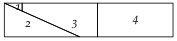

That is a slide. Cut the remaining piece from its top left corner to the point along its bottom edge, and slide the upper piece 3 down along the cut until it is wide. It then sticks out on the left by a small triangle and leaves a gap of exactly the same triangle at the bottom right, so cut that triangle, piece 1, off beforehand and put it in the gap. Four pieces.
Dudeney states the general rule: a strip more than and not more than times as long as it is broad can be cut into pieces to make a square, of them plain rectangles. The same construction proves it: cut off bands of length , and the rest, between and long, slides in three pieces into the last band. The program builds it for strips 5, 10 and 24 long, in 4, 5 and 6 pieces.
Answer Four pieces: a band cut off, and the rest slid along a diagonal
Mrs Hobson’s Hearthrug
The whole rug was , and the two triangles cut off make an oblong together, 72. So the square rug has area 900 and side 30. The top edge of the rug, from its left end to the cut corner, is 30 long, and so is the bottom edge from the other cut corner to its right end: both can stay as edges of the square, one top and one bottom. The rug is 27 high, so the part with the bottom edge has to move 3 down, and 6 to the left to bring its right edge in line with the square.
Two pieces do it, if the cut between them repeats every 6 across and 3 up, for then moving one piece by one step of the pattern, 6 left and 3 down, fits it back against the other. The cut is a staircase of teeth: each tooth runs 6 across and 12 down, parallel to the cut corners, and then rises 15 straight up.
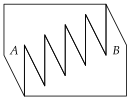
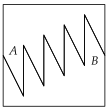
Placed so that one rise runs up the line 30 from the left edge to the top corner, the staircase cuts the rug into A and B; move B one tooth down and they make the 30 by 30 square. A search of every placing of such a staircase finds that this is the only one that works.
Dudeney mentions easy answers in four and three pieces; two is the fewest possible, since the rug is not itself a square.
Answer Two pieces, cut by a staircase and slid one tooth
The Pentagon and Square
First the drawing.
With the circle of radius 1, A is from the centre, AD is , and E lies beyond the centre, so . That is exactly the square of the side of the regular pentagon in the circle, , so the construction is exact.
Now the dissection, which Dudeney does in six pieces, improving, he says, on a seven-piece answer by Paul Busschop. Take the pentagon ABCDE with side 1 and the diagonal AC level. Cut off the top triangle ABC along AC, and cut it again from F, the middle of AC, to M on AB with AM equal to AF. The two pieces, turned without being turned over, fit against the side AE of the trapezium left below and make a parallelogram GHDC of the same height.
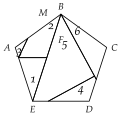

A parallelogram becomes a square by the standard two cuts. The square’s side is the mean proportional between the base HD and the height of the parallelogram; mark it off from C to K on the base line, cut along CK, and cut from G at right angles to CK as far as CK. The pieces of the parallelogram then slide into the square. Traced back into the pentagon these cuts give six pieces in all, which the fitting program assembles into both the pentagon and the square without turning any over. Of the two ways the first three pieces can make the parallelogram, only this one gives six; the other gives seven.
The square’s side is times the pentagon’s side, an irrational number, as Dudeney says, so the cuts must be found geometrically. He mentions a correspondent’s five-piece answer resting on the idea that half the diagonal plus half the side equals the side of the square. That sum is , short of by a fifth of one per cent: close enough to fool the eye, and wrong.
Answer Six pieces: triangle ABC cut into three, the trapezium into three
The Dissected Triangle
Measure the triangle in triangles of side 1: one of side 5 holds 25, and the smaller triangles must use the same 25. The crux is to find two ways of writing 25 as a sum of squares that share a part: and . The 9 is a triangle of side 3, which a cut parallel to the base takes off the top whole, piece 1. From the ends of that cut drop two perpendiculars to the base, cutting off the small triangles 2 and 3, and cut the rectangle between them along a diagonal into 4 and 5.
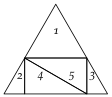


Pieces 2 and 3 are each half of an equilateral triangle of side 2, cut down its middle, and together they make one. Pieces 4 and 5 are each half of an equilateral triangle of side , whose area is 12 small triangles, and together they make that. With piece 1 that is three triangles; and 2, 3, 4 and 5 also fit together as one triangle of side 4, which with piece 1 makes two.
Dudeney turns piece 5 over in the two-triangle and three-triangle forms, and he could not have done otherwise. Pieces 4 and 5 are the same right-angled triangle turned half round, not mirror images, while the two halves of an equilateral triangle cut down its middle are mirror images; and the fitting program finds no way to make either form without turning a piece over.
Answer Cut off the top triangle of side 3, then two half-triangles and a rectangle cut diagonally
The Table-Top and Stools
Dudeney’s point is that “oval” need not mean ellipse, and his stools are the pointed oval that architects call the vesica piscis:
the lens where two equal circles overlap. The crux is to use arcs of the table’s own radius everywhere. Take the table’s radius as 1. In the middle mark a curved square whose corners are at the points , each side an arc of radius 1 bulging outwards, and quarter it along its diagonals: pieces 5, 6, 7 and 8. From its four corners cut straight up and down to the rim, giving the side pieces 1 and 2 and the top and bottom pieces 3 and 4.
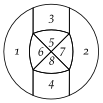
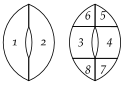
Pieces 1 and 2 join along their straight edges to make one stool: its outline is two arcs of the table’s circle and its hole is two of the curved square’s arcs, a smaller vesica. For the second stool, turn 3 and 4 through a right angle and close them together, so their rims make the sides and their inner arcs the hole, and put the quarters at the two ends.
The quarters fit only if the ends of the stool are the same shape as a quarter: two straight edges at a right angle, as long as half the diagonal of the curved square, and an arc of radius 1. That fixes . The end of the stool has straight edges long, and they must equal , so . With that value the program finds the two stools identical, and with any other, for instance , they are not. Each hand-hole is table-radii long and only wide. As Dudeney remarks, 5 and 6 never part company and could be one piece, and so could 7 and 8, making six pieces in all; he kept eight to match the story.
Answer Arcs of the table’s radius throughout, with the inner corners at
The Great Monad
(I) They are equal. In the old drawings the outer circle passes through the corners of the square round the inner circle, so its diameter is that square’s diagonal CD. A square has half the area of the square on its diagonal, and circles go as the squares of their diameters, so the outer circle has twice the area of the inner one, and the ring left over equals the inner circle.
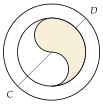


(II) Cut along a second S, the first turned through a right angle. The circle falls into four pieces, each a quarter turn of the next, so all four are the same size and shape.
(III) Cut straight through the centre at to the line through the centres of the two small half-circles. Each of the Yin and the Yan falls into two pieces, of different shapes, and Dudeney shows they have the same area. The circle drawn on half the diameter, K in his figure, has a quarter of the area of the whole, and so does each piece of the second question; comparing them, what one piece of the straight cut loses on one side of the S it gains on the other. The program confirms the halves are equal to within rounding, and a search through every whole number of degrees finds that is the only direction that halves the Yin.
Answer (I) Equal; (II) a second S at right angles; (III) a straight cut at
The Square of Veneer
The nails sit at the whole-inch points, so the trick is to cut along a grid that never meets them. Rule the square into small squares, each of an inch: a line of that grid lies at a multiple of , which is a whole number of inches only at the edges. Every cut along it misses every nail.
Now , so the square can become squares of 12 and 5 small units. Cut out a square A whole from one corner, and cut the rest into three pieces B, C and D along the grid, as shown, which fit together as a square.
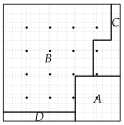
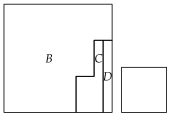
The two squares measure and inches, and indeed . The program checks that the four pieces fill the veneer, that B, C and D make the larger square, and that no cut passes through a nail. Dudeney’s general formula for splitting a square of side into two, and , gives these sizes with , and .
Answer Four pieces: squares of and inches
The Two Horseshoes
The key is the Great Monad of No. 158.
Take a circle of radius 2 and divide it into the Yin and the Yan by the usual S, two semicircles of radius 1 whose centres and lie on a diameter, one unit either side of the centre . Each shoe is one half of the Monad, cut in two and reassembled. In the circle below, the Yin is and together, and the Yan is and .
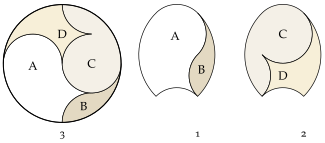
The piece is cut from the Yin by a circle of radius 1 that touches the circle about and runs out to the rim. Give a quarter turn about the point one unit below , and the arc along which it was cut falls exactly on the arc of the circle about that bounds . The two fit into shoe 1, the long side of the shoe being part of the rim of the circle and the notch at the heel the arc that left behind.
The second shoe must be the same shape, and its pieces different from and . Dudeney’s device is the curvilinear square: the region round the point one unit above that lies outside four circles of radius 1, centred on , and the two points two units above them. Neighbouring circles touch, so the square has four concave sides and a quarter turn about its centre carries it on to itself. is the Yan’s copy of with this square added, and is what remains of the Yan. A quarter turn of about the centre of the square moves the -like part exactly as moved, and leaves the square where it was, so shoe 2 comes out the same shape as shoe 1, turned half round. The four pieces all differ: their areas are , , and 2, the square itself being , and each shoe has area , half the circle.
Dudeney gave the principle and the drawing but no construction, and his drawing is too rough to measure. The construction above is the one his words force. The curvilinear square must have and among its four centres for the quarter turn to carry the Monad’s circles into each other, which fixes it; and the cut for must touch the circle about , as it does in his drawing. A program built the pieces as exact shapes and confirmed each claim. The four pieces tile the circle, each shoe is two pieces meeting without overlap, and the two shoes are the same symmetrical shape, bounded by exactly the four arcs described in the puzzle. It also shows why must run out to the rim: cutting off only the lens inside the circle would leave in two parts.
Answer Cut each shoe as shown: and , and ; the four make the Monad’s circle
The Betsy Ross Puzzle
Fold the circle in half along a diameter, and fold the half into five equal sectors of , like a fan. The paper now lies in ten layers, all in one narrow wedge. Cut straight across the wedge, from a point A on one edge to a point on the other edge nearer the centre.


Unfolding reflects the cut in every fold line. The folds lie along the five lines of symmetry of a regular pentagon, whose ten symmetries turn the one cut into ten, joined end to end into a closed star: five points where A was, apart, and five notches between. The nearer to the centre the cut reaches on the second edge, the longer the points. For the regular star, the outline of a pentagram, the notch must be of the way out, which is with the golden ratio.
Answer Fold in half, then into five sectors; one straight cut across the wedge
The Cardboard Chain
This is a craft puzzle, and the secret is to cut partly through the card from each side. Take a card 8 inches by . Rule lines BB and CC half an inch from the long edges, and short cross lines half an inch apart between them, the same on both sides of the card, pricking through with a needle so that they match.
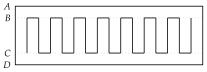
Split the card edgeways, through its thickness, from the edge AA down to BB and from DD up to CC. Cut right through along all the short cross lines, and half through along the stretches of BB and CC shown solid; then turn the card over and cut half through along the other stretches, those that lie under the dotted parts. With a little care the card now separates into two ladders that interlace, and cutting away the waste leaves the chain in one piece, every link solid. There is nothing to calculate; the method is Dudeney’s, and cutting two keys on a ring the same way is a good variation.
Answer Split the card edgeways from both edges and cut half through from each side
The Paper Box
There is nothing to solve here, and Dudeney printed no answer. His diagram of creases and cuts is not reproduced; the description above, with a square of paper, some patience and his second drawing of the box half folded, is how he left it.
Answer A folding recipe, not a puzzle
The Potato Puzzle
Twenty-two. Think about what one more cut does. If a new cut crosses earlier cuts inside the slice, at different points, those points divide it into stretches, and each stretch splits one piece into two. So the new cut adds pieces, and to add as many as possible it must cross every earlier cut, at a point where no other cut passes. With cuts that gives pieces: 2, 4, 7, 11, 16 and 22 for up to six cuts. Six cuts all touching a small circle in the middle, at equal angles, do it: no two are parallel, no three meet at a point, and all the crossings fall inside the slice.

Loyd’s cheese is the same argument one dimension up. A new plane cut meets the earlier planes in lines, which divide it into at most regions, and each adds a piece; adding these up gives Dudeney’s formula , which the program confirms up to ten cuts.
Answer 22 pieces; in general
The Seven Pigs
Three straight lines divide a square into at most seven parts, by the rule of the last puzzle, so with seven pigs every part must hold exactly one: the fences must cross each other inside the pen, no two parallel and not all through one point. Within that the answer is found by trial, and Dudeney’s fences are these.
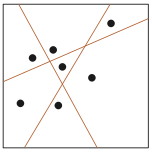
The program cuts the pen along his three fences, finds seven sties with one pig in each, and checks that every fence passes clear of every pig.
Answer Three fences crossing inside the pen, as shown
The Landowner’s Fences
Four fences are needed, and the reason is the count from the potato puzzle: straight lines divide a field into at most parts, so three fences give at most 7 enclosures, too few for eleven trees, and four give at most 11. Eleven is then exactly the most four can make, so every two fences must cross inside the field, no three at one point, and every enclosure must hold one tree. Dudeney’s four fences do it.
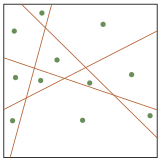
The program cuts the field along his fences, as measured from his diagram, and finds eleven enclosures with one tree in each and every fence clear of the trees.
Answer Four fences, each crossing the other three inside the field
The Wizard’s Cats
Three circles that overlap in the usual way, like a diagram of three sets, divide the plane into eight parts:
seven inside the circles and one outside them all. That is two short of ten. The extra two come from the magic circle itself: make each of the three circles touch it. The space inside the magic circle but outside the three is then pinched off at the three touching points into three separate parts, giving enclosures, and the cats sit one in each.
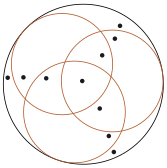
In Dudeney’s drawing the three circles come within a hair’s breadth of the magic circle, and drawn to touch it they give ten enclosures with one cat in each, none on a line.
Answer Three overlapping circles, each touching the magic circle
The Christmas Pudding
The principle is symmetry about the centre. Any cut from edge to edge that looks the same after a half turn about the centre divides the disc into two parts, each of which is the other turned half round: the same size and shape. So the cut must pass through the centre, and each stretch on one side must be matched by the same stretch turned half round on the other. That leaves the job of threading such a cut between the plums.
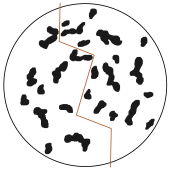
Dudeney’s cut runs from the edge down to A, across to B, through the centre C, on to D, across to E and down to the edge, and the stretch from E outwards is the half-turn of the stretch from A outwards. The program checks that it gives two halves, each the other turned half round, and that with A and B placed to within the accuracy of his drawing it misses every plum.
As he says, the stretches beyond the plums can be varied endlessly, straight or crooked, provided each is matched by its half-turn.
Answer A cut through the centre, the same after a half turn, threaded between the plums
A Tangram Paradox
The foot is not created from nothing: it is paid for by a thin strip along the side of the first figure’s body, too thin for the eye. Counting areas shows it. Take the square of the Tangram as 4 on a side: the two large triangles have area 4 each, the medium one 2, the two small ones 1 each, and the square and the parallelogram 2 each, 16 in all. In both figures the head is the square, the hat a small triangle and the arm the parallelogram, 5 of the 16. That leaves 11 for the body and the foot.
In the first figure the body uses the other four pieces, both large triangles, the medium one and the other small one, and has area 11. In the second the body uses only the two large triangles and the medium one, area 10, and the small triangle becomes the foot. Both bodies are 2 wide at the bottom, but the first is 6 tall and the second only . The dotted line AB in the first figure is the outline of the second body laid over it: the first body is larger by the thin strip between AB and its own edge, a strip of area exactly 1, the area of the foot. Spread along the whole side it is too thin for the eye to notice.
Answer The foot is the strip along the side of the first body, rearranged