Library · Amusements in Mathematics · Chapter 7
Greek Cross Puzzles
Dudeney begins the geometry of the book with dissections: cut one figure into pieces that fit together to make another. Three rules govern them, and he states all three. The cuts must be exact, since a dissection that nearly works does not work at all. The fewest pieces is the aim, and a solution that leaves pieces “hanging by a thread” has not really saved one. And pieces may be turned over unless the puzzle forbids it, though a puzzle is often better for forbidding it.
He opens with the Greek cross, five equal squares arranged as a plus sign, and a long essay on its transformations. The key fact is Pythagoras’s theorem. Cut off the lower arm of a cross whose squares have side 1 and set it beside an upper arm: the cross becomes two unit squares and a right-angled triangle, and its area, 5, is the square on a line of length , the distance from the middle of one arm’s side to the middle of the opposite arm’s side. So a cross of area 5 becomes a square of side , and two cuts through the centre, each joining the midpoints of opposite arm sides, divide it into four equal pieces that make that square.
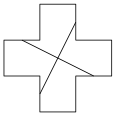
Four puzzles follow the essay.
No. 142. The Silk Patchwork
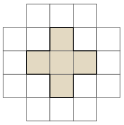
The Wilkinson ladies have made a patchwork quilt of equal square patches, five rows of five with the four corner patches missing. In the middle is a Greek cross of five patches. Unpick the cross and cut along the seams, and the rest falls into four pieces of the same size and shape that make a square. George Wilkinson asks the opposite: cut along the seams to leave a square whole, and four pieces of the same size and shape that make a perfect Greek cross.
No. 143. Two Crosses from One
Cut a Greek cross into five pieces that will make two Greek crosses, both of the same size.
No. 144. The Cross and the Triangle
Cut a Greek cross into six pieces that will fit together to form an equilateral triangle. Dudeney calls it a hard problem, and practically impossible without knowing his method of turning an equilateral triangle into a square, No. 26 of The Canterbury Puzzles.
No. 145. The Folded Cross
Cut a Greek cross out of paper and fold it so that a single straight cut of the scissors produces four pieces that will fit together to make a square.
The Silk Patchwork
Count patches first.
The quilt has 21. A Greek cross cut along the seams has five equal square arms, so its area is five times a square number of patches: 5 or 20. Four equal pieces making 5 patches would each be a patch and a quarter, so the cross has 20 patches, arms two patches wide, and the square left whole is a single patch.
Dudeney keeps the centre patch, F, as the square. Each of the four pieces is then a two-by-two block with one patch more, the shape sometimes called the P pentomino, and they lie round F like the sails of a windmill. In the cross each block becomes an arm and the extra patches meet to fill the middle.
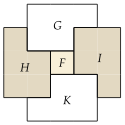
This is not the only way. A search of every cutting along the seams finds 38 that leave one patch whole and four equal pieces making the cross. The whole patch may be the centre or any of the eight edge patches next to a missing corner. With the centre kept there are six cuttings, and four of them use P-shaped pieces, Dudeney’s windmill and its mirror image among them. Dudeney called the puzzle “quite easy”, and did not claim a unique answer.
Answer Keep the centre patch; cut the rest into four P-shaped pieces
Two Crosses from One
Each new cross has half the area of the old, so its squares have side when the old ones have side 1.
The crux is to cut one of them out whole, tilted, and let the rest make the other. Turn the small cross through the angle whose tangent is about the centre of the large one. Then the corners of the small cross land at points with simple coordinates, because and . For instance the corner at the tip of the upper arm lands at , the middle of the side of the large cross’s upper arm. Each arm of the small cross touches the large cross at one such point, and the large cross minus the small one, A, falls into four pieces.
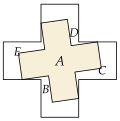
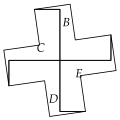
Each of the four pieces, B, C, D and E, has area and a right-angled corner between two edges of length 1, taken from the end of an arm of the large cross. Bring those four corners together at one point, and the four pieces make a cross exactly equal to A, as the right-hand figure shows; no piece is turned over. A program checks it with exact fractions.
Dudeney adds a harder question: three equal crosses from one, in the fewest pieces. He says it can be done in thirteen and withheld his solution for his readers, so it is not treated here.
Answer Cut out one cross whole, turned through ; the four pieces left make the other
The Cross and the Triangle
The idea behind the cut is to lay two tilings over each other: crosses tile the plane, and so do the six pieces of the triangle, and the cuts are where the edges of the two tilings agree. The construction below hides that idea, and the paragraph after it brings it out. Take the squares of the cross to have side 1, so the cross has area 5, and the triangle of the same area has side with , about 3.398. Dudeney’s construction runs as follows.
Join A and B, the midpoints of the lower side of the left arm and the upper side of the right arm. AB has length , the side of the square equal to the cross.
From C, the lower corner of the right arm, draw CD to meet AB, of length ; from E, the lower left corner of the foot, draw EF to meet CD, also of length .
From E and F draw arcs of that same radius to meet at G below the cross, and let FG cross the edge of the right arm at H.
Mark I on the top edge with IK equal to HC, K being the top right corner, and L on AB with LB equal to AD. Then IL is parallel to FG.
The cuts AB, DC, EF, FH and IL divide the cross into six pieces, which fit together as shown.
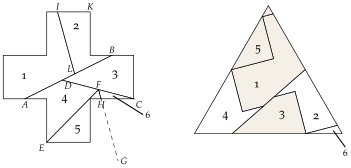
The construction works because it lays two tilings over each other. Crosses tile the plane, each a step of or from its neighbours, and the triangle’s pieces tile it too. In the construction I and L are exactly H and G moved one step , and the three cut directions DC, EF and FG are the three directions of the triangle’s sides. Dudeney also describes the method the other way round: find the direction of the line MN in the triangle, place its corner O over E, and turn the triangle over the cross until MN is parallel to AB; the pieces can then be marked off one by one.
A program carried out the construction to 40 decimal places. CD and EF meet at exactly 60 degrees and IL is exactly parallel to FG, as Dudeney says it should be. The cuts make six pieces, and a fitting program placed them in the triangle without turning any over, in the arrangement Dudeney draws. He adds a warning for solvers who assume the triangle is as tall as the cross: it is not. The cross stands 3 units high and the triangle only , about 2.943.
Answer Six pieces, cut along AB, DC, EF, FH and IL as shown
The Folded Cross
The crux is that folding turns one cut into several, arranged symmetrically.
Draw AB from the top corner of the upper arm to the opposite bottom corner of the lower arm; it passes through the centre D. Fold along AB, then fold again along the line CD through the centre at right angles to AB. The paper now lies in four layers in the wedge between the two folds. Cut straight along the middle of that wedge, from the centre outwards.
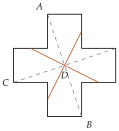

Unfolded, the cut and its reflections in the two folds are four rays from the centre, making angles of , , and with the horizontal. That is, two straight lines through the centre at right angles, each joining the middles of the sides of opposite arms: exactly the cuts in the figure at the start of this chapter. The four pieces are equal, each of area , and they make the square of side shown on the right, each piece moved without turning.
Answer Fold along AB, then along CD at right angles through the centre; cut along the middle of the folded wedge