Library · Amusements in Mathematics · Chapter 4
Locomotion and Speed Puzzles
On this page
Every puzzle in this short chapter turns on one line of school arithmetic: distance is speed multiplied by time. The difficulty is never the formula. It lies in keeping clear which quantity is shared by two journeys and which is not, and most of the traps Dudeney sets depend on a reader averaging speeds that ought never to be averaged.
The units are the old ones. A mile is 1,760 yards, and speeds are in miles an hour unless a puzzle says otherwise. The money in the last puzzle is twenty shillings to the pound, so £3 is sixty shillings.
No. 67. Average Speed
On a recent motor ride we went out at ten miles an hour. The roads were clearer on the way home, and we came back over the same route at fifteen miles an hour. What was our average speed for the whole trip? Do not answer too quickly, or you will almost certainly be wrong.
No. 68. The Two Trains
I put this to a stationmaster, and he answered it at once. Two trains leave at the same moment, one from London for Liverpool and the other from Liverpool for London, each running at its own steady speed. After they pass each other, one reaches its destination in one hour and the other in four hours. How much faster is the one train running than the other?
No. 69. The Three Villages
I meant to drive from Acrefield to Butterford, but by mistake took the road through Cheesebury. Cheesebury is nearer to Acrefield than to Butterford, and lies twelve miles to the left of the direct road I should have taken. When I reached Butterford I found I had driven thirty-five miles. All three roads are straight, and each distance between two villages is a whole number of miles. What are the three distances?
No. 70. Drawing Her Pension
“One of the oddest characters I know,” said a gentleman in a Government office, “is a lame old widow who climbs a hill every week to draw her pension at the village post office. She crawls up at a mile and a half an hour and comes down at four and a half miles an hour, and the double journey takes her exactly six hours. How far is it from the bottom of the hill to the top?”
No. 71. Sir Edwyn de Tudor
Sir Edwyn de Tudor is riding to rescue the fair Isabella, held captive by a wicked baron nearby. He works out that at fifteen miles an hour he would reach the castle an hour too soon, and at ten miles an hour an hour too late. The rescue depends on his arriving at exactly the appointed time, five o’clock, when the lady takes her afternoon tea. How far did he have to ride?
No. 72. The Hydroplane Question
A flying man visits Slocomb-on-Sea, and the whole town, the Dobsons included, turns out to watch his hydroplane fly to Poodleville, five miles off, and back. A strong wind blows straight along the course. With the wind behind him he makes the outward trip in ten minutes; flying dead into it, he takes an hour to return. His engine works uniformly throughout. How long would the ten miles have taken him in a perfect calm?
No. 73. Donkey Riding
At the seaside Tommy and Evangeline race donkeys over a one-mile course on the sands, marked off in quarter-miles. The donkeys refuse to part company, so the race is a dead heat. Judges posted along the course note three facts: the first three quarters took six and three-quarter minutes; the first half-mile took the same time as the second half-mile; and the third quarter took the same time as the last quarter. How long did the whole mile take?
No. 74. The Basket of Potatoes
A man with a basket of fifty potatoes has his son lay them out in a straight line: one yard from the first potato to the second, three yards from the second to the third, five from the third to the fourth, and so on, the gap growing by two yards each time. The basket stands beside the first potato. Starting there, with all the potatoes laid out, the boy must pick them up and carry them to the basket one at a time. How far does he walk?
No. 75. The Passenger’s Fare
Mr Smithers hires a motor car for £3 to take him from Addleford to Clinkerville and back. At Bakenham, exactly halfway, he picks up an acquaintance, Mr Tompkins, and agrees to take him on to Clinkerville and bring him back to Bakenham on the return. What is a fair fare for Mr Tompkins?
Average Speed
Average speed means total distance over total time, and the two halves of the trip share their distance, not their time. Let the route be miles. The outward run takes hours and the return , so the whole trip of miles takes and the average speed is miles an hour, whatever is. With Dudeney’s sixty miles: six hours out, four back, 120 miles in ten hours.
The hasty answer of averages the two speeds as though each were kept up for the same time. The car spends longer at the slower speed, so the slow speed carries more weight. The correct figure, , is the harmonic mean of the two speeds, and it is always below their ordinary mean unless they are equal. Dudeney is right.
Answer 12 miles an hour
The Two Trains
The crux is that after the meeting each train runs over exactly the ground the other has already covered. Say the trains meet hours after starting, the train that finishes an hour after the meeting runs at and the other at . The first train still has to cover the stretch the second ran in hours, and it does so in one hour; the second train covers the first’s stretch in four hours. So The first gives and the second . Setting these equal, , so , and the trains met after hours. The train that arrives an hour after the meeting runs exactly twice as fast as the other, which agrees with Dudeney.
The same argument with times and after the meeting gives the ratio , which is why the stationmaster could answer so quickly: one and four are both squares.
Answer One train runs twice as fast as the other.
The Three Villages
Drop the perpendicular from Cheesebury to the direct road ; it is 12 miles long and cuts the triangle into two right-angled triangles sharing that side. Write and , with and , and let the foot of the perpendicular be miles from and miles from , so and . The figure shows the answer the argument will reach.
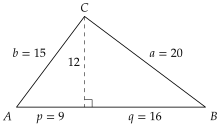
The crux is that and must themselves be whole numbers. Since the foot lies on the road, , a whole number. Then is rational, so is rational; and a rational number whose square is the whole number must be a whole number. The same goes for . So and are both perfect squares.
Now .
Running through , the values of are 0, 25, 52, 81, 112 and 145, so is 12, 13 or 15, with , 22 or 20. The corresponding are 385, 340 and 256, and only the last is a square. Hence , , , , and the direct road is miles. Acrefield to Cheesebury is 15 miles, Cheesebury to Butterford 20, and Acrefield to Butterford 25, a 3, 4, 5 triangle scaled by five. This is Dudeney’s answer, and it is the only one.
A reader who takes “twelve miles to the left of the road” to mean twelve miles from the line of the road, extended if need be, finds a second triangle. With the foot of the perpendicular 9 miles beyond Acrefield, on the far side from Butterford, the direct road is miles, and the sides 15, 20, 7 also satisfy every number in the puzzle. But then the nearest point of the road to Cheesebury is Acrefield itself, 15 miles away, so Cheesebury is not twelve miles from the road at all. Measured to the road that exists, the answer is unique.
Answer Acrefield to Cheesebury 15 miles, Cheesebury to Butterford 20, Acrefield to Butterford 25
Drawing Her Pension
The crux is to price one mile of hill, up and back. Climbing a mile at miles an hour takes of an hour, and coming down it at takes . One mile there and back therefore costs her and in six hours she manages miles of hill. She spends hours climbing and coming down. Dudeney gives the same miles. Her average speed over the round trip is miles an hour, the harmonic mean of her two speeds, as in No. 67.
Answer miles
Sir Edwyn de Tudor
The two rides differ by two hours, from an hour early to an hour late, and the crux is to see how much of that difference each mile contributes. A mile takes of an hour at the faster speed and at the slower, a difference of Two hours of difference therefore needs miles. At fifteen miles an hour the ride takes four hours, an hour less than the time allowed, so he has five hours, and must ride at miles an hour. To arrive at five o’clock he sets out at noon. Dudeney’s answer is the same. Note once more that the right speed, 12, is the harmonic mean of 10 and 15 and not their average: the two wrong rides are equally wrong in time, not in speed.
Answer 60 miles (leaving at noon and riding at 12 miles an hour)
The Hydroplane Question
The crux is that the engine’s own speed is exactly halfway between the ground speeds with and against the wind, since the wind adds to one and subtracts the same amount from the other. Work in miles a minute. With the wind he covers five miles in ten minutes, a mile a minute; against it, five miles in sixty minutes, . So miles a minute, that is and miles an hour. In a calm the ten miles take This matches Dudeney. It is worth noticing that the windy round trip took seventy minutes, half as long again. A wind along the course always slows a round trip, because the machine spends longer being held back than being helped. The whole calculation assumes, as Dudeney says, that the wind blows along the line of flight.
Answer minutes
Donkey Riding
Call the four quarter-mile times minutes. The crux is that the second and third facts together make the first half-mile worth two of the last quarters: . The first fact then reads so , the first half-mile took minutes, and the whole mile took minutes.
There are four unknowns and only three facts, so something must be left open, and it is the split of the first half-mile: any between 0 and works, with . The judges’ facts happen to fix the total regardless. Dudeney says exactly this, and his nine minutes is right.
Answer 9 minutes
The Basket of Potatoes
The crux is where the potatoes lie. The gaps are the odd numbers , and the first odd numbers add up to (each new odd number turns a square of dots into a one). So the potato after gaps lies yards from the basket, and the fifty potatoes lie at yards; the last is 2,401 yards out.
For each potato the boy walks out and back, twice its distance. His total walk is using . With potatoes the same sum is , which is Dudeney’s rule. Since and , the walk is miles, in agreement with Dudeney.
Answer 80,850 yards, or miles
The Passenger’s Fare
The trip has four equal legs, Addleford to Bakenham, Bakenham to Clinkerville, back to Bakenham, and back to Addleford, so each leg costs fifteen shillings. Tompkins rides on the middle two, thirty shillings’ worth, and Smithers rides on all four. The question has no single forced answer, since “reasonable” is a matter of agreement, and that is presumably why the two men argued. The crux is to name the rule of sharing, and then the arithmetic is easy.
Dudeney’s rule is that those in the car share the cost of each leg equally. Smithers pays the two outer legs alone and half of each middle leg; Tompkins pays half of thirty shillings, which is fifteen shillings. A second argument lands in the same place. If Tompkins had hired the car alone for his part of the journey, it would have cost him thirty shillings; if he joins a hire Smithers has already made, he adds nothing to the bill. Neither man is entitled to be counted as first, so split the difference: Tompkins pays the average of thirty and nothing, fifteen shillings. (This averaging over the order of joining is what economists call the Shapley value.)
A third rule, charging by the mile travelled, divides the £3 between Smithers’s four legs and Tompkins’s two, and asks twenty shillings of Tompkins. It overcharges him, since it takes no account of the fact that the car had to make his journey anyway: Smithers’s bill would fall from sixty shillings to forty, although carrying Tompkins cost nothing extra. Dudeney’s fifteen shillings is the fairer answer, and the one both sound arguments give.
Answer 15 shillings