Library · Amusements in Mathematics · Chapter 11
Points and Lines Problems
Trees in rows, castles on walls and pies on a table: every puzzle here asks for points arranged so that many straight lines pass through them. Dudeney says what makes them hard. It is easy to see a solution once drawn and difficult to find one, because nothing in the conditions tells you where to begin.
Most of the chapter is about one case, ten points on five lines of four, and a little counting settles its shape. Five lines of four points make twenty meetings of a point with a line. Two straight lines cross at most once, so a point on three of the lines would use up three of the ten possible crossings of pairs of lines, and every point on only one line would waste a crossing elsewhere. The count works only one way: every point lies on exactly two of the lines, and every two lines cross at one of the points. So a solution is simply five straight lines, no two parallel and no three through one point, and the ten points are where they cross.
No. 206. The King and the Castles
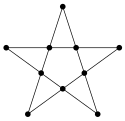
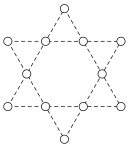
A king resolved to build ten castles joined by fortified walls, forming five straight lines with four castles in every line. His architect’s plan, shown here, left every castle open to approach from outside, and the king commanded that as many castles as possible should be reachable only by crossing the walls. How would you build them? Remember that they must still form five straight lines with four castles in every line.
No. 207. Cherries and Plums
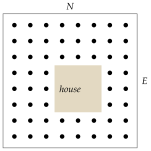
A cottage stands in an orchard of fifty-five trees: ten cherries, ten plums, and the rest apples. The cherries form five straight lines with four cherry trees in every line, and so do the plums. Which are the cherries and which the plums? For the best aspect, as few as possible of them are planted on the north and east sides of the orchard. Four trees may be in a line even though other trees, or the house, stand between them.
No. 208. A Plantation Puzzle
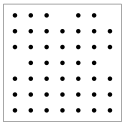
A square plantation of forty-nine trees has lost the four trees missing from this plan. The owner wants to cut down all but ten of the rest, leaving the ten in five straight rows with four trees in every row. Which ten must he leave?
No. 209. The Twenty-One Trees
A gentleman wishes to plant twenty-one trees in his park so that they form twelve straight rows with five trees in every row. Can you give him a pretty symmetrical arrangement?
No. 210. The Ten Coins
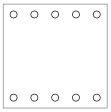
Place ten pennies on a large sheet of paper, five along each edge, as shown. Remove four of them, without disturbing the others, and put them back on the paper so that the ten form five straight lines with four coins in every line. That is not difficult; but in how many different ways can it be done, the two rows at the start being always the same?
No. 211. The Twelve Mince-Pies
Twelve mince-pies lie on the table in six straight rows with four pies in every row. Move just four of them to new places so that there are seven straight rows with four in every row. Which four, and where?
No. 212. The Burmese Plantation
A chaplain in Upper Burma has a plantation of forty-nine trees planted in a square, seven by seven. He wants to cut down twenty-seven of them so that the twenty-two left standing form as many rows as possible with four trees in every row. No row may have more than four trees.
No. 213. Turks and Russians
On open level country a party of Russian infantry, no two standing on the same spot, was surprised by thirty-two Turks, who opened fire from all directions. Each Turk fired one bullet at the same moment, each bullet passed just over the heads of three Russians, and each bullet killed a different man. What is the smallest number of Russians there could have been, and what were the casualties on each side?
The King and the Castles
By the opening count, any plan is five straight walls, each crossing the other four, with a castle at each crossing. A castle is safe when it is shut inside the walls, and which castles are shut in depends only on the order in which the five walls cross one another. A program lists every possible order by sweeping the walls across the page one crossing at a time, and finds that five straight lines can cross in just six essentially different ways.
These are Dudeney’s six forms, drawn with the answer to No. 210.
The architect’s plan is the Star, and it shuts in no castle at all. Four of the forms shut in one each. The Compasses shuts in two, and it is the only form that does.
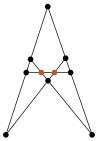
The two castles in on the cross-wall can be reached only over a wall. Dudeney’s claim is exactly right: two is the greatest number, and this is the only form that gives it.
Answer The Compasses: two castles enclosed, the most possible
Cherries and Plums
The cherries in are joined by broken lines and the plums, drawn as rings, by full ones.
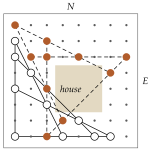
Only two of the twenty trees stand on the north or east side: the cherry in the north-west corner and the one at the end of the third row. A program looked for every set of ten orchard trees that stand on five lines of four, and there are only six. Just one pair of them shares no tree and puts as few as two on the north and east sides, and that pair is Dudeney’s. The cherries take the form he calls the Funnel and the plums the Dart.
Answer The arrangement shown, the only one with just two on the north and east sides
A Plantation Puzzle
Leave the ten trees in .
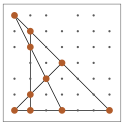
The rows are the bottom row, the second column, the long diagonal, the other diagonal from the bottom left corner to the centre, and the steep line from the top left corner to the middle of the bottom row. A program tried every way of leaving ten of the forty-five trees on five rows of four and found only this one; the four missing trees rule out the rest.
Answer The ten trees shown, the only way
The Twenty-One Trees
Dudeney gives two arrangements, rebuilt here with exact coordinates.
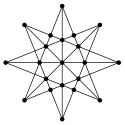
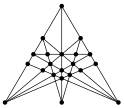
Each has twelve straight rows of five trees, and no row of six. In the first, eight trees are the points of a star and one stands at the centre; it is symmetrical about both axes. The second is symmetrical about its upright axis only. The first figure is not rigid: the tips on its diagonals can be moved in or out, and the other trees follow without losing a row. With the axis tips at 60 squares from the centre and the diagonal tips at , every tree falls on a corner of squared paper: the inner trees on the axes at 20, on the diagonals at , and the remaining eight at and its reflections.
Answer Either of the two figures
The Ten Coins
Dudeney’s answer is 2,400. He takes three coins from one row and one from the other, which can be done in 100 ways, and multiplies by the 24 orders in which the four coins can go to their new places.
The count can be checked from the opening argument. Any three coins in a straight line are in one of the rows, so a row that keeps three or more coins must be one of the five lines. The rows are parallel and every two of the lines cross, so only one row can be a line. It must keep exactly four coins, and the other row keeps two. Each of the other four lines then joins one coin of the four to one coin of the two, each of the two taking a pair, and that can be done in six ways. A program works out all six for each of the 100 choices. Exactly one keeps all four moved coins on the sheet; the others throw a coin off the paper, some of them far off.
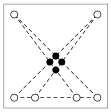
Here the three middle coins of the top row and the middle coin of the bottom row have moved to the four black places. So there are 100 different pictures, and Dudeney’s 2,400 counts which penny goes where. If coins may leave the sheet the pictures number 280, and among them are all six forms.
Answer 2,400, counting which coin goes to which place; 100 different arrangements
Dudeney follows this answer with a note on the ten points in general. The six forms, which he names the Star, the Dart, the Compasses, the Funnel, the Scissors and the Nail, are the six ways five lines can cross, and the program under No. 206 confirms that there is no seventh.
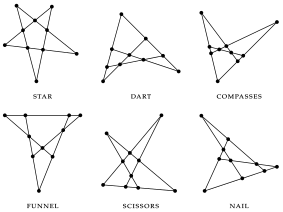
The castles give the Star and the Compasses, the cherries the Funnel, the plums and the plantation the Dart, and every coin solution on the sheet is the Scissors.
He adds that ten pawns go on a seven by seven board in just three ways, all Darts. The program for No. 208 finds sixteen placements, which are three up to turning and reflecting the board, and all three are Darts. His notebook then gives the smallest boards for the other forms: the Star 9 by 7, the Nail 11 by 7, the Scissors 11 by 9 and the Compasses 17 by 12. “They may be beaten,” he writes, “but I do not think so.” A program that tries every board in order of size confirms the Star and the Scissors, and beats the other two. The Nail fits on an ordinary eight by eight board, and the Compasses on 13 by 13, which has 169 squares against 204.
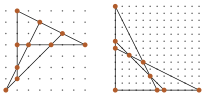
His other records, about several schemes on one board, are not checked here.
The Twelve Mince-Pies
Move the two outer pies of the upper row and the two inner pies of the lower row. The eight that stay already make two rows of four: the sides of the upward triangle. Put the four moved pies at the black places.
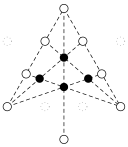
Two of them go on the upright line through the top and bottom pies: one where it meets the line from each lower corner to the inner pie of the upper row on the far side, and one where it meets the line from each lower corner to the far pie of the middle row. The other two go where those slanting lines cross each other. That gives seven rows of four: the two sides, the upright line, and four slanting lines, two from each lower corner. In the coordinates of the star, with the pies of a row two units apart and the rows one unit apart, the four places are , and , the middle row being at height 0; a program checks that there are exactly seven rows of four and none of five.
Answer Move the outer pies of the top row and the inner pies of the bottom row to the black places
The Burmese Plantation
Dudeney’s arrangement leaves the twenty-two trees in .
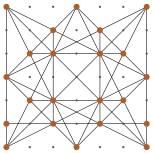
It has twenty-one rows of exactly four trees, and no row of five, as a program confirms. It is symmetrical from left to right. Dudeney believed twenty-one was the greatest number of rows possible. That can now be settled. A row of four in a seven by seven square must lie on one of the 44 lines through at least four of the trees, so the question is a finite one: choose 22 trees so that as many of those lines as possible hold exactly four, and none of them five or more. An integer-programming solver (a program that settles yes-or-no choices under linear conditions, proving when no choice can meet them), asked for 22 trees with 22 or more such rows, proves after about eight minutes that there is no such set.
So twenty-one is the greatest number, as he thought.
Answer Twenty-one rows, the greatest number possible
Turks and Russians
Two Turks firing along the same line from opposite ends shoot over the same three heads, so the thirty-two bullets need only sixteen lines. The question is then the fewest points that can lie on sixteen straight lines of three.
Ten will not do. Any two Russians lie on at most one of the lines, and a line of three holds three pairs of them, so ten Russians, with 45 pairs, give at most 15 lines. Eleven give at most 18, and eleven are enough.
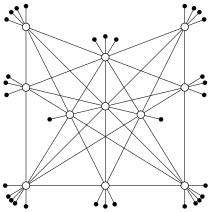
The Russians are the rings and the Turks the black dots, one at each end of each of the sixteen lines. The figure cannot be drawn freely. Put four of the Russians at the corners of a square and the other seven are forced, with coordinates that need ; a program checks the sixteen lines exactly, and that no line holds four.
Each Turk fires over three Russians and hits the Turk opposite, who hits him in turn, since the shots are simultaneous. If any bullet killed a Russian, another man would be needed to stand in the line, and there would then be more than eleven. So there were eleven Russians, none of them hurt, and all thirty-two Turks were killed by one another. Dudeney says the arrangement was first found by the Rev. Mr Wilkinson about twenty years before he wrote.
Answer Eleven Russians, none hurt; all thirty-two Turks shot one another