Library · Amusements in Mathematics · Chapter 20
Problems concerning Games
On this page
- No. 378. Dominoes in Progression
- No. 379. The Five Dominoes
- No. 380. The Domino Frame Puzzle
- No. 381. The Card Frame Puzzle
- No. 382. The Cross of Cards
- No. 384. Card Triangles
- No. 386. A Trick with Dice
- No. 387. The Village Cricket Match
- No. 388. Slow Cricket
- No. 389. The Football Players
- No. 390. The Horse-Race Puzzle
- No. 391. The Motor-Car Race
The games here supply only the pieces. Dominoes must be played end to end with like against like, cards count their pips (the ace counting one), and cricket, football and racing each lend a story to a small piece of arithmetic. Most of the questions ask how many ways something can be done, and a count like that turns on what is to be called different. Dudeney is usually careful to say, and where he is not, the answer below says which reading gives his number.
Every count was made again by a program that tries each case in turn: every line of dominoes, every placing of the cards. The patience game, No. 385, needed more: a search through every position the cards can reach, which settles the fewest moves for certain.
No. 378. Dominoes in Progression
Six dominoes have been played here by the ordinary rules, 4 against 4, 1 against 1 and so on, and the spots on the successive dominoes, 4, 5, 6, 7, 8, 9, are in arithmetical progression. In how many ways can six dominoes from an ordinary box of twenty-eight be played so that their numbers lie in arithmetical progression? Play always goes from left to right, and a falling progression such as 9, 8, 7, 6, 5, 4 is not allowed.

No. 379. The Five Dominoes
These five dominoes are played in proper sequence, and the two end dominoes hold five pips between them, as do the three in the middle. There are just three other arrangements that give five for both additions: (1–0) (0–0) (0–2) (2–1) (1–3), (4–0) (0–0) (0–2) (2–1) (1–0) and (2–0) (0–0) (0–1) (1–3) (3–0). How many arrangements of five dominoes give six instead of five in the two additions?

No. 380. The Domino Frame Puzzle
The full set of twenty-eight dominoes is laid out as a square frame, played as in the game with 6 against 6, 2 against 2 and so on. In Dudeney’s picture the pips along the top and the left-hand side each add up to 44, and the other two sides to 59 and 32. Rearrange the dominoes in the same form, still correctly played, so that all four sides add up to 44.
No. 381. The Card Frame Puzzle
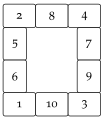
Some children made a frame of the ten cards from ace to ten of diamonds, and wanted the pips on all four sides to add up alike. They gave it up as impossible: the top, the bottom and the left-hand side add up to 14, but the right-hand side to 23. It is quite possible. Rearrange the ten cards in the same form so that all four sides add up alike, to 14 or to any other number.
No. 382. The Cross of Cards
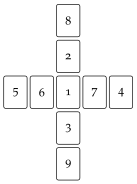
Arrange the ace to nine of diamonds in a cross, as shown, so that the pips in the upright bar and in the cross bar add up alike; here both come to 23. Changing the order of the cards within a bar, or making the two bars change places, does not make a new solution. How many fundamentally different solutions are there? The total need not be 23.
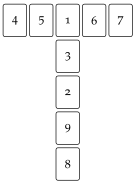
Arrange the ace to nine of a suit in the form of a T, as shown, so that the row and the column count the same; here both come to 23. One arrangement is easy to find. In how many ways can it be done? A reflection in a mirror does not count as different, but every other change in the places of the cards does.
No. 384. Card Triangles
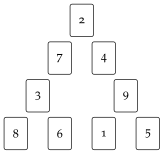
Arrange the ace to nine of diamonds in a triangle, as shown, so that the pips add up alike on the three sides; here each side comes to 20, but any total will do. In how many ways can it be done? Turning the triangle so that another side is nearest to you does not count as different; nor does exchanging the 4, 9, 5 with the 7, 3, 8 while also exchanging the 1 and the 6. But exchanging only the 1 and the 6 does count, because the order round the triangle is changed.
Make two piles of cards, from the bottom 9D, 8S, 7D, 6S, 5D, 4S, 3D, 2S, 1D and 9H, 8C, 7H, 6C, 5H, 4C, 3H, 2C, 1H. The task is to exchange the spades with the clubs, so that one pile holds the diamonds and clubs in order and the other the hearts and spades. Besides the places of the two piles there are four vacant spaces. Any card may be laid on a space, but a card may be laid on another only if that card is of the next higher value, of any suit. Find the shortest way. With four vacant spaces four cards can be piled in seven moves, with three spaces in nine, and with two spaces no more than two cards can be piled; once such facts are grasped, a number of cards can be moved bodily and the moves simply counted.
No. 386. A Trick with Dice
Throw three dice without letting Dudeney see them. Multiply the points of the first by 2 and add 5, multiply the result by 5 and add the points of the second, then multiply by 10 and add the points of the third. From the total he can at once name the three throws: 1, 3 and 6, for example, give 386. How does he do it?
No. 387. The Village Cricket Match
Dingley Dell against All Muggleton. Mr Dumkins made a late cut and Mr Podder called him to run. Four runs were apparently completed, but the umpires at each end called “three short”, six short runs in all. What did Mr Dumkins score? Later Mr Struggles made an off-drive, and the spectators applauded what they took for three sharp runs, but the umpires declared two short runs at each end, four in all. By how much, if at all, did this increase Mr Struggles’s total?
No. 388. Slow Cricket
Wessex batted all day, the last man being out just before stumps. Two men were out leg before wicket for 19 runs between them, four were caught for 17 between them, one was run out for nothing, and the others were all bowled for 3 each. There were no extras. The captain made exactly 15 more than the average of his team. What did the captain score?
No. 389. The Football Players
“At the close of last season,” said an enthusiast, “of the footballers of my acquaintance four had broken their left arm, five had broken their right arm, two had the right arm sound, and three had sound left arms.” What is the smallest number of players he could have known? There need not have been fourteen, since two of the men with a broken left arm might be the two with a sound right arm.
No. 390. The Horse-Race Puzzle
Three horses start in a race, at odds of 4 to 1 Acorn, 3 to 1 Bluebottle and 2 to 1 Capsule. How much must be staked on each to win £13 whichever horse comes in first? Staking £5 on each would win £10 if Acorn won, £5 if Bluebottle won, and nothing if Capsule won.
No. 391. The Motor-Car Race
Cars are whirling round the circular track at Brooklands. “How many cars are running?” asks a spectator. “One-third of the cars in front of Gogglesmith added to three-quarters of those behind him will give you the answer.” How many cars were running?
Dominoes in Progression
Twenty-three ways. Once the first domino and the common difference are chosen there is no choice left: if the first domino is – and the difference is , the line must run –, –, –, –, –, –. No number may exceed six, so can be at most and at most . With a difference of 1 that leaves twenty first dominoes, with a difference of 2 three, and a difference of 3 is too large:
difference 1: 0–0, 0–1, 1–0, 0–2, 1–1, 2–0, 0–3, 1–2, 2–1, 3–0, 0–4, 1–3, 2–2, 3–1, 1–4, 2–3, 3–2, 2–4, 3–3, 3–4;
difference 2: 0–0, 0–2, 0–1, the last giving 0–1, 1–2, 2–3, 3–4, 4–5, 5–6.
Three dominoes are never used at all: 0–5, 0–6 and 1–6. A program that builds every line of six different dominoes finds exactly these twenty-three, with exactly Dudeney’s first dominoes.
Dudeney adds that a box running up to double nine would give forty ways. It gives eighty-four. The same rule, with nine in place of six, allows lines with a difference of 1, with a difference of 2 and with a difference of 3; in general a box up to double gives lines for each difference . The program agrees: 84. Forty does not come from any size of box, since boxes up to double seven and double eight give 38 and 57.
Answer Twenty-three ways
The Five Dominoes
Ten ways, of which one is (2–0) (0–0) (0–1) (1–4) (4–0). Dudeney left the other nine to the reader. A line read backwards is the same arrangement, and on that understanding a program that tries every line of five different dominoes finds four arrangements for five, exactly his four, and ten for six.
Answer Ten
The Domino Frame Puzzle
The sum of the pips on all twenty-eight dominoes is 168. The four corner squares are counted twice, once in each of their sides, so if every side is to make 44, the corners must make . Dudeney’s frame:
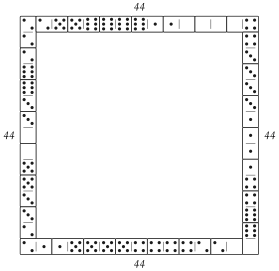
A program read the frame from the diagram in his answer and checked it: the full set is used once, every domino is played like against like, and the sides come to 44, 44, 44 and 44, with the corners making 8.
There are many solutions, and some come from this one. A string of dominoes that begins and ends with the same number can be turned end for end without spoiling anything. On the left-hand side the string from 2–2 down to 3–2 can be turned round in this way, or the string from 2–6 to 3–2, or from 3–0 to 5–3, and on the right-hand side the string from 4–3 to 1–4. The program made each of these changes and found each result correct.
Answer As above
The Card Frame Puzzle
The ten cards hold 55 pips. If every side is to make 14, the four sides together make 56, and since the corner cards are counted twice, the corners must make , which is impossible. For a side total of 18 the corners must make , and a little trying gives this:
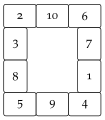
Dudeney counts ten solutions in all: two with sides of 18, four of 19, two of 20 and two of 22. He does not count as different the exchange of the two middle cards of an upright side, nor a reflection in a mirror. A program that tries all 3,628,800 ways of placing the cards finds 160 solutions. His ten come out when a frame is also not counted as different from its reflection top to bottom or from itself turned half round, as well as from its reflection left to right; each solution then has sixteen forms. Counting only one mirror gives twenty. No side total other than 18, 19, 20 and 22 can be made.
Answer Ten, as Dudeney counts them
The Cross of Cards
Eighteen. Only the centre card and the division of the other eight into two bars matter. Each bar then holds half of what is left over from the centre, , so the centre must be odd, and the total of each bar is . Dudeney lists the cross bar of each, the centre in the middle:
| 5 6 1 7 4 | 3 5 1 6 8 | 3 4 1 7 8 | 2 5 1 7 8 | 2 5 3 6 8 | 1 5 3 7 8 |
| 2 4 3 7 8 | 1 4 5 7 8 | 2 3 5 7 8 | 2 4 5 6 8 | 3 4 5 6 7 | 1 4 7 6 8 |
| 2 3 7 6 8 | 2 4 7 5 8 | 3 4 9 5 6 | 2 4 9 5 7 | 1 4 9 6 7 | 2 3 9 6 7 |
There are four ways each of making 23, 25 and 27, with the ace, 5 and 9 in the centre, and three each of making 24 and 26, with 3 and 7. A program that tries every centre and every division of the other cards finds the same eighteen, and his list holds each of them once.
Answer Eighteen
10,368 ways. The card at the head of the column belongs to both the row and the column, so the other eight must split into two groups of four with equal sums. For that the head card must be odd. With the ace there, the other cards split in four ways; with the 3 in three ways; with the 5 in four; with the 7 in three; and with the 9 in four: eighteen groupings in all. Each group of four can be ordered in 24 ways, so each grouping gives arrangements, and the eighteen give 10,368. Either group can go in the row, which doubles this, and a mirror image is not counted, which halves it again.
A program placed the nine cards in all 362,880 possible ways and found 20,736 correct ones, which is 10,368 once mirror images are paired off.
Answer 10,368 ways
Card Triangles
144 ways. The corner trick of the Card Frame tells us which totals to look for. The three sides together count every card once and the three corner cards twice, so three times a side’s total is plus the corners. The corners add up to at least and at most , so a side comes to between and . Here are the two extremes:
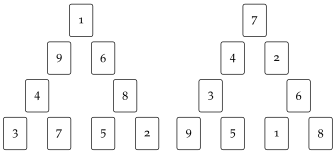
The two middle cards of any side can always be exchanged, so each fundamental arrangement can be shown in eight ways. There are eighteen fundamental arrangements: two with sides of 17, four of 19, six of 20, four of 21 and two of 23. Eighteen times eight is 144.
A program tried all 362,880 ways of placing the cards and found 864 correct ones. Each is one of six that differ only by turning the triangle or reflecting it, which leaves 144, and pairing off the middle cards of each side leaves Dudeney’s eighteen, with his totals. No arrangement makes sides of 18 or 22.
Answer 144 ways
Dudeney’s record was 62 moves, and he invited readers to beat it. It can be beaten: 56 moves are enough, and no fewer will do.
His play is written in steps that move several cards at once. By “4C up” he means the 4 of clubs with all the cards resting on it:
1D on space, 2S on space, 3D on space, 2S on 3D, 1H on 2S, 2C on space, 1D on 2C, 4S on space, 3H on 4S (9 moves so far), 2S up on 3H (3 moves), 5H and 5D exchanged and 4C on 5D (6), 3D on 4C (1), 6S (with 5H) on space (3), 4C up on 5H (3), 2C up on 3D (3), 7D on space (1), 6C up on 7D (3), 8S on space (1), 7H on 8S (1), 8C on 9D (1), 7H on 8C (1), 8S on 9H (1), 7H on 8S (1), 7D up on 8C (5), 4C up on 5D (9), 6S up on 7H (3), 4S up on 5H (7), 62 moves in all.
Every card’s position can be described by what it rests on, another card or a space, and since the spaces are all alike, that description is all that matters. From the starting position only 333,952 positions can be reached, few enough for a program to list them all, nearest first, and so to find the fewest moves that reach the goal. It finds 56. It also checked Dudeney’s play step by step: each of his twenty-seven steps is done in the fewest moves that step allows, and the whole play reaches the goal. The six extra moves come from the plan itself.
Here is a play of 56 moves, each moving one card; it was also checked by playing it out on six places:
1D on space, 1H on space, 2C on space, 1H on 2C, 3H on space, 2S on 3H, 4C on space, 3D on 4C, 2S on 3D, 1D on 2S, 4S on 5H, 5D on space, 4S on 5D, 5H on 6S, 4S on 5H, 3H on 4S, 6C on space, 5D on 6C, 3H on space, 4S on 5D, 3H on 4S, 1H on space, 2C on 3H, 1H on 2C, 5H on space, 6S on 7H, 7D on space, 6S on 7D, 5H on 6S, 7H on 8S, 8C on space, 7H on 8C, 8S on 9H, 7H on 8S, 8C on 9D, 5H on space, 6S on 7H, 5H on 6S, 1H on space, 7D on 8C, 2C on space, 1H on 2C, 3H on space, 4S on 5H, 3H on 4S, 5D on space, 6C on 7D, 1D on space, 2S on 3H, 1H on 2S, 5D on 6C, 3D on space, 4C on 5D, 3D on 4C, 2C on 3D, 1D on 2C.
The nines never move, so the two new piles stand where the old ones stood. Dudeney’s remarks on how many moves it takes to pile cards with a given number of spaces were not checked separately; the search makes no use of them.
Answer 56 moves (Dudeney’s record was 62)
A Trick with Dice
Take 250 from the total, and the three figures left are the three throws: . The instructions turn throws , , into . A program works through all 216 throws and finds the rule holds for each.
Answer Subtract 250
The Village Cricket Match
Mr Dumkins scored nothing, and Mr Struggles’s total went up by one. A run counts only if each batsman reaches the crease at the other end. Dudeney drew the paths of the batsmen. In the first case neither Dumkins nor Podder was ever within the crease opposite the one he started from: for all their running, each turned back short of the far end, and they finished where they began. In the second, Luffey and Struggles, for all their careless running, ended at opposite ends from where they started, so they had completed one run. The answer rests on Dudeney’s reading of the umpires’ calls and his drawings of the paths; there is nothing for a program to count, and it was not checked.
Answer Dumkins nothing; Struggles one more
Slow Cricket
21, and the captain was not out. The last man was out, so ten men were out and one was not out; the men bowled were therefore three, making 9 between them. If the man not out made , the team made , and the average is . If the captain is the man not out, , which gives and a total of 66. Any other captain fails: a man bowled or run out made 3 or nothing, and a man leg before or caught made at most 19 or 17, while the average plus 15 is always more than 19. A program that tries every score for the man not out and every place for the captain finds this the only answer.
Answer 21, not out
The Football Players
Seven. They can be made up in three ways: two with both arms sound, one with a broken right arm and four with both broken; or one with both sound, one with a broken left arm, two with a broken right arm and three with both broken; or two with a broken left arm, three with a broken right arm and two with both broken. If every man was injured, only the last will do.
A program tries every mixture of the four kinds of player and finds these three and no others. Seven is also the only number possible: every man’s left arm is either broken or sound, so the men number , and the right arms agree, .
Answer Seven
The Horse-Race Puzzle
£12 on Acorn, £15 on Bluebottle and £20 on Capsule. If Acorn wins, the backer receives and loses ; if Bluebottle wins, ; if Capsule wins, . Each time he is £13 up. A program solving the three conditions finds this the only way.
Answer £12, £15 and £20
The Motor-Car Race
Thirteen. On a circular track every other car is both in front of Gogglesmith and behind him. If there are cars, then , so and : one-third of twelve and three-quarters of twelve make thirteen. A program confirms that no other number of cars works.
Answer Thirteen