Library · Amusements in Mathematics · Chapter 15
Chessboard Problems
The chessboard here is a sheet of sixty-four squares, and the pieces are cut from it rather than moved across it. Most of these puzzles ask for a board to be cut along its lines into pieces of the same shape, or into pieces all different, and the difficulty is always the same one: there are a great many ways to try, and a way that looks new is often an old one turned round or turned over.
A program listed the cases for every count below, and each of Dudeney’s printed divisions was read square by square from his diagrams and checked.
No. 288. Chequered Board Divisions
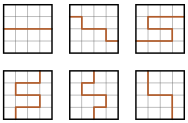
In how many ways may a board be cut along the lines into two parts of the same size and shape? A board of four squares can be cut in one way only, straight down the middle, since turnings and reflections of a way do not count as new. A board of sixteen squares can be cut in six ways, all shown here, and there are no others. In how many ways can the board of thirty-six squares, six by six, be cut?
No. 289. Lions and Crowns
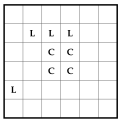
A young lady wishes to cut this square of valuable material along the lines into four parts, all of exactly the same size and shape, so that every part holds a lion (L) and a crown (C). There is only one way of doing it. What is it?
No. 290. Boards with an Odd Number of Squares
Cut out the central square of a board with an odd number of squares, and divide what is left into two pieces of the same size and shape. The board three by three can be divided in one way only, as shown; the other ways of cutting give the same pieces. In how many ways can the board five by five be divided? A piece that, turned over, is like another counts as the same shape.

No. 291. The Grand Lama’s Problem
Every priest who beat the Grand Lama at chess had a jewel set in the square of the golden board on which he gave checkmate. After four such defeats the Lama died, and his successor, who preferred cutting off heads, ordered the four priests to cut the board along the lines into four parts of the same shape, each of sixteen squares and each holding one of the gems. How was it done?
No. 292. The Abbot’s Window
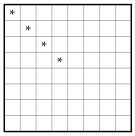
The Abbot of St Edmondsbury, born on Christmas Eve, had no love for things that are odd. His dormitory window had sixty-four lights, eight by eight, and while every row and column held an even number of lights, all the diagonal lines except fourteen held an odd number. He ordered some lights to be closed so that every line, across, down and diagonally, should hold an even number of lights. Which lights were closed, with the least possible loss of light?
No. 293. The Chinese Chessboard
Into how many pieces may the chessboard be cut along the lines, no two pieces alike? The colours count: a single black square differs from a single white one, and a row of three with two white squares differs from a row of three with two black. The back of the board is plain, so the pieces may be turned round but not turned over.
No. 294. The Chessboard Sentence
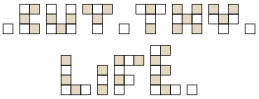
Dudeney once cut a chessboard into letters that make a sentence, CUT THY LIFE, with stops between the words. The ideal sentence would have only one full stop, but he did not manage that. Fit the pieces together to make a perfect chessboard.
Chequered Board Divisions
255 ways. Dudeney’s key is that the cut must leave the edge at the point straight across the centre from where it entered. Every cut in his figures has that shape: it runs through the centre of the board, and a half turn about the centre carries it onto itself and each piece onto the other. So only half of the cut has to be chosen, a path along the lines from the centre to the edge that never meets its own half-turned copy. Dudeney sorted his cuts by the short key line through the centre that each one contains, and gave a table by cases, .
A program listed every such half cut and counted the whole cuts in two ways, once by keeping one of each family of turnings and reflections, and once by Burnside’s lemma, which counts the families from the number of cuts each turning or reflection leaves unchanged. Both give 1, 6 and 255 for the boards of four, sixteen and thirty-six squares.
Of the ordinary chessboard Dudeney wrote that the solution would entail considerable labour, and he did not attempt it. The same program finds 92,263 ways in a few seconds, which agrees with the number in the On-Line Encyclopedia of Integer Sequences.
Answer 255 ways
Lions and Crowns
Two of the four pieces are shaded. Each has nine squares, a lion and a crown, and a quarter turn of the square carries each piece onto the next.
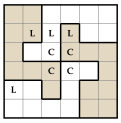
A program checked Dudeney’s claim that there is only one way. It grew every piece of nine squares that holds the lone lion in the lower left with one lion and one crown, 931 of them, and tried to fill the rest of the square with three copies of each, turned or turned over. Only this division survives, so the answer is unique even if the stuff may be turned over.
Answer The division above
Boards with an Odd Number of Squares
Fifteen ways. The rule is the same as for the even boards, except that the cut now comes in two halves: one runs from a corner of the missing square out to the edge, and the other is its copy turned half round. For lack of room Dudeney gave the fifteen as lists of numbered steps; here they are drawn.
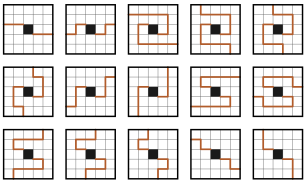
The program that counted the even boards, adapted to start from the corners of the hole, finds one way for the board three by three and fifteen for five by five, counting a piece and its reflection as the same.
Answer Fifteen ways
The Grand Lama’s Problem
Two of the four pieces are shaded. They wind in from the edge to the middle, and a quarter turn of the board carries each onto the next.
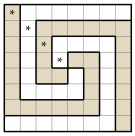
Read square by square from Dudeney’s diagram, the four pieces have sixteen squares each and one gem each, so they are the same shape without any piece being turned over. Dudeney compares it with the Weaver, No. 14 in The Canterbury Puzzles.
Answer The division above
The Abbot’s Window
Twelve lights, closed in the form of a St Andrew’s cross.
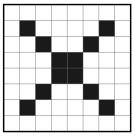
Each row and column has eight lights, so an even number must be closed in each. A diagonal with an odd number of lights needs an odd number closed, and there are twelve of these once the four corner panes are left out. The corners are a matter of wording: Father John wanted them darkened too, but the sage ruled that a single pane is not a line. Had they counted, the least would have been sixteen, the cross and the four corners.
The twelve are the least possible, and a program proves it: a search that minimises the number of closed lights finds nothing smaller. But the cross is not the only way to do it. There are 237 ways of closing twelve lights that keep every line even, or 48 if a way turned round or reflected counts as the same. The count was made twice, by the search and by listing all closings that keep every line even, which linear algebra over the numbers modulo 2 reduces to twenty-six free choices. Dudeney’s cross has one distinction that the Abbot, who took it as a compliment to St Andrew, might have valued: of all the minimum closings it is the only one with every symmetry of the window.
Answer Twelve lights, as above
The Chinese Chessboard
Eighteen pieces. In the first diagram the eighteenth piece has eight squares, the largest possible; the second is cut so that no piece has more than five squares.
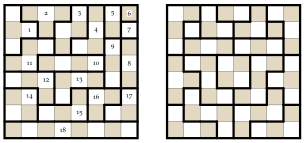
Dudeney gives no reason why eighteen is the most, but there is a short one. A program counted the different pieces of each size, colours counting and turning over forbidden: two single squares, one domino (turned half round, a domino changes which end is black, so both colourings are the same piece), four pieces of three squares and ten of four. These seventeen smallest pieces cover 56 squares. Nineteen different pieces would need these seventeen and two more of at least five squares each, 66 squares in all, more than the board has. And eighteen pieces can leave at most squares for the largest, so the first diagram cannot be beaten on that point either. Both diagrams were read square by square and checked: eighteen pieces each, no two alike.
Answer Eighteen pieces
The Chessboard Sentence
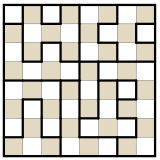
Every piece keeps its colours when it is turned, so a letter fits only where its black squares fall on black. The fourteen pieces were read from Dudeney’s picture, square by square with their colours, and his board from his answer, and a program found that the board is made of exactly those pieces. It also looked for other ways of fitting them and found 124, or 62 if a board turned half round counts as the same.
Answer As above