Library · The Fiddler: Solutions · Chapter 6
Can You Spell Like a Queen Bee?
In Spelling Bee, a word game from the New York Times, finding every word earns the rank of Queen Bee. That maximum score is never shown. The cutoff for Genius is shown, and it is per cent of the maximum, rounded to the nearest whole number, so dividing the Genius cutoff by approximates the maximum. It does not always pin it down, since several maxima can round to the same cutoff.
Suppose a round of Spelling Bee has some very large, randomly chosen maximum. What is the probability that the maximum can be determined exactly from its Genius cutoff?
The Fiddler, Zach Wissner-Gross, August 28, 2026(original post)
The official solution appeared in the post of September 4, 2026 and gives per cent for the main puzzle, agreeing with the answer below, and picking out the same four maxima in every ten. The Extra Credit half of that post is paywalled, so is my own and has not been checked against it.
Solution
Write for the maximum and for the Genius cutoff. The question asks for the density of those that share their cutoff with no other maximum.
The thing to watch is not but how it changes. Step up by one and rises by , so either holds still or climbs by one, and can do nothing else. Two maxima collide exactly when holds still, and since is greater than a half, can never hold still twice in a row. Collisions therefore come in pairs and never in threes, which is what makes the counting easy.
Now the bookkeeping. Over a long run, must climb at an average rate of per step, so a fraction of the steps climb and the remaining hold still. Each stationary step spoils exactly two maxima, the one on either side of it, and no maximum is spoiled twice because no two stationary steps are adjacent. The ambiguous maxima therefore have density , and
Since , everything repeats every ten, and the cycle is worth seeing. Ten maxima are squeezed onto seven cutoffs:
| 0 | 1 | 2 | 3 | 4 | 5 | 6 | 7 | 8 | 9 | |
| 0 | 1 | 1 | 2 | 3 | 4 | 4 | 5 | 6 | 6 | |
| determined? | yes | yes | yes | yes |
Seven cutoffs for ten maxima means three cutoffs get used twice, spoiling six maxima and leaving four. Four in ten is , which is what the density argument said without needing the table.
The argument never used the digit , only that lies between a half and one. So in general a cutoff at a fraction of the maximum determines it with probability . At nothing is ever determined, which is right, since then every cutoff would serve exactly two maxima, and the answer improves linearly as the cutoff climbs towards the maximum itself.
The computation
The check enumerates cutoffs and looks for collisions, in exact rational arithmetic so that no tie is settled by floating point.
import math
from fractions import Fraction
from collections import Counter

def rnd(x):                                   # nearest whole number, halves up
    return math.floor(x + Fraction(1, 2))

def cuts(M, pcts):
    return tuple(rnd(Fraction(p*M, 100)) for p in pcts)

def density(pcts, lo=100_000, span=20_000):
    T = {M: cuts(M, pcts) for M in range(lo-300, lo+span+300)}
    c = Counter(T.values())
    return Fraction(sum(c[T[M]] == 1 for M in range(lo, lo+span)), span)

print(density([70]))                          # 2/5
Twenty thousand consecutive maxima give exactly . The same enumeration confirms the structural claim the argument rests on, that every collision group has size two and never three.
Extra Credit
Set the rank of Genius aside. The other ranks are Amazing at per cent of the maximum, Great at , Nice at , Solid at , Good at , Moving Up at , and Good Start at , each rounded to the nearest whole number. For a very large, randomly chosen maximum, what is the probability that it can be determined exactly from these seven cutoffs together?
Two of the seven do no separating at all
Begin with Amazing, the sharpest. Rounding halves upwards, equals for and also for , since rounds up. Amazing therefore reads the same on and and differently on everything else, so on its own it sorts the maxima into the pairs and gets no further. Every remaining question is about a single pair: a maximum is determined exactly when one of the other six cutoffs tells it apart from its partner.
Good Start is no help either, for a structural reason worth noticing. Its cutoff steps up as passes , which is odd, so the step falls between an even and the odd one after it. That is the gap between two pairs and never the gap inside one. Amazing locates the pair, Good Start agrees with it, and neither can look inside.
Five cutoffs are left to do the work: , , , and per cent.
Counting what is left
A pair survives as an ambiguity exactly when all five of those read the same on both halves. Cutoff separates them when a rounding boundary falls between and , an interval of width , so whether it separates depends only on the residue of . The pattern turns out to repeat every , not every as the percentages first suggest, because per cent never casts the deciding vote.
That makes the count small enough to write out. Of every twenty consecutive maxima exactly six are ambiguous, which is three of the ten pairs, namely , and . Hence
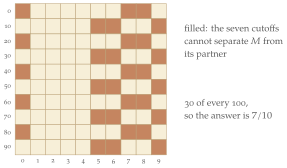
Seven cutoffs beat one, but by less than one might expect, against . They are nowhere near independent: all seven are rounded percentages of the same number, so they tend to break at the same places, two of them cannot separate a pair at all, and the five that can are strongly correlated with each other. Treating them as independent would predict about rather than . Adding ranks reaches diminishing returns quickly.
A caveat about halves
This answer depends on how ties are rounded, and not cosmetically. Amazing at per cent lands exactly on a half for every odd maximum, which is as common a tie as one could arrange. Rounding halves upwards, the ordinary reading of rounded to the nearest whole number, gives . Rounding halves to the nearest even number instead gives , a materially different answer. The main puzzle is not sensitive in this way and gives under either convention, because at per cent the ties are rarer and fall where they do no damage.
The computation
Same enumeration, with the seven percentages in place of the one.
print(density([2, 5, 8, 15, 25, 40, 50])) # 7/10Forty thousand consecutive maxima give exactly , and the ambiguous ones occupy six residues modulo , confirming that the period is and not . The enumeration also confirms the two structural claims: every colliding group is a pair of the form , and across four thousand such pairs the and per cent cutoffs separate none of them, while per cent separates half, per cent two fifths, per cent a fifth, per cent a tenth and per cent two twenty-fifths.