Library · The Fiddler: Solutions · Chapter 7
How Far Can You Roll?
Frederica Fiddleria attaches a light to a point on the circumference of a circular wheel with a radius of one metre. She rolls the wheel for one revolution along the ground, and the light traces a path.
What is the length of that path?
The Fiddler, Zach Wissner-Gross, August 21, 2026(original post)
The official solution appeared in the post of August 28, 2026 and gives metres for the main puzzle, agreeing with the answer below. The Extra Credit half of that post is paywalled, so is my own and has not been checked against it.
Solution
A rolling wheel does not slip, and that one fact fixes the speed of every point on it.
The point in contact with the ground is momentarily stationary. Nothing else in the picture is, so at each instant the whole wheel is turning about that contact point, exactly as if it were hinged there. Every point of the wheel is therefore moving in a circle about the contact point, and its speed is the angular rate times its distance from that point.
Measure time by the angle that the wheel has turned through, so the angular rate is and one revolution is from to . Then
the speed of any point of the wheel is its distance from the point of contact,
and the length of the path it traces is This is worth stating on its own because it does the extra credit as well. A question about motion has become a question about a distance inside a circle.
Now put the light on the rim. The contact point is on the rim too, and the angle between them measured at the centre is exactly , the angle turned through. Two points on a unit circle separated by a central angle are one chord apart, and that chord is . So the light’s speed is : zero at the start, when the light is on the ground, and at the top, twice the speed of the centre. Hence
The curve is a cycloid and the result is the classical one, that an arch of a cycloid is eight times the radius, which was known before calculus was. Two things are worth a moment. The answer is a whole number, and has disappeared from a question about a circle. And the wheel advances along the ground while the light travels , so a light on the rim covers about per cent further than the wheel it is fixed to.
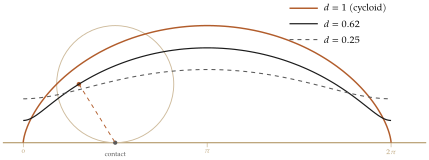
The computation
The check should roll the wheel rather than evaluate the integral. Trace the point through one revolution and measure the resulting polyline.
import numpy as np
from math import pi

t = np.linspace(0.0, 2*pi, 4_000_001)
x = t - np.sin(t)                      # rim point, wheel of radius 1
y = 1.0 - np.cos(t)
print(f"{np.hypot(np.diff(x), np.diff(y)).sum():.8f}")
# 8.00000000
Four million segments give , in error by .
Extra Credit
Instead of placing the light on the circumference, Frederica picks a random point inside the circle, with any two regions of the same area equally likely to contain it. On average, what can she expect the length of the path to be?
One path at a time
Take a point at distance from the centre, with . When the wheel has turned through , the angle at the centre between our point and the contact point is , and the two lie at distances and from the centre. The law of cosines gives the distance between them, which by the observation above is the speed: At this is , which is the rim case again. So the path length for a point at radius is and this has no elementary form. Substituting turns it into a complete elliptic integral of the second kind, which behaves correctly at both ends: , and , the centre running in a straight line one circumference long. Individually, then, these path lengths are not nice numbers, and there is no reason yet to expect their average to be one.
All the paths at once
The move is to stop averaging elliptic integrals and average distances instead.
A uniform point in the disc has radius density on , so writing for the distance from the point at polar coordinates to the contact point, In polar coordinates the element of area is , so the right-hand side is an area integral over the disc: That step is the whole extra credit. The angle that describes the rolling is the same angle that sweeps out the disc, so an average over points of an integral over time collapses into one integral over the disc. What is left is the integral of distance from a fixed point of the circumference, since that is where the contact point sits.
In the right coordinates it is elementary. Put the origin at the rim point. The unit disc is then for , because the chord from a point of a unit circle at angle to the diameter has that length. So using . Therefore
Every one of these path lengths is an elliptic integral, and none is rational except at the two ends, yet the average is a fraction with a in it. The in the area element cancels against the hiding in the mean distance from a rim point, which is .
The value sits where it should, between for the centre and for the rim, and nearer the top of that range because weighting by area favours points far from the centre.
The computation
Again, roll the wheel. Draw a uniform point in the disc, trace it through one revolution, and measure the polyline, with no formula from above reused.
import numpy as np
from math import pi

rng = np.random.default_rng(7)
M, NT = 400_000, 3000
t = np.linspace(0.0, 2*pi, NT + 1)
d = np.sqrt(rng.random(M))              # uniform in the disc: radius density 2d

lens = np.empty(M)
i = 0
for chunk in np.array_split(d, 80):
    x = t[None, :] - chunk[:, None]*np.sin(t)[None, :]      # roll it
    y = 1.0 - chunk[:, None]*np.cos(t)[None, :]
    lens[i:i+len(chunk)] = np.hypot(np.diff(x, axis=1),
                                    np.diff(y, axis=1)).sum(axis=1)
    i += len(chunk)

print(f"{lens.mean():.6f} +- {lens.std()/np.sqrt(M):.6f}")
# 7.111089 +- 0.000779        64/9 = 7.111111
Four hundred thousand traced paths give , three hundredths of a standard error from .
Two further checks, each independent of the derivation. Gauss-Legendre quadrature of agrees with the elliptic form to for across the whole range. And by the geometric route rather than the kinematic one, sampling points of the disc directly gives a mean distance to a rim point of against , which multiplied by returns once more.