Library · The Fiddler: Solutions · Chapter 87
Can You Squeeze the Sheets?
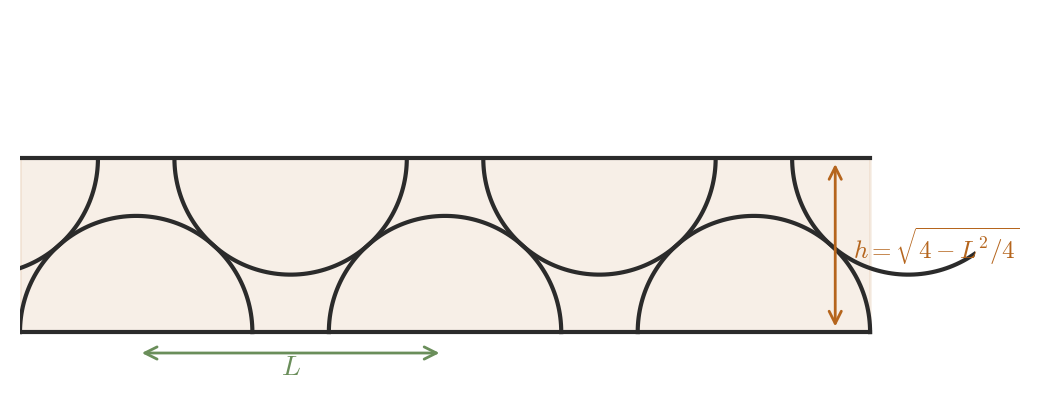
Two identical flat sheets carry parallel semicircular ridges of radius , with adjacent ridges a distance apart. The sheets face each other, ridges toward ridges, and cannot slide sideways. Which leaves the most empty space between them, measured as cross-sectional area per unit length?
The Fiddler, Zach Wissner-Gross, January 3, 2025(original post)
Solution
To pack as tightly as possible the sheets are offset by half a period, so each ridge nestles between two opposing ridges. A top ridge centre and the nearest bottom ridge centre are then separated horizontally by and vertically by the gap ; the ridges (radius each) touch when the centres are apart: In one period of width the slab between the two centre-lines has area , from which the two half-disks (one per sheet, total area ) are solid. The empty area per unit length is therefore Setting gives , so
The computation
Rather than evaluate , encode the geometry directly: for each spacing , find the gap at which the offset ridges just touch, then lay a fine grid over one period of the cross-section and measure the fraction of it that lies inside neither sheet’s semicircles. Scanning locates the most open spacing.
import numpy as np
from scipy.optimize import brentq, minimize_scalar
def empty_per_length(L):
    h = brentq(lambda h: (L / 2)**2 + h**2 - 4, 0, 2)   # ridges just touch
    n = 1500
    xs = (np.arange(n) + 0.5) * L / n
    ys = (np.arange(n) + 0.5) * h / n
    X, Y = np.meshgrid(xs, ys)
    bottom = (X**2 + Y**2 < 1) | ((X - L)**2 + Y**2 < 1)  # bumps up at x=0, L
    top = (X - L / 2)**2 + (Y - h)**2 < 1                 # bump down at x=L/2
    return (~(bottom | top)).mean() * h                   # empty area / period / L
res = minimize_scalar(lambda L: -empty_per_length(L),
                      bounds=(2.001, 3.999), method='bounded')
print(round(res.x, 3), round(-res.fun, 4))   # 2.658  0.3126
Extra Credit
With hemispherical dimples of radius instead of ridges (centres at least apart, any number, sheets not necessarily identical), what is the minimum empty space, as volume per unit area of one flat sheet?
The two-dimensional trick (offset the bumps and let them touch) becomes a sphere-packing question in the gap, and the optimum trades the gap height against how densely the hemispheres tile each sheet. The densest planar arrangement of centres at spacing is the triangular lattice. The minimum is the source’s paywalled extra credit; this is a packing optimisation rather than a single derivative, so I leave it as a computational target rather than assert a number I cannot check.