Library · The Fiddler: Solutions · Chapter 8
Camp Algebra
Camp Algebra held a competition in which campers were split into two teams: the Aces and the Ciphers. Members of the two teams competed in a triathlon of chess, basketball, and baseball, and the results are reproduced below.
To commemorate the event, the counselors designed a cuboidal trophy with dimensions that cleverly related to the results of the three events. Then, being Camp Algebra after all, they computed the square of the shortest path along the trophy’s surface from one corner to the opposite corner. After decoding that number, what camp mascot did they carve into the trophy?
The Fiddler, Zach Wissner-Gross, August 14, 2026(original post). Originally set for the Financial Times’ games special, edited by Ollie Roeder. There was no Extra Credit this week.
The official solution appears in the post of August 21, 2026, which had not been published when this chapter was written. The answer here is my own.
Read the team names first
This one is a puzzle in the style of the MIT Mystery Hunt rather than a mathematical brainteaser, so the work is in noticing rather than deriving. What there is to notice is stated in the first sentence, before any of the events.
An ace is a one and a cipher is a zero. Both words carry that meaning in ordinary English, a cipher being the old name for the digit nothing, and the two teams are named for the two binary digits. That is the only instruction the puzzle gives about how to read anything, and it turns out to be enough: it says how to read the basketball, it says how to read the baseball, and it says how to read the final number.
Three events give three results, three results give three dimensions, and the trophy does the rest.
Chess
Occupatus, playing as white for the Aces, had Castor, playing as black for the Ciphers, on the ropes. But the industrious Castor clearly gave a dam. With what next move did Castor turn the tables?
The game runs to , reaching the position below. White is a rook up for a knight and looks to be winning comfortably.
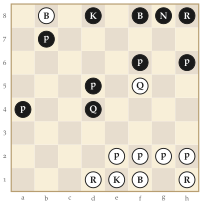
Black’s queen on already looks down the open file at the rook on , which is the first thing anyone checks and the wrong thing to play: is answered by and Black has traded a queen for a rook.
The move that wins is quieter, and it is made by the one piece that has not moved all game: The bishop steps out of to check along the – diagonal. Now count White’s replies. The king has nowhere to go, nothing can capture the bishop, and of the two squares that would block the diagonal, cannot be reached by any white piece. Exactly one legal move remains on the board, and the rook that interposes is pinned against its own king by the queen it is blocking, so it cannot recapture: That is the dam. Castor forces White to build one across the diagonal and then walks through it, and the flavour is a fair warning as well as a joke, since Castor is the beaver’s genus.
For the trophy only the result matters. The Ciphers win the chess, a decisive chess game is scored –, and the margin is .
Basketball
The Aces crushed the Ciphers in the second competition. While the box score showed all the players’ names in order, it neglected to tally the two teams’ scores bit by bit.
The box score gives each player’s shooting but no team totals, so the reader has to add them up. Total field goals include the three-pointers, so a player’s points are .
| Aces | FG | 3FG | FT | Pts |
|---|---|---|---|---|
| Parker, Unity | 8–14 | 2–4 | 2–2 | 20 |
| Edwards, Solo | 7–12 | 3–5 | 2–3 | 19 |
| Roberts, Singleton | 7–11 | 1–3 | 3–3 | 18 |
| Foster, Primo | 6–10 | 2–4 | 3–5 | 17 |
| Ellis, Uno | 6–9 | 2–3 | 4–4 | 18 |
| Carter, Tally | 6–10 | 3–5 | 3–4 | 18 |
| Thompson, O’Neal | 6–10 | 4–4 | 1–1 | 17 |
| 127 |
| Ciphers | FG | 3FG | FT | Pts |
|---|---|---|---|---|
| Smith, Zero | 5–9 | 2–4 | 1–2 | 13 |
| Taylor, Nil | 4–8 | 2–3 | 2–3 | 12 |
| Allen, Void | 4–9 | 1–3 | 3–5 | 12 |
| Harris, Off | 4–7 | 1–2 | 2–2 | 11 |
| Ingram, Null | 4–6 | 1–2 | 2–4 | 11 |
| Robinson, Nought | 4–7 | 2–4 | 1–2 | 11 |
| Davis, Nada | 3–6 | 1–2 | 3–4 | 10 |
| 80 |
Now look at the first names, which is what all the players’ names in order is pointing at. Every Ace is a word for one: Unity, Solo, Singleton, Primo, Uno, Tally, O’Neal. Every Cipher is a word for nothing: Zero, Nil, Void, Off, Null, Nought, Nada.
Seven players a side, so each team’s names spell a seven-bit string, and for the Aces that string is , which is . Their points also come to . The puzzle has quietly checked your reading for you, which is what the phrase bit by bit is doing there.
The Ciphers score , so the margin is .
Baseball
In the final event, the Aces narrowly defeated the Ciphers, 5–4. But whatever did the scoreboard look like? Surely both line-ups had something to say about that.
The play-by-play is given inning by inning, so replay it. Singles, doubles, triples, home runs and walks advance the runners in the ordinary way, and strikeouts, fly outs and ground outs are outs. Every half-inning comes to exactly three outs, which is the check that the replay is being done correctly, and the totals come to – as the problem promises.
| 1 | 2 | 3 | 4 | 5 | 6 | 7 | 8 | 9 | R | |
|---|---|---|---|---|---|---|---|---|---|---|
| Aces | 0 | 0 | 1 | 0 | 1 | 1 | 1 | 0 | 1 | 5 |
| Ciphers | 0 | 1 | 0 | 1 | 0 | 0 | 1 | 1 | 0 | 4 |
The detail worth noticing is what the scoreboard does not contain. No inning ever scores two. Nine innings apiece and every entry a or a , so the line score is itself a pair of binary numbers, nine bits each. That is the third appearance of the same idea, after the team names and the box score, and it is why the line-ups have something to say.
The margin is .
The trophy
Three events, three margins, and the dimensions follow: A long thin bar, which is a strange trophy but exactly the right shape for the question being asked, because it is the case where the shortest surface route is not the obvious one.
To find that route, unfold the box flat. A path between opposite corners crosses two faces, and each choice of two adjacent faces unfolds into a rectangle in which the path is a straight line, so its length is a hypotenuse. For a box the three candidates are and the shortest path squared is the smallest of them. With two of the three coincide: Going the long way round one of the unit ends costs less than crossing the narrow face, because the enters unsquared-with-a-partner in one case and squared-alongside-a- in the other. The winner keeps the two unit steps together:
Decoding 2213
The puzzle has now said binary three times, so write the number in binary: That is twelve bits, which is not a multiple of five, so pad it to fifteen and cut it into three groups. Five bits is exactly the width one letter needs, since fits in five bits and : The padding is forced rather than chosen: pad to twenty bits instead and the leading group is , which is not a letter.
The computation
A puzzle of this kind can be argued into almost any answer, so it is worth pinning this one down independently of the argument that produced it. Search every cuboid with integer sides up to , compute the shortest surface path squared, decode it five bits to a letter, and ask which dimensions can possibly spell bee.
def path2(a, b, c):
    return min((a+b)**2 + c**2, (a+c)**2 + b**2, (b+c)**2 + a**2)

def decode(n):                       # five bits to a letter, A = 1
    s = bin(n)[2:]
    s = s.rjust(((len(s) + 4) // 5) * 5, "0")
    v = [int(s[i:i+5], 2) for i in range(0, len(s), 5)]
    return "".join(chr(64 + x) for x in v) if all(1 <= x <= 26 for x in v) else None

hits = [(a, b, c) for a in range(1, 401) for b in range(a, 401)
        for c in range(b, 401) if decode(path2(a, b, c)) == "BEE"]
print(hits, path2(1, 1, 47))
# [(1, 1, 47)] 2213
Exactly one triple in that whole range spells it, and it is . The three margins were read off three unrelated events, none of which knows anything about the other two, and they land on the only dimensions that work. The chess line was checked the same way, by generating every legal move in the position and every White reply to it: is mate in two, is a slower forced mate in three, and nothing else wins at all.