Library · The Fiddler: Solutions · Chapter 4
Can You Cheat on the Quiz?
Charlie’s teacher gives a pop quiz of three multiple-choice questions, each with four options, A to D, and each worth one point. Charlie has not studied and has no idea of any answer. He does know that his teacher never lets consecutive questions share a correct answer: if one answer is C, the next is not C. And he manages to see his neighbour’s answer to the first question before the neighbour covers the page.
On average, what score can Charlie expect?
The Fiddler, Zach Wissner-Gross, September 11, 2026(original post)
The official solution appeared in the post of September 18, 2026 and gives for the main puzzle by the same argument, the seen letter being the unique best guess for the third question. The Extra Credit half of that post is paywalled, so the three-way tie at is my own and has not been checked against it.
Solution
The puzzle does not say how the teacher chooses among the keys that obey the rule, so take the natural reading: every such key is equally likely. That is the same as choosing the first answer at random and each later answer at random from the three that differ from the one before.
The first question is a sure point, since Charlie copies it.
The second cannot repeat the first, so its answer is one of the other three, each equally likely, and any of them is a one-in-three guess.
The third question is where the rule starts to leak. It cannot repeat the second, and the second is unknown, so it looks like a blind one-in-four. Look closer. Suppose the first answer was A. The second is then B, C or D, and whichever it is, the third may still be A, because only the second answer is barred. So A is never excluded at the third question, while each of B, C and D is excluded whenever it happens to be the second answer, a third of the time. Hence and the same for C and D. The letter Charlie saw is his best guess for the third question as well as the first.
Expected score adds up question by question, so the best plan is the best guess for each question on its own, and
The computation
With four letters the valid keys can simply be listed: there are of them for three questions. For each letter Charlie might see, the check tallies how often every other question takes each letter, takes the commonest as his guess, and averages, all in exact fractions.
from fractions import Fraction
from itertools import product
from collections import Counter

def keys(n):                    # every key with no consecutive repeat
    return [s for s in product(range(4), repeat=n)
            if all(s[i] != s[i+1] for i in range(n-1))]

def expected_score(n, k):       # Charlie looks at question k (0-based)
    K, total = keys(n), Fraction(0)
    for a in range(4):
        cond = [s for s in K if s[k] == a]
        score = Fraction(1)
        for j in range(n):
            if j != k:
                c = Counter(s[j] for s in cond)
                score += Fraction(max(c.values()), len(cond))
        total += Fraction(len(cond), len(K)) * score
    return total

print(expected_score(3, 0))     # 5/3
Extra Credit
Now the quiz has seven questions, under the same rule, and Charlie may look at exactly one of his neighbour’s answers. Which should he look at, and what score should he then expect?
Solution
Call the letter Charlie sees , and let be the chance that the question places away, in either direction, also has answer . A question can match only if the one before it does not, and then does so with chance , so The rule is symmetric in time, since the reversed sequence of answers obeys the same rule with the same probabilities, so the recurrence runs backwards along the quiz as well as forwards. Its fixed point is , and the distance from it is multiplied by at every step: This matches the three-question case, with and .
The sign alternates, and that decides the guess. At an even distance the seen letter is likelier than a quarter, so Charlie guesses it and is right with chance . At an odd distance it is less likely than a quarter, and the other three letters share what is left equally, so he guesses any of them and is right with chance .
Now set an odd distance beside the even one after it: They are equal. The value of a glimpse decays in pairs, and at distances one and two, and at three and four, and at five and six.
That pairing settles where to look. The glimpse is worth most to the questions near it, so the middle of the quiz is the obvious choice, and looking at question four leaves the other six at distances . Question three leaves them at , which swaps a distance of three for a distance of four and so loses nothing, and question five is its mirror image. Three positions tie: Question two gives and question one only , since a glimpse at the edge of the quiz spends half its reach on questions that are not there.
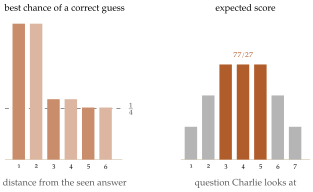
The question is phrased as though it has a single answer, and the middle question is the one most solvers will give. It is a correct answer, though not the only one.
The computation
The same enumeration, now over the valid keys of a seven-question quiz, run once for each question Charlie might look at.
print([expected_score(7, k) for k in range(7)])
# [653/243, 673/243, 77/27, 77/27, 77/27, 673/243, 653/243]
It confirms the three-way tie at exactly, and it knows nothing of the recurrence that predicted it.