Library · The Fiddler: Solutions · Chapter 56
Can You Canoodle at the Coldplay Concert?
At a Coldplay show, the camera operators put of the couples on the jumbotron, chosen at random (and never the same couple twice in one show). You and your partner canoodle for half of every concert. How many shows can the two of you attend while keeping your chance of ever being caught canoodling below ?
The Fiddler, Zach Wissner-Gross, August 8, 2025(original post)
Solution
In one show the chance of being shown is , and you are canoodling half the time, so the chance of being caught is . Over independent shows the chance of never being caught is , and you want this to stay at or above : so the most shows you can attend is .
The computation
Accumulate the survival probability show by show ( each) and take the largest for which it still sits at or above .
print(max(N for N in range(1, 400) if 0.995**N >= 0.5)) # 138Extra Credit
Suppose instead each couple canoodles for a fraction of the show equal to , where and are independent uniform values, one per partner. The operators only show couples currently canoodling, and pick them with probability proportional to how much they canoodle. What fraction of the show do the couples that appear most often on the jumbotron spend canoodling?
Solution
The canoodling fraction has density on . Weighting by appearance (proportional to ) makes the on-screen density , and (The source value is paywalled; this closed form is my own.)
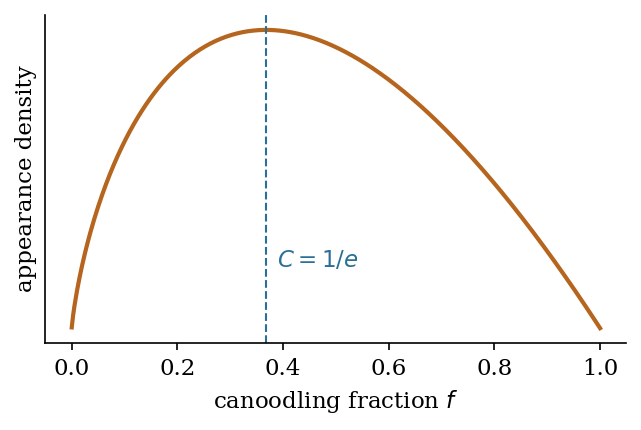
The computation
Build the appearance-weighted distribution empirically: draw millions of couples with , histogram them weighted by (their on-screen likelihood), and read off the peak.
import numpy as np
from math import e
rng = np.random.default_rng(0); f = rng.random(6_000_000)*rng.random(6_000_000)
h, edg = np.histogram(f, bins=300, range=(0, 1), weights=f)   # weight by appearance ~ f
print(round((edg[:-1] + edg[1:])[np.argmax(h)]/2, 4), round(1/e, 4))   # ~0.368, 1/e