Library · The Fiddler: Solutions · Chapter 9
How Lucky Can a Baseball Team Get?
Two teams of equal skill, the Algebraists and the Geometers, play each other times over a season. Each game is won by either team with probability , independently of every other game.
On average, how many games would you expect the team with the better record to have won?
The Fiddler, Zach Wissner-Gross, August 7, 2026(original post)
The official solution appears in the post of August 14, 2026, which had not been published when this chapter was written. The answers here are my own.
Solution
The teams play nobody but each other, and that is the whole problem. There is only one random quantity in it.
Let be the number of games the Algebraists win. Every game has a winner, so the Geometers win the other , and the better record is The two records are not two separate pieces of luck. They are one piece of luck, read forwards and backwards. Whatever the season does, the better record stands as far above as the worse one stands below it, so the only question left is how far that is.
The answer is therefore plus the average distance from to its own mean, where . That average distance is the mean absolute deviation, and for a symmetric binomial it has a closed form. For , The smallest case makes it believable: with the distance is with probabilities , averaging , and the formula gives too. With both come to .
Setting ,
For large the central binomial coefficient satisfies , so the better record sits about games above . Two teams that are exactly as good as each other finish five games apart, and there is nothing to account for. The gap is what coin flips look like. A season is long enough to produce a standings table and nowhere near long enough to make one mean anything.
The computation
Playing the season checks the model rather than the algebra, which is the point of doing it at all.
import numpy as np

rng = np.random.default_rng(20260811)
N = 4_000_000
wins = rng.binomial(162, 0.5, N)          # the Algebraists' wins
better = np.maximum(wins, 162 - wins)     # the Geometers win the rest
print(f"{better.mean():.6f}")
# 86.070587       exact value 86.069876
Four million seasons give against the exact .
The mean absolute deviation formula deserves its own check, since the whole answer rests on it. Summing over all outcomes in exact rationals returns precisely , as an equality of fractions and not merely to within rounding.
Extra Credit
Now there are teams of equal skill, and each team plays each other team five times, so each plays games in all. On average, how many games would you expect the team with the best record to have won?
Solution
Two things about a single team survive the move to a league. One does not.
Each team’s games are still independent fair coin flips as far as that team is concerned, so the marginal law is exactly , with mean and variance . Nothing has changed there.
What breaks is independence. The pairings supply games, each game hands out exactly one win, and so A sum with no randomness in it has no variance, which pins the correlation without any argument about shared games: The direct count agrees: two teams meet five times, in those games one team’s wins are the other’s losses, and their remaining games are independent, so the covariance is that of five fair games with itself reversed, namely .
A maximum depends on the joint law and not on the margins, and this joint law does not factorise. There is no closed form here, and inventing one is the only real error the problem offers. The value comes from playing the league out:
Independence is not a harmless simplification
The tempting shortcut is to treat the thirty teams as thirty separate -game seasons. That model is exactly computable, since a maximum of independent variables has distribution function : It is wins short. The shortfall is small, but its sign is the interesting part, and it is the opposite of what most people guess. Negative correlation sounds as though it should hold the leader back, since a team can only climb by pushing others down. It does the reverse, because the pushing down is exactly the point.
Three facts settle it, none of them requiring the joint law. Every team still has variance , so no team is more erratic in one model than the other. But within a season the thirty records lie further apart in the round robin: for exchangeable variables with correlation the expected sample variance is , and gives And the centre they are spread around never moves: the mean record is exactly in every round-robin season, while under independent schedules it wanders with a standard deviation of about wins. The round robin pins the middle of the table and forces the ends apart, which lifts the top of it. The same pinning is why the best record is also less variable, standard deviation against : the leader is being measured from a centre that cannot drift.
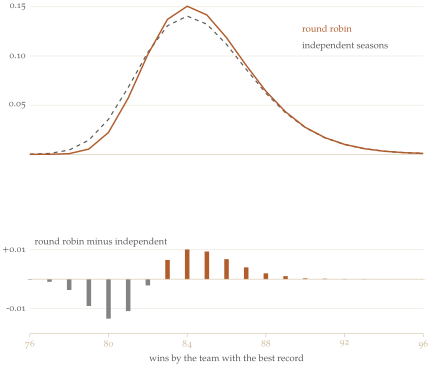
The two-team case proves the direction, because there the coupling is total and both numbers are exact. The puzzle itself gives . Had the Algebraists and Geometers instead each played games against the rest of the world, the better of their two records would average where turns a difference of two binomials back into a single one. The excess above is against , a ratio of , and the asymptotics say where it is going: against , a factor of exactly . With two teams the correlation is and the mechanism runs at full strength. With thirty it is diluted to , and the same effect survives at a fifth of a win.
The computation
Two encodings, written separately, so that a plausible bug cannot agree with itself. The first draws a for each pairing. The second flips all games one at a time. Both assert that every game has been accounted for before the maximum is taken.
import numpy as np

T, PER = 30, 5
pairs = [(i, j) for i in range(T) for j in range(i + 1, T)]
rng = np.random.default_rng(20260811)

M = 4_000_000
W = np.zeros((M, T), dtype=np.int16)
for i, j in pairs:
    d = rng.binomial(PER, 0.5, M).astype(np.int16)
    W[:, i] += d
    W[:, j] += PER - d
assert (W.sum(axis=1) == len(pairs) * PER).all()

best = W.max(axis=1)
print(f"{best.mean():.4f}")
# 84.9816     standard error 0.0014
Four million leagues give with a standard error of . The game-by-game encoding gives over four hundred thousand leagues, agreeing to within its own noise. The same runs confirm the two structural claims made above, returning a within-season sample variance of against the predicted , and a season mean record of with no variation at all.