Library · The Fiddler: Solutions · Chapter 11
Can You Win the World Cup?
Fiddler Nation has reached the semifinals of the World Cup. All four surviving teams hold the same total amount of energy. Before each semifinal, every team independently decides how much of that energy to spend on the match; whatever is left goes to the final. Whichever team spends more in a game wins it, and the two rounds fall so close together that nobody recovers any energy in between.
The other three managers are abysmal. Each will independently pick a percentage between and , uniformly at random, and spend that share of the team’s energy in the semifinal, keeping the rest for the final. You are the cleverest manager of the bunch. What is the largest probability with which you can win the World Cup?
The Fiddler, Zach Wissner-Gross, July 17, 2026(original post)
The official solution appears in the post of July 24, 2026, which had not been published when this chapter was written. The answers here are my own.
Solution
Measure every team’s energy in units of one full tank, so each side starts with and you spend in the semifinal and in the final. Write for the share your semifinal opponent spends, and and for the shares spent by the two teams meeting in the other semifinal. All three are independent and uniform on .
The first half is immediate. You reach the final exactly when you outspend your opponent, so
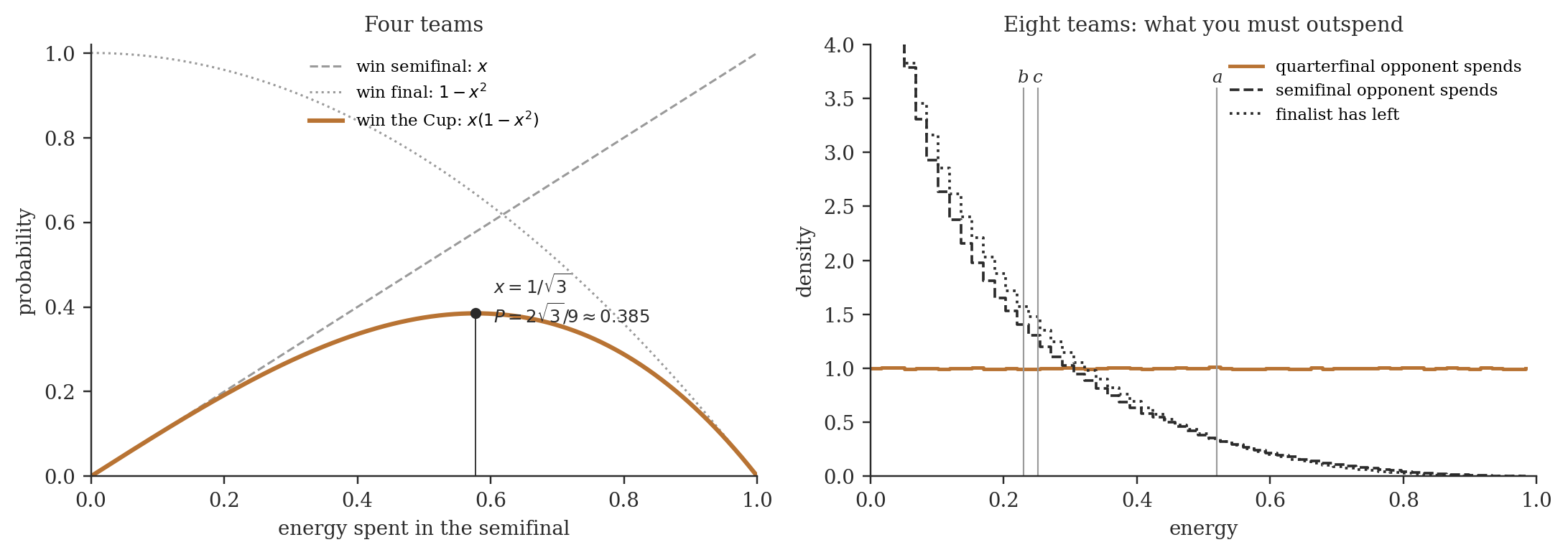
The second half is where the puzzle hides its idea, and it is worth being slow about. You will meet the winner of the other semifinal, and that team won by spending more than its opponent. Its semifinal outlay was therefore , and it arrives at the final carrying You arrive carrying . You win the final when , which is to say when . Since and are independent and uniform, , and so
Here is the observation that makes the problem: you want the other semifinal to be expensive. A team that wins cheaply is a dangerous finalist, because it keeps almost a full tank. A team that wins by spending nearly everything is a spent force. So you are quietly rooting for a bloodbath on the far side of the draw, and says exactly that the bloodbath must have cost more than your own semifinal did.
The two events involve different teams and independent choices, so the probabilities multiply: Now the tension is visible. Spending more wins the semifinal and loses the final; the product is largest somewhere in between. Differentiating, which vanishes at , and there, so this is a maximum. Spending of the tank in the semifinal gives
It is worth noticing how good that is. Three of the four teams are equally matched and choosing at random, so a manager with no idea would win about a quarter of the time. Knowing only that the others are random, and choosing one number well, lifts you to better than three in eight.
The computation
The check must not evaluate or anything else the derivation produced, since that would only confirm the algebra. Instead, play the tournament. Draw the three random managers, run both rounds by the stated rule, and count how often Fiddler Nation lifts the cup, sweeping across the unit interval to find the best value empirically.
import numpy as np

rng = np.random.default_rng(20260718)
N = 20_000_000
A = rng.random(N)                     # your semifinal opponent's spend
B, C = rng.random(N), rng.random(N)   # the other semifinal

def win_rate(x):
    reach_final = x > A                       # you outspend A
    other = np.maximum(B, C)                  # that semifinal's winner spent this
    win_final = (1 - x) > (1 - other)         # you outspend what it has left
    return np.mean(reach_final & win_final)

xs = np.linspace(0.01, 0.99, 197)
ps = np.array([win_rate(x) for x in xs])
i = int(np.argmax(ps))
print(f"best x on the grid : {xs[i]:.4f}   (1/sqrt(3) = {1/np.sqrt(3):.4f})")
print(f"win probability    : {ps[i]:.5f}   (2*sqrt(3)/9 = {2*np.sqrt(3)/9:.5f})")
print(f"at x = 1/sqrt(3)   : {win_rate(1/np.sqrt(3)):.5f}")
# best x on the grid : 0.5800   (1/sqrt(3) = 0.5774)
# win probability    : 0.38477   (2*sqrt(3)/9 = 0.38490)
# at x = 1/sqrt(3)   : 0.38477
Twenty million tournaments put the best allocation at the grid point nearest and the winning rate at , against the derived .
Extra Credit
Fiddler Nation has in fact reached the quarterfinals, not the semifinals, so eight teams remain and each must spread one tank of energy across up to three matches. The other seven managers are as abysmal as before. Each picks a uniformly random percentage of its team’s energy for the quarterfinal; if it survives, it picks a uniformly random percentage of what remains for the semifinal; if it survives that, everything left goes to the final. Your strategy must be fixed in advance. What is the largest probability with which you can win the World Cup?
Solution
Fix your three outlays , and in advance, with ; there is no reason to hoard, since spending more can only help in the match at hand. Your three opponents come from disjoint parts of the draw, so the three matches are independent and the probabilities again multiply.
The single idea from the main puzzle now does all the work, and it does it three times over. Winning costs energy, so every opponent after the first is a survivor, and survivors are poor. Your three opponents have won zero, one and two matches respectively, and each victory has drained them.
The quarterfinal. Your opponent has played nobody and spends a uniform share , so This is the only full-strength opponent you will face.
The semifinal. Your opponent won a quarterfinal, so it outspent someone: its quarterfinal outlay was for two independent uniforms, leaving . It then commits a uniform share of that remainder, so its semifinal spend is with uniform. Conditioning on , the spend is uniform on , and has density . Therefore the second piece collecting the cases where the opponent has less than left in total. The first integral is and the second is , and they combine to the tidy
The final. Your opponent has won twice. Write for what a quarterfinal winner has left, a variable with density on . Such a team spends , uniform on , in its semifinal, and keeps . Two of them meet, and the one that advances is the one with the larger ; you must outspend whatever it kept. Writing for the distribution function of , which is the same function that appeared above, and for its integral, where means . The factor counts which of the two teams advances and the condition has become inside the integral. This last integral has no closed form, so the optimum is located numerically in the computation below.
Maximising the product of the three subject to gives
More than half the tank goes into the very first match, which is the opposite of what husbanding your resources would suggest. The reason is the one idea again: the tournament weakens your later opponents for you, but nobody has weakened the first. Your semifinal opponent spends only a sixth of a tank on average, and the finalist arrives poorer still, so a quarter of a tank suffices against each. The scarce resource is spent where the opposition is richest.
The computation
Again the check plays the tournament rather than trusting the integrals. Eight teams, seven random managers drawing a fresh uniform fraction at each round they survive, and a search over the allocations that sum to one.
import numpy as np

def win_rate(a, b, c, N=12_000_000, seed=123):
    r = np.random.default_rng(seed)
    U, V = r.random((7, N)), r.random((7, N))
    qf   = U                       # each opponent's quarterfinal spend
    rem  = 1 - U                   # what it keeps if it survives
    sf   = V * rem                 # its semifinal spend
    rem2 = rem * (1 - V)           # what it takes to a final
    idx  = np.arange(N)

    win_qf = a > qf[0]                                  # team 0 is your first opponent
    w      = np.where(qf[1] > qf[2], 1, 2)              # teams 1,2 meet; bigger spender wins
    win_sf = b > sf[w, idx]

    w1 = np.where(qf[3] > qf[4], 3, 4)                  # the other half of the draw
    w2 = np.where(qf[5] > qf[6], 5, 6)
    finalist = np.where(sf[w1, idx] > sf[w2, idx], w1, w2)
    win_f = c > rem2[finalist, idx]

    return np.mean(win_qf & win_sf & win_f)

best = max(((win_rate(a, b, 1 - a - b), a, b)
            for a in np.arange(0.44, 0.60, 0.01)
            for b in np.arange(0.16, 0.30, 0.01)), key=lambda t: t[0])
p, a, b = best
print(f"best allocation : a={a:.3f}  b={b:.3f}  c={1-a-b:.3f}")
print(f"win probability : {p:.5f}")
print(f"at the derived optimum : {win_rate(0.520, 0.230, 0.250):.5f}")
# best allocation : a=0.520  b=0.230  c=0.250
# win probability : 0.28162
# at the derived optimum : 0.28162
Twelve million eight-team tournaments put the best allocation at and the winning rate at , matching the optimum found from the integrals.