Library · The Canterbury Puzzles · Chapter 9
The Spider and the Fly
On this page
- No. 73. The Game of Kayles
- No. 74. The Broken Chessboard
- No. 75. The Spider and the Fly
- No. 76. The Perplexed Cellarman
- No. 77. Making a Flag
- No. 78. Catching the Hogs
- No. 79. The Thirty-one Game
- No. 80. The Chinese Railways
- No. 81. The Eight Clowns
- No. 82. The Wizard’s Arithmetic
- No. 83. The Ribbon Problem
- No. 84. The Japanese Ladies and the Carpet
- No. 85. Captain Longbow and the Bears
- No. 86. The English Tour
The last part of Dudeney’s book has no story to hold it together. He called it simply Miscellaneous Puzzles: forty-two of them, from Nos. 73 to 114, each with its own small scene, a medieval game in one place, a cellar or a railway carriage in another. They follow here in his order across this chapter and the next two, and each chapter takes its name from one of its puzzles. None of them carries a number forward, so none has a Reckoning.
No. 73. The Game of Kayles
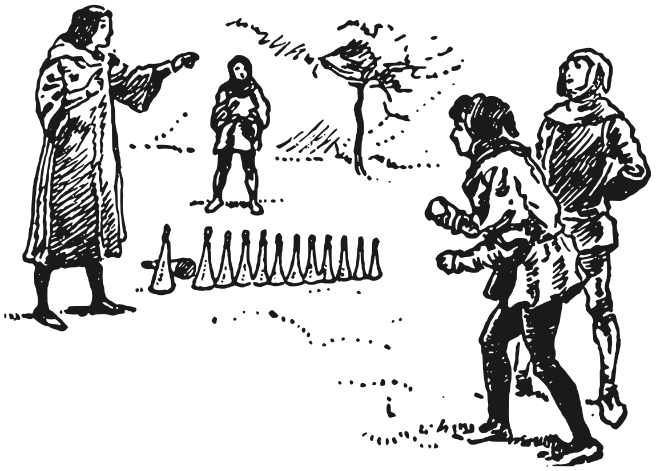
Kayles, from the French quilles, was a great favourite in the fourteenth century and the parent of ninepins. The pins were set up in a straight row and knocked down, first with a thrown club and later with a ball, and the players became so expert that they could always knock down any single pin, or any two pins standing next to each other. So they changed the game: whoever knocked down the last pin won.
Here is a table version. Set thirteen counters (coins, dominoes, beans, anything) close together in a straight row, and take away the second one. Then the two players take turns to remove either one counter or two counters that stand next to each other, and the player who takes the last counter wins. Which player can be sure of winning, and how?
No. 74. The Broken Chessboard
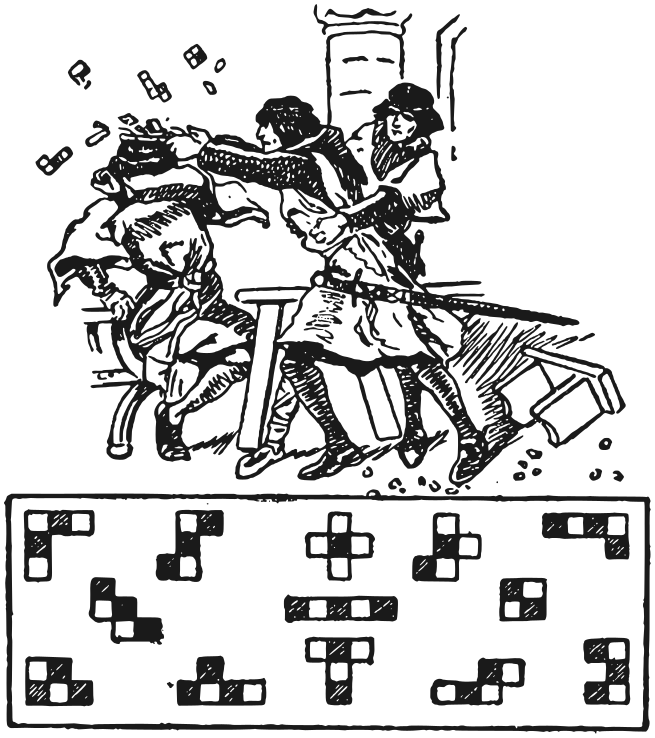
The old chronicles tell how Prince Henry, the son of William the Conqueror, played chess with Louis, the Dauphin of France, and won so much from him that Louis threw the chessmen in his face. Henry struck him with the board, drew blood, and would have killed him on the spot had his brother Robert not held him back.
Tradition, not to be trusted on this point, says that the board broke into the thirteen pieces in the picture: twelve pieces of five squares, all of different shapes, and one little piece of four. Fit them together into a perfect chessboard, properly chequered.
No. 75. The Spider and the Fly
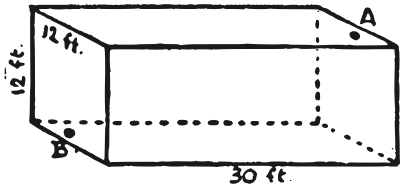
A room is 30 feet long, 12 feet wide and 12 feet high. A spider sits on one end wall, in the middle of its width and 1 foot below the ceiling, at A. A fly sits on the opposite end wall, in the middle and 1 foot above the floor, at B. What is the shortest distance the spider must crawl to reach the fly, which stays where it is? The spider never drops or uses its web, but crawls fairly over the walls, floor and ceiling.
No. 76. The Perplexed Cellarman
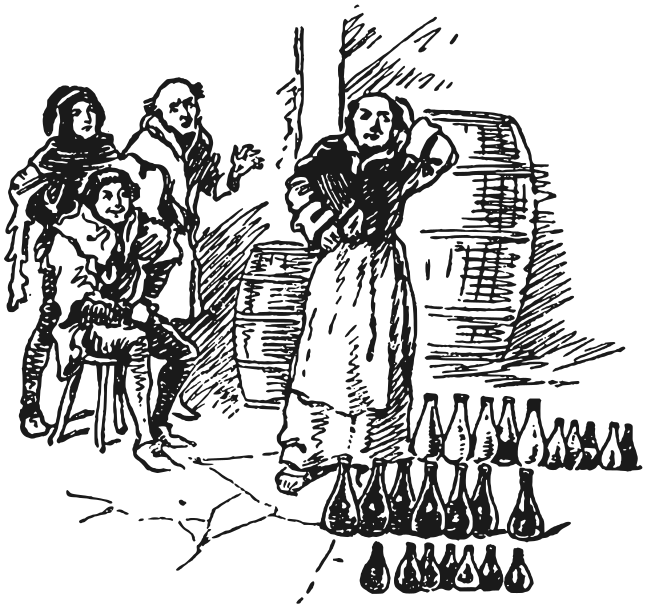
Abbot Francis, of an old monastery in the west of England, was known for miles around for his fairness. One day he complained to Brother John, the cellarman, about a certain bottling of wine. John had bottled a dozen large bottles and a dozen small, and five of each had been drunk in the refectory. “Then give the two dozen bottles, full and empty, to the three men waiting at the gate,” said the Abbot, “and see that no man receives more wine than another, nor any difference in bottles.”
John had seven large and seven small bottles full, and five large and five small empty. Two small bottles hold as much as one large, but an empty large bottle is not worth two small ones, so each man must take the same number of bottles of each size. How was the division made?
No. 77. Making a Flag
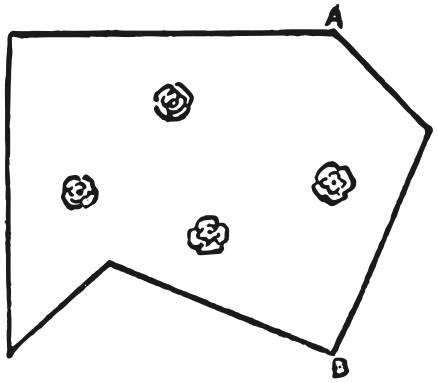
A good dissection puzzle in only two pieces is a rarity. The picture shows a piece of bunting with four roses on it. Cut it into two pieces, without waste, that fit together to make a perfectly square flag with the four roses placed symmetrically. Without the roses this would be easy: cut from A to B and fit the piece in at the bottom. But the cut may not pass through a rose, and there lies the difficulty.
No. 78. Catching the Hogs
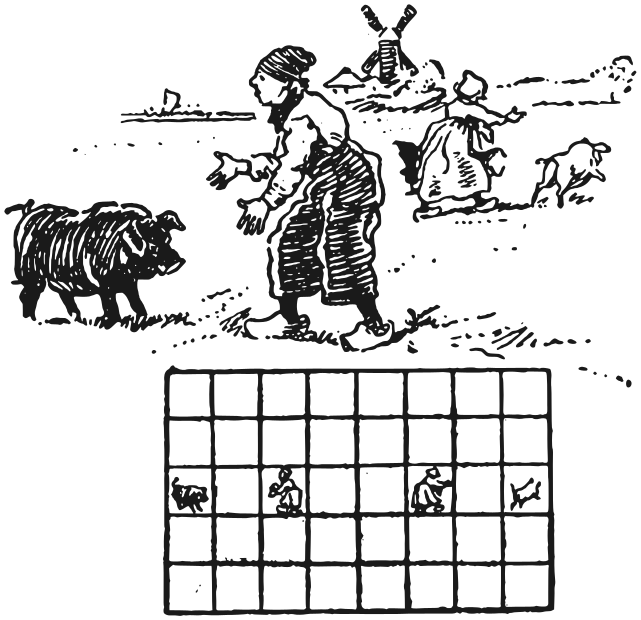
Hendrick and his wife Katrün are trying to catch their two hogs, and failing. Why? The answer is in a little game. Copy the board and put four counters on the squares shown, for Hendrick, Katrün, the black hog on the left and the white hog on the right. One player has Hendrick and Katrün, the other the hogs. The first player moves Hendrick and Katrün one square each, up, down, left or right (never diagonally); then the second player moves both hogs one square each in the same way; and so on in turns, until Hendrick has caught one hog and Katrün the other by moving onto its square. The game would be absurdly easy if the hogs moved first, but Dutch pigs will not.
No. 79. The Thirty-one Game
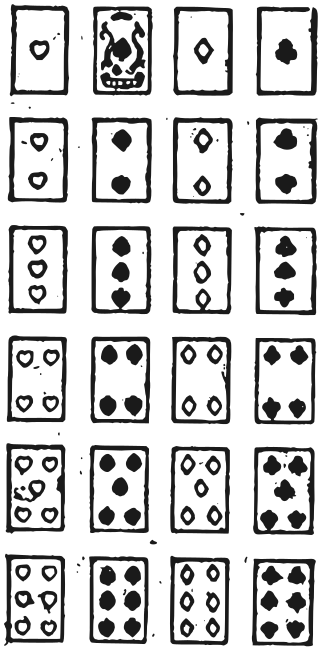
This game was once a favourite of card-sharpers at racecourses and in railway carriages. The sharper lays out the twenty-four cards in the picture, the ace to six of each suit. The two players take turns to turn down a card and add its value to a running total. Whoever makes the total exactly thirty-one wins, and a player who can only go beyond thirty-one loses.
Should you play first or ask your opponent to? And how should you play? The obvious plan is to lead a 3 and then make 10, 17, 24 and 31 in turn, since whatever your opponent turns you can always answer with the card that makes up seven. But try it against the sharper. You play 3, he plays 4 (seven); you play 3 (ten), he plays 3 (thirteen); you play 4 (seventeen), he plays 4 (twenty-one); you play 3 (twenty-four). He turns the last 4 and makes twenty-eight, and there is no 3 left for you to make thirty-one. You must go beyond it, or let him make it.
No. 80. The Chinese Railways
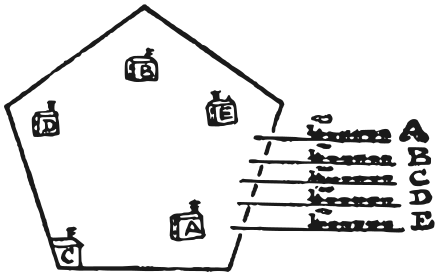
The plan shows a Chinese city inside pentagonal walls. Five European powers each wanted a concession to run a railway into it, and at last one of the Emperor’s advisers said, “Let every one of them have one!” The letters show where each company’s line must enter the city, on the right, and where its station must stand. No line may cross another, or pass through another company’s station. Trace the five lines, A to A, B to B, and so on.
No. 81. The Eight Clowns
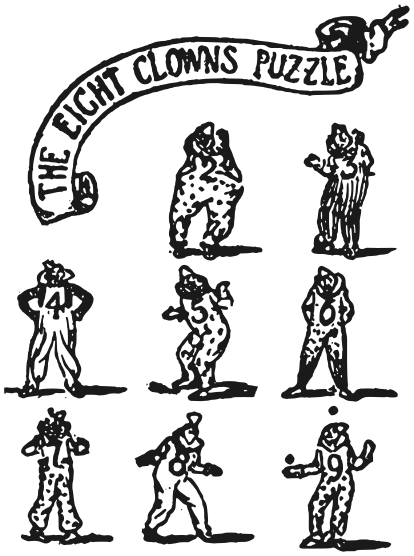
A troupe of clowns on the Continent each wore one of the numbers 1 to 9 on his body, and they finished their act by forming magic squares at speed. Suppose clown No. 1 fails to appear, as in the picture. Arrange the other eight in a square of nine places, one place left empty, so that every row, every column and both diagonals add up alike. The empty place may be anywhere, but it is No. 1 who is missing.
No. 82. The Wizard’s Arithmetic
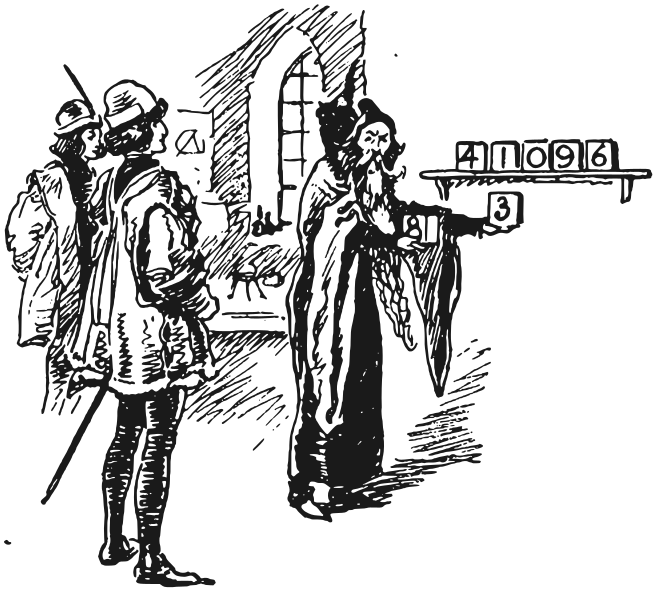
A knight asked a famous wizard for a sample of his skill with numbers. The wizard set five numbered blocks on a shelf, apparently at random, reading 41096, and took up an 8 and a 3 to make 83. “Canst thou multiply one into the other in thy mind?” The knight could not. The wizard simply put the 3 in front of the row and the 8 at the end, and the shelf read 3410968, which is exactly 83 times 41096.
How many other two-figure multipliers can you find that do the same? You may put as many blocks on the shelf as you like, with any figures you choose.
No. 83. The Ribbon Problem
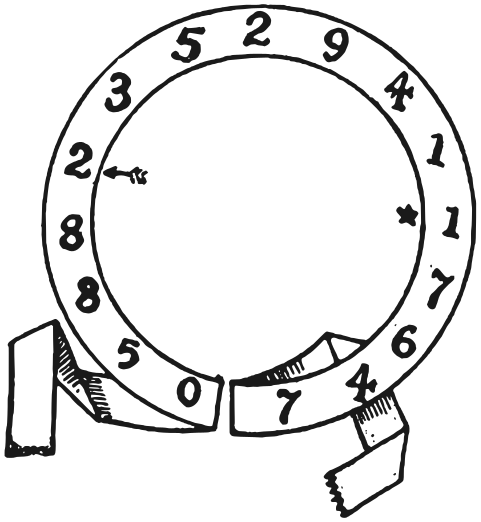
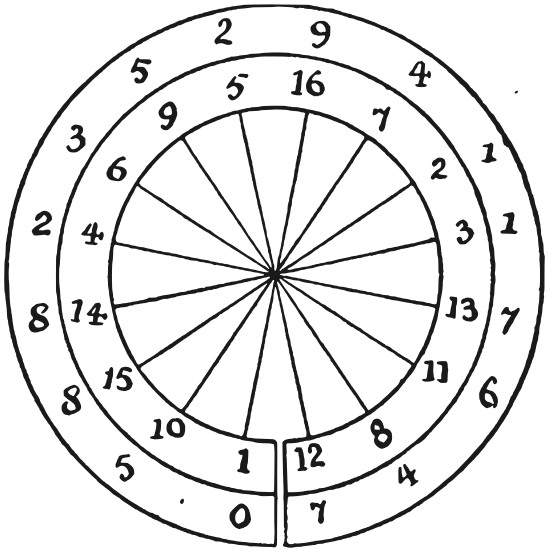
Take the ribbon by its ends and pull it straight, and it reads 0588235294117647. Multiply this number by any of 2, 3, 4, 5, 6, 7, 8 or 9, and you get the same figures in the same circular order, starting from a different place: multiplied by 4 it gives 2352941176470588, which starts at the dart, and multiplied by 3 it starts at the star. Put a different set of figures on the ribbon that behaves in the same way, keeping the 0 and the 7 at its two ends.
No. 84. The Japanese Ladies and the Carpet
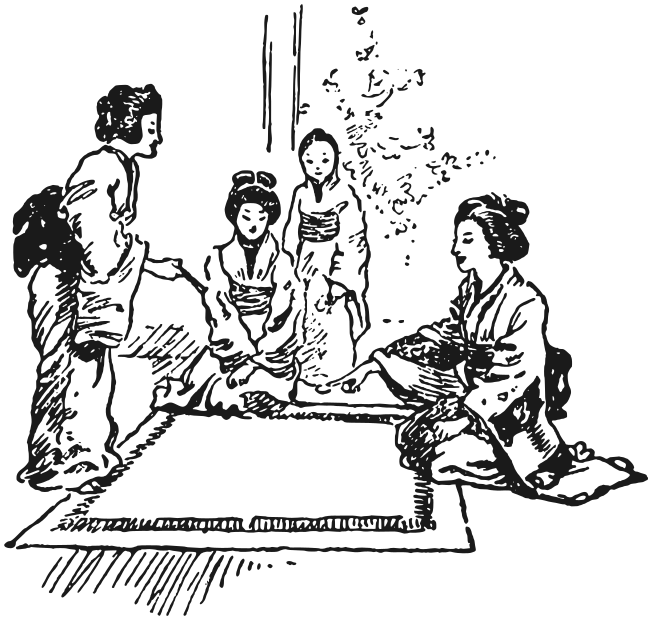
Three Japanese sisters owned a square ancestral carpet and decided to cut it into three square rugs, one for each. One sister offered to take a smaller share, since then four pieces would be enough: with a carpet of nine square feet, one could take a square of two feet whole, another a square of two feet in two pieces, and the third a square foot whole. The other two would not hear of it and insisted on three squares of exactly the same size. Western authorities say that needs seven pieces; a correspondent in Tokyo says the legend has it done in six. Can it be? Cut the square carpet into six pieces that form three equal square mats.
No. 85. Captain Longbow and the Bears
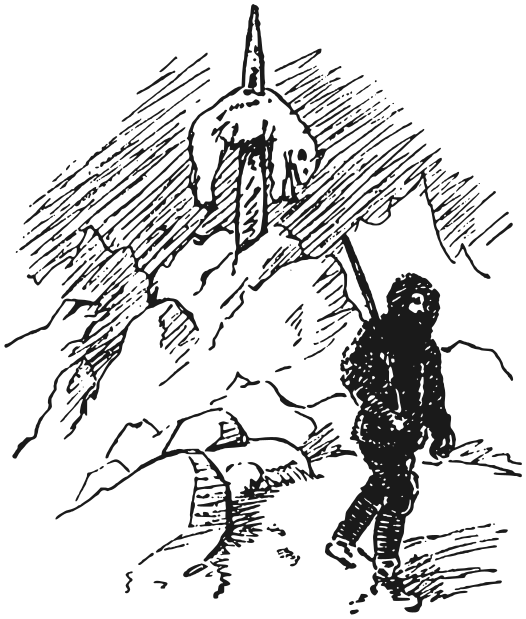
Captain Longbow says he reached the North Pole, though nobody believes him. He found a bear there going round and round the top of the pole (which, he says, is a pole), puzzled that every way he looked was due south. The Captain shot it and left it impaled on the Pole as evidence for future travellers.
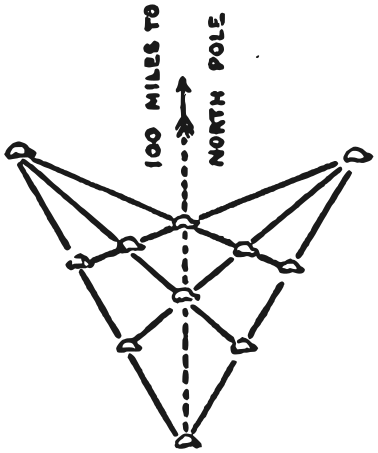
A hundred miles south on the way home he looked down from a height one morning and saw eleven bears nearby, placed so that there were seven rows of bears with four bears in every row. Try making eleven dots on paper with seven rows of four and you will find it difficult, but the Captain insists it was quite possible. How were they arranged?
No. 86. The English Tour
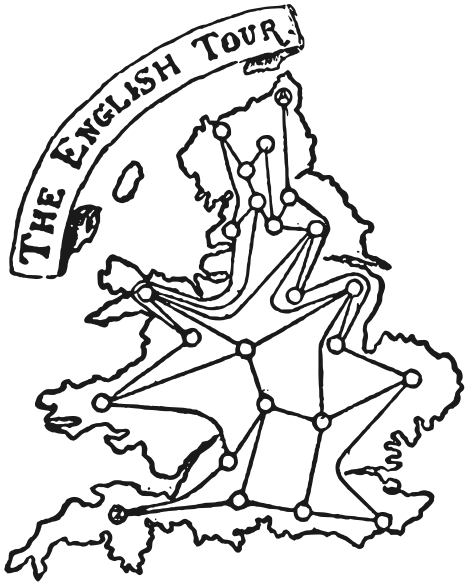
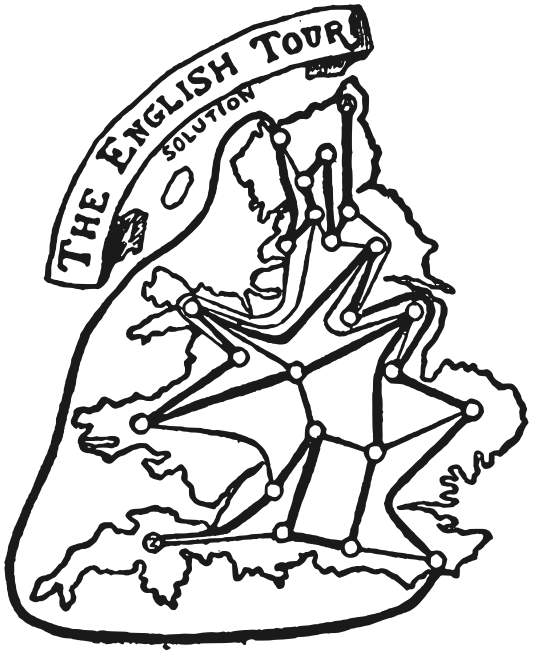
The map shows twenty-four towns joined by railways. A resident of A, at the top, wants to visit every town once and only once and finish at Z. This would be easy if he could cut across country by road as well as by rail, but he may not. How does he do it?
The Game of Kayles
Dudeney’s key is a copying strategy. If you can leave your opponent the rows of counters in matching pairs (two rows of three, say, or a row of one and a row of one), you win: whatever he takes from one row, you take the same from its twin, and you are sure to take the last counter. In a single unbroken row the first player wins at once by taking the middle counter, or the middle two, and copying from then on. Taking away the second counter before play spoils that easy win.
The start, one counter and then a row of eleven, is not a matching position, and the first player wins by knocking down the sixth or the tenth counter, counting the missing one as the second. Either move leaves rows of one, three and seven. Dudeney shows how every reply can be met by play that eventually leaves matching pairs, and then leaves “the complete analysis” to the reader.
That analysis was completed long after Dudeney, and it shows why rows of one, three and seven belong together. Independently, R. P. Sprague in 1935 and P. M. Grundy in 1939 showed that in any game of this kind, where both players have the same moves and whoever moves last wins, every position behaves like a single pile in the game of Nim and can be given a number. R. K. Guy and C. A. B. Smith worked out these numbers for Kayles in 1956. For a single row of counters they begin
| row of | 0 | 1 | 2 | 3 | 4 | 5 | 6 | 7 | 8 | 9 | 10 | 11 | 12 | 13 |
| number | 0 | 1 | 2 | 3 | 1 | 4 | 3 | 2 | 1 | 4 | 2 | 6 | 4 | 1 |
and the number of a row is the smallest whole number that is not the number of any position one move away. The number of several rows together is found by writing their numbers in binary and adding without carrying, so that , and , which are , and , give . A position is lost for the player about to move exactly when that number is 0, because every move from such a position makes it non-zero, and from any non-zero position some move makes it 0 again. Rows of one, three and seven have numbers 1, 3 and 2, which add in this way to 0; the starting position, with numbers 1 and 6, does not. Knocking down the sixth or tenth counter are the only first moves that reach 0.
Answer first player; knock down the 6th or 10th
The Broken Chessboard
The twelve pieces of five squares are the twelve different shapes that five squares can make, and the thirteenth is a square of four. Figure 9.1 shows Dudeney’s arrangement. Nothing short of trial finds it, but the colours help: every piece must go where its dark and light squares match the board, which rules out most placements before they are tried.
It is not the only one. Keeping the pieces face up, there are four arrangements in all, and four more that are the same ones with the whole board turned half round.
Turning a board a quarter turn swaps its colours, so these cover both ways of chequering it.
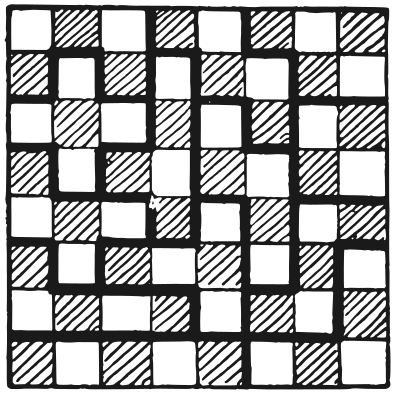
Answer four ways (eight with half turns)
The Spider and the Fly
Imagine the room as a cardboard box, cut open along some of its edges and laid flat.
Any route over the surfaces becomes a line on the flat card, and the shortest route across a given set of faces becomes a straight line. So the problem is to choose the faces the spider crosses, unfold them, and measure.
The direct route runs straight down the middle: 1 foot up to the ceiling, 30 feet along the ceiling and 11 feet down the far wall to the fly, which is 42 feet. Better routes cut diagonally across the side walls. Dudeney’s four candidates are in Figure 9.2. The best of them goes from the end wall onto the ceiling, crosses one side wall slantwise, then the floor, and reaches the far end wall. Laid flat, the ceiling, the side wall and the floor make a strip 36 feet across and 30 long, with the two end walls hinged to its ends. The spider then sits 1 foot beyond one end of the strip and the fly 1 foot beyond the other, so they are feet apart along it. Across the strip the spider is level with the middle of the ceiling and the fly with the middle of the floor, feet apart. The route is two feet shorter than the direct one, and it crosses five of the room’s six faces. Dudeney’s other two candidates measure and feet.
Dudeney ended by asking the reader for the shortest routes when the spider and the fly are 2, 3, 4, 5 and 6 feet from the ceiling and the floor. They are and feet at 2 and 3 feet, both across four faces, and at 4 feet and beyond the direct 42-foot route down the middle is best.
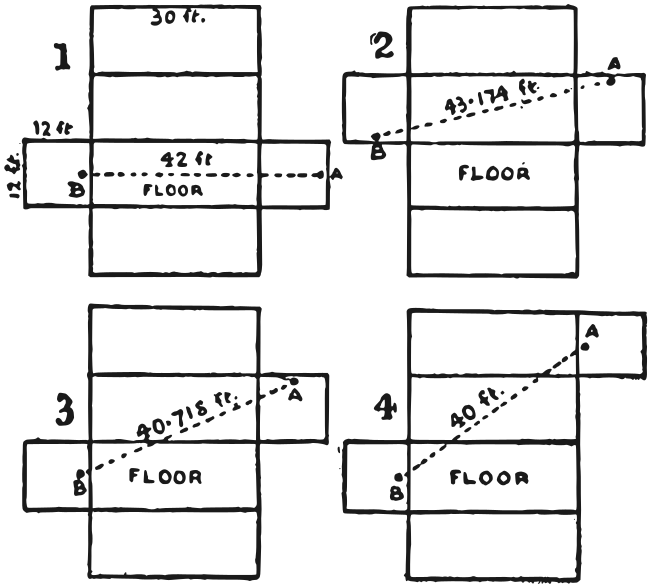
Answer 40 feet
The Perplexed Cellarman
There are twelve large bottles and twelve small, so each man takes four of each.
Count wine in small bottlefuls: there are , so each man’s share is 7. A man with full large bottles and full small ones has , with neither more than four, so either and , or and . The seven full large bottles must be shared as three numbers from that add up to 7, which can only be .
So one man receives three full large bottles and one full small, with one large and three small empty. Each of the other two receives two full large and three full small, with two large and one small empty. That is the only way to do it.
Answer full: 3 large + 1 small, and twice 2 large + 3 small
Making a Flag
The cut is a staircase. Figure 9.3 shows it running across the bunting in a zigzag of equal teeth, clear of every rose. Slide the right-hand piece down by one tooth and the teeth fit back together, one step along, while the outline closes into a square with the roses symmetrically placed. Moving one piece a step along a staircase changes the proportions of the whole while wasting nothing, and here the steps can be placed to weave between the roses. Dudeney compares it with a stepped dissection in his Amusements in Mathematics.
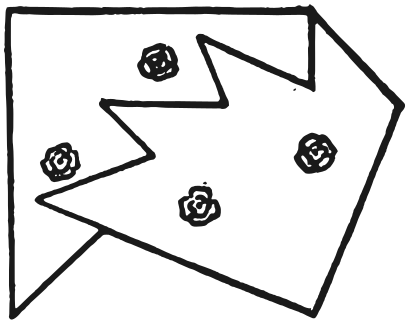
Answer a staircase cut
Catching the Hogs
Colour the board like a chessboard. Every move, by a person or a hog, goes to a square of the other colour. A capture happens when a chaser moves onto a hog, so the chaser must start its move on a square next to the hog, which means a square of the other colour. Now look at one chaser and one hog at the moment the chaser is about to move. After the chaser moves and the hog replies, both have changed colour, so whether they stand on the same colour or on different colours never changes. If they start on the same colour, the chaser can never be next to the hog when it is its turn, and the hog is never caught.
Hendrick has one square between him and the black hog, so they stand on the same colour, and he can chase it for ever. So can Katrün with the white hog. But four squares separate Hendrick from the white hog, and four separate Katrün from the black one, so those pairs start on different colours. On a board this small the chaser can then drive the hog into a corner and catch it; either capture takes at most six moves.
Hendrick and Katrün failed because each went after the hog in front of them. They should have changed hogs.
This is the principle chess players call “the opposition”. Dudeney’s rule is the same one: an odd number of squares between chaser and hog means no capture, an even number means a capture. In his revised edition he gives the number of squares between each chaser and the hog behind as six, but on his own board it is four; the rule is untouched, since both are even.
Answer each must chase the hog behind them
The Thirty-one Game
The plan of making 3, 10, 17, 24 and 31 works in a game with unlimited cards, because any card from 1 to 6 can be answered by the card that makes seven. Here there are only four cards of each value, and the sharper wins by exhausting the ones you need. Every time you answer his 4 with a 3, or his 3 with a 4, you use up the pair together, and with the 3s and 4s gone the key numbers cannot be reached.
The first player can still win, by leading a 5. If the opponent then plays another 5, making 10, answer with a 2 to make 12, and go on answering every 5 with a 2. The first player has turned exhaustion against the sharper. After his third 5, which makes 24, you play 2 to make 26, and the last 5, the only card that would make 31, is already on the table. If at any point he plays anything other than a 5, you step in and make the next of 10, 17, 24 and 31, and keep doing so.
A lead of 1 or 2 also wins, though the play is more complicated; a lead of 3, 4 or 6 loses against correct play.
In the first edition Dudeney named only the lead of 1 besides the 5, and he added the 2 when he revised the book.
Answer play first and lead a 5
The Chinese Railways
The difficulty is that the five lines enter side by side on one wall, in the order A, B, C, D, E, while the stations are scattered in a quite different order round the city, so a line cannot simply head for its station without cutting across its neighbours. The way out is to keep the lines together as a bundle, like the approach tracks to a crowded terminus, and let each one leave the bundle only when it reaches its own station, curving round the stations of the others. Diagram 1 in Figure 9.4 is Dudeney’s layout, which he thought used the least track.
He also asked how many solutions there are, and gave an unexpected answer: infinitely many, if lines have no width. Diagrams 2 to 5 show line A alone, wound one more turn around stations B and E each time. Every winding still leaves the other companies an unobstructed way to their stations, and nothing stops the winding from going on for ever. He added that with some sensible limit on the windings, the number of solutions would be a little short of two thousand, but he did not say which limit, so that count cannot be checked.
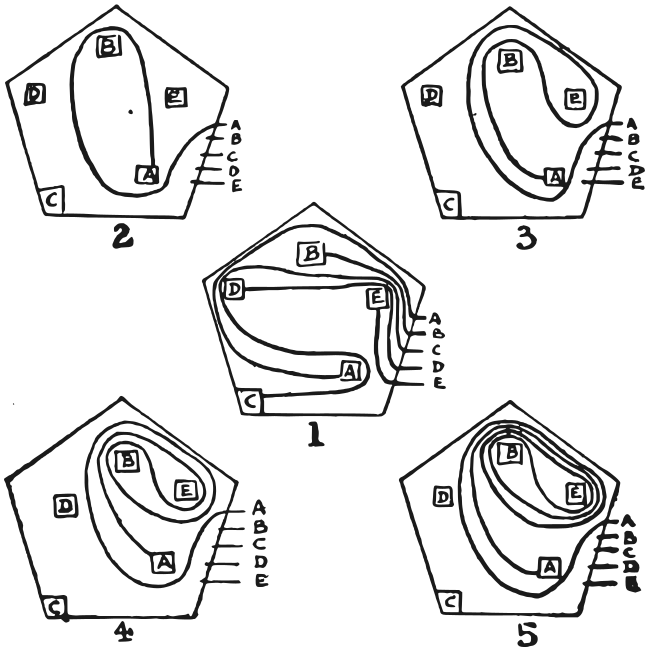
Answer Diagram 1; infinitely many
The Eight Clowns
Taken plainly, it cannot be done. The eight numbers 2 to 9 add up to 44, and the three rows of a magic square together hold every number once, so each row would have to add up to a third of 44, which is not a whole number. With No. 9 missing instead there is no difficulty: 1 to 8 add up to 36, each line to 12, and the square is easy to make.
Dudeney’s way out is in the picture. Clown No. 9 is juggling, and the two balls hang in the air just above his figure, like the dots that mark a recurring decimal. He is showing , which is . To see why that equals 1, call it : then , so subtraction gives and . With No. 9 standing in for No. 1, the troupe forms and every row, column and diagonal adds up to 12.
It is a joke answer, and the arithmetic behind it is sound.
Answer 9 read as
The Wizard’s Arithmetic
Write the multiplier as a two-figure number with tens figure and units figure , and let the number on the shelf be , with figures. Putting in front and at the end makes , so the trick works when that is, For the wizard’s 83 this reads , and .
The equation also shows how to hunt for others: for each multiplier, find a power of 10 that makes the right-hand side divisible by , and check that the quotient has the right number of figures. Since powers of 10 repeat their remainders on division by any number below 90, only a limited range of lengths needs trying.
There are exactly two more, as Dudeney says, and a search over every multiplier and that range of lengths confirms it. The multiplier 86 works with : . The other is 71, and its smallest shelf number has fifty-two figures, which, multiplied by 71, gives the same figures with a 1 in front and a 7 behind. Every multiplier that works has infinitely many shelf numbers. For 83, putting the block 41095890 in front of 41096 any number of times still gives a number the wizard can multiply by 83 in his way.
Answer 86 and 71 (with 83)
The Ribbon Problem
The ribbon number is the repeating block of the decimal for : . Working out that decimal by long division, the remainders run through every number from 1 to 16 before repeating, so the decimals of are the same sixteen figures started at different places. Multiplying the ribbon number by gives the block of , which is why it survives multiplication by anything up to 16, and not merely up to 9. Dudeney’s ring figure (Figure 9.5) writes the remainders inside the circle of figures: the place where each remainder stands is the place where the corresponding product begins.
The same happens for any prime
whose decimal takes the longest possible period, figures. A ribbon that starts with 0 needs larger than 10. To end in 7, notice that times the block is a row of nines, so the last figure of the block times the last figure of must end in 9; with a block ending in 7, must end in 7 as well. The primes above 10 that end in 7 are 17, 37, 47, and so on, but repeats after only three figures. The next is 47, whose decimal has the full period of 46 figures: and this number, multiplied by anything from 2 to 46, gives the same circle of figures. Dudeney’s printing of this number, in the 1908 edition and in the revised one, has a 3 where the sixth figure from the end should be 8.
Dudeney thought it improbable that a shorter number would do, and he was right. Among all numbers of fewer than 46 figures, the only ones that behave this way under 2 to 9, start with 0 and end with 7, are the 1/17 block itself and that block written twice.
Answer the 46-figure block of 1/47
The Japanese Ladies and the Carpet
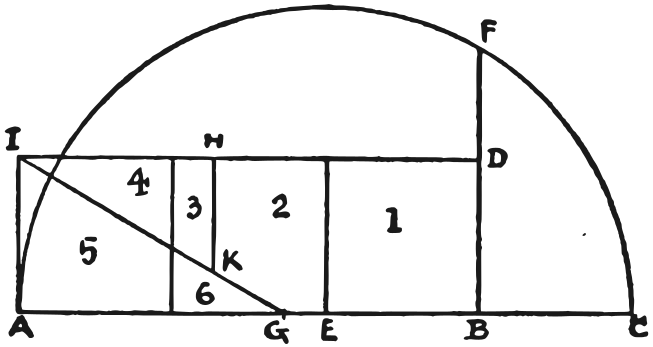
Take the three equal mats first and see how to join them into one square, then reverse the process. Three unit squares side by side make a rectangle 3 long and 1 high, and the square of the same area has side . Dudeney finds that side with compasses: extend the base of the rectangle by its height, draw a semicircle on the whole, and the perpendicular raised where the rectangle ends meets the semicircle at height , the mean proportional of the two sides.
The semicircle calculation in the Haberdasher’s solution gives the reason: height squared equals the product of the two base segments, here .
Now cut the rectangle along the slanting line from its top left corner to the point on the base at distance from the left, and down from the top at distance from the right until this vertical meets the slanting line. With the two edges between the squares, that makes six pieces (Figure 9.6). The remarkable thing is how they go together. Nothing is turned. Pieces 5 and 6, below the slanting line, stay where they are. Pieces 4 and 3 slide together, right by and down by , and sit against the slanting line further along. Pieces 2 and 1 slide together, left by and up by , and fill the top of the square. The six pieces make a square of side exactly.
For the puzzle as set, run this backwards: cut the carpet into the six pieces, and pieces 1, 4 with 5, and 2 with 3 and 6 make the three mats. Dudeney also shows how to find the mats’ side directly from the carpet. On the carpet , mark on the side with half the diagonal , draw , and drop a perpendicular from onto it. Then is the side of the three mats, the carpet’s side divided by .
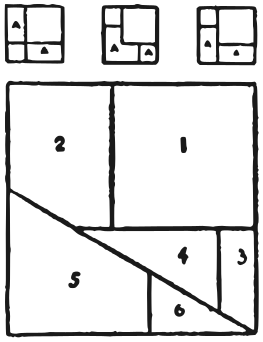
Answer six pieces, as in the figure
Captain Longbow and the Bears
The story of the bear on the Pole is part of the puzzle.
Dudeney says that eleven bears cannot form seven rows of four on their own; that impossibility is not proved here. A catalogue of tree-planting arrangements records constructions with six rows for eleven points and seven for twelve. The twelfth point is the impaled bear. In Dudeney’s arrangement (Figure 9.7) three of the eleven stand on the line running due north, and that line, a hundred miles long, ends at the Pole, where the twelfth bear completes the seventh row.
The other six rows are ordinary. The arrangement is symmetric about the northward line, with a bear far out on each side, and each of those two starts three rows of four, fanning across the group. Whether the seventh row is a hundred feet long or a hundred miles makes no difference, so long as it is straight.
Answer the dead bear on the Pole makes the seventh row
The English Tour
By rail alone it cannot be done: no route from A calls at every town once and ends at Z. Dudeney expected the solver to find that out, and then to read the conditions again. The traveller may not cut across country by road, but nothing is said about going by sea. Two towns, and only two, stand on the coast, one in the north-west and one in Kent. Travelling by rail to one of them, he takes a coasting steamer round to the other and finishes the tour by rail (Figure 9.8). With that one voyage there are four routes in all.
Answer by rail, and once by sea
Sources. The puzzles are retold from Nos. 73 to 86, and the illustrations reproduced from, Henry Ernest Dudeney, The Canterbury Puzzles and Other Curious Problems (1907; revised edition 1919), in the text of Project Gutenberg eBook 27635; the map for No. 86 was read from a scan of the 1908 printing. On Kayles: R. P. Sprague, “Über mathematische Kampfspiele”, Tôhoku Mathematical Journal 41 (1935), pages 438 to 444; P. M. Grundy, “Mathematics and games”, Eureka 2 (1939), pages 6 to 8; R. K. Guy and C. A. B. Smith, “The G-values of various games”, Proceedings of the Cambridge Philosophical Society 52 (1956), pages 514 to 526. The numerical answers are found again by the programs in the verify folder accompanying this book.