Library · The Canterbury Puzzles · Chapter 5
The Strange Escape of the King’s Jester
Iwas the king’s fool, and for a long time his favourite, because I could make riddles that nobody at court could answer, the king least of all, which he found hilarious as long as the joke was on somebody else. Then I took up conjuring. The king decided I was a wizard and ordered me put to death. I asked, as a last favour, to be killed by the king himself rather than by the executioner. He said he could not see what difference it made, but granted me the choice. So I chose for him to kill the executioner.
That bought me a reprieve, but not a long one, and soon I was thrown into a dungeon to wait for the end. What follows is how I got out, with a riddle at every step. I will tell how each one was done afterwards, for anyone who cannot see it.
These are riddles of the sideways kind, so this chapter has no numbers to carry and no Reckoning. Each escape has one idea in it, and the solutions follow the story.
No. 49. The Mysterious Rope
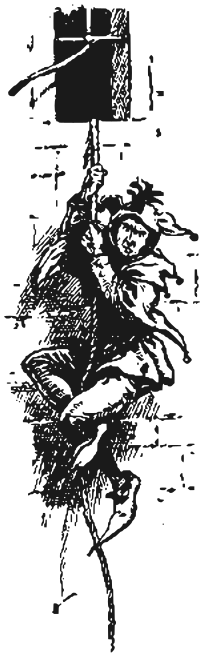
My cell was not underground but high in one of the towers, and the door was far too strong to break. After days of work I loosened one bar of the narrow window and squeezed through, but the courtyard was so far below that dropping meant certain death. Then, in a dark corner of the cell, I found a rope. It was too short, and letting go from the end of it would still have killed me.
I remembered the Irishman who lengthened his blanket by cutting a yard off the bottom and sewing it on the top. So I divided my rope in half and tied the two parts together again. After that it was long enough to reach the ground, and I climbed down safely. How?
No. 50. The Underground Maze
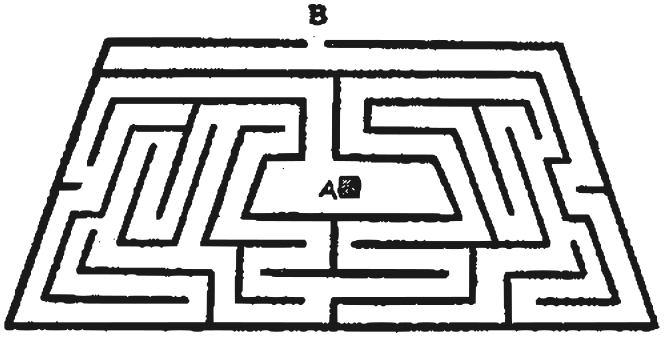
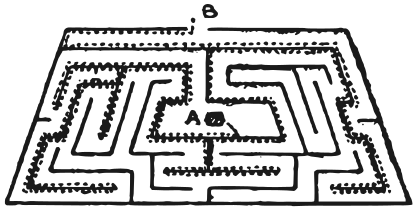
The only way out of the courtyard was down a few steps into the centre of an underground maze, marked A, and out through its door at B. With a plan it would be easy. But the maze was pitch black, and I knew I could wander in it for hours and come back to where I started. How could I be certain of reaching the door in the dark?
No. 51. The Secret Lock
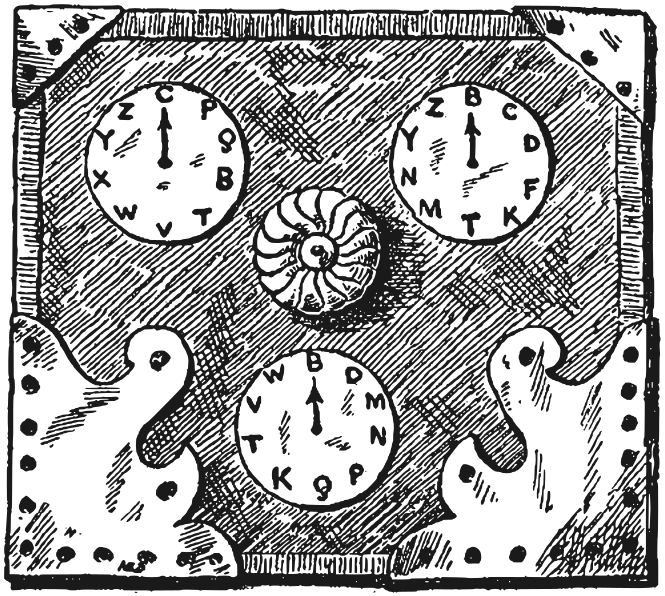
The door at last, and it was fastened with the king’s secret lock. The handle would turn only when each of three dials pointed to the right letter, and with ten letters on every dial I might try nine hundred and ninety-nine combinations before the thousandth worked. I had no time for that.
But I had once heard the monk who designed the lock worry that the king’s servants would forget the combination. The natural answer was to make the three letters spell a word. I found an English word of three letters, one from each dial, set the dials, and the door opened. What was the word?
No. 52. Crossing the Moat
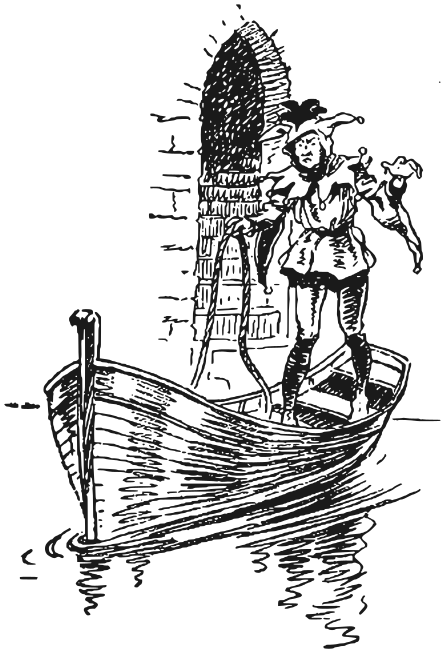
Now I faced the moat, very wide and very deep, and I cannot swim. There was a boat tied to the wall, but the oars had been taken away, and when I untied it and pushed off it simply sat on the still water. There was no current and nothing to paddle with. How did I get the boat across?
No. 53. The Royal Gardens
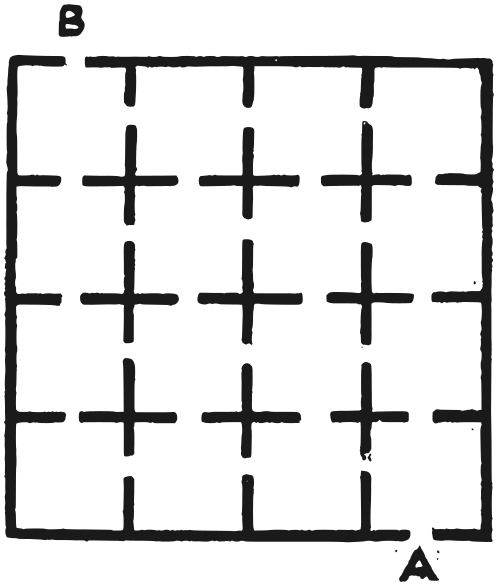
It was daylight, and I still had to get through the royal gardens outside the walls. A mad old gardener had once laid them out as a square divided by high walls into sixteen smaller gardens, with doorways between neighbouring gardens and only two gates to the outside, A and B, as the plan shows. I had to go in at A and out at B, slipping from garden to garden so the gardeners would not see me.
I managed it, and afterwards I realised I had entered every one of the sixteen gardens exactly once. How could that be?
No. 54. Bridging the Ditch
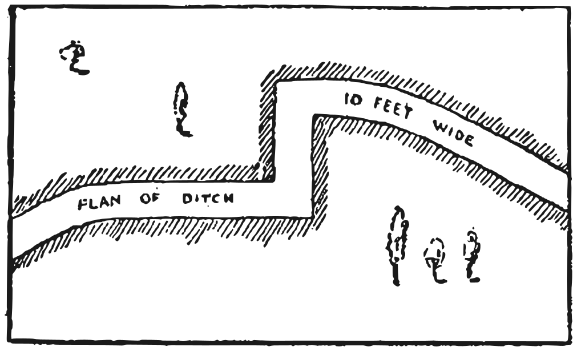
I thought I was free, and then I remembered the ditch: ten feet wide, and I had sprained my ankle getting out of the gardens, so jumping was out of the question. In a heap nearby I found eight narrow planks, none of them more than nine feet long. With those alone I built a bridge and crossed. How?
After that a friend found me a horse and a disguise, and in time, through friends at court, I won a royal pardon, though never again the king’s full favour.
The Mysterious Rope
Dividing a rope in half need not mean cutting it into two shorter pieces. A rope is twisted from strands, and the jester untwisted his into two thinner ropes, each as long as the original. Tied end to end they made a rope nearly twice as long, thinner but strong enough for a thin man in a hurry.
Answer untwist it into two strands
The Underground Maze
In the dark he put one hand on a wall and walked without ever taking it off. In a maze whose walls are all joined to one another, and to the outer wall, following one wall with one hand must eventually lead along every stretch of that wall, and the door at B is set in it. The dotted route in Figure 5.1 shows the walk with the left hand; the right hand works too, and the two routes together cover every wall except two small detached pieces on the left, as Dudeney noted.
Following a detached wall can fail when the starting point is enclosed by a wall that touches nothing else, an island, because then the walker simply circles it for ever.
Answer keep one hand on the wall
The Secret Lock
The first dial carries C, P, Q, B, T, V, W, X, Y and Z; the second B, C, D, F, K, T, M, N, Y and Z; the third B, D, M, N, P, Q, K, T, W and V. The only vowel anywhere is Y, so an English word of three letters, one from each dial, must use it. A word ending in Y after two consonants would need an S to begin it, or H, L or R in the middle, and none of those letters is there. A word beginning with Y and then two consonants does not exist. So the Y must be in the middle, and the only such word is PYX, the box in which the consecrated bread is kept: P from the third dial, Y from the second and X from the first.
A modern dictionary is less strict than Dudeney. Webster’s list of 1934 also allows cwm, the Welsh word for a mountain hollow, which fits the dials without using a vowel at all.
The monk who designed the lock, and the jester, would not have known it.
Answer PYX
Crossing the Moat
The jester tied the rope to the stern, stood in the bows, and gave the rope a series of violent jerks, and the boat crept across the water. Dudeney reported that this had been tried in practice, and that speeds of two or three miles an hour had been claimed. It is a strange result and deserves a word of explanation. The man and the boat cannot push themselves along by internal forces alone, any more than one can lift oneself by one’s bootstraps, so the push must come from the water. It does: when the boat is jerked forward sharply the water resists more than it does during the slower recovery between jerks, and the difference, stroke after stroke, moves the boat.
Answer jerk the rope at the stern
The Royal Gardens
Taken at its word, the jester’s claim is impossible. Colour the sixteen gardens like a chessboard. Every doorway joins a light garden to a dark one, so a walk through the gardens alternates light, dark, light, dark. A walk through all sixteen, each entered once, would visit eight of each colour and must start and finish on different colours. But the gardens at A and B are at opposite corners of the square, and opposite corners of a four-by-four board have the same colour. So there is no such walk.
The jester’s way out is in the word entered. Following the route in Figure 5.2, he reaches every garden except the one marked with a star before arriving in the garden with gate B. From there, instead of going through the starred garden and coming back, which would mean entering the last garden twice, he steps one foot through the doorway into the starred garden, thinks better of it, and steps back. He has entered the starred garden without ever leaving the last one, and he walks out at B.
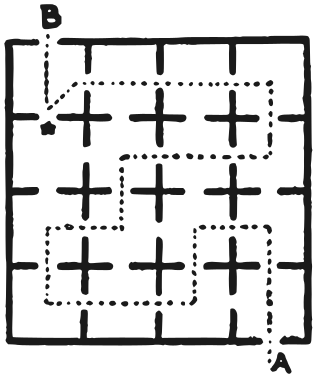
Answer a foot in the starred garden
Bridging the Ditch
A single plank cannot span a ditch ten feet wide if it is only nine feet long, wherever it is laid straight across. The jester built his bridge where the ditch turns through a right angle. On the outside of the bend the two arms of the outer bank meet in a corner, and close to that corner a short plank can rest on both arms at once. One layer of such planks is not enough, though: a nine-foot plank with both ends on the outer bank never comes within nine feet of the inner corner opposite, so the last plank could not reach it.
So the planks go in layers. Two are laid across the corner from arm to arm; a third rests on those two, further out over the ditch, where it would be too short to reach the banks; and the last plank runs from the third to the inner corner of the far bank (Figure 5.3). Four planks are enough, and the jester’s eight make a steadier platform.
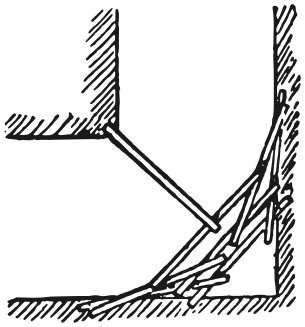
Answer at a corner of the ditch
Sources. The escape is retold from Nos. 49 to 54, and the illustrations reproduced from, Henry Ernest Dudeney, The Canterbury Puzzles and Other Curious Problems (1907; revised edition 1919), in the text of Project Gutenberg eBook 27635. The word list used for the lock is the Webster’s Second International word list distributed as /usr/share/dict/words.