Library · The Canterbury Puzzles · Chapter 6
The Squire’s Christmas Puzzle Party
On this page
Squire Davidge of Stoke Courcy Hall, in Somerset, was a famous huntsman, a famously generous host and, every Christmas, the giver of a puzzle party. Each guest had to arrive with a puzzle, and the Squire gave a new watch to whoever answered best. A young lady kept a record of one such evening in a neat hand, full of asides about who later married whom, and seven of the puzzles survive from it. Some are jokes, one is a small feat of counting, and one, set by a boy, defeated a young lawyer from Oxford.
The puzzles come first, then the Reckoning, then the solutions.
No. 55. The Three Teacups
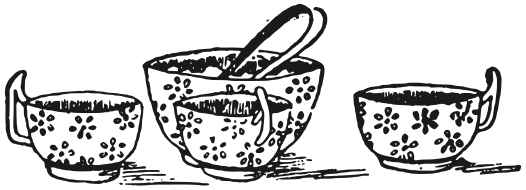
Miss Charity Lockyer, who (the diarist notes) has since married a curate from Taunton Vale, put three empty teacups on the table and challenged the room to put ten lumps of sugar into them so that every cup held an odd number of lumps. A young man who had been to Oxford and was studying the law announced, with some heat, that it was impossible and offered to prove it. How did Miss Charity do it?
Carry forward the number of different ways it can be done.
No. 56. The Eleven Pennies
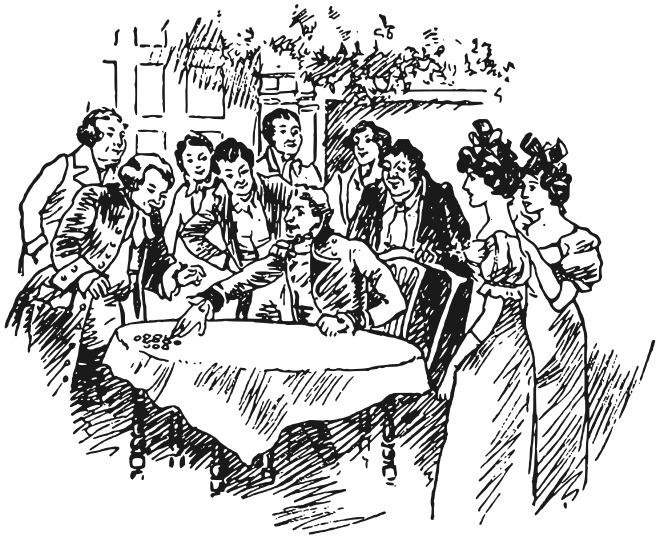
A guest borrowed eleven pennies and set them out on the table. He asked the company to take away five of the coins, add four, and leave nine. Everyone was sure there would have to be ten left. The answer caused a good deal of amusement. What was it?
No. 57. The Christmas Geese
Farmer Rouse sent his man Jabez to market with a flock of geese. Jabez reported back. He sold Mr Tyler half the flock and half a goose over. He sold Farmer Avent a third of what was left and a third of a goose over. He sold Widow Foster a quarter of what was left and three quarters of a goose over. On the way home he shared a mug of cider with Ned Collier at the Barley Mow and sold him exactly a fifth of what was left, with a fifth of a goose over for Mrs Collier. The nineteen geese he brought home he could not sell at any price.
No goose was ever cut up. How many did Farmer Rouse send to market?
Carry forward the number of geese, and the number sold to each buyer in turn.
No. 58. The Chalked Numbers
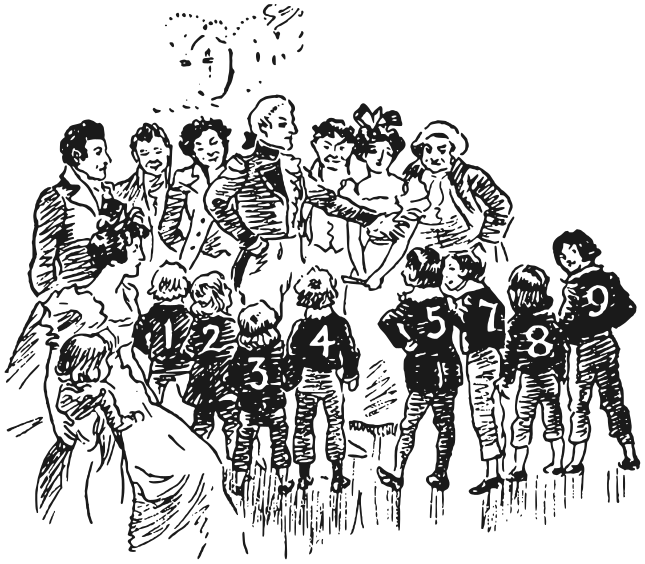
Major Trenchard chalked a different number on the backs of eight boys and stood them in two groups: 1, 2, 3 and 4 on one side, which add up to 10, and 5, 7, 8 and 9 on the other, which add up to 29. He asked for the boys to be rearranged into two new groups of four whose numbers add up to the same total. The Squire’s niece asked whether the 5 ought to be a 6. The Major said the numbers were quite correct, if properly regarded.
Carry forward the number of different ways to split the boys, and what each group adds up to.
No. 59. Tasting the Plum Puddings
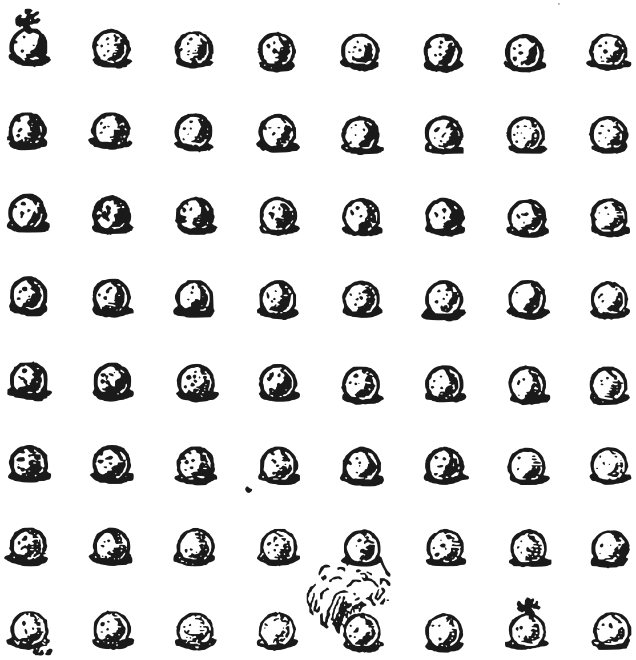
Everyone knows that each Christmas pudding you taste brings you a lucky day in the new year. One guest brought a sheet of paper with sixty-four puddings drawn on it in eight rows of eight.
Put your pencil on the pudding with a sprig of holly in the top corner and strike out all sixty-four puddings, through their centres, in twenty-one straight strokes. Strokes go up, down or across, never diagonally, and no pudding may be struck out twice. The pudding that is steaming hot must be the one where your tenth stroke ends, and the other pudding with holly, in the bottom row, must be the very last.
No. 60. Under the Mistletoe Bough
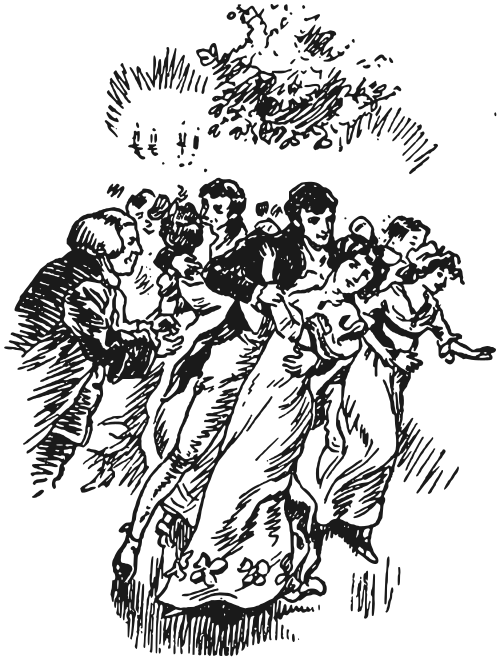
A gloomy widower sat apart from the party all evening, and it later emerged that he had been keeping a tally of every kiss under the mistletoe, which scandalised the young ladies when they heard.
The company was the Squire and his wife and six other married couples, one widower, three widows, twelve bachelors and boys, and ten maidens and girls. Everybody kissed everybody else once, except that no male kissed a male, no married man kissed a married woman other than his own wife, the widower kissed nobody, and the widows did not kiss each other; and every bachelor and boy kissed every maiden and girl twice. A kiss returned counts as one kiss. How many kisses were there?
Carry forward the number of kisses.
No. 61. The Silver Cubes
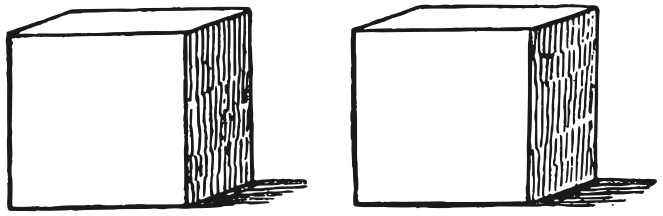
Master Herbert Spearing, a widow’s son, brought two cubes of solid silver, each two inches along every edge, so that each held eight cubic inches and the two together sixteen. He wanted exact measurements for two cubes, not necessarily the same size, that together hold exactly seventeen cubic inches. The young lawyer from Oxford said he believed it could not be done. Can it?
Carry forward the denominator of the answer.
At midnight the Squire calls for the reckoning before he hands out the watch. Five of the puzzles gave numbers to carry forward.
Take the kisses under the mistletoe and take away the geese sold to Mr Tyler.
Multiply by what each group of boys adds up to.
Take away the geese sold to Farmer Avent and the ways of filling the teacups.
Multiply by the ways of splitting the boys, and take away the denominator of the silver cubes.
Add the geese Farmer Rouse sent to market and the geese sold to Widow Foster.
If every answer is right, the result is a year, and the young lady who kept the record would not have known it, because it had not happened yet.
The Three Teacups
The Oxford man had a proof, and it was a good one: three odd numbers always add up to an odd number, and ten is even.
What he missed is that a cup can be put inside another cup, and a cup holds whatever is in any cup standing in it. Miss Charity put seven lumps in one cup, two in the second and one in the third, and then stood the third cup inside the second. The first cup holds seven, the third holds one, and the second holds its own two lumps and the cup with one in it, three in all.
Suppose the lumps put separately into the inner cup, the cup holding it and the third cup are , and , with . The inner cup holds , the outer holds and the third holds , and all three must be odd. So and are odd and is even. With the odd and share lumps, in ways, which gives fifteen possibilities, from to . Here the cups are treated as indistinguishable. With three labelled cups, each configuration has six assignments of cups to the three roles, making ninety. Nesting all three cups never works, because the counts would be , and , forcing odd and and even, and those cannot add up to ten.
Answer nest one cup inside another; 15 ways
The Eleven Pennies
From the eleven coins take away five. Then add four to the five you took away, and you leave nine, in the heap of coins you removed.
Answer nine, in the heap taken away
The Christmas Geese
Work backwards from the nineteen geese Jabez brought home. Before he met Ned Collier he had some number , sold a fifth of it and a fifth of a goose more, and kept 19: , so and . Before Widow Foster, gives . Before Farmer Avent, gives . Before Mr Tyler, gives . So Jabez set out with 101 geese and sold 51, 17, 9 and 5 of them in turn, every sale a whole number of geese.
Answer 101 geese
The Chalked Numbers
The numbers on the boys add up to , an odd total, and no two groups can have equal sums when the grand total is odd. So the Major’s “properly regarded” must change a number, and the boy with 9 on his back, grinning at the end of the line, stands on his head and becomes a 6. Now the total is 36, and each group must add up to 18. A list of every split shows exactly four ways to split the boys: 1, 2, 7, 8 against 3, 4, 5, 6; 1, 3, 6, 8 against 2, 4, 5, 7; 1, 4, 5, 8 against 2, 3, 6, 7; and 1, 4, 6, 7 against 2, 3, 5, 8.
Answer turn the 9 into a 6; 4 ways
Tasting the Plum Puddings
A stroke that runs along a row or a column is a rook’s move, so the task is a rook’s tour of the board: sixty-four squares, each visited once, in twenty-one straight moves, from the holly in the top left corner to the holly in the bottom row. Dudeney’s route is shown in Figure 6.1. It runs along the top two rows and down the left side, then winds inwards, and its tenth stroke ends exactly at the steaming pudding.
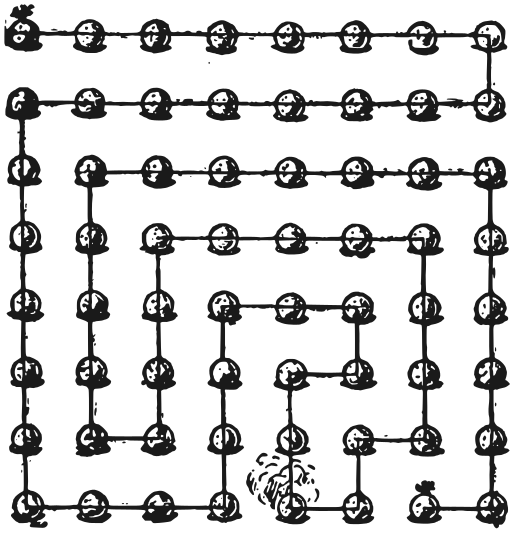
The finishing square matters more than it looks.
Colour the puddings like a chessboard: every unit step between neighbouring puddings changes colour. A route through all sixty-four uses sixty-three such steps, even when several make one straight stroke, so it starts and ends on different colours. The two holly puddings are on different colours; the pudding in the opposite corner, on the same diagonal as the start, is on the same colour, and no such route can end there. Dudeney believed his route was the only one that meets the condition about the tenth stroke, but said he could not be certain, and this edition does not settle the question either.
Answer Dudeney’s route, in the figure
Under the Mistletoe Bough
Leave the widower out: he kissed nobody. That leaves 39 people: seven married couples, three widows, twelve bachelors and boys, and ten maidens and girls. If each of them kissed every other once, there would be kisses. The bachelors and boys kissed the maidens and girls a second time, which adds , making 861. Now take away the kisses that did not happen. No male kissed a male: there are males, so kisses go. No married man kissed another man’s wife: go. The widows did not kiss each other: go. That leaves kisses under the mistletoe.
Answer 645 kisses
The Silver Cubes
The young lawyer was wrong, though his doubt is understandable. The two cubes must have edges and with , and no two whole numbers will do. As with the Doctor’s phials in the second chapter, the way in is to draw lines on the curve : a line through two points with fractional coordinates, or a tangent at one, meets the curve again at another.
To find a small starting point, try a negative edge . The other numerator must then have cube . Testing small denominators reaches , for which . Thus The tangent to the curve at meets it again at a point with both coordinates positive: Two silver cubes with edges of inches and of an inch hold exactly seventeen cubic inches between them.
Dudeney called this the answer in the smallest possible numbers. The precise claim checked here is that its common denominator is the least possible: a search through every positive pair with a common denominator up to 45,000 finds no solution with denominator below 40,831.
Answer edges and inches
The Reckoning
The numbers carried forward are 15 ways with the teacups; 101 geese, sold 51, 17, 9 and 5 to the four buyers; 4 ways to split the boys into groups of 18; 645 kisses; and the denominator 40,831. Worked in order, Dudeney revised The Canterbury Puzzles for a new edition in 1919, adding the fuller solutions that this book starts from.
Sources. The puzzles are retold from Nos. 55 to 61, and the illustrations reproduced from, Henry Ernest Dudeney, The Canterbury Puzzles and Other Curious Problems (1907; revised edition 1919), in the text of Project Gutenberg eBook 27635, from which his remarks are also quoted; the date of the revision is that of his preface, 2 July 1919. Every numerical answer in this chapter is found again by the programs in the verify folder accompanying this book.