Library · The Canterbury Puzzles · Chapter 8
The Professor’s Puzzles
On this page
It was Christmas Eve, and the Puzzle Club was nearly deserted. Only Grigsby, Hawkhurst and I had been kept in town over the season of mince pies, and the evening had grown slow when the man we called the Professor of Puzzles walked in. He was middle-aged, cheerful and kind, with a streak of cynicism, and he had played with puzzles of every sort all his life. Two or three of his best, he said, had come to him in dreams. No old puzzle was ever used up: it could always be improved, dressed up or carried further. Take magic squares. Any child can put the numbers one to nine in a square so that every row, every column and both diagonals add up to fifteen. Put coins in place of the numbers, he said, and it becomes a new puzzle.
He set six puzzles that evening, and they follow in the order he set them, with the answers after. Like the club’s cases, they carry no numbers forward and have no Reckoning.
The money is the old English money: twelve pence to the shilling and twenty shillings to the pound, with amounts written as Dudeney wrote them, so that 2s. 6d. is two shillings and sixpence. The coins that matter here are the sixpence, the shilling, the florin (2s.), the half-crown (2s. 6d.), the double florin (4s.) and the crown (5s.).
No. 67. The Coinage Puzzle
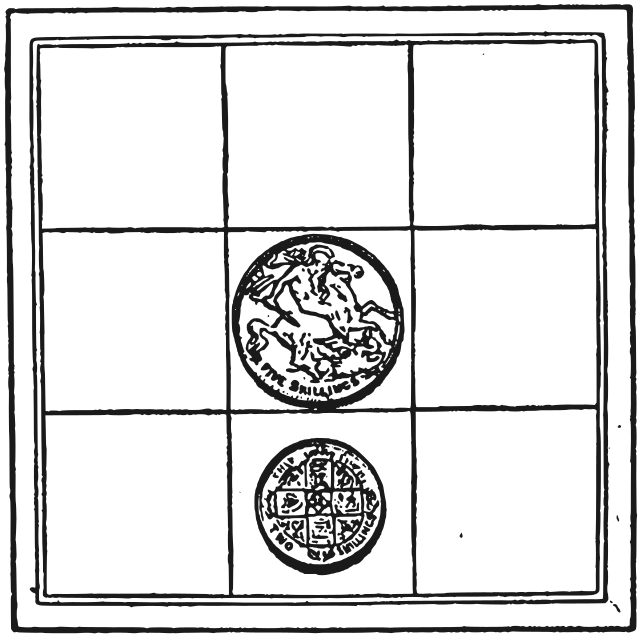
The Professor drew a square of nine divisions and put a crown in the centre and a florin in the middle of the bottom row, as in the picture. “Now put the fewest possible current English coins into the seven empty divisions, so that each of the three rows, the three columns and the two diagonals adds up to fifteen shillings. Every division must hold at least one coin, and no two divisions may hold the same amount.”
“How can it matter that they are coins?” asked Grigsby.
“You will find out when you get near the answer.”
Hawkhurst said he would do it with numbers first and put the coins in afterwards. Five minutes later he burst out, “Hang it, I can’t help getting the two in a corner. May the florin be moved?” It could not, and he gave up.
No. 68. The Postage Stamps Puzzles
“Now stamps instead of coins. Take ten current English postage stamps, nine of them of different values and the tenth a duplicate of one of the others. Stick two of them in one division and one in each of the others, so that every row, column and diagonal adds up to ninepence.”
Grigsby had an answer within a few minutes on the back of an envelope. The Professor smiled and asked whether he was quite sure that England had a stamp worth threepence-halfpenny.
“When you have done that,” the Professor went on, “here is a much better one. Stick English stamps in the square so that every row, column and diagonal adds up alike, using as many stamps as you choose, so long as no two of them have the same value. It is a hard nut.”
The stamps on sale, according to the list Dudeney gives with his answers, were worth ½d., 1d., 1½d., 2d., 2½d., 3d., 4d., 5d., 6d., 9d., 10d., 1s., 2s. 6d., 5s., 10s., £1 and £5.
No. 69. The Frogs and Tumblers
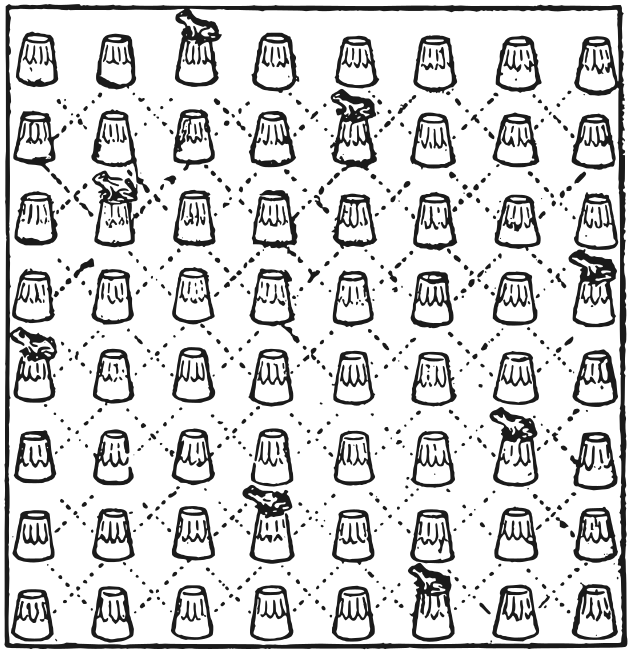
From his capacious pockets the Professor brought out a handful of little Japanese frogs, snails and lizards, grotesque in shape and brilliant in colour. He had the waiter set sixty-four tumblers on the table in a square, eight rows of eight, and he put eight green frogs on eight of the glasses, as in the picture.
“The tumblers make eight rows across and eight down,” he said, “and if you look along the diagonals both ways there are twenty-six more lines. Run your eye along all forty-two lines and you will find no two frogs anywhere in one line. Now three of the frogs jump to three empty glasses so that, in their new places, still no two frogs are in a line. What are the jumps?” The frogs do not change places with one another: each of the three jumps to a glass that was empty.
“Surely there must be scores of answers,” I said.
“I shall be very glad if you can find them,” said the Professor drily. “I know of only one, or two if you count its reversal, which the symmetry of the position allows.”
No. 70. Romeo and Juliet
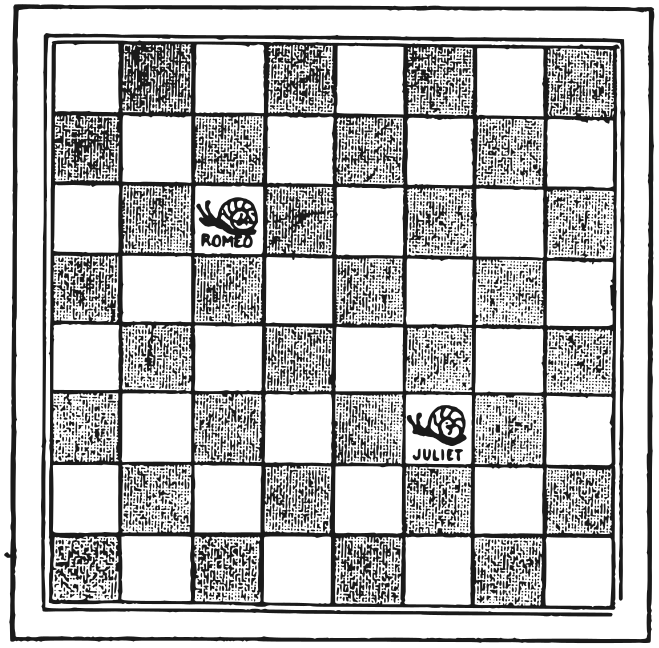
The Professor had the tumblers taken away and the chessboards brought. Two snails were Romeo and Juliet. Juliet waits on her balcony, but Romeo has been dining and cannot for the life of him remember the number of her house. The sixty-four squares are sixty-four houses, and he calls at every house once and only once before he reaches his love. He crawls from a square to a neighbouring one, up, down, across or diagonally. Make him do it with the fewest possible turnings. The direction he sets off in does not count as a turning.
Grigsby chalked a route at once. Romeo reached Juliet, calling at every house exactly once, but he turned nineteen times, and that is not the fewest. Hawkhurst, curiously, hit on the answer straight away, and the Professor remarked that this was one of those puzzles a person may solve at a glance or not master in six months.
No. 71. Romeo’s Second Journey
“That was sheer luck, Hawkhurst,” said the Professor. “Here is a much easier one, because it can be analysed systematically, though you may still not do it in an hour. Put Romeo on any white square you like and make him crawl into every other white square with the fewest possible turnings. This time he may visit a white square twice, but he must never pass a second time through the same corner of a square, and he must never enter a black square.”
“May he leave the board for refreshments?” asked Grigsby.
“No. He stays on the board until he has done it.”
Since Romeo never enters a black square, every step he takes is diagonal, from one white square to the next through the corner they share.
No. 72. The Frogs who would a-wooing go
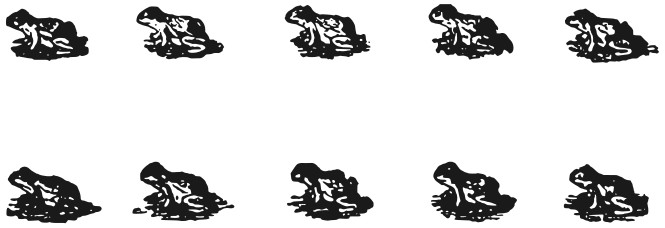
While we struggled with Romeo, the Professor set out ten frogs on the table in two rows of five, as in the picture. “Four of them go a-wooing. Each of the four makes one jump, landing on the table, and after that the ten frogs stand in five straight rows with four frogs in every row.”
Hawkhurst soon had an arrangement, but it made only four rows, and he had moved six frogs. Grigsby had two of the frogs jump onto their comrades’ backs, and was told that the jumps were to be made onto the table.
At last the Professor gathered up his Japanese reptiles and wished us good night. When we next met at the club we agreed that the puzzles we had failed to solve we “really had not had time to look at”, while those we had mastered after enormous labour we “had seen at the first glance”.
The Coinage Puzzle
Every line through the centre has the crown in the middle, so the two amounts at its ends add up to ten shillings. The florin at the foot of the middle column therefore faces eight shillings at its head. Call the amount in the top left corner shillings. The top row makes the top right corner , and the two diagonals make the bottom corners and . The left column then leaves for the middle of that side, and the middle row leaves opposite it. So one number settles the whole square: The bottom row and the right column come out at fifteen for every , so all eight lines hold.
This explains Hawkhurst’s trouble. Every amount must be positive, which keeps between 1 and 6, and in whole shillings each choice repeats an amount: puts a second 2 in the middle row, gives 4 twice, gives 4 twice again, and repeats the crown. In the familiar square of the numbers one to nine the 2 always sits in a corner, and with the florin fixed in the middle of a side no square in whole shillings exists. The coins have to supply fractions of a shilling.
Now count coins. The crown and the florin are one coin each. No coin is worth eight shillings, so the top division needs at least two. That leaves the six divisions round the sides, and the question is how many of them can hold a single coin. Two opposite divisions add up to ten shillings, and no two different coins do, so at most one of each opposite pair can. In fact at most one of the six can. The only coins that could stand alone in them are the half-crown, the double florin and coins of a shilling or less (the crown and the florin are already used), and running through each such coin in each of the six places shows that as soon as one division holds a single coin, none of the other five amounts is the value of a coin.
So the six hold at least coins, and the whole square at least .
Dudeney’s answer reaches fifteen with (Figure 8.1): a double florin and a sixpence, two double florins, a half-crown; a florin and a shilling, the crown, a crown and a florin; a crown and a half-crown, the florin, a crown and a sixpence. Its mirror image, with , is the only other way to do it in fifteen coins. The double florin earns its place: without it the eight shillings take three coins, and the least becomes sixteen.
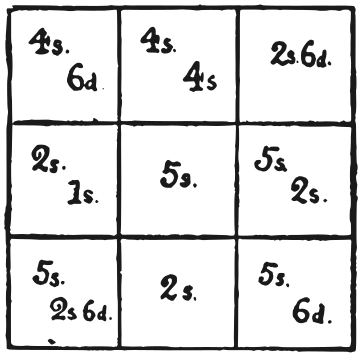
Answer 15 coins
The Postage Stamps Puzzles
In the first puzzle every line adds up to ninepence,
so the centre holds 3d. and the two divisions opposite each other across it add up to 6d. Each division therefore holds less than 6d., and so does every stamp in it. Dudeney’s list has only eight values below sixpence: ½d., 1d., 1½d., 2d., 2½d., 3d., 4d. and 5d. The puzzle needs nine different values. With the stamps on his list it cannot be done.
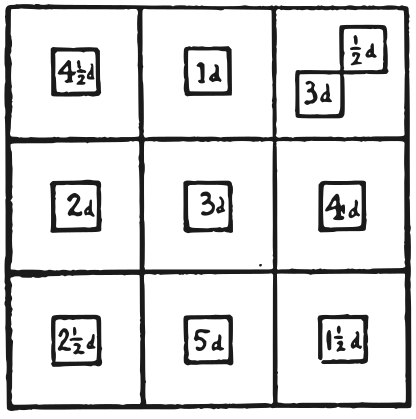
Dudeney’s own answer (Figure 8.2) uses a stamp of 4½d., which his list does not contain. With that stamp allowed, the nine values are forced: they must be the nine values below sixpence, which add up to 24d. The whole square holds three lines of ninepence, 27d., so the tenth stamp is the duplicate 3d. The division totals run from 1d. to 5d. in steps of a halfpenny, set out like the numbers one to nine in the ordinary magic square, and the division that needs 3½d. takes a 3d. and a ½d. stamp together. That was the stamp Grigsby had invented. Apart from turning the square round or over, this is the only answer.
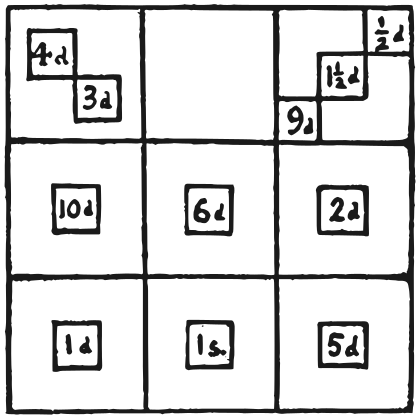
The second puzzle Dudeney answers with eleven stamps, every line adding up to 1s. 6d., and one division left empty, which he points out the conditions did not forbid. The empty division is forced. Suppose every division held a stamp, and look at the most valuable stamp used, worth . The division opposite it across the centre holds at least ½d., and the two together make twice the centre, so the centre is worth at least half of d. The whole square holds nine times the centre, and it can hold only stamps worth or less, each used once. For every stamp on the list the stamps up to it fall short. The nearest miss is the shilling: the centre must be at least 6¼d., and since every amount is a whole number of halfpence, at least 6½d., so the square needs at least 58½d., while all twelve stamps up to a shilling add up to 56½d. Every other choice of largest stamp falls further short, and the large ones by a great deal. So one division must stay empty, and with one empty, eleven stamps is the fewest that will do.
Dudeney added a remark that explains all three of these squares. Any nine numbers that can be set out in three rows, with the same step from left to right in every row and the same step from row to row, make a magic square when they are put in the places of the numbers one to nine. The coinage square is 2, 2½, 3; 4½, 5, 5½; 7, 7½, 8 shillings, with steps of half a shilling across and two and a half down.
Answer a 4½d. stamp; an empty division
The Frogs and Tumblers
Count the rows from the top and the glasses from the left. The starting frogs stand in glasses 3, 5, 2, 8, 1, 7, 4 and 6 of the eight rows, which is an answer to the old problem of placing eight queens on a chessboard with no two attacking each other.
The three frogs that jump are those in the second glass of the third row, the last glass of the fourth row and the fourth glass of the seventh row. The first jumps down to the second glass of the seventh row, the second up to the eighth glass of the third row, and the third to the fourth glass of the fourth row (Figure 8.3). Each frog keeps its column and the three simply exchange rows among themselves, so every row and every column still has one frog, and only the diagonals need checking. In the new position the frogs stand in glasses 3, 5, 8, 4, 1, 7, 2 and 6, and no two share a diagonal.
The starting position looks the same when the board is turned half round, and turning the answer half round gives the Professor’s second solution, in which the three frogs standing opposite the first three, across the centre of the board, make the matching jumps. There are no others.
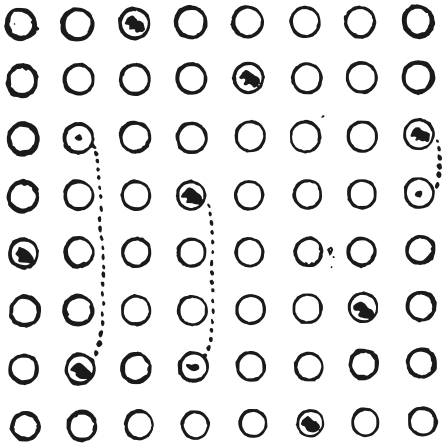
Answer three jumps; two solutions
Romeo and Juliet
A turning costs something and a straight run costs nothing,
so the runs should be as long as the board allows. The corners suggest how. A corner square can be reached only along one of its two edges or along the long diagonal, and a route that runs along the edges collects the corners for nothing, each at the place where one run meets the next. The two snails also stand opposite each other through the centre of the board, Romeo on the third square of the third row and Juliet on the sixth of the sixth, which suggests a route that is the same when turned half round and read backwards, so that only half of it has to be designed.
Figure 8.4 shows the result. The board is taken as two rings of squares round a block of sixteen in the middle. Romeo steps down one square and runs diagonally up to the second row, then follows the inner ring along that row and down the second column. A diagonal takes him up to the top edge, and he follows the outer ring along the top row and down the first column. The long diagonal from corner to corner carries him across the board. The second half repeats the first turned round: down the last column, along the bottom row, up a diagonal to the seventh column and down it, along the seventh row, and a short diagonal and one step bring him to Juliet. That is fifteen straight runs and fourteen turnings, against Grigsby’s nineteen.
Dudeney states that fourteen is the fewest and that this route, with its reversal, is the only one that achieves it. He gives no proof, and none is offered here.
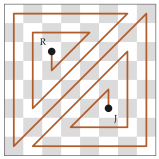
Answer 14 turnings
Romeo’s Second Journey
Much of this one can be settled by reasoning, as the Professor promised.
Only two white squares sit in corners of the board, the top left and the bottom right. A corner square has only one white neighbour, so Romeo can enter it or leave it only through one corner, and he cannot pass through it without using that corner twice. The two white corners must therefore be where his journey begins and ends.
Twelve other white squares lie on the edge of the board. Whenever Romeo arrives at one of them, going straight on would take him off the board, so he must turn there. That is at least twelve turnings.
The count must also be even. Every turning takes Romeo from one diagonal direction to the other, because turning right round would take him back through the corner he just used. So his straight runs alternate between the two directions. His first run leaves a corner along the long diagonal and his last run reaches the other corner along it, so the first and last runs lie in the same direction, there is an odd number of runs, and the number of turnings is even. Twelve is impossible: with exactly twelve, every turning would be at an edge square, so the first run could not stop until it reached one, and along the long diagonal the first edge square is the far corner, which ends the journey with most of the board unvisited. So Romeo needs at least fourteen turnings.
Dudeney’s route, in Figure 8.5, makes sixteen. The squares marked with a cross are crossed twice, once in each direction, and never through the same corner. A search shows that fourteen cannot be reached, so sixteen is the fewest.
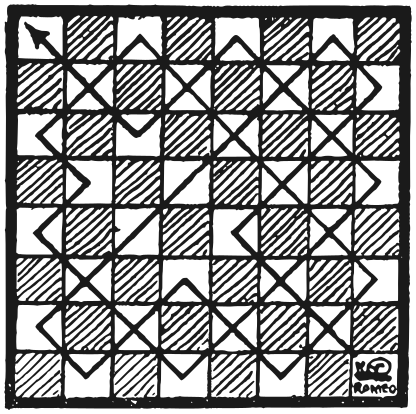
Answer 16 turnings
The Frogs who would a-wooing go
Number the places in each row 0 to 4 from the left. Four frogs jump (Figure 8.6). The middle frog of the top row hops halfway towards the bottom row. The middle frog of the bottom row moves straight away from the top row by the distance between the rows. The two end frogs of the bottom row jump up past the top row, to points that distance above it and one place beyond each end.
The five rows of four are then the top row with its middle frog gone, and four slanting lines. Each end frog that jumped starts two of them: one runs through the nearer end of the top row and the nearer inside frog of the bottom row to the frog below the middle, and the other runs through the next frog of the top row and the frog halfway between the rows to the far inside frog of the bottom row. Taking the gap between the rows as one place, each of the four slanting lines rises or falls by one row for every one or two places it travels, which can be checked frog by frog. The distance between the rows does not matter, because stretching the picture up or down keeps straight lines straight.
Dudeney remarks that two or three other arrangements are possible, and that this one is the most satisfactory.
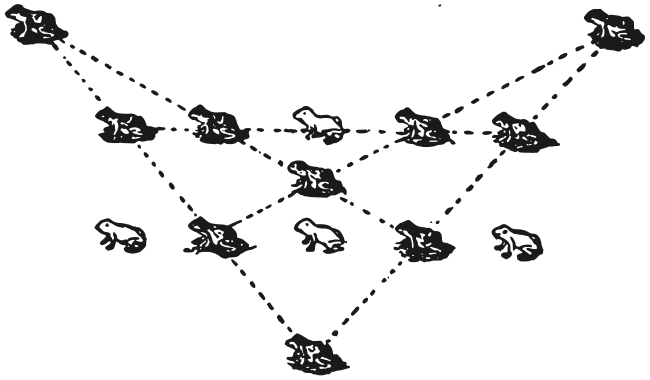
Answer four jumps, as in the figure
Sources. The Professor’s evening is retold from Nos. 67 to 72, and the illustrations reproduced from, Henry Ernest Dudeney, The Canterbury Puzzles and Other Curious Problems (1907; revised edition 1919), in the text of Project Gutenberg eBook 27635. The list of stamps is Dudeney’s own, from his solution to No. 68, and it reads the same in the 1908 printing. The numerical answers are found again by the programs in the verify folder accompanying this book.