Library · The Canterbury Puzzles · Chapter 1
The Road out of Southwark
On this page
- No. 1. The Reve’s Puzzle
- No. 2. The Pardoner’s Puzzle
- No. 3. The Miller’s Puzzle
- No. 4. The Knight’s Puzzle
- No. 5. The Wife of Bath’s Riddles
- No. 6. The Host’s Puzzle
- No. 7. The Clerk of Oxenford’s Puzzle
- No. 8. The Tapiser’s Puzzle
- No. 9. The Carpenter’s Puzzle
- No. 10. The Puzzle of the Squire’s Yeoman
- No. 11. The Nun’s Puzzle
- No. 12. The Merchant’s Puzzle
- No. 13. The Man of Law’s Puzzle
- No. 14. The Weaver’s Puzzle
- No. 15. The Cook’s Puzzle
- No. 16. The Sompnour’s Puzzle
- The Reckoning
Acompany of pilgrims meets at the Tabard Inn in Southwark, bound for Canterbury, and the Host proposes that each should pass the ride by setting the others a puzzle. That is the whole of Dudeney’s frame, and it is enough. Sixteen pilgrims speak in this chapter, on the first stretch of the road out of London. Between them they stack cheeses, count squares on a shield, pour ale, cut up tapestry, deal cards, ride in rows, share out a supper and count their companions out of a ring.
The puzzles come first, each beneath Dudeney’s illustration where he drew one and told by one of the pilgrims. After the last comes the Reckoning, which folds the answers into one number, and after that the solutions. Nothing beyond school arithmetic is needed, though several of the puzzles reward a stubborn afternoon.
No. 1. The Reve’s Puzzle
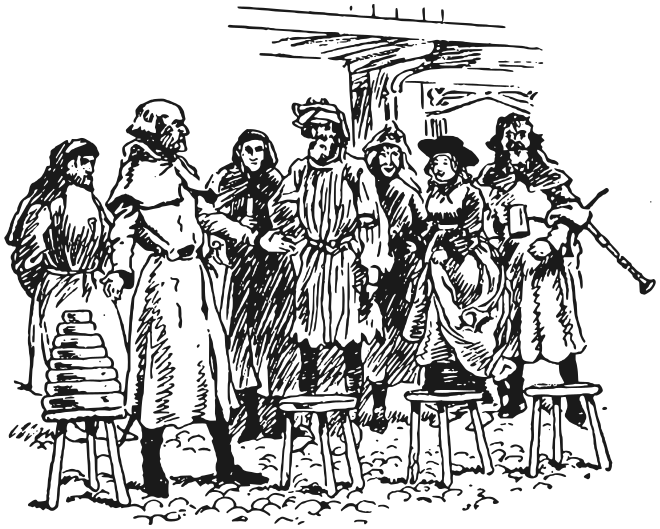
The Reve, which is to say the man who runs a lord’s estate and can find a missing penny in a ploughed field, always rode at the very back of our group. He said it helped him think. At a tavern where we stopped for lunch he borrowed four stools from the landlord, stacked eight cheeses on the stool at one end, the largest at the bottom and the smallest on top, and turned to the rest of us with the look of a man who had been waiting all morning for exactly this moment. The puzzle, he told us, had beaten every last person in his home town of Baldeswell, in Norfolk.
The rules were short. Move one cheese at a time, from the top of one stool to another. Never put a cheese on top of a smaller one. Finish with the whole stack on the stool at the far end.
“Fewest moves wins a drink,” he said, “and I have never yet had to buy one.”
Try it with eight cheeses. Then, if the landlord has more cheese than seems likely, try it with ten, and after that with twenty-one.
Carry forward the fewest moves for eight cheeses.
No. 2. The Pardoner’s Puzzle
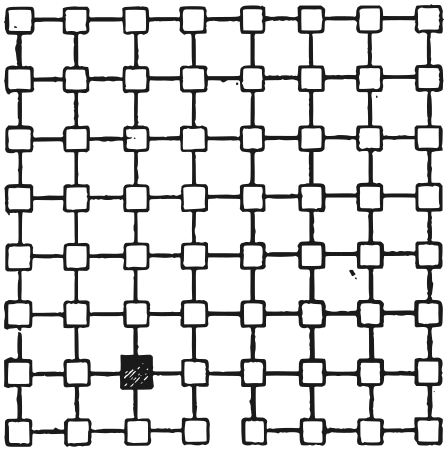
The Pardoner, lately back from Rome with a satchel of pardons and not much shame, begged to be let off. Nobody let him off. So he unrolled a map of sixty-four towns he had passed through on his travels, set out in eight rows of eight, with a straight road joining each town to its neighbours above, below and to either side. One short road along the bottom edge is missing. That, he said, had been washed away, and nobody should try to use it.
Start at the town drawn in black and visit every other town exactly once, travelling in fifteen straight stretches. You may finish wherever you like.
No. 3. The Miller’s Puzzle
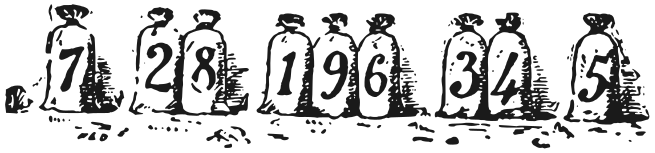
The Miller had nine sacks of flour standing in a row outside a barn, each with a large number painted on it, the numbers 1 to 9. He had stood them in groups: a single sack at each end, a pair next to each single, and three together in the middle, so that the row read 7, 28, 196, 34, 5.
“Look at that,” he said, tremendously pleased. “Seven times twenty-eight is a hundred and ninety-six. The number in the middle.” Then his face fell. “But thirty-four times five isn’t.”
He wanted both ends to work, so that each single sack multiplied by the pair beside it gives the three-sack number in the middle. The groups stay where they are; only the sacks inside them change places. Flour is heavy and the Miller is not getting any younger, so he wanted to move as few sacks as he possibly could. Which sacks go where?
Carry forward the number of sacks that must change their places.
No. 4. The Knight’s Puzzle
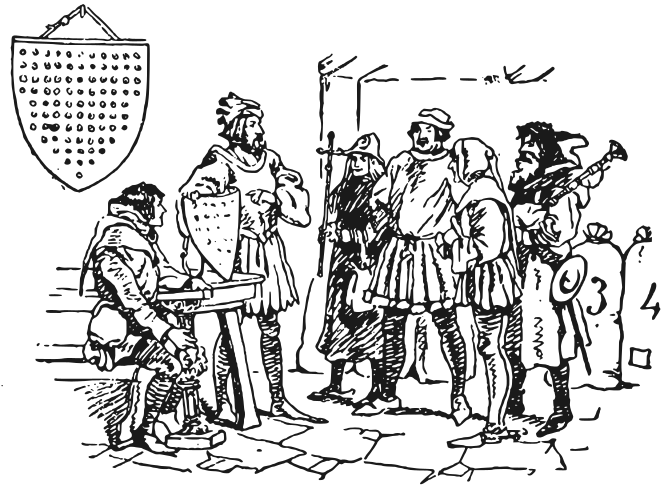
The Knight, a very perfect gentle knight with fifteen battles behind him, carries a white shield scattered with red roses, eighty-seven of them. A heraldry bore would call it argent, semée of roses, gules. He said the riddle had been put to him by a man he fought beside in Turkey.
Take a piece of chalk and draw a square on the shield with a rose at each of its four corners. The square may sit at any angle. How many different squares can you draw?
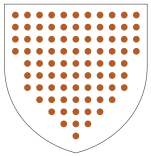
Carry forward the number of squares.
No. 5. The Wife of Bath’s Riddles
The Wife of Bath insisted she had no head for puzzles, though her fourth husband had been fond of them, and she remembered one of his. Why is a bung that has been knocked tight into a barrel like a bung that is just falling out of one? The company got that in about four seconds.
So she tried another. She was sewing in her room one day, she said, when her son came in. A voice told him to go away and stop bothering his mother. He refused. “I am your son,” he said, “but you are not my mother, and I am not leaving until you explain how that can be.” How can it be?
No. 6. The Host’s Puzzle
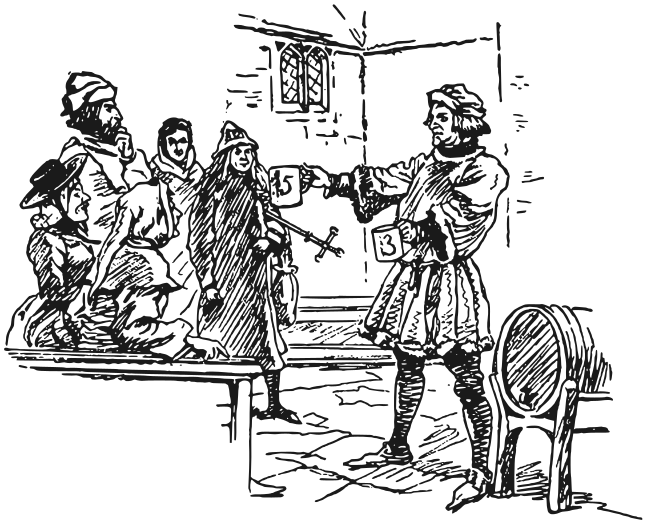
Our Host, who owns the Tabard and had come along chiefly to keep an eye on the bill, produced a cask of London ale and two pewter measures, one holding exactly five pints and the other exactly three. Neither had any markings on it.
“A pint in each,” he said. “A true pint. No other vessels, no chalk marks, no guessing by eye.”
Nobody knew how much ale was in the cask, and he wasn’t saying. You may fill a measure from the cask, pour one vessel into another until the first is empty or the second is full, empty a measure back into the cask, or empty it into the pilgrims, who volunteered for this with touching enthusiasm. You may also open the tap and let the cask run dry. Each of these counts as one step. How few steps will do it?
Carry forward the fewest steps.
No. 7. The Clerk of Oxenford’s Puzzle
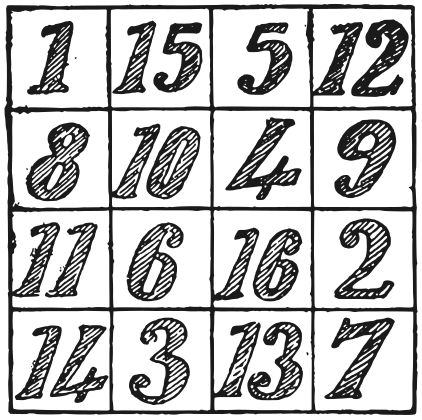
The Clerk of Oxenford spends every penny his friends lend him on books, and he had lately been reading about magic squares, the grids of numbers once worn as charms against the plague. He had made a small puzzle out of one the night before.
Cut his square of sixteen numbers into four pieces, cutting only along the lines, and fit the pieces back together into a magic square: each of the four rows, each of the four columns, and both long diagonals must add up to 34.
No. 8. The Tapiser’s Puzzle
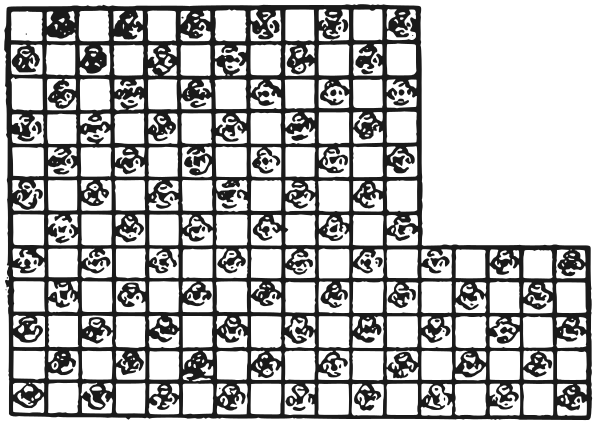
The Tapiser makes tapestry, and he wanted it understood that this is quite different from being a tapster, who pours ale. He held up a piece of his work, a chequered pattern of 169 small squares, roses on alternate squares.
Cut it into three pieces that fit together into one perfect square, cutting only along the lines between the small squares. The cloth has a right side and a wrong side, so no piece may be turned over, and the chequered pattern has to match up in the finished square. There are several ways to do it. The Tapiser wants the way in which one of the three pieces is as small as possible, so that the other two keep as much of his tapestry intact as they can.
Carry forward the number of small squares in the smallest piece.
No. 9. The Carpenter’s Puzzle
The Carpenter had been given a block of wood three feet long, a foot wide and a foot deep, by a London scholar who dabbled in astrology, and asked to carve it into an ornate pillar. The scholar would pay by the cubic inch for the wood cut away. You can see the pillar in the Carpenter’s hand in the picture of the Knight.
The block had weighed thirty pounds and the pillar weighed twenty, so the Carpenter reckoned he had removed a third of the wood, one cubic foot. The scholar would not accept weighing: the heart of the block might be heavier or lighter than the outside. How could the Carpenter show, simply and beyond argument, how much wood he had cut away?
No. 10. The Puzzle of the Squire’s Yeoman
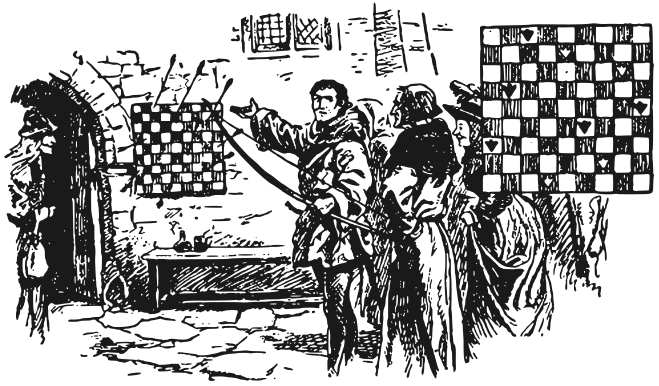
The Squire’s Yeoman is a forester who carries a mighty bow and never lets his feathers droop. At an inn called the Chequers he showed off by shooting nine arrows into the chequered signboard, one into the middle of each of nine squares, so that no two arrows lay in a line, whether along a row, down a column or on any diagonal. The inset shows where they landed.
Then he set the puzzle. Move three of the arrows, each to a square next to it (sideways, up, down or diagonally), so that once again no two of the nine arrows lie in a line.
No. 11. The Nun’s Puzzle
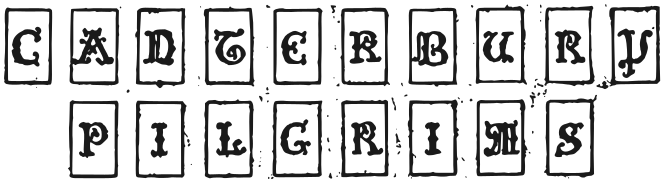
The Nun admitted, without any detectable remorse, that the sisters keep a pack of cards hidden inside a hollowed-out book for the evenings when the abbess is away.
Her cards had one letter each, eighteen in all, and between them they spelled CANTERBURY PILGRIMS. Her trick was to deal them like this. Put the top card face up on the table. Move the next card to the bottom of the pack. Put the next card on the table, to the right of the first. Move the next to the bottom. Carry on until every card is on the table, and the row reads CANTERBURY PILGRIMS.
In what order must the pack be stacked? You could work backwards, or fetch a real pack of cards, but the Nun would think a little less of you.
Carry forward the place of the card G in the pack, counting the top card as the first.
No. 12. The Merchant’s Puzzle
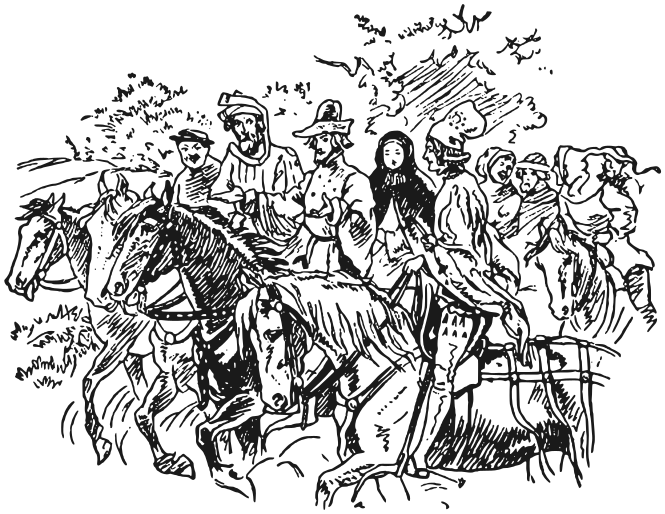
The Merchant, who could not look at a group of people without counting them, pointed out that the thirty of us could ride in single file, or two abreast, or in rows of three, five, six, ten or fifteen, or all thirty in one enormous line across the road, and in no other way if every row was to be full. That makes eight ways.
“I once rode with a company that could line up in sixty-four different ways,” he said. “Every row full, every time.” He would not tell us how many were in it, only that it was the smallest company that could manage the trick. How many were there?
Carry forward the number in the company.
No. 13. The Man of Law’s Puzzle
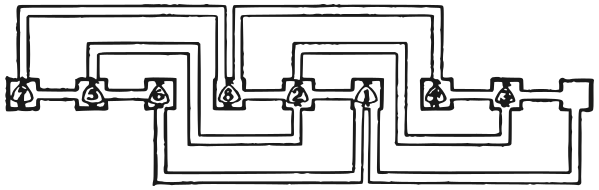
The Sergeant of the Law always looks busier than he is. Talking one evening about prisons, he drew a plan of nine dungeons joined by passages, as shown. Eight hold a prisoner each and one is empty. Reading along the row, the prisoners are numbered 7, 5, 6, 8, 2, 1, 4, 3, with the empty dungeon at the end.
A prisoner may walk along a passage into the empty dungeon, one man at a time, and no dungeon may ever hold two men. In the fewest possible moves, get the prisoners into the order 1, 2, 3, 4, 5, 6, 7, 8 along the row, with the empty dungeon still at the end.
Carry forward the fewest moves.
No. 14. The Weaver’s Puzzle
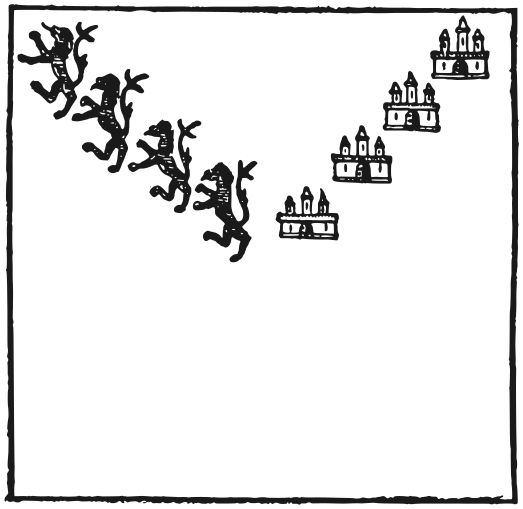
The Weaver brought out a square of fine cloth embroidered with four lions and four castles. The Knight, who knows his heraldry, explained that they came from the arms of Castile and León, and was very pleased with himself about it.
Cut the cloth into four pieces of exactly the same size and shape, each carrying one lion and one castle. No cut may pass through any part of a lion or a castle.
No. 15. The Cook’s Puzzle
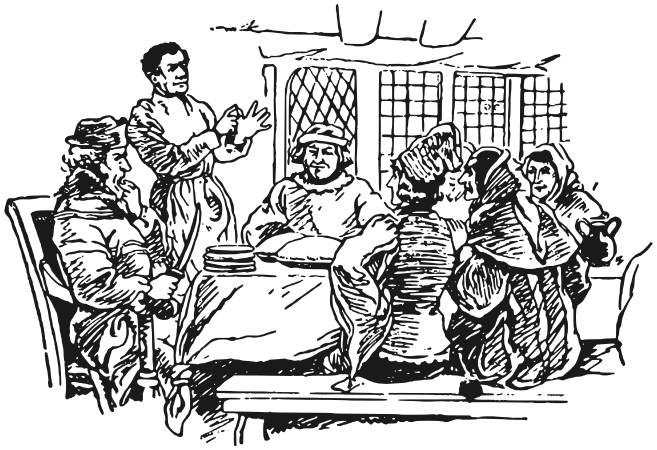
At supper the Cook set down a warden pie and a venison pasty in front of eleven of us, each cut into four portions and not a crumb more. Five of the eleven would eat only the pie. Four would eat only the pasty. The last two, easily the most agreeable people on the whole pilgrimage, were happy to eat either.
Every portion goes to a different person, so eight of us would eat and three would go without. The Franklin, who was paying, had to decide which eight. How many different groups of eight could he choose?
The Cook warned us that almost everyone gets this wrong by exactly forty. Then, while we argued about it, he quietly carried both dishes into the next room and served them to another table. There was bread and cheese in the pantry, he said.
Carry forward the number of different groups of eight the Franklin could choose.
No. 16. The Sompnour’s Puzzle
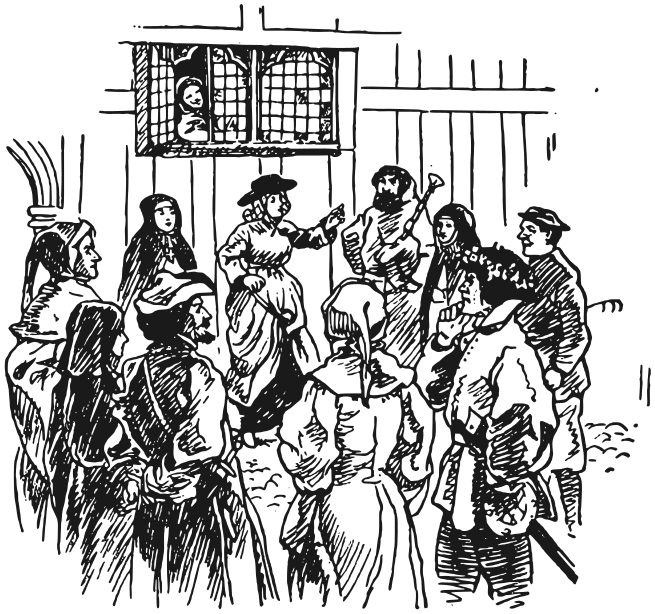
The Sompnour delivers summonses for the church courts, which makes him about as welcome as a bailiff and unusually good at picking people out of a crowd. One night the inn had beds for only five of the ten of us, five men and five women, so he stood us in a circle and proposed a count-out. Someone counts round the circle clockwise, the person the count lands on steps out, and the next count starts from the person after them. He meant the men to be counted out so that the women got the beds, and he whispered a number to the Wife of Bath to count with.
She forgot it. She counted elevens instead, starting with herself as one, and one after another all five women were counted out.
What number should she have used, and with whom should she have started, so that the five men went out and nobody else? The Sompnour wants the smallest number that works.
Carry forward the number the Wife of Bath should have counted.
When the day’s riding is done, the Host calls for the reckoning. Ten of the puzzles gave a number to carry forward. Work them as follows.
Multiply the Sompnour’s count by the Man of Law’s moves.
Take away the place of the Nun’s card G and the Tapiser’s smallest piece.
Multiply by the Host’s steps.
Take away the Cook’s companies, the Merchant’s company and the Knight’s squares.
Add the Miller’s sacks and the Reve’s moves.
If every answer is right, the result is a year, and no pilgrim on the road to Canterbury would have needed telling which.
The Reve’s Puzzle
Begin with three stools, the version called the Tower of Hanoi. One cheese takes one move; two take three, and three take seven: move the smaller pile aside, move the largest, then rebuild the smaller pile on it. Write for the fewest moves that shift cheeses from one stool to another. The largest cheese must move at least once. At the moment of its first move it leaves its stool for an empty one, so the other cheeses are all on the third stool, and getting them there took at least moves. After its last move they must be rebuilt on top of it, which takes at least more. Hence , and the usual method (shift the top to the spare stool, move the largest, rebuild the on top of it) takes exactly that many, so . Eight cheeses on three stools would cost moves.
A fourth stool changes the arithmetic sharply. Choose a number and proceed in three stages: move the smallest cheeses to a spare stool, using all four stools; move the remaining cheeses to the far stool, using only the three stools not occupied by the small pile; then move the small pile across on top of them, using all four again. Writing for the number of moves this method needs with the best choice of , Here counts the two transfers of the small pile and the middle transfer on three stools. For eight cheeses with , this is . The table works this out for up to ten cheeses.
| cheeses | 1 | 2 | 3 | 4 | 5 | 6 | 7 | 8 | 9 | 10 |
| moves | 1 | 3 | 5 | 9 | 13 | 17 | 25 | 33 | 41 | 49 |
| increase | 1 | 2 | 2 | 4 | 4 | 4 | 8 | 8 | 8 | 8 |
The last row is the curious one. The increases are powers of two, and the power appears exactly times before the next power takes over. For eight cheeses the small pile may hold four or five, and both routes cost moves, which is why Dudeney warned that for eight cheeses “there will be more than one way of making the piles”. For ten cheeses the small pile must hold six, and the count is . Twenty-one cheeses is the triangular number , so the increases run through each power of two from to its full allotment of times:
That the split method gives these numbers is arithmetic. That no cleverer method does better is another matter altogether.
For eight and ten cheeses the question can be settled by brute force, since the arrangements number only and about a million. For every number of cheeses it remained open for decades, until Thierry Bousch proved in 2014 that the split method is always best. Dudeney’s is therefore right, though he had no means of knowing it.
Answer 8 cheeses: 33 moves : 49 : 321
The Pardoner’s Puzzle
A route of fifteen straight stretches through sixty-four towns turns fourteen times, so the question is how to cover the grid with very few turns. A straight stretch runs along a row or a column, and the natural plan is to plough up and down the columns.
Number the rows from the top and the columns from the left. From the black town, in row 7 and column 3, go up to row 2; step left to column 2; run down to the bottom row; run along the bottom row to column 4; go back up to row 2. From there the route ploughs across the remaining columns, running down and up each one in turn and stepping sideways alternately along row 2 and along the bottom row. The first of those sideways steps, from column 4 to column 5, falls along row 2, which is exactly where the bottom road is missing. At column 8 the route runs all the way up to the top row, along the top row back to column 1, and down column 1 to finish (Figure 1.2). That is fifteen stretches, and every town is visited exactly once.
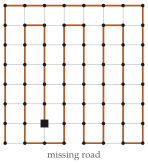
Fifteen is also the least possible: a search shows that no route from the black town visits every town once in fourteen stretches or fewer.
Answer 15 stretches, as in the figure
The Miller’s Puzzle
Label the sacks from left to right, so that a single , a pair , a trio , a second pair and a single must satisfy using each of the digits to once. The trio is at most and a pair at most , so neither single can be . The search is best organised by the two singles. Once and are chosen, must be a common multiple of both, and and must be two-digit numbers whose digits, with those of , and , use all nine exactly once. Working through the pairs of singles in this way, a patient reader finds four arrangements, and a search of every row confirms there are no others, two of them the mirror images of the other two: together with their reversals and .
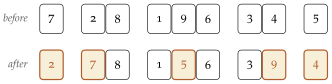
The Miller wants the least trouble, so compare each arrangement with his original row 7, 28, 196, 34, 5 and count the sacks that stand somewhere new. The arrangement keeps the 8, 1, 6 and 3 where they were and moves only five sacks (Figure 1.3).
Each of the other three disturbs seven. The least trouble is therefore unique, as Dudeney promised.
Answer 2, 78, 156, 39, 4, with five sacks moved
The Knight’s Puzzle
Put the roses on a grid, one unit apart, so that every rose has whole-number coordinates. A square can tilt: for example, a side two steps across and one up is followed by a side one step back and two up (Figure 1.4). A square with a rose at each corner is fixed by one corner and by the arrow along one of its sides, say steps across and steps up with and . Turning that arrow a quarter-turn gives the next side, steps back and steps up, so the four corners are

Every square on the shield arises this way exactly once, since each square has exactly one side whose arrow points with and when read anticlockwise from a suitable corner. Counting the squares therefore means counting, for each arrow , the corners for which all four points are roses.
The squares with arrows and are mirror images and have the same size, with side . Grouping them that way gives twenty-one families.
| arrows | squares | arrows | squares |
|---|---|---|---|
| (1,0) | 66 | (4,1),(1,4) | 32 |
| (1,1) | 57 | (3,3) | 15 |
| (2,0) | 48 | (4,2),(2,4) | 24 |
| (2,1),(1,2) | 82 | (3,4),(4,3) | 14 |
| (2,2) | 33 | (5,0) | 10 |
| (3,0) | 32 | (5,1),(1,5) | 16 |
| (3,1),(1,3) | 56 | (5,2),(2,5) | 10 |
| (3,2),(2,3) | 42 | (4,4) | 3 |
| (4,0) | 19 | (5,3),(3,5) | 6 |
| (6,0) | 4 | ||
| (6,1),(1,6) | 4 | ||
| (6,2),(2,6) | 2 |
The total is . Two of the families have the same size without being the same shape of placement: the upright squares with arrow and the tilted ones with arrow both have side , because . Dudeney noticed this too, and it is the only such coincidence on the shield.
Answer 575 squares
The Wife of Bath’s Riddles
The first is a pun, and the Wife’s fourth husband would have been proud of it. The bung knocked tight into the barrel is in secure; the bung falling out is insecure. The second needs no pun at all. The order to leave came not from his mother but from his father, who was also in the room. The son could truthfully say that the parent who had spoken was not his mother.
Answer in secure; his father spoke
The Host’s Puzzle
First, why the puzzle is hard. Filling a measure leaves it full, emptying or drinking leaves it empty, and pouring one measure into the other stops only when the first is empty or the second is full. So after any of these steps at least one measure is empty or full, and a pint in each, with neither measure empty nor full, can never be reached by the two measures alone. The cask must take part as a third vessel. The trouble is that a cask of unknown contents measures nothing: pour three pints into it and nobody can say what it now holds.
The Host’s craft lies in the third step. With both measures full he lets the rest of the cask run away, a waste the pilgrims loudly protest, and from that moment the cask holds a known quantity: none at all. Now it can be used like any other vessel. Using the 3-pint measure to ladle ale between the 5-pint measure and the cask, he arranges for the cask to hold exactly six pints. Refilling the 5-pint measure from those six leaves a single pint behind in the cask. Two more fillings of the 3-pint measure from the 5-pint, each drunk by the company, leave a single pint in the 5-pint measure. The pint in the cask is then drawn off into the 3-pint measure. The table shows the thirteen steps.
| step | cask | 5-pint | 3-pint | |
|---|---|---|---|---|
| 1 | fill the 5 from the cask | ? | 5 | 0 |
| 2 | fill the 3 from the cask | ? | 5 | 3 |
| 3 | let the cask run dry | 0 | 5 | 3 |
| 4 | empty the 3 into the cask | 3 | 5 | 0 |
| 5 | fill the 3 from the 5 | 3 | 2 | 3 |
| 6 | empty the 3 into the cask | 6 | 2 | 0 |
| 7 | pour the 5 into the 3 | 6 | 0 | 2 |
| 8 | fill the 5 from the cask | 1 | 5 | 2 |
| 9 | fill the 3 from the 5 | 1 | 4 | 3 |
| 10 | the company drinks the 3 | 1 | 4 | 0 |
| 11 | fill the 3 from the 5 | 1 | 1 | 3 |
| 12 | the company drinks the 3 | 1 | 1 | 0 |
| 13 | draw the cask into the 3 | 0 | 1 | 1 |
This is exactly the sequence Dudeney gives. Whether thirteen steps can be beaten is a question about a finite puzzle, since the amounts in the vessels are whole numbers of pints and the measures are small. A search through every reachable state, in order of the number of steps taken, finds no shorter route.
Dudeney’s thirteen steps are the fewest possible.
Answer 13 steps, as in the table
The Clerk of Oxenford’s Puzzle
Six of the numbers, forming the two pieces 1, 8 and 9, 2, 13, 7, can stay exactly where they are. The other ten form two L-shaped pieces of five squares, and the two pieces simply change places, sliding without turning (Figure 1.5).
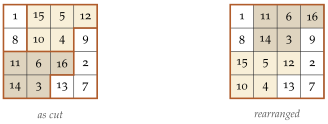
Checking the result is a matter of adding. The rows are , , and ; the columns are , , and ; the diagonals are and . All ten sums are 34.
Answer two L-shapes change places
The Tapiser’s Puzzle
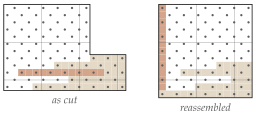
The tapestry is twelve squares wide for seven rows and seventeen wide for the five rows below, which makes squares, so the finished piece is a square thirteen each way. The roses fall on alternate squares, so a piece keeps the pattern in step whenever it is moved an even number of squares in total, counting across and down together, and a quarter-turn about a suitable point keeps it in step too.
Start by trying slides without turning the pieces. That approach fails the Tapiser badly. A search over every way to cut the tapestry into three connected pieces and slide them into a square shows that the smallest piece must then hold at least 49 squares.
To do better, a piece has to turn.
Dudeney’s answer turns just one piece, and it is a plain strip: the tenth row, from the third square to the fourteenth, twelve squares long. Lift it out, turn it a quarter-turn, and it becomes the left-hand column of the square. The long piece to its right drops down one row and slides five squares to the left, and the rest of the tapestry does not move at all (Figure 1.6). The pattern matches throughout, and two of the three pieces hold between them of the 169 squares.
Twelve cannot be beaten. A search over every way of cutting the tapestry into three connected pieces, allowing any turns but no turning over, and trying every position the finished square could take, finds none whose smallest piece has fewer than twelve squares.
Dudeney’s answer is the best there is.
Answer smallest piece: 12 squares
The Carpenter’s Puzzle
Weight measures wood only if the wood is the same all the way through, and the scholar’s objection is fair. Volume does not care what the wood is made of. The Carpenter built a box whose inside measured exactly three feet by one by one, the size of the original block, stood the pillar in it, and filled every gap with fine dry sand, shaking it down until no more would go in. Then he lifted the pillar out without spilling a grain and shook the sand down again on its own. It filled one cubic foot of the box, and that is the volume of wood the carving had removed, whatever the wood weighed.
Answer one cubic foot, by sand
The Puzzle of the Squire’s Yeoman
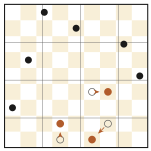
The test for arrows in line is arithmetic: two arrows share a line exactly when they share a row, a column, the difference row minus column, or the sum row plus column. Number the rows and columns of the nine-by-nine signboard from 0 to 8, starting at the top left. The arrows begin in columns 2, 4, 7, 1, 8, 5, 0, 6 and 3 of rows 0 to 8 in turn. No two share a row or a column, and no two share a diagonal, because the differences row minus column are all different and so are the sums row plus column.
Three moves keep all of that true. The arrow in row 5 steps one square right, from column 5 to column 6; the arrow in row 7, column 6, steps diagonally down to row 8, column 5; and the arrow in row 8, column 3, steps straight up to row 7, column 3 (Figure 1.7). The new columns, row by row, are 2, 4, 7, 1, 8, 6, 0, 3 and 5. They are all different, the nine differences row minus column are , and the nine sums are , again all different. So once more no two arrows lie in a line.
Answer three moves, as in the figure
The Nun’s Puzzle
Number the places in the pack to from the top and ask which place each card on the table came from. The dealing lays down places on the first pass through the pack, while places are sent one by one to the bottom and so come round again in their original order. This is the same as setting the eighteen places around a circle and removing every second one: take one, skip one, take one, skip one, going round and round and ignoring places already taken.
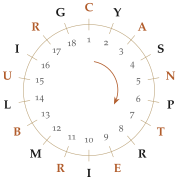
So write C against place and then, going round, write each following letter of CANTERBURY PILGRIMS against the second empty place.
The first pass puts C, A, N, T, E, R, B, U, R at the odd places. The second pass skips to reach for Y, skips for P at , and so on, the gaps widening as the circle fills (Figure 1.8). Reading the places in order from to gives the pack from top to bottom. The letter G, laid sixteenth, turns out to be the bottom card of the pack, at place .
Answer C Y A S N P T R E I R M B L U I R G, top to bottom
The Merchant’s Puzzle
A company of can ride in rows of exactly when divides , so the Merchant is asking for the least number with exactly divisors, and included. For example, has six divisors: choose a power of 2 from and a power of 3 from . The combinations are . If with distinct primes , a divisor is fixed by choosing each exponent from up to , so the number of divisors is Every factor divides and so is a power of two, and the ways of writing as such a product correspond to the eleven ways of breaking into parts. For any fixed list of exponents the smallest puts the largest exponent on the prime , the next largest on , and so on, since swapping a larger exponent onto a smaller prime can only reduce the product. That leaves eleven candidates to compare.
| exponents | least number | |
|---|---|---|
| 63 | about | |
| 31, 1 | ||
| 15, 3 | ||
| 15, 1, 1 | ||
| 7, 7 | ||
| 7, 3, 1 | ||
| 7, 1, 1, 1 | ||
| 3, 3, 3 | ||
| 3, 3, 1, 1 | ||
| 3, 1, 1, 1, 1 | ||
| 1, 1, 1, 1, 1, 1 |
The smallest is . Dudeney adds that no smaller number has even more than sixty-four divisors, which is true: the best below is , with sixty. As he also remarks, the Merchant was wise to say they rode over a common, since a single row of would not be possible along an ordinary road.
Answer 7,560 pilgrims
The Man of Law’s Puzzle
The plan looks tangled, but only the connections matter. Follow the passages and redraw the dungeons so that joined dungeons sit side by side, and the plan becomes a three-by-three grid, each dungeon joined to its neighbours across and down. Dudeney called this his “buttons and string” method. Laid out on the grid, the prisoners start as where the dot is the empty dungeon. This is exactly the sliding eight-puzzle, the little square tray of numbered tiles with one gap.
A rough lower bound comes from distance. Each prisoner must move at least as many times as the number of grid steps between his start and his goal, and those distances add up to 14. The true answer is well above that, because prisoners get in each other’s way. The grid has only reachable arrangements, few enough to search completely, and the search finds that the fewest moves is 26.
Dudeney’s sequence, naming the prisoner who moves each time, is
Answer 26 moves
The Weaver’s Puzzle
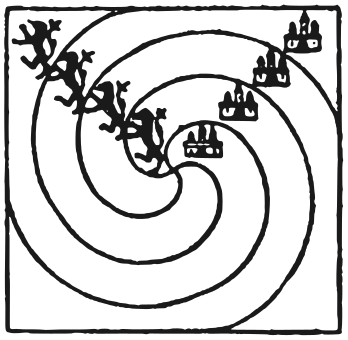
Four pieces of the same size and shape will come from any cut that looks the same after a quarter-turn about the centre of the square. Draw one curve from the centre out to the edge, then turn that curve through a quarter, a half and three quarters of a turn, and cut along all four. Each cut piece is the previous one turned through a quarter, so all four are congruent.
The four lions lie on the diagonal running from the top left corner towards the centre, and the four castles on the diagonal from the top right corner, so a quarter-turn carries the line of lions onto the line of castles. A curve that starts at the centre and spirals outwards between the lions and the castles, turned four times, leaves each of the four pieces holding exactly one lion and one castle (Figure 1.9).
Answer four spiral pieces
The Cook’s Puzzle
Four portions of pie and four of pasty go to eight different pilgrims, so three of the eleven go hungry.
Call the five who eat only pie the pie-eaters, the four who eat only pasty the pasty-eaters, and the two who will eat either the obliging pair. Everything turns on what the pair are given. Suppose of the pair have pie and have pasty. Then portions of pie go to pie-eaters and of pasty to pasty-eaters, and the number of ways to serve the table is found by multiplying the choices.
| pair with pie | pair with pasty | choices | servings |
|---|---|---|---|
| 0 | 0 | 5 | |
| 1 | 0 | 20 | |
| 0 | 1 | 40 | |
| 2 | 0 | 10 | |
| 0 | 2 | 30 | |
| 1 | 1 | 80 | |
| 185 |
That makes ways to serve the supper. The question, however, is how many different groups of eight the Franklin may choose, and here the last row misleads. When one of the pair eats pie and the other pasty, swapping the two changes the serving but leaves the same eight people at the table. Those servings are only different companies. In every other row the company decides the serving, since the numbers of pie-eaters and pasty-eaters at the table show who of the pair must have had what. The number of companies is therefore , and the “mistake of forty” is the difference between counting servings and counting diners. Dudeney groups the companies differently, as , and reaches the same total.
Answer 145 companies (185 servings)
The Sompnour’s Puzzle
The Wife’s mistake shows where everyone stood. Number the ten places clockwise from the Wife of Bath, who stands at place . Counting eleven from herself, the count falls first on place , which is the Wife herself, and then, starting afresh from the next person each time, on places , , and . All five are women, so the women stand at and the men at .
The Sompnour wants a count, and a starting place, that removes places in some order. The first count is taken among ten people, the second among nine, and so on down to six. A count of lands in the same place as a count of plus any multiple of the ring’s current size, so what matters is the remainder of on division by , by , by , by and by . Trying in turn against all ten starting places, the first count to succeed is , and it succeeds from exactly one place, place .
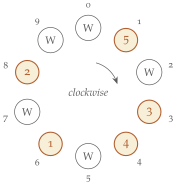
Place is two to the Wife’s right as the ring faces inward, and Dudeney names its occupant as the Doctor of Physic. The count of from the Doctor falls on place , the Shipman; then on the Doctor himself; then on places , and , which Dudeney gives as the Cook, the Sompnour and the Miller (Figure 1.10). Any count that leaves the same remainders as on division by , , , and works equally well, and those counts are plus the multiples of the least common multiple of those five numbers, .
Answer count 29, beginning at the Doctor of Physic
The Reckoning
The ten numbers carried forward are 33 from the Reve, 5 from the Miller, 575 from the Knight, 13 from the Host, 12 from the Tapiser, 18 from the Nun, 7,560 from the Merchant, 26 from the Man of Law, 145 from the Cook and 29 from the Sompnour. Worked in order, In 1170 Thomas Becket, Archbishop of Canterbury, was killed in his own cathedral by four knights, and it is to his shrine that every pilgrim in this book is riding. He died on the twenty-ninth of December, so by a happy coincidence the Sompnour’s count is the day of the month.
Sources. The puzzles are retold from Nos. 1 to 16, and the illustrations reproduced from, Henry Ernest Dudeney, The Canterbury Puzzles and Other Curious Problems (1907; revised edition 1919), in the text of Project Gutenberg eBook 27635, from which his introduction and solutions are also quoted. The optimality of the split method for four stools, conjectured by Frame and Stewart, is proved in Thierry Bousch, “La quatrième tour de Hanoï”, Bulletin of the Belgian Mathematical Society, Simon Stevin 21 (2014), pages 895 to 912. The date of Becket’s death follows the Encyclopædia Britannica entry on Saint Thomas Becket. Every numerical answer in this chapter is found again by the programs in the verify folder accompanying this book.