Library · The Canterbury Puzzles · Chapter 3
Puzzling Times at Solvamhall Castle
On this page
Sir Hugh de Fortibus keeps a castle, a large household and a habit of setting problems for anyone within earshot. The records of Solvamhall preserve nine of them, set over games of golf, at tournaments, in the great hall after dinner and, on one occasion, to a builder who had done nothing to deserve it. Sir Hugh was fond of pretending to lose his temper when people could not answer, and fonder still of trick questions, so it pays to read each one twice.
The puzzles come first, then the Reckoning, then the solutions.
No. 32. The Game of Bandy-Ball
Bandy-ball, the ancestor of golf, was the great game at Solvamhall, and Sir Hugh was a master of it. His course had nine holes, and the distances from each to the next were 300, 250, 200, 325, 275, 350, 225, 375 and 400 yards.
Suppose a player could hit the ball in a perfectly straight line and always send it exactly one of two fixed distances, so that each shot either stops short of the hole, runs past it, or drops in. Which two distances would take him round the whole course in the fewest strokes? Distances of 125 and 75 yards will do it in 28 strokes, which is good, but not the best.
Carry forward the fewest strokes, and each of the two distances in yards.
No. 33. Tilting at the Ring
The other favourite sport at the castle was tilting at the ring: a ring hangs from a bar at about the height of a rider’s eyebrow, and the rider gallops at it and tries to carry it off on his lance. It is very hard, and men were proud of the rings they won.
At one tournament Henry de Gournay beat Stephen Malet by six rings. Each had his rings made into a chain, one ring linked into the next. De Gournay’s chain was exactly sixteen inches long and Malet’s exactly six. All the rings were the same size, made of metal half an inch thick. How many rings had each man won?
Carry forward the number of rings each man won.
No. 34. The Noble Demoiselle
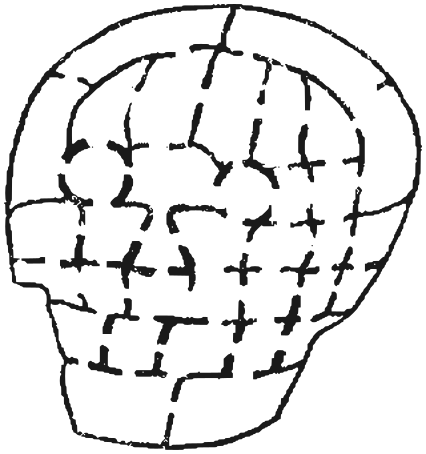
Over wine one evening Sir Hugh told how, as a young man, he had rescued a noble lady from the dungeon of his father’s worst enemy, a dungeon laid out in the shape of a skull and known as the Death’s-head. He then produced its plan, thirty-five cells joined by doorways.
Start in one of the cells on the outside of the dungeon and pass through every doorway exactly once. There is only one outside cell from which this can be done, and wherever you go, you will finish in the cell where the lady was held. Which cell was it?
No. 35. The Archery Butt
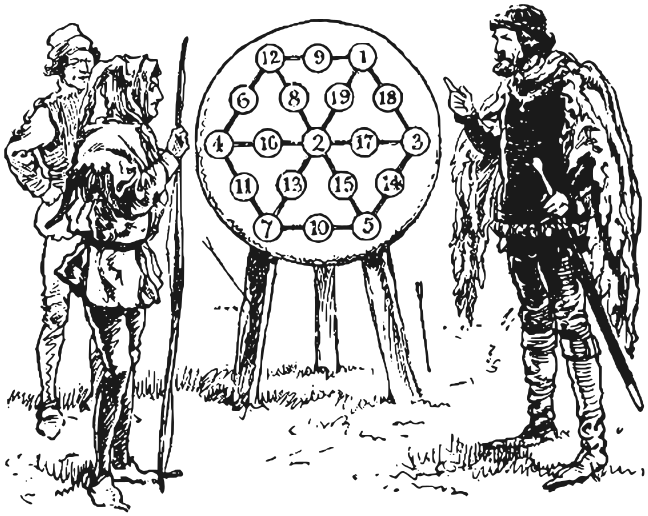
The castle’s archery target had no rings. Sir Hugh had instead painted it with the numbers 1 to 19 in the pattern shown, joined by twelve lines of three numbers: six around the outside and six running in towards the centre. Every one of the twelve lines adds up to 22.
One afternoon, when the archers were bored, he told them to rewrite the numbers so that every line added up to 23 instead.
Carry forward the number in the centre of your target.
No. 36. The Donjon Keep Window
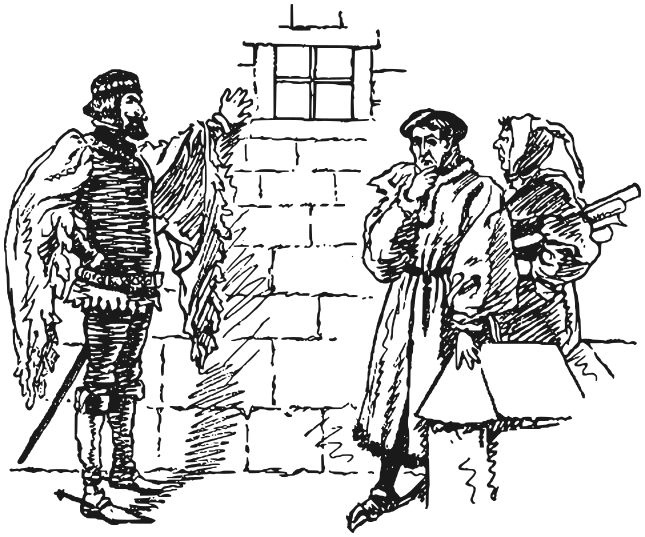
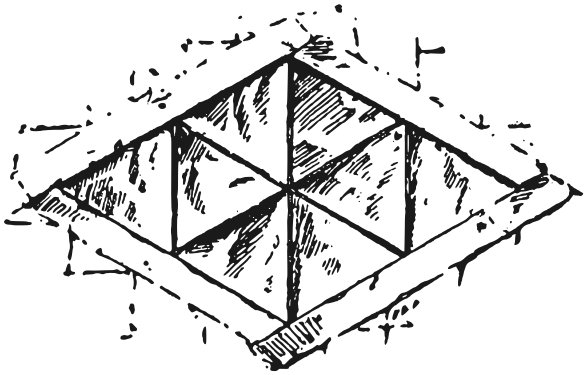
Sir Hugh took his chief builder up to the walls of the keep and pointed to a window. It was square, a foot each way on the inside, and divided by thin bars into four lights, each half a foot on every side.
He wanted another window made higher up. It too must have four sides of one foot each, but it must be divided by bars into eight lights, all of whose sides are equal. The builder said it could not be done, and Sir Hugh roared at him. Ignore the thickness of the bars. How is it done?
No. 37. The Crescent and the Cross
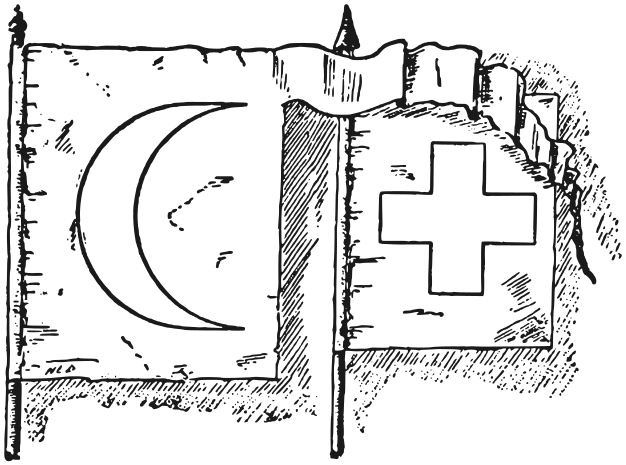
Sir Hugh’s kinsman came home from the Holy Land with a flag bearing a crescent. Sir Hugh spent a long time comparing it with the cross on his own banner, and then announced that a dream had shown him how the crescent could be cut up and reassembled into the cross exactly, using every scrap of it. The flag looks the same from both sides, so pieces may be turned over.
How can the crescent be cut into pieces that make the cross?
No. 38. The Amulet
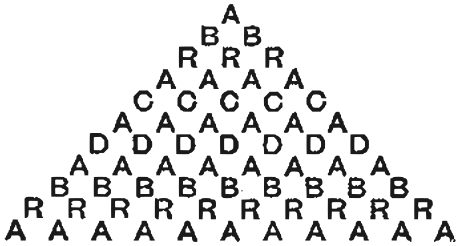
A foreigner was found loitering in the castle courtyard and suspected of spying. All the guards found on him was a piece of parchment hung round his neck, bearing the word ABRACADABRA written out as a triangle, as shown. A priest explained that it was a charm against fevers and toothache, and Sir Hugh let the man go with food and a coat.
Then he asked the priest a question. Starting from the A at the top and moving downwards each time to a letter touching the one before, in how many different ways can you read the word ABRACADABRA?
Carry forward the number of ways.
No. 39. The Snail on the Flagstaff
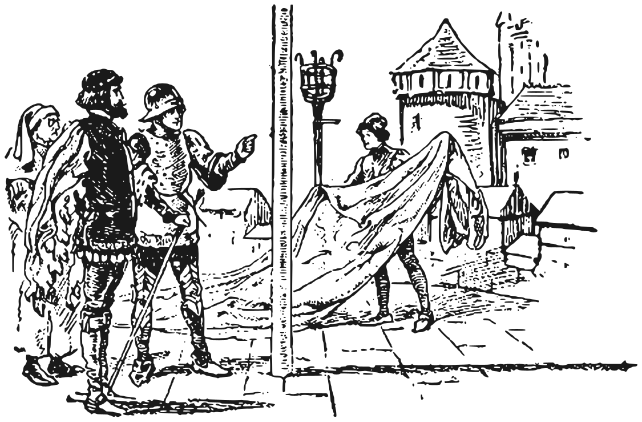
During celebrations at the castle, while flags were going up, someone noticed a snail climbing the flagstaff. An old retainer remarked that snails are said to climb three feet by day and slip back two feet by night. Sir Hugh asked how many days this one would take to reach the top.
The retainer said nobody could know without taking the staff down and measuring it. Sir Hugh said there was no need. How many days, and how does he know? Everything you need is in the pictures of Sir Hugh in this chapter.
Carry forward the number of days.
No. 40. Lady Isabel’s Casket
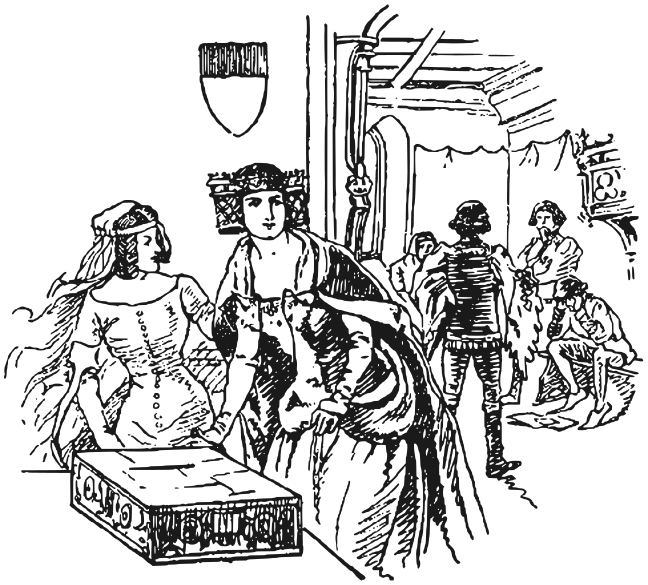
Sir Hugh’s young ward, Lady Isabel, known as Isabel the Fair, owned a casket with a perfectly square lid. The lid was inlaid with a strip of gold ten inches long and a quarter of an inch wide, and the rest of it was covered exactly by square pieces of wood, no two of them the same size.
Sir Hugh promised Isabel’s hand to whichever suitor could tell him the size of the lid from those facts alone. Many failed. What size is it?
Carry forward the side of the lid, and the side of its largest square, in inches.
The candles are lit in the great hall and Sir Hugh calls for the reckoning. Six of the puzzles gave numbers to carry forward.
Take the snail’s days and take away Stephen Malet’s rings.
Multiply by the side of the largest square in the casket, and take away the side of the lid.
Multiply by De Gournay’s rings.
Add the ways of reading the amulet.
Add both of the bandy-ball distances, the fewest strokes, and the number in the centre of the target.
If every answer is right, the result is a year that matters to this book more than to Sir Hugh.
The Game of Bandy-Ball
A shot can finish a hole only if the hole’s distance is made of whole numbers of the two shots, counted forwards and backwards, so the task is to choose two distances that make all nine holes short. Call the two distances the drive and the approach. With a drive of 125 yards and an approach of 100, and remembering that a shot may carry past the hole so that the next comes back, Sir Hugh’s nine holes go like this: 300 yards in three approaches; 250 in two drives; 200 in two approaches; 325 in two approaches and a drive; 275 in three drives and one approach played back towards the hole; 350 in two drives and an approach; 225 in a drive and an approach; 375 in three drives; and 400 in four approaches. That is strokes.
Why can no other lengths do better? Suppose a pair could finish in 26 strokes or fewer. Each of the other seven holes needs at least one stroke, leaving at most nineteen for the 200-yard and 225-yard holes together. For each of these two holes, record the net number of each kind of shot, counting backwards shots negatively. The sum of the absolute net counts cannot exceed the number of strokes played.
If the two pairs of net counts are independent, they determine the two lengths: solve the two linear equations saying that the shots total 200 and 225 yards. There are only finitely many whole-number count pairs within the nineteen-stroke allowance. This also includes fractional lengths; nothing requires the lengths themselves to be whole yards.
If the count pairs are dependent, their ratio must be . They are eight and nine times one whole-number pair. The allowance forces that pair to use just one shot, so one length is 25 yards. Those two holes then use at least seventeen strokes, leaving nine for seven holes; in particular the 250-yard hole can use at most three. Its net counts determine the other length, giving another finite list.
Together these cases give 10 359 candidate pairs. A program solves the remaining seven hole equations for each pair and counts the least possible net shots. Even this relaxed count, which ignores restrictions on the order of shots, is never below 26. Only 100 and 125 yards attain 26, and the route above shows that their shots can actually be played.
Answer drive 125, approach 100: 26 strokes
Tilting at the Ring
Call the inside width of a ring, the hole the next ring passes through, . With metal half an inch thick, one ring on its own measures inches across. Link a second ring through it and the chain grows by less than a full ring, because the two rings overlap by the thickness of metal on each side of the join: it grows by . Every further ring does the same (Figure 3.1). So a chain of rings is inches long.
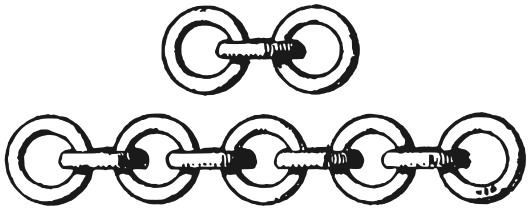
If Malet won rings and De Gournay , then Subtracting, , so inches, and then gives . Malet won three rings and De Gournay nine.
Answer Malet 3 rings, De Gournay 9
The Noble Demoiselle
Every time the rescuer passes through a cell, he goes in by one doorway and out by another, so doorways at a cell are used in pairs. A route through every doorway exactly once can therefore exist only if all but two cells have an even number of doorways, and then it must start in one of the two odd cells and finish in the other. Sir Hugh’s dungeon has exactly two cells with an odd number of doorways, three each. One of them lies on the outside of the skull, low on the left, and that is where the route must begin. The other lies inside, above the skull’s left eye, and that is where every such route ends: the lady’s cell (Figure 3.2).
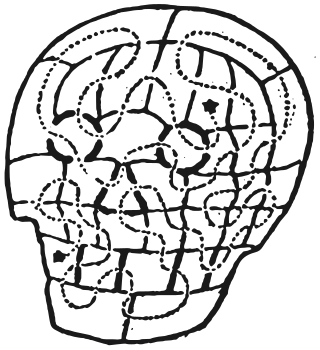
The plan is small, and one gap in the right-hand band is narrow enough to be either a doorway or a break in the pen stroke.
Read as a doorway, it gives the plan four odd cells and no route at all. Read as a pen break, it gives exactly the two cells Dudeney starred, and a route from one to the other through all the remaining doorways.
Answer the cell above the skull’s left eye
The Archery Butt
Call the number in the centre , the six numbers round it the inner ring, the six at the corners of the outer hexagon the corners, and the six between them the middles. Each of the six lines running inwards holds the centre, an inner number and a corner; each of the six sides holds two corners and a middle. If every line adds to 23, the six inward lines together make , and the six sides make . All nineteen numbers add to 190. Taking the first of these from the total gives , and then the sides give so must be even. Trying the even centres, a search finds that only can be completed, and it can be completed in essentially two ways, one of which is shown in Figure 3.3; the other is its companion found by Dudeney, exchanging the 7, 10, 5, 8 and 9 with the 13, 4, 17, 2 and 15, and the 18 with the 12.
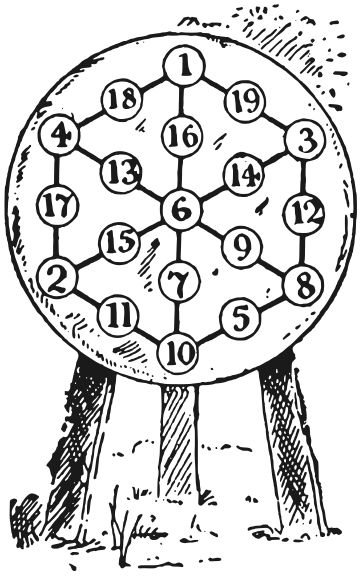
Answer 6 in the centre; two arrangements
The Donjon Keep Window
Sir Hugh never said the new window had to be square. A diamond, with four sides of one foot and angles of sixty and a hundred and twenty degrees, is made of two equilateral triangles of side one foot. Each of those can be divided by bars joining the midpoints of its sides into four equilateral triangles of side half a foot, which gives eight lights, every side of every light six inches long (Figure 3.4).
Answer a diamond of eight lights
The Crescent and the Cross
Dudeney’s method goes through a square. The crescent on Sir Hugh’s kinsman’s flag is not an arbitrary moon: its two horns are cut off by straight lines, and its inner and outer arcs are copies of each other. Cut as in the first diagram, its four pieces fit together into a square. A square can be cut into a Greek cross by straight cuts, and making those cuts through the square made from the crescent divides it further, into ten pieces in all, which reassemble into the cross (Figure 3.5). Dudeney added that he knew a way with fewer pieces, but that it was much harder to follow.
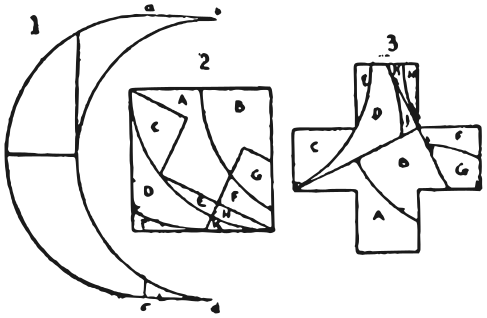
Answer ten pieces, via a square
The Amulet
The amulet is a triangle of eleven rows, the th row holding copies of the th letter of ABRACADABRA, set so that every letter touches exactly two letters in the row below. Start at the single A at the top. From it there are two ways down to a B; from whichever B you choose there are two ways down to an R; and so on. Each of the ten steps down doubles the number of routes, so there are ways of reading the word.
Answer 1024 ways
The Snail on the Flagstaff
The height of the staff is in the pictures, which is why Sir Hugh saw no need to take it down.
First, Sir Hugh’s own height. In the picture of the keep window he stands against the wall just below the window whose inside he has described as a foot square, and he is six times as tall as the window: Sir Hugh is six feet tall.
Second, the shadows in the picture of the flagstaff. Dudeney drew Sir Hugh’s shadow half as long as Sir Hugh, and the shadow of the staff as long as Sir Hugh is tall. Shadows cast at the same moment keep the same proportion to the things that cast them, so the staff is twice its six-foot shadow: twelve feet high.
Now the snail. It gains a foot in every full day and night, three up and two back, so at the end of the ninth night it is nine feet up, three feet from the top. On the tenth day it climbs those three feet and arrives, before it has a chance to slip back. The quick answer of twelve days forgets that the last climb needs no night after it.
Answer on the tenth day
Lady Isabel’s Casket
Test Dudeney’s proposed inlay by checking the distinct square sizes and their fit around the strip. The lid is twenty inches square. His inlay, in Figure 3.6, uses squares with sides of 12, 8, , 7, , 5, 3, , , 2, 1 and inches around the gold strip. Their areas, with the strip’s , add up to exactly 400 square inches, the area of a twenty-inch square, and they fit together without gaps or overlaps.
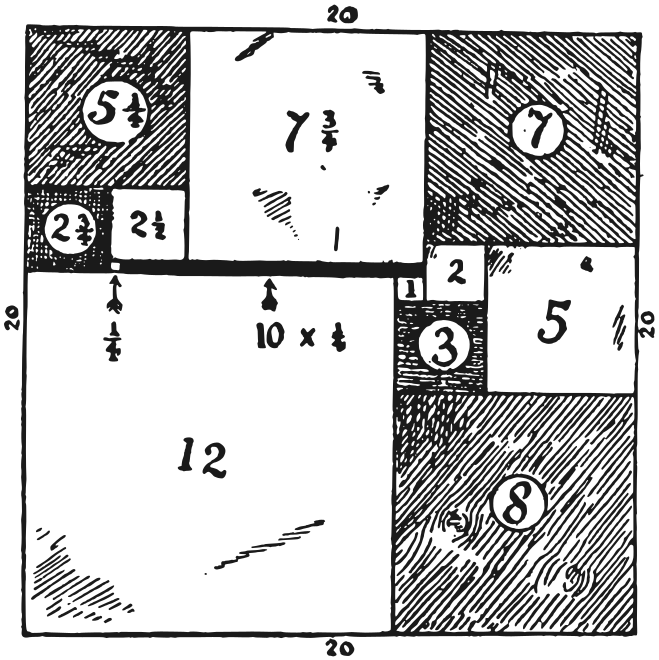
The hard part is Dudeney’s claim that the strip forces this answer: that no other size of lid, and no other set of unequal squares, can be fitted round a strip ten inches by a quarter. He did not show his working, and it has not been reproduced here. A capped search over lids with sides in whole quarter-inches is incomplete, so the uniqueness rests on Dudeney’s word.
Answer a lid 20 inches square
The Reckoning
The numbers carried forward are 26 strokes with distances of 125 and 100 yards; 9 and 3 rings; 6 in the centre of the target; 1,024 readings of the amulet; 10 days for the snail; and a lid of 20 inches whose largest square is 12. Worked in order, Henry Ernest Dudeney was born in 1857, at Mayfield in Sussex.
Sources. The puzzles are retold from Nos. 32 to 40, and the illustrations reproduced from, Henry Ernest Dudeney, The Canterbury Puzzles and Other Curious Problems (1907; revised edition 1919), in the text of Project Gutenberg eBook 27635, from which his remarks are also quoted. Dudeney’s date and place of birth follow the MacTutor History of Mathematics biography. Every numerical answer in this chapter is found again by the programs in the verify folder accompanying this book.