Library · The Canterbury Puzzles · Chapter 7
Adventures of the Puzzle Club
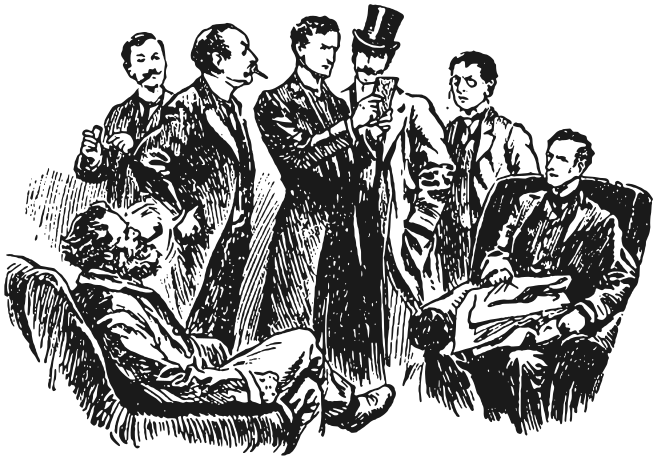
The Puzzle Club met in a clubhouse in the Adelphi and avoided publicity, until its part in a well-known case made that impossible. Its members included some of the best mathematicians and subtlest thinkers in London: Russell, a bearded Senior Wrangler with a quiet post at Somerset House; Melville, a barrister short of briefs; Wilson, a journalist cleverer than he looked; Tomkins, an accountant devoted to the theory of numbers; Churton, a bank clerk with views on perpetual motion; Baynes, a man of private means; and Macdonald, who had never solved a puzzle himself but often set others on the right track.
They took no interest in crime as such. They took up a case only when it was a genuine puzzle, and five of their cases follow. Some need an eye for a picture, some a head for numbers. The cases come first and the solutions after. Like the jester’s escape, these are cases rather than sums, so there is no Reckoning.
No. 62. The Ambiguous Photograph
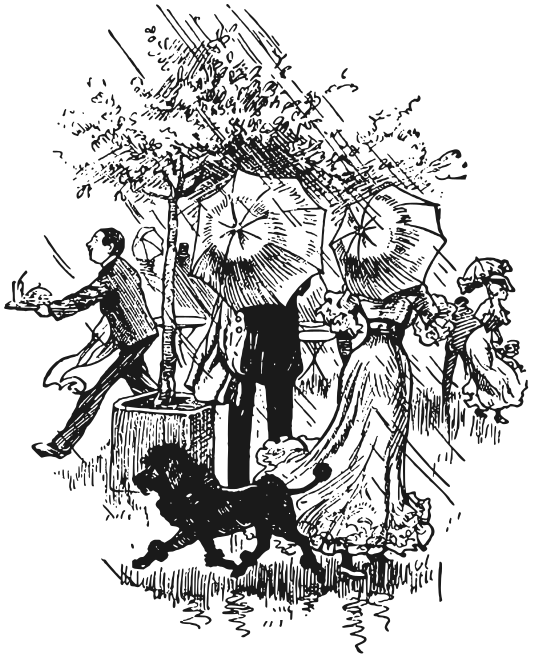
Baynes arrived at the club with a problem from Dovey, a private detective. A jealous American lady, lately married to Lord Marksford, had set one of Dovey’s men to follow her husband round Paris with a pocket camera. The man proudly produced a snapshot of his lordship walking in the street with a lady who was not his wife.
Her ladyship was unimpressed. Most of the man was hidden, head and shoulders included, and, she said, nobody could tell from the picture whether he was walking with the lady or in the opposite direction. A sudden summer shower had come on as the picture was taken, which is the real cause of the difficulty, and everyone at the club agreed with her. His frock coat could be front or back, and the coat over his arm hid which way the arm went; his legs were caught perfectly straight; the pose suggested left to Tomkins and right to Melville. Only Baynes said her ladyship was wrong, and that the photograph held the evidence. Was Lord Marksford walking with the lady, and how can you tell?
No. 63. The Cornish Cliff Mystery
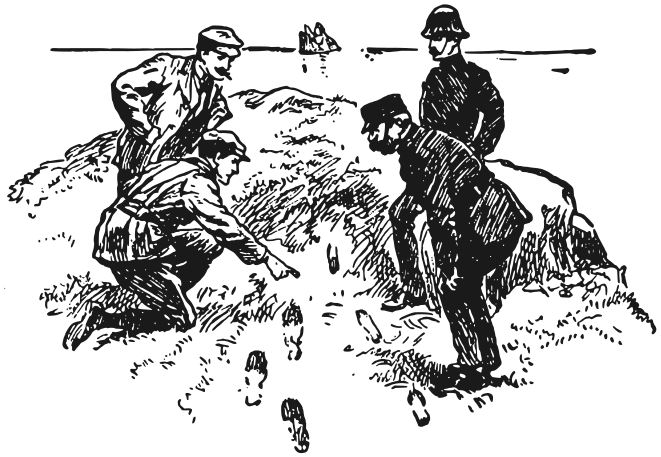
Two clerks, Lamson and Marsh, had absconded from a City bank with a large sum and were known to be hiding in Cornwall, inside a police cordon. Melville and Wilson, on a walking holiday nearby, went with an inspector to see the key clue. Beside a stile the police had found a pocket-book of Marsh’s. Beyond the stile, in thin soft soil, the footprints of both men ran some two hundred yards straight to the edge of a sheer cliff, trampled about at the brink, and stopped. There were no other marks for yards around and no possible way down. The inspector concluded that the two men had thrown themselves over and proposed to call off the search.
Melville told him that would be a fatal mistake. Lamson was over six feet tall and had the large feet; Marsh was small. Yet the large prints showed a shorter stride than the small ones. Marsh’s prints were heaviest at the heel and Lamson’s at the toe. And the large prints sometimes lay over the small ones, never the other way round. The two men had not walked backwards in their own tracks, which no one could do so exactly, and they had not flown. How did they get away?
No. 64. The Runaway Motor-Car
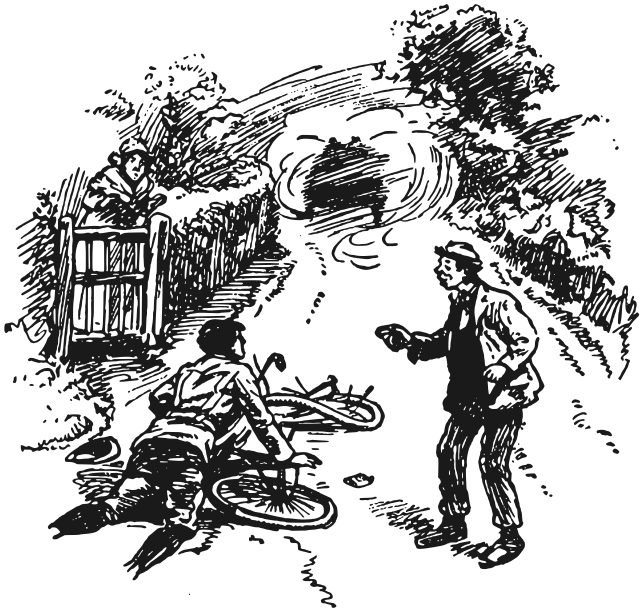
A motor car came round a corner in Surrey at a terrific speed, knocked a cyclist off his machine and drove on. There were two witnesses. An old lady, Mrs Wadey, got the letters of the registration and was sure the number began with a 1, but the rest was lost in the dust. The other was the village simpleton, who is no good at anything except sums in his head. All he could say was that the number had five figures, none of them 0, and that the first two figures multiplied by the last three gave a number made of the same five figures in a different order, the way 24 times 651 makes 15,624.
Russell said the car would be easy to find. What was its number?
No. 65. The Mystery of Ravensdene Park
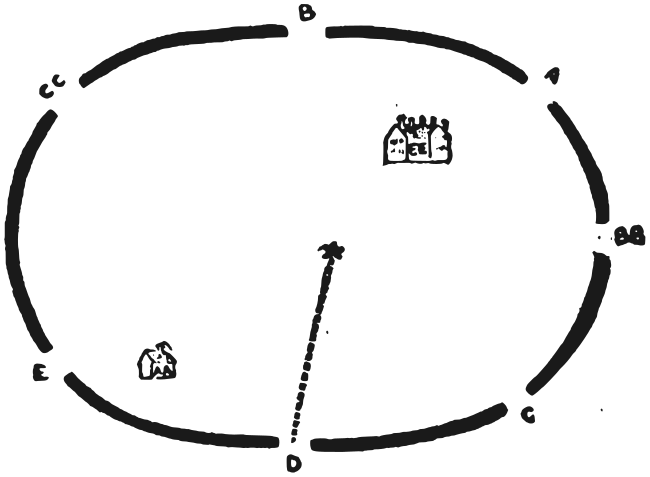
On the night of 17 February snow fell for half an hour from eleven o’clock and covered the ground. At midnight Mr Cyril Hastings left a neighbour’s house and walked home across Ravensdene Park, from gate D towards A. In the morning he was found stabbed, at the star on the plan. The seven gates were closed and the footprints in the snow examined. Mr Hastings had walked from D to where he fell. The butler, who went to bed five minutes before midnight, had walked from E to EE. The gamekeeper had walked from A to his lodge at AA. One stranger had come in at B and left at BB, and another had come in at C and left at CC. Nobody else had entered the park since the snow.
It was foggy, and some of the tracks wandered badly, but the police were certain of one thing: no track crossed any other. Unhelpfully, they drew no sketch before the snow melted. Tracing out the possible routes, which of A, B, C or E could have reached Mr Hastings?
No. 66. The Buried Treasure
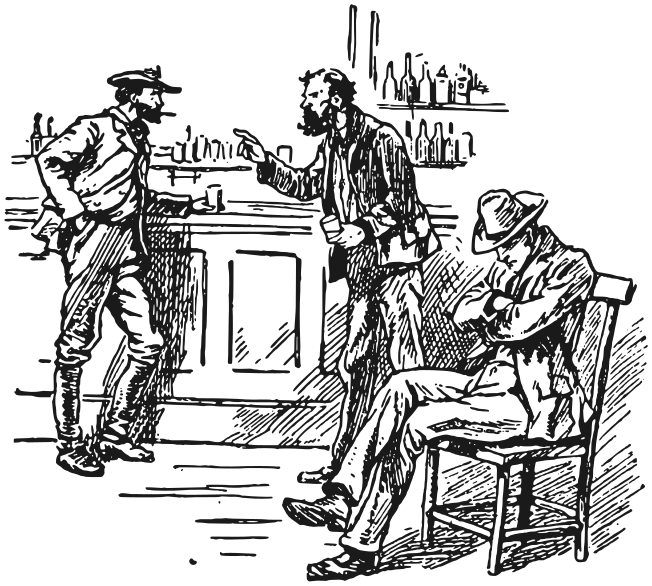
A young man named Dawkins, just back from Australia, told the club how he had made his fortune. Down on his luck in a Melbourne wine shop, he overheard a man describe a document about buried treasure. The treasure lay in a square field, at a point exactly two furlongs from one corner, three furlongs from the next corner, and four furlongs from the corner after that. Nearly every field in the district was square, and no two the same size, so the man despaired of finding the right one.
Dawkins, being something of a mathematician, realised that those three distances can meet at a point inside a square of only one size. He worked it out, found the field, and dug up the treasure. What was the area of the field?
The Ambiguous Photograph
Look at the coat over his lordship’s arm. Its buttons are on the left-hand side, and a man’s coat buttons on the right. It is a lady’s coat, and a man does not stroll about Paris carrying a lady’s coat unless he is walking with the lady it belongs to. So Lord Marksford was walking with her, not away from her. She was lightly dressed, and the rain was only a sudden shower, so she had not thought it worth putting on. The detective’s employer need not have worried: a telegram arrived at the club before the evening was out to say that the lady was his lordship’s sister.
Answer walking with her: her coat
The Cornish Cliff Mystery
The two men never went near the edge together. At the stile Marsh, the small man, took Lamson’s large boots in his hands and walked alone to the cliff in his own boots. At the edge he changed into Lamson’s boots and walked backwards all the way to the stile, carrying his own. Then the two of them went off another way, and the pocket-book was dropped on purpose to send the police to the footprints.
Every detail Melville noticed fits. A man walking forwards comes down hardest on his heels, and walking backwards on his toes, which is why the small prints are deep at the heel and the large ones at the toe. A man walking backwards takes shorter steps, which is why the large feet have the shorter stride. And the backward journey came second, so the large prints lie over the small ones and never the other way round. The pair were found two miles away, hiding under straw in a barn.
Answer Marsh walked back in Lamson’s boots
The Runaway Motor-Car
Every five-figure number without a 0 can be tested:
split it after the second figure, multiply the two parts, and see whether the product is a rearrangement of the same five figures. Exactly twelve numbers with five different figures pass, and only one of them begins with a 1: so the number of the car was 14926. The other eleven are 24651, 42678, 51246, 57834, 65281, 65983, 72936, 75231, 78624, 86251 and 87435. Russell was right that there would be only one, and the simpleton’s arithmetic caught the driver.
Answer 14926
The Mystery of Ravensdene Park
Only the order of the gates round the park matters, because a track may wander anywhere so long as it crosses no other. Going round the park from the top, the gates come in the order B, A, BB, C, D, E, CC. The two strangers’ tracks run from gate to gate, from B to BB and from C to CC, and each of them divides the park in two.
The track from C to CC has D and E on one side, and A, B and BB on the other. Mr Hastings’ own track runs from D to the place where he died, so that place is on the D side of the C to CC track, or on the track itself. The gamekeeper started at A and the stranger from B left by BB, both on the far side, and neither could have reached Mr Hastings without crossing the track from C to CC. That leaves the butler, whose track began at E on the near side, and the stranger who came in at C, whose track forms the dividing line itself. Both could have reached the spot, and the tracks can be drawn in two different ways to allow for it (Figure 7.1).
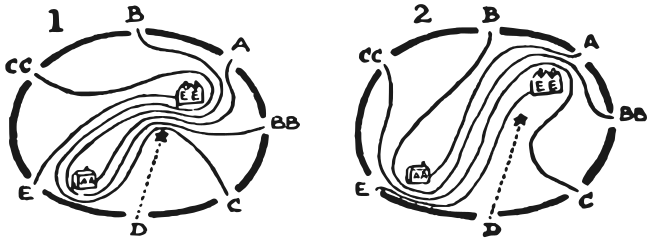
The butler, however, was in bed five minutes before midnight, and Mr Hastings did not leave his neighbour’s house until midnight. The murderer was the man who came in by gate C.
Answer the man who entered at C
The Buried Treasure
Put the field on a grid with its corners at , and , taken in order, and let the treasure be at , two furlongs from the first corner, three from the second and four from the third:
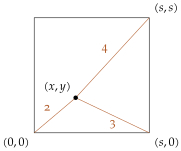
Subtracting the first equation from the second gives , and the second from the third gives , so Putting these into and clearing fractions, , which tidies to The area of the field is square furlongs. The smaller root, about 2.06 square furlongs, makes and hence , putting the treasure outside the field, which the document ruled out. So the area is square furlongs, about 17.937, and since a square furlong is ten acres, the field covered about 179.37 acres.
Answer about 179.37 acres
Sources. The cases are retold from Nos. 62 to 66, and the illustrations reproduced from, Henry Ernest Dudeney, The Canterbury Puzzles and Other Curious Problems (1907; revised edition 1919), in the text of Project Gutenberg eBook 27635. The numerical answers are found again by the programs in the verify folder accompanying this book.