Library · The Canterbury Puzzles · Chapter 10
Foxes and Geese
On this page
- No. 87. The Chifu-Chemulpo Puzzle
- No. 88. The Eccentric Market-woman
- No. 89. The Primrose Puzzle
- No. 90. The Round Table
- No. 91. The Five Tea Tins
- No. 92. The Four Porkers
- No. 93. The Number Blocks
- No. 94. Foxes and Geese
- No. 95. Robinson Crusoe’s Table
- No. 96. The Fifteen Orchards
- No. 97. The Perplexed Plumber
- No. 98. The Nelson Column
- No. 99. The Two Errand Boys
- No. 100. On the Ramsgate Sands
The miscellany goes on, Nos. 87 to 100: a toy train, a poultry farm, a primrose, a round table and Nelson’s Column among them. The chapter takes its name from No. 94, an old game played on a board shaped like a cross.
No. 87. The Chifu-Chemulpo Puzzle
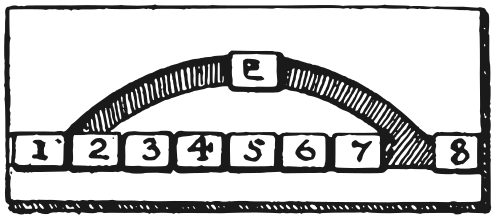
This puzzle was once on sale in the London shops. It shows a military train, an engine and eight cars, on a main line with a curved siding. Reverse the cars, so that they stand in the order 8, 7, 6, 5, 4, 3, 2, 1 instead of 1 to 8, with the engine left on the siding as at first, in the fewest possible moves. Each time the engine or a car passes over one of the points, from the main line onto the siding or back, it counts as one move; movement along the main line is not counted. With 8 at the end, as shown, there is just room to pass 7 onto the siding, run 8 up to 6, and bring 7 down again. The siding holds five cars, or four and the engine, and the cars move without the aid of the engine. The makers invited the purchaser to “try to do it in 20 moves”. How many do you need?
No. 88. The Eccentric Market-woman
Mrs Covey keeps a little poultry farm in Surrey, and does business in her own way. One day she took a number of eggs to market. She sold half of them to one customer and gave him half an egg over. She sold a third of what was left to the next, and gave a third of an egg over; then a fourth of the remainder and a fourth of an egg over; then a fifth of the remainder and a fifth of an egg over. What was left she divided equally among thirteen of her friends, and in all these dealings she never broke an egg. What is the smallest number of eggs she could have taken to market?
No. 89. The Primrose Puzzle
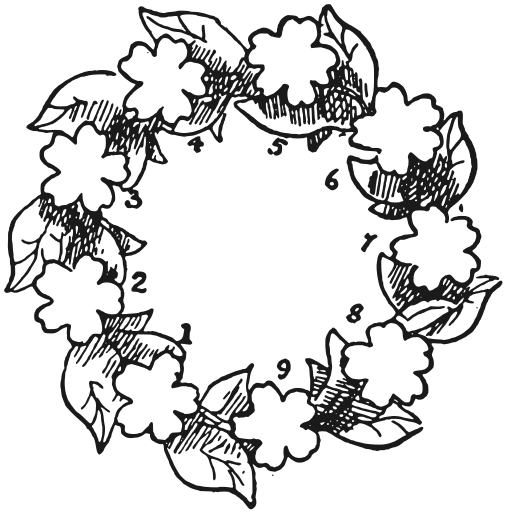
Choose the name of a flower, or of a tree, with eight letters. Touch one of the primroses in the garland with your pencil, jump over the next flower to the one beyond, and write the first letter of your word on that flower. Then touch another empty flower, jump over one in either direction, and write the second letter, and so on, taking the letters in their proper order, until all eight are written and the word can be read correctly round the garland. You must always touch an empty flower and land on an empty one, but the flower jumped over may be full or empty. Only English words are allowed.
No. 90. The Round Table
Seven friends, Adams, Brooks, Cater, Dobson, Edwards, Fry and Green, spent fifteen days together at the seaside and had a round breakfast table to themselves. They agreed that no man should ever sit down twice between the same two neighbours. They wanted a scheme for all fifteen sittings, so the plan was practicable; but the hotel proprietor, asked to draw up a scheme for every sitting, failed miserably. Can you do it?
No. 91. The Five Tea Tins
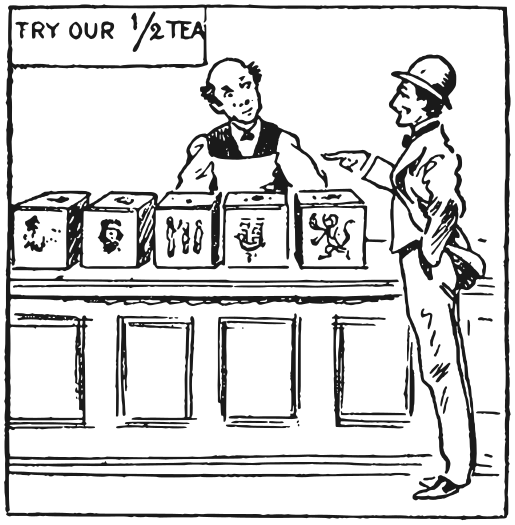
A tea merchant keeps five cubical tea tins in a row on his counter. Each tin has a picture on each of its six faces, thirty pictures in all, but one picture on No. 1 is repeated on No. 4, and two other pictures on No. 4 are repeated on No. 3, so there are only twenty-seven different pictures. He always keeps No. 1 at the same end of the row, and never lets Nos. 3 and 5 stand side by side. In how many ways can the tins be arranged so that the row of five pictures at the front is never the same twice? Two equal pictures may appear in the row; it is only their order that counts.
No. 92. The Four Porkers
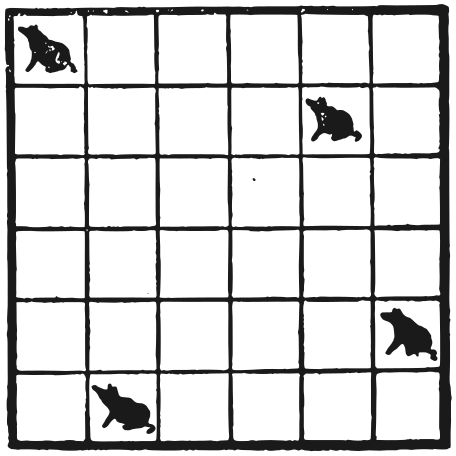
Four pigs are placed in four of thirty-six sties, as shown, so that every sty is in a straight line, across, down or diagonally, with at least one pig, and yet no pig is in line with another. In how many different ways can this be done? Turning the page round, or looking at it in a mirror, does not make a new arrangement.
No. 93. The Number Blocks
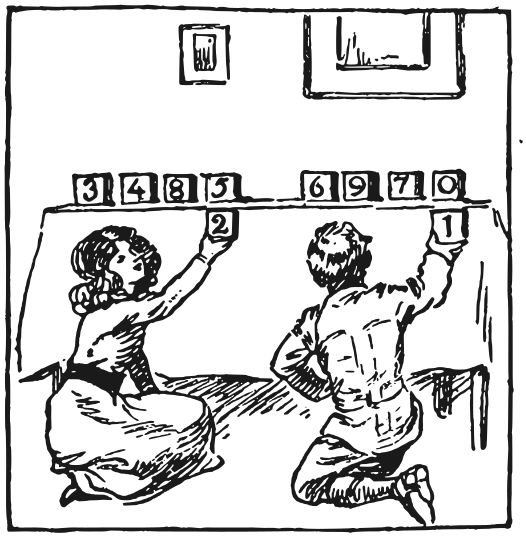
The children have ten blocks bearing the figures 1 to 9 and 0. They divide them into two groups of five and arrange each group as a multiplication sum, the two sums having the same product. They have found the arrangement with the smallest product: 3485 times 2 is 6970, and 6970 times 1 is the same. Now find the largest possible product. A multiplier may have two figures; fractions and tricks are not allowed.
No. 94. Foxes and Geese
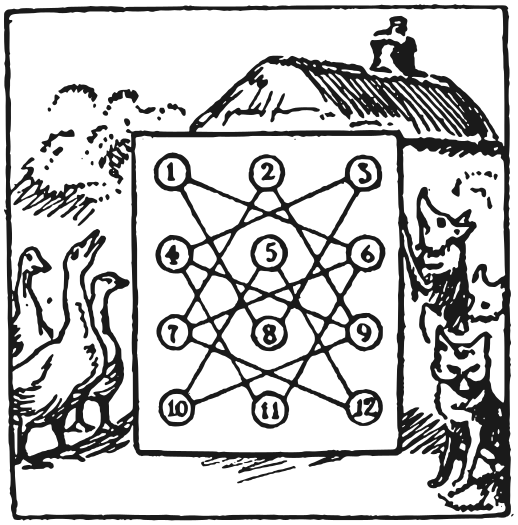
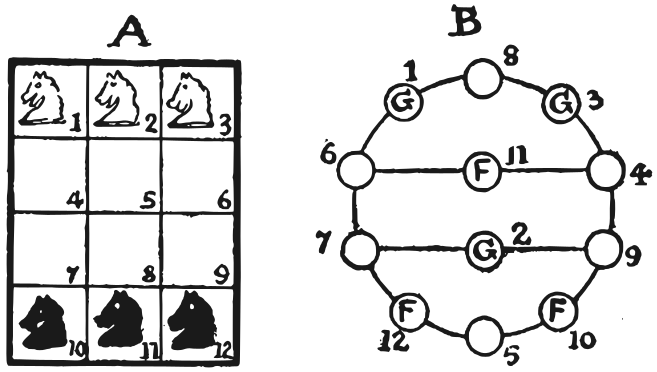
Draw the diagram and put three geese on discs 1, 2 and 3 and three foxes on 10, 11 and 12. Moving one at a time, fox and goose alternately, each along a line to the next disc, make the foxes and geese change places in the fewest possible moves. Never let a fox and a goose stand at the two ends of a line, or there will be trouble: for instance the fox on 11 cannot move first, since on 4 or 6 it would be within reach of a goose, and the fox on 10 cannot go to 9, nor the fox on 12 to 7. Only one creature may stand on a disc.
No. 95. Robinson Crusoe’s Table
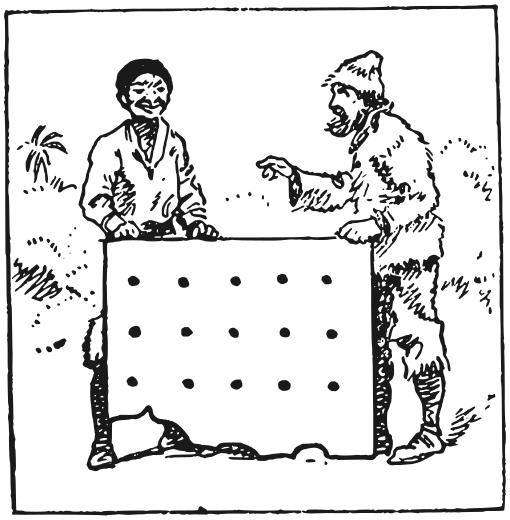
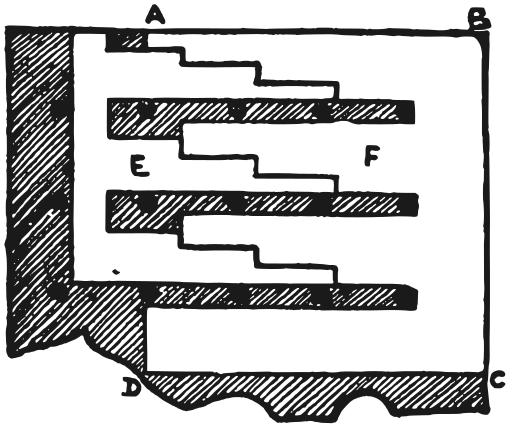
Here is an extract from Robinson Crusoe’s diary that the editors left out. Crusoe found on the shore a piece of timber with fifteen holes in it, and resolved to make from it a square table for afternoon tea, with no holes in the top and in no more than two pieces joined together, and as large as possible. Friday thought his own nation would do better: they would stop up the holes. The picture shows the exact shape of the wood and the positions of the holes. How did Crusoe cut it?
No. 96. The Fifteen Orchards
Fifteen men of a Devon village planted apple trees to settle an argument about spacing: one had a single tree in his orchard, another two, another three, and so on up to fifteen. Last year every tree in each man’s orchard bore exactly the same number of apples as the others in that orchard, and the totals of the fifteen orchards were almost the same. In fact, if the man with eleven trees had given one apple to the man with seven, and the man with fourteen had given three each to the men with nine and thirteen, they would all have had exactly the same number. How many would each have had?
No. 97. The Perplexed Plumber
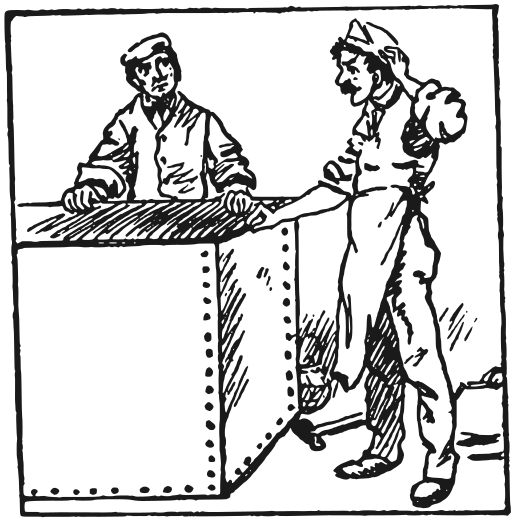
Sam Solders, a plumber in Peckham, had been figuring day and night for three weeks, to his wife’s despair. A customer had ordered two rectangular zinc cisterns, one with a top and one without, each to hold exactly 1000 cubic feet when filled to the brim, at a fixed price each. Being a thrifty man, he wanted to make them with the least possible metal. What are the dimensions of the most economical cistern with a top, and the exact proportions of the most economical one without a top? No allowance need be made for turnings.
No. 98. The Nelson Column
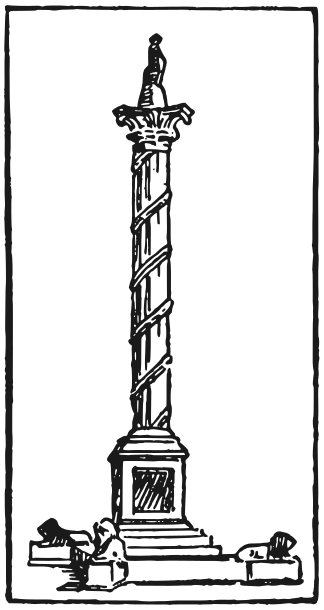
Standing in Trafalgar Square during a Nelson celebration, a friend of puzzling habits murmured “Two feet” and “Five times round”, and then produced this. Suppose the shaft of the column is 200 feet high and 16 feet 8 inches round (the figures are chosen for the puzzle, and the shaft is taken to be the same thickness all the way up), and a spiral garland winds round it exactly five times from bottom to top. How long is the garland? It looks difficult but is really remarkably easy.
No. 99. The Two Errand Boys
A country baker sent his boy with a message to the butcher in the next village, and at the same moment the butcher sent his boy to the baker. One ran faster than the other, and they passed at a spot 720 yards from the baker’s shop. Each stopped ten minutes at his destination and then ran back, and they passed each other again 400 yards from the butcher’s. How far apart are the two shops? Each boy kept to a steady pace throughout.
No. 100. On the Ramsgate Sands
Thirteen children were dancing in a ring on the sands at Ramsgate. How many rings can they form without any child ever holding the same hand, right or left, a second time? That is, no child may ever have the same neighbour twice.
The Chifu-Chemulpo Puzzle
Twenty moves cannot be done; the fewest possible is twenty-six. The picture settles how the track works. The siding leaves the main line at one set of points and rejoins it at another, and beyond each set of points is a short dead end with room for one vehicle, where car 1 and car 8 stand. Because 7 can go onto the siding while 8 stays at the end, a vehicle can stand on the points themselves and back onto the siding from there. Along the main line or along the siding, vehicles can shuffle up and down for nothing, but they can never pass one another, so what matters is the order of the vehicles on each track, and every change of order costs a trip over the points.
The table gives one route of twenty-six moves. Each line shows the order along the main line from left to right, and along the siding from its left end, after the move of that number. A vehicle leaving the main line at the left goes onto the left end of the siding, and one coming off at the right leaves from the right end.
| move | main line | siding | move | main line | siding |
|---|---|---|---|---|---|
| 0 | 12345678 | E | 14 | 6438E7 | 521 |
| 1 | 2345678 | 1E | 15 | 65438E7 | 21 |
| 2 | 345678 | 21E | 16 | 265438E7 | 1 |
| 3 | 45678 | 321E | 17 | 265438E71 | |
| 4 | 5678 | 4321E | 18 | 265438E1 | 7 |
| 5 | 54678 | 321E | 19 | 2654381 | 7E |
| 6 | 5467 | 321E8 | 20 | 265431 | 7E8 |
| 7 | 35467 | 21E8 | 21 | 2765431 | E8 |
| 8 | 3467 | 521E8 | 22 | 2E765431 | 8 |
| 9 | 34687 | 521E | 23 | 82E765431 | |
| 10 | 3687 | 4521E | 24 | 8E765431 | 2 |
| 11 | 368E7 | 4521 | 25 | 8765431 | E2 |
| 12 | 68E7 | 34521 | 26 | 87654321 | E |
| 13 | 638E7 | 4521 |
Dudeney gives a different route, also of twenty-six moves. No route takes fewer.
Answer 26 moves
The Eccentric Market-woman
Try a small sale: from 29 eggs she sells 15 and leaves 14. Adding one to each stock turns 30 into 15, an exact halving. This suggests keeping track of the eggs-plus-one. If she has eggs and sells half of them and half an egg more, she is left with , so the number she has plus one halves. In the same way the sale of a third and a third of an egg leaves her two-thirds of her eggs-plus-one, and so on. Starting with eggs, after the four sales she has The four sales are , , and eggs. For all four to be whole numbers, must be divisible by their denominators. Their least common multiple is 60, so write . What is left, , must be shared among thirteen friends. The smallest that makes a multiple of 13 is , giving .
So she took eggs. She sold 360, 120, 60 and 36, kept 143, and each friend received 11.
Answer 719 eggs
The Primrose Puzzle
Number the nine flowers round the garland.
A jump lands two flowers away from where it starts, so the difficulty comes at the end: the last letter must go on a flower that still has an empty flower two places from it on one side or the other, and as the garland fills, that becomes impossible for most flowers. A word can be written in the order its letters are read only if some letters can be written out of turn, in places where an equal letter belongs.
Dudeney’s words are BLUEBELL and PEARTREE. For BLUEBELL his moves, each giving the flower touched and the flower written on, are B from 3 to 1, L from 6 to 8, U from 5 to 3, E from 4 to 6, B from 7 to 5, E from 2 to 4, L from 9 to 7, L from 9 to 2. The garland then reads BLUEBELL from flower 1 to flower 8. The word works because its second and eighth letters are both L and its fourth and sixth both E, so those letters can change places without spoiling the word. PEARTREE has the same two coincidences, E and R.
Of all the ways the eight letters can be placed, the one that asks least of the word is Dudeney’s: letters 2 and 8 equal, and letters 4 and 6 equal. Every other way needs more letters to coincide, three the same or more pairs. Dudeney adds that MARITIMA, the sea pink, would also do if it were English.
Answer BLUEBELL, PEARTREE
The Round Table
Each man has six companions,
so there are possible pairs of neighbours for him, and every sitting uses one of them. Fifteen sittings is therefore the most possible, and a scheme for fifteen days must give every man every pair of neighbours exactly once. Here is Dudeney’s, each seating read round the table, with the last man sitting next to Adams:
| ABCDEFG | ACDBGEF | ADBCFGE |
| AGBFECD | AFCEGDB | AEDGFBC |
| ACEBGFD | ADGCFEB | ABFDEGC |
| AEFDCGB | AGEBDFC | AFGCBED |
| AEBFCDG | AGCEDBF | AFDGBCE |
Dudeney first set the problem for six people over ten days, in 1905. For people the most is sittings, and he records that schemes for an even number of people were found by others, while odd numbers proved much harder; he says he eventually found a method for every case and wrote out schemes up to 25.
Answer a scheme of fifteen sittings
The Five Tea Tins
First the tins alone. With No. 1 fixed at the end, the other four can stand in orders, of which 12 put Nos. 3 and 5 side by side, leaving 12. Each of the five tins can show any of its six faces at the front, so if all thirty pictures were different there would be rows of pictures.
Some of these rows are the same. A row can be repeated only if two tins that share pictures change places while showing shared pictures. No. 1 cannot move from its end, so the only exchange is between Nos. 3 and 4, which share two pictures. For the rows to match, each must show one of those two pictures (four ways), the other three tins can show anything ( ways), and the order of the tins must stay allowed after the exchange. The exchange keeps an order allowed only if No. 5 stands next to neither No. 3 nor No. 4, which puts it between No. 1 and No. 2 or at the far end beside No. 2. Only two pairs of orders do that: 1 5 2 3 4 with 1 5 2 4 3, and 1 3 4 2 5 with 1 4 3 2 5. So rows are counted twice, and the number of different rows is .
Answer 91 584
The Four Porkers
Read the pigs as chess queens. Every sty in line with a pig means every square is attacked, and no pig in line with another means no two queens attack each other, so the question asks for the ways four queens that leave each other alone can cover a six-by-six board. A search of every placing finds seventeen arrangements; the count here comes from that search.
Turning and reflecting them gives 120 in all: fourteen of the seventeen give eight arrangements each, one (201605) gives only four because it has some symmetry of its own, and two (260015 and 306104) give only two each, being more symmetrical still. So . Writing each arrangement as the row of the pig in each column (0 for a column with no pig), the seventeen are
| 104603 | 136002 | 140502 | 140520 | 160025 | 160304 |
| 201405 | 201605 | 205104 | 206104 | 241005 | 250014 |
| 250630 | 260015 | 261005 | 261040 | 306104 |
The one in the picture is 160025. Dudeney notes that Jaenisch, in 1862, quoted twenty-one, which he thought must count some reflections twice. With three pigs, if they are allowed to be in line with one another, every sty can still be covered, in one way only: 105030.
Answer 17 (120 counting turns and reflections)
The Number Blocks
Arrange the blocks into two multiplications using disjoint sets of figures, then compare their products. Larger leading figures are worth trying first; a complete search through every split shows that the largest product is : The second sum can also be written . Large products want the large figures in the leading places of both factors, and the two sums must balance exactly, which is what makes the search awkward by hand. The children’s smallest, , is confirmed as the least.
Answer 58 560
Foxes and Geese
The lines on the board are the moves of a chess knight on a board three squares wide and four deep, as Dudeney’s Diagram A in Figure 10.1 shows. Untangle the strings and the board becomes Diagram B: a ring of ten discs with two cross-pieces, one through disc 11 and one through disc 2. The geese start on 1, 3 and the cross-piece at 2; the foxes on 10, 12 and the cross-piece at 11.
Seen this way the play is simple. A goose on 1 or 3 must step to 8 to let the fox on 11 onto the ring; then all six creatures walk round the ring the same way, keeping their distance, until the last moves take the foxes to 1, 2 and 3 and the geese to 10, 11 and 12. It takes eleven moves for the foxes and eleven for the geese, twenty-two in all, and a search shows that no shorter solution exists. Here is Dudeney’s, played round by round, the fox moving first in each:
| round | fox | goose | round | fox | goose |
|---|---|---|---|---|---|
| 1 | 7 | ||||
| 2 | 8 | ||||
| 3 | 9 | ||||
| 4 | 10 | ||||
| 5 | 11 | ||||
| 6 |
Answer 22 moves
Robinson Crusoe’s Table
The holes lie in three rows of five. Dudeney cuts the timber into two pieces, E and F, along a stepped line (Figure 10.2), and throws away the shaded strips that carry the holes. The pieces then fit together, E into F, to make the square ABCD. The steps are what let two pieces do the work of several: each row of holes is taken out as a strip, and the stepped edges close the gaps the strips leave.
Answer two pieces, E and F
The Fifteen Orchards
Call the number each man would end with . Then every orchard except five held apples, and each orchard’s total is a multiple of its number of trees, because every tree bore the same. So is divisible by 1, 2, 3, 4, 5, 6, 8, 10, 12 and 15, that is, by 120. The other five held (seven trees), (nine), (eleven), (thirteen) and (fourteen), so must leave remainder 1 on division by 7, 3 by 9, 10 by 11, 3 by 13 and 8 by 14. The number 120 does all of these: .
The next number that works is , since 360 360 is the least number divisible by all of 1 to 15. As Dudeney says, no young apple tree bears apples by the tens of thousands, so 120 is the only sensible answer.
Answer 120 apples
The Perplexed Plumber
A long, narrow base uses more wall than a square base of the same area. For example, bases and have the same area, but perimeters 50 and 40 feet. In general, follows from . Replacing a rectangular base by a square of the same area leaves the volume, height, floor and roof unchanged, and can only reduce the four walls. So the best base is square.
A cube of side 10 feet has the required volume. To compare all square bases with it, write the base side as , where is positive. Keeping the volume at 1000 cubic feet makes the height . Floor and roof use square feet and the walls , giving a total . Subtract the cube’s 600 square feet: Every factor is non-negative, and the excess vanishes only when . Thus the best closed cistern is a cube of side 10 feet, using 600 square feet of zinc.
For an open cistern, place two identical cisterns rim to rim. Their combined metal is exactly the metal of one closed cistern of twice the volume. The argument above works at any scale, so that closed cistern is best when it is a cube. Each open cistern is therefore half a cube, with a square base whose side is twice its depth.
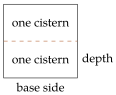
For 1000 cubic feet the base is feet square and the depth about 6.300 feet. Dudeney suggested , which holds 1000.19 cubic feet, a little too much, to the buyer’s advantage.
Answer cube of 10 ft; open: half a cube
The Nelson Column
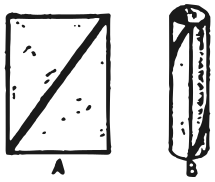
Roll a sheet of paper with a diagonal drawn on it into a tube, and the diagonal becomes one turn of a spiral (Figure 10.4). Unroll the column in the same way and each of the five turns of the garland is the long side of a right-angled triangle whose other sides are a fifth of the height, 40 feet, and the circumference, feet. These are in the ratio , so the triangle is the familiar 5, 12, 13 triangle enlarged, and each turn measures feet. The whole garland is five times as long, feet, or 216 feet 8 inches. By a pleasant accident of the figures, that is exactly the height and the circumference added together.
Answer 216 ft 8 in
The Two Errand Boys
At the first meeting the two boys have together run the distance between the shops once, and the baker’s boy has done 720 yards of it. At the second meeting they have together run it three times: out, and back as far as the meeting place. Each has also waited ten minutes, but they waited the same time, so at the second meeting each has been running for the same length of time, and the baker’s boy has again done his fixed share of the running. Three times the distance means three times his 720 yards, 2160 yards. He has run the whole distance to the butcher’s and then 400 yards back, so the distance is yards, exactly a mile.
Dudeney’s rule, three times the first distance less the second, is the same reasoning. It needs both boys to have left on the way back before they pass again; with these figures they have.
Answer 1760 yards, a mile
On the Ramsgate Sands
Each child has twelve others who might hold its hands, and every ring uses two of them, so no child can take part in more than six rings. Six is possible. Here are Dudeney’s six, each read round the ring with the ends joined:
| ABCDEFGHIJKLM | ACEGIKMBDFHJL |
| ADGJMCFILBEHK | AEIMDHLCGKBFJ |
| AFKCHMEJBGLDI | AGMFLEKDJCIBH |
Dudeney credits Lucas with a simple mechanical method for children and rings. Lucas himself credits it to M. Walecki, a teacher at the Lycée Condorcet in Paris. Put one child in the middle and the rest on a circle; each ring runs from the middle child in a zigzag across the circle, and turning the zigzag one place round the circle gives the next ring.
Answer 6 rings
Sources. The puzzles are retold from Nos. 87 to 100, and the illustrations reproduced from, Henry Ernest Dudeney, The Canterbury Puzzles and Other Curious Problems (1907; revised edition 1919), in the text of Project Gutenberg eBook 27635. On the rings: Édouard Lucas, Récréations mathématiques, volume II (second edition, 1896), the sixth recreation. The numerical answers are found again by the programs in the verify folder accompanying this book.