Library · The Canterbury Puzzles · Chapter 11
The Great Grangemoor Mystery
On this page
- No. 101. The Three Motor-Cars
- No. 102. A Reversible Magic Square
- No. 103. The Tube Railway
- No. 104. The Skipper and the Sea-Serpent
- No. 105. The Dorcas Society
- No. 106. The Adventurous Snail
- No. 107. The Four Princes
- No. 108. Plato and the Nines
- No. 109. Noughts and Crosses
- No. 110. Ovid’s Game
- No. 111. The Farmer’s Oxen
- No. 112. The Great Grangemoor Mystery
- No. 113. Cutting a Wood Block
- No. 114. The Tramps and the Biscuits
The last fourteen of Dudeney’s puzzles, Nos. 101 to 114, bring the book to its end: motor-cars, a sea-serpent, a snail, four princes, a game of noughts and crosses and a murder in a country house. The chapter takes its name from the murder, No. 112.
No. 101. The Three Motor-Cars
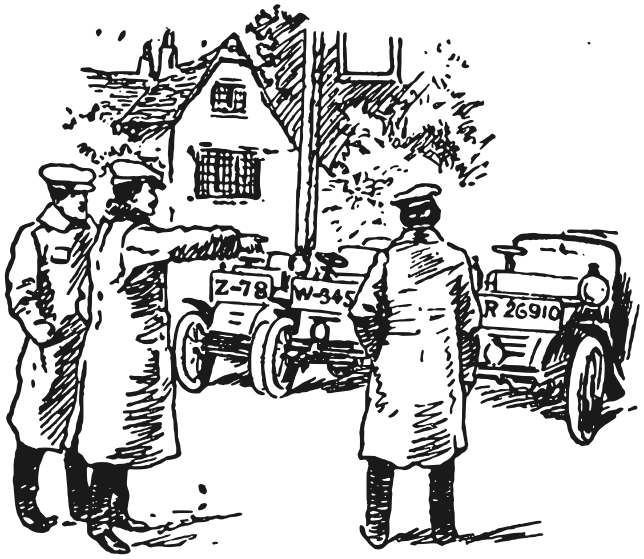
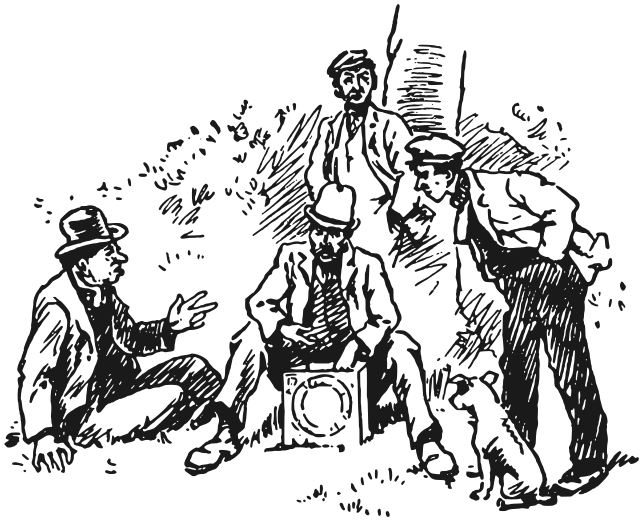
One of the three motorists in the picture is pointing out a coincidence. The numbers on their three cars, 78, 345 and 26910, use all ten figures once each, and 78 times 345 makes 26910. There are many such sets of numbers with two, three and five figures. But there is one set, and only one, in which the second number is also an exact multiple of the first. What are its three numbers?
No. 102. A Reversible Magic Square
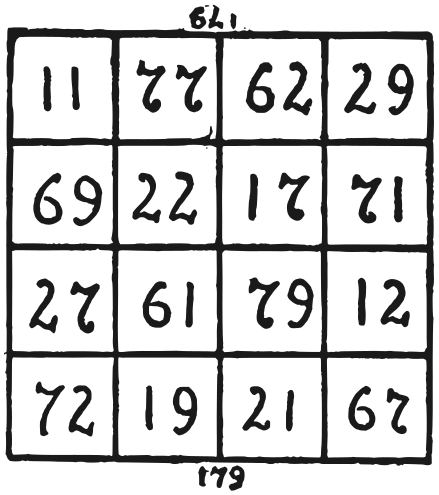
Construct a square of sixteen different numbers that is magic, adding up alike in the four rows, the four columns and the two diagonals, whether you look at it the right way up or upside down. You may not use the figures 3, 4 or 5, which do not survive being turned over; a 6 becomes a 9 and a 9 a 6, a 7 becomes a 2 and a 2 a 7, and 1, 8 and 0 read the same both ways. The total must be the same both ways up.
No. 103. The Tube Railway
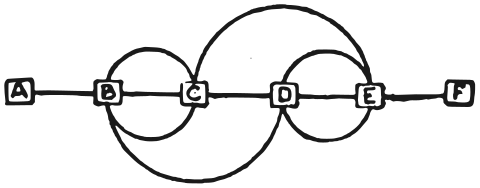
The plan shows an underground railway with a flat fare for any journey, so long as no stretch of line is travelled twice. A passenger with time on his hands goes every day from A to F. How many different routes can he choose from? He can take the direct route A, B, C, D, E, F, or a long one such as A, B, D, C, B, C, E, D, E, F, and where there is more than one line between two stations, each choice gives a different route.
No. 104. The Skipper and the Sea-Serpent
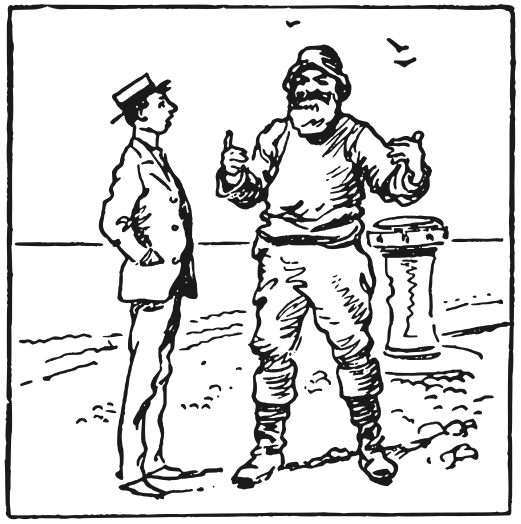
A weather-beaten skipper told Mr Simon Softleigh, on holiday on the south coast, how he had once met a sea-serpent off Cape Horn and cut it with his sword into three pieces all exactly the same length. “Each piece was equal in length to three-quarters the length of a piece added to three-quarters of a cable. How many cables long must that there sea-serpent have been?” Out of a thousand people who try it, says Dudeney, not one will get it exactly right.
No. 105. The Dorcas Society
After four and a half months’ hard work the ladies of a Dorcas Society finished a silk patchwork quilt for the curate, and were so delighted that everybody kissed everybody else, except of course the bashful young man himself, who kissed only his sisters, whom he had come to escort home. There were exactly a gross of kisses, a mutual kiss counting as two. How much longer would the ladies have taken over the quilt if the curate’s sisters had played lawn tennis instead of coming to the meetings? The ladies all came regularly and all worked equally well.
No. 106. The Adventurous Snail
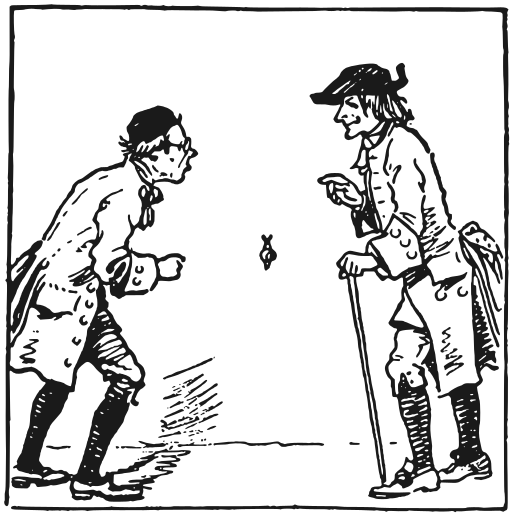
Everyone knows the nursery snail that climbs a pole 3 feet by day and slips back 2 feet by night. Here is the original story. Two philosophers watched a snail climbing a wall 20 feet high, going up 3 feet each day and slipping back 2 feet each night. “How long will it take to climb to the top and down the other side? The wall has a sharp edge, so that when it gets there it will at once begin to descend, putting precisely the same exertion into climbing down each day as it did into climbing up, and sleeping and slipping at night as before.” The day is divided equally into twelve hours of daytime and twelve of night.
No. 107. The Four Princes
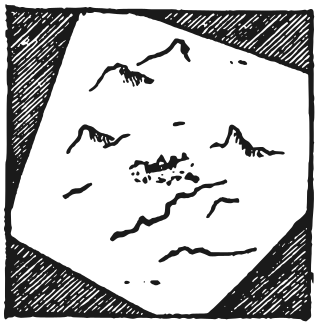
An Eastern king, finding his four sons in rebellion, confined each to a corner of his square kingdom, in a triangular territory of the same area as the others. The country was so wild that the four triangles came out all of different shapes. Give the three sides of each district in the smallest possible numbers, all whole furlongs; that is, find four right-angled triangles with whole-number sides and equal areas, as small as possible.
No. 108. Plato and the Nines
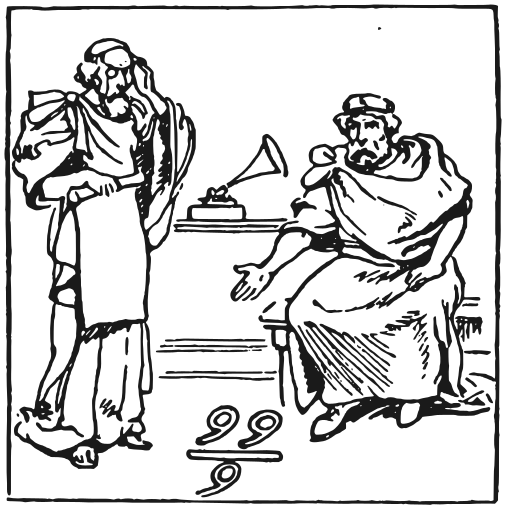
A crank at Athens, convinced of the magic of the number nine, kept pestering Plato about it. To be rid of him, Plato showed that three nines can be arranged to make eleven, as a fraction, 99 over 9, and told him to come back when he could arrange three nines to make twenty. Only the most elementary signs are needed. How is it done?
No. 109. Noughts and Crosses
Every child knows the game: two players take turns to put a nought or a cross in a square of nine cells, and whoever first gets three in a line wins. If both players know the game perfectly, one of three things must always happen: the first player wins, the first player loses, or the game is drawn. Which?
No. 110. Ovid’s Game
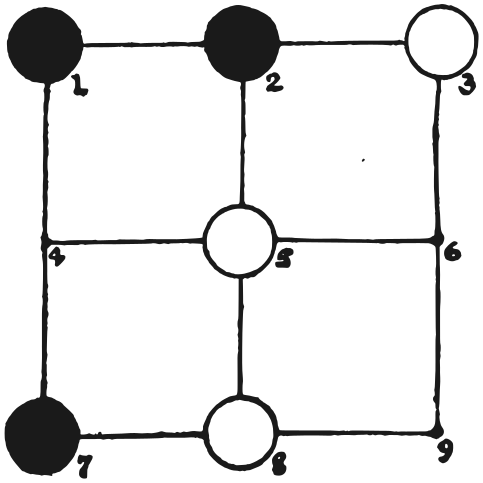
This extension of noughts and crosses is mentioned in the works of Ovid and is the parent of Nine Men’s Morris. Each player has three counters and plays them in turn onto the nine points of the diagram, trying to get three in a row, column or diagonal. Diagonals count for winning, but moves must follow the lines actually drawn. When all six are down, they move in turn, a counter to an adjacent empty point along a line, with the same aim. In the example, White played first and Black has just played on 7; White will move 8 to 9 and then, whatever Black does, 5 to 6, and win. If both players are perfect, does the first player always win, does the second, or is every game a draw?
No. 111. The Farmer’s Oxen
A farmer put this question: “My ten-acre meadow will feed twelve bullocks for sixteen weeks, or eighteen bullocks for eight weeks. How many bullocks could I feed on a forty-acre field for six weeks, the grass growing regularly all the time?” The grass is taken to be of the same length and thickness everywhere when the cattle begin to eat.
No. 112. The Great Grangemoor Mystery
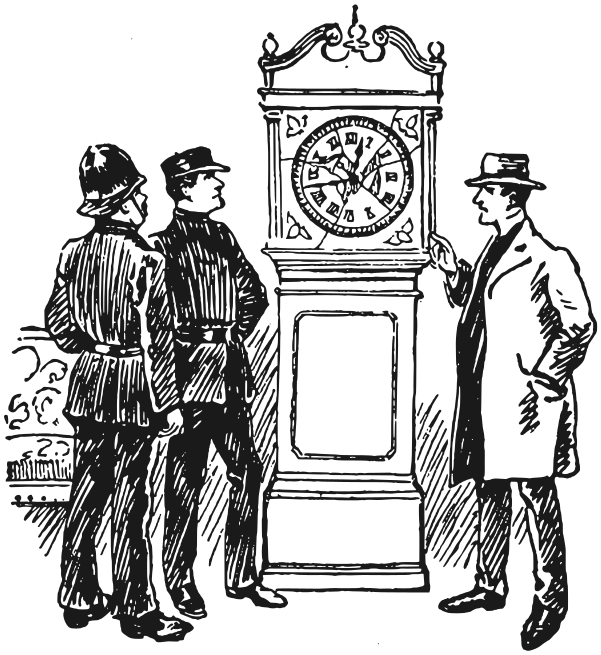
Mr Stanton Mowbray, a reputed millionaire, was found one morning at Grangemoor Park, shot through the head. The bullet had gone on to strike the tall clock in the room at the very centre of its face, and had welded together the three hands (the clock had a seconds hand on the same dial) just as they stood at that moment. The welded hands still turned together on their spindle, and the servants had spun them round several times. A stranger had been arrested, and it was known exactly when he left by train that morning, so the time of the shot mattered. Mr Wiley Slyman looked at the clock: the hour hand stood exactly twenty minute-divisions, a third of the dial, ahead of the minute hand, and the seconds hand nearly twenty-two divisions behind it. After a few moments with his notebook he wrote down the exact time. What was it?
No. 113. Cutting a Wood Block
A thrifty carpenter had a block of wood 8 inches long, 4 inches wide and inches deep. How many pieces inches by inches by inches could he cut from it? It is all a question of how you cut them, and most people would waste more wood than they need.
No. 114. The Tramps and the Biscuits
Four tramps came by a box of biscuits, which they agreed to share equally at breakfast. In the night one of them crept to the box, threw one biscuit to the dog, and ate exactly a quarter of the rest. Later a second did the same with what remained, one to the dog and a quarter for himself, then the third, then the fourth. In the morning they shared what was left equally, and again the odd biscuit went to the dog. Each noticed that the box was lighter but, thinking himself alone to blame, said nothing. What is the smallest number of biscuits there could have been?
The Three Motor-Cars
The second number must be a multiple of the first. If it is times the first number , the product is . This organises a search: choose , try its three-figure multiples, and check whether the product supplies exactly the unused figures. The numbers are and . Dudeney remarks that proving it the only answer is no easy matter. By hand it would be long; here the proof is a search. There are just nine sets of two-, three- and five-figure numbers that use all ten figures once with the product rule, and this is the only one of the nine in which the second number is a multiple of the first. With one, four and five figures there are thirteen sets, such as .
Answer 27, 594, 16038
A Reversible Magic Square
Pairing each number with its upturned partner is the key: the pairs let the same set of numbers survive the turn. Dudeney’s square is in Figure 11.1. Its sixteen numbers are all different, every row, column and diagonal adds up to 179, and turned upside down it is still magic with the same total. In fact the upside-down square is made of the very same sixteen numbers in new places.
Four of them, 11, 69, 27 and 72, read the same either way up, and the other twelve change into one another in pairs: 22 and 77, 62 and 79, 29 and 67, 17 and 21, 12 and 71, 19 and 61. He uses only the figures 1, 2, 6, 7 and 9, and writes his 7 so that it looks like an upturned 2.
Answer total 179 both ways up
The Tube Railway
A journey must start along A to B and finish along E to F, so everything happens between B and E. There are nine stretches of line there: three between B and C, three between D and E, and single lines C to D, B to D (the lower arc) and C to E (the upper arc). Dudeney counts by first listing the orders in which the stations can be visited, which he calls directions, and then counting the ways of choosing lines for each. The direction B, C, D, E gives routes, for instance, while B, D, C, E uses the three single lines and gives only one. Listing every direction and adding is long work by hand; a search through every journey finds 640 routes, none using more than seven of the nine stretches.
Answer 640 routes
The Skipper and the Sea-Serpent
If a piece is cables long, then , so and . Each piece was three cables long, and Mr Softleigh concluded that the serpent was nine. The skipper had cut it lengthwise, from the tip of its nose to the tip of its tail, so it was only three cables long, the same as each piece. As Dudeney points out, the question was how long it must have been, and the honest answer is at least three cables and anything up to nine, depending on the direction of the cuts.
Answer 3 cables (at least)
The Dorcas Society
Suppose there were ladies, of them the curate’s sisters. Every pair of ladies exchanged a mutual kiss, which counts as two, giving kisses, and the curate exchanged with his sisters. So . With 12 ladies the ladies alone account for 132, leaving 12 for the curate, so 6 are his sisters. With 11 the ladies make 110, and the remaining 34 would need 17 sisters out of 11 ladies; with 13 the ladies alone make 156. So there were twelve ladies, six of them sisters.
Without the sisters, six ladies would have done the work of twelve, taking twice as long: nine months instead of four and a half, which is four and a half months longer.
Dudeney also considers the other readings of “everybody kissed everybody else”. If all the ladies kissed the curate but he returned only his sisters’ kisses, there must have been twelve ladies and no sisters at all; if he kissed his sisters but they did not kiss him, all twelve must have been his sisters. Neither fits a story in which some ladies were sisters and some were not.
Answer four and a half months longer
The Adventurous Snail
The climb is the easy part. After seventeen days and nights the snail is 17 feet up; on the eighteenth day it climbs 3 feet and reaches the edge. It goes straight over, and the night’s slip of 2 feet now carries it 2 feet down the far side, leaving 18 feet to go.
The descent needs an extra assumption. Dudeney takes the same 2-foot tendency to slide as acting by day as well as by night. The words of the question do not determine that model. Under it, by day the snail climbs 3 feet while fighting a tendency to slip 2 feet, so its daily exertion would carry it 5 feet on the level. Going down, the same exertion carries it 5 feet and the slip adds 2 more, 7 feet in the daytime; the night’s slip adds another 2, so it descends 9 feet in twenty-four hours. The last 18 feet take exactly two days, and the whole journey, up and down, takes twenty days.
Answer 20 days under Dudeney's model
The Four Princes
The familiar triangle comes from , : its sides are , and . The same construction with any positive whole numbers gives sides , and . Expanding their squares verifies the right angle.
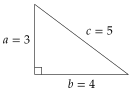
Why does this cover every triangle? First divide its sides by their common factor. In the reduced triangle exactly one short side is even: two odd squares sum to 2 modulo 4, which cannot be a square, while two even sides would share a factor. Call the odd side , the even side and the longest side . Then The two factors on the left are whole numbers with no common factor. Since their product is a square, each must be a square: write them as and . Adding and subtracting gives , , and then . Restoring the common factor covers every whole-sided right triangle.
Dudeney’s four districts, in furlongs, are
| side | side | longest side | |
|---|---|---|---|
| first prince | 518 | 1320 | 1418 |
| second prince | 280 | 2442 | 2458 |
| third prince | 231 | 2960 | 2969 |
| fourth prince | 111 | 6160 | 6161 |
each of area square furlongs. Each comes straight from a pair of generators: 37 and 7, 37 and 33, 40 and 37, and 56 and 55. Dudeney found the first three pairs from a formula that always gives three triangles of equal area, and then searched for a fourth pair with the same area. A search shows that this really is the smallest possible: no area below belongs to four different right triangles with whole sides. The smallest area for two such triangles is 210, and for three it is 840, with the triangles 15, 112, 113; 24, 70, 74 and 40, 42, 58.
Three equal triangles was the problem that, Dudeney reports, kept Lewis Carroll up until four in the morning without success, as he wrote in his diary. Dudeney also notes that Montucla, editing Ozanam, claimed that no more than three equal right triangles could be found in whole numbers, and that there is in fact no limit to how many can be found.
Answer area 341 880 square furlongs
Plato and the Nines
A decimal point makes a divisor less than one, so division can increase the total. Write Dividing 18 by nine-tenths is the same as multiplying it by ten and dividing by nine, which gives 20. The decimal point is the “most elementary sign” that does the work.
Answer
Noughts and Crosses
Analysis of the complete game tree gives a draw with perfect play; neither player can win except by the other’s mistake. The second player’s first reply is where the danger lies. If the first player takes the centre, the second must take a corner: a side loses by force. If the first player takes a corner, the second must take the centre, and every other reply loses. If the first player opens on a side, the second has several safe replies (the centre, the two corners beside the opening mark, or the side opposite it), but the other four lose, so there are, as Dudeney says, numerous pitfalls.
Answer a draw
Ovid’s Game
The centre belongs to four winning lines; each corner to three and each side to two. Complete analysis of the placing and moving stages shows that the first player wins, provided he opens in the centre. If the first move into the centre is barred, the second player should take the centre at once, and the game should then be drawn; Dudeney adds that the first player must then take two adjoining corners, such as 1 and 3, with his first two counters, and that the game needs great care on both sides.
One detail of the rules needs settling. The diagram draws only the rows and columns, and the counters move only along them, but the diagonals must count as lines of three for winning: in Dudeney’s example Black’s counter on 7 is there to block White’s diagonal 3, 5, 7. With the diagonals counted, the first player wins from the centre; opening in a corner leads to a draw, and opening in the middle of a side actually loses. If only rows and columns counted, the game would be drawn whatever the first player did, so Dudeney’s answer depends on the diagonals.
Answer first player wins by taking the centre
The Farmer’s Oxen
Measure grass by what one bullock eats in a week, and let each acre start with of it and grow a week. Twelve bullocks for sixteen weeks on ten acres, and eighteen for eight weeks, give Subtracting, , so , and then . Forty acres for six weeks provide bullock-weeks, enough for bullocks.
Dudeney, following Newton’s Universal Arithmetic, puts it another way: six bullocks keep down the growth on ten acres, so 24 keep down the growth on forty; the grass standing on ten acres feeds six bullocks for sixteen weeks, so on forty acres for six weeks it feeds 64 more; and .
Answer 88 bullocks
The Great Grangemoor Mystery
Since the hands were welded, spinning them changed nothing that matters: only their positions relative to one another tell the time. (Slyman’s remark that they would swing back into equilibrium is the detective’s flourish; it is not needed.) The minute hand gains 55 divisions an hour on the hour hand, so the moments when the hour hand is exactly 20 divisions ahead come round every hours, that is every 1 hour 5 minutes seconds, starting from four o’clock. That gives eleven times in twelve hours, and at each the seconds hand stands in a different place. Only one of them has it nearly 22 divisions behind the minute hand: , when it is divisions behind. The shot was fired at minutes seconds to three.
The three hands only look evenly spaced; no time puts them exactly a third of the dial apart.
Answer 2 h 54 min s
Cutting a Wood Block
The block holds cubic inches and each piece , so by volume there is room for 25 and a little over. A construction using straight-through saw cuts gives 24; volume alone does not rule out 25. The unrestricted packing optimum is not settled here.
As in the puzzle, ignore the wood lost to the width of the saw blade. Saw half an inch off the length and put it aside. Cut what is left, by 4 by inches, into three slabs each inches thick. On each slab, by 4 inches, lay out a row of three pieces inches long and wide, and beside it a row of five pieces inches long and wide; the two rows are inches together and exactly fill the slab. That is eight pieces a slab and 24 in all, wasting only the half-inch end.
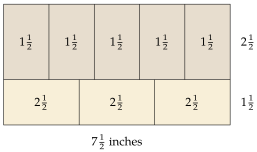
For cuts parallel to the block’s faces, going straight through each piece being cut, 24 is the most possible. This restricts the pieces to be aligned with the block. Scaling to quarter-inch units makes every piece dimension a whole number; the necessary widths of recursively cut boxes are sums or maxima of these dimensions, so whole-unit cut positions suffice for this rule.
Answer 24 pieces with aligned, straight-through cuts
The Tramps and the Biscuits
Add three biscuits to the box, in imagination. If a tramp finds biscuits, throws one to the dog and eats a quarter of the rest, he leaves , and . So each night visit multiplies the number plus three by . After four visits the number plus three is of what it was, so the starting number plus three must be divisible by . In the morning one more goes to the dog and the rest divides by four, which needs the remaining number plus three to be divisible by 4 as well, so the starting number plus three must be divisible by . The least is biscuits. The tramps took 255, 191, 143 and 107 in the night, 321 were left in the morning, and each received 80.
Dudeney gives the general rule: with tramps the number is any multiple of , less .
He adds that the biscuits must have been of the miniature kind that finds favour in the nursery.
Answer 1021 biscuits
Sources. The puzzles are retold from Nos. 101 to 114, and the illustrations reproduced from, Henry Ernest Dudeney, The Canterbury Puzzles and Other Curious Problems (1907; revised edition 1919), in Project Gutenberg eBook 27635.