Library · The Canterbury Puzzles · Chapter 2
The Road to Canterbury
On this page
- No. 17. The Monk’s Puzzle
- No. 18. The Shipman’s Puzzle
- No. 19. The Puzzle of the Prioress
- No. 20. The Puzzle of the Doctor of Physic
- No. 21. The Ploughman’s Puzzle
- No. 22. The Franklin’s Puzzle
- No. 23. The Squire’s Puzzle
- No. 24. The Friar’s Puzzle
- No. 25. The Parson’s Puzzle
- No. 26. The Haberdasher’s Puzzle
- No. 27. The Dyer’s Puzzle
- No. 28. The Great Dispute between the Friar and the Sompnour
- No. 29. Chaucer’s Puzzle
- No. 30. The Puzzle of the Canon’s Yeoman
- No. 31. The Manciple’s Puzzle
- The Reckoning
The second half of the road runs through Kent, past Rochester and Sittingbourne, and the puzzles grow more ambitious as the city comes nearer. Some of the pilgrims on this stretch count things that run to hundreds of thousands. Two of them set puzzles they could not solve themselves, one quarrels his way into a fallacy, and Chaucer, who is travelling with the company, sets a question about a mountain.
As before, the puzzles come first and the solutions after, and the numbers carried forward meet in a Reckoning at the end of the chapter.
No. 17. The Monk’s Puzzle
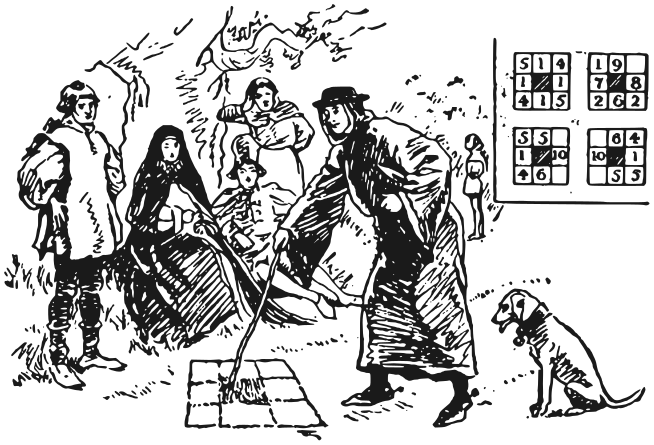
The Monk loves hunting more than he loves his breviary, and he keeps a pack of dogs. Their kennels stand in a square of nine, three by three, and he never uses the one in the middle, which he says is no good for anything.
He wants to put dogs in some or all of the eight outside kennels so that each of the four sides of the square holds exactly ten dogs. A corner kennel belongs to two sides at once, and any kennel may be left empty. The small diagrams in the corner of the picture show four ways of doing it; the fourth is only the third turned round, but it still counts as a different way. In how many different ways can the Monk place his dogs?
Carry forward the number of ways.
No. 18. The Shipman’s Puzzle
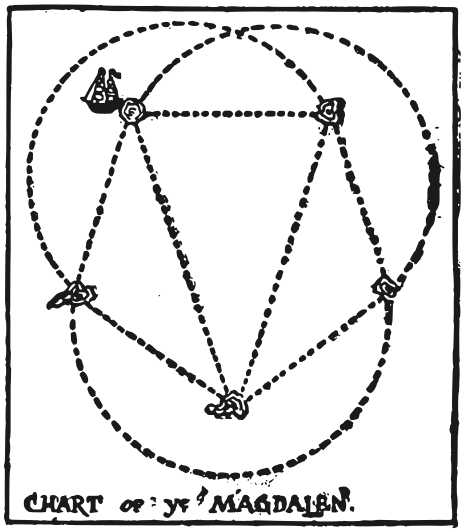
The Shipman knows every harbour from Gotland to Finisterre, and his ship is called the Magdalen. He trades with the people of five islands, and his chart shows ten sea routes joining them.
Each year the Magdalen sails every one of the ten routes exactly once, and always sets out from the same island, the one where the ship is drawn. In how many different orders can the Shipman make his ten voyages?
Carry forward the number of orders.
No. 19. The Puzzle of the Prioress
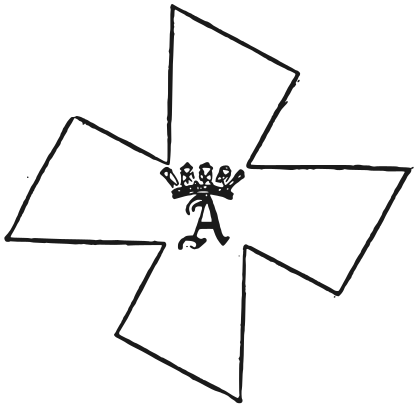
The Prioress, whose name is Eglantine, speaks French in the manner of Stratford-at-Bow and wears a gold brooch with a crowned A on it. A learned man from Normandy gave it to her, she said, and told her that the cross had some mysterious affinity with the square. The Abbot of Chertsey had since assured her that the cross could be cut into four pieces that fit together into a perfect square, but neither of them had told her how.
The Clerk of Oxenford announced that she had been deceived, which went down badly. Was he right? Cut the cross into four pieces that make a square.
No. 20. The Puzzle of the Doctor of Physic
The Doctor of Physic knows the cause of every malady and is particularly fond of gold. He produced two glass phials, both perfect spheres. The smaller is exactly one foot round its middle, and the larger exactly two feet.
He wants two more spherical phials, of different sizes from these, that between them hold exactly as much as the first two. Ignore the glass, the necks and the bases. What must their circumferences be, given as exact numbers and as simply as possible?
Carry forward the number of digits in the denominator of the answer.
No. 21. The Ploughman’s Puzzle
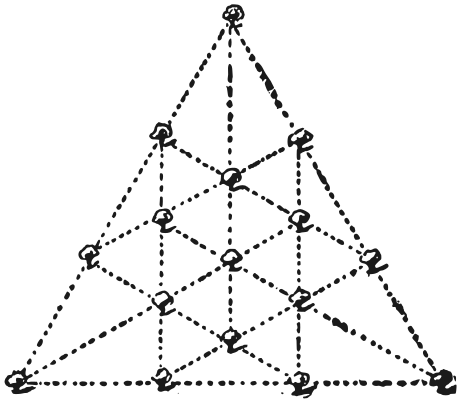
The Ploughman said riddles were too clever for a simple man like him, then produced one anyway. The lord of his manor in Sussex has sixteen oak trees planted so that they stand in twelve straight rows with four trees in every row, as in the picture. A learned traveller once said that the same sixteen trees could have been planted to make fifteen straight rows of four. Plenty of people in the village doubted it.
How can sixteen trees stand in fifteen straight rows, with four trees in every row?
No. 22. The Franklin’s Puzzle
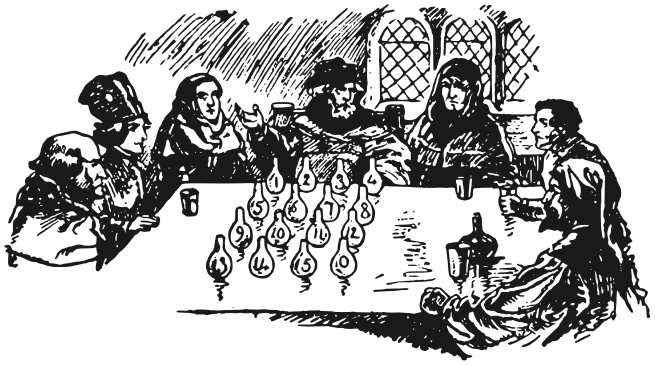
The Franklin has a beard as white as a daisy and a house where it snows food and drink. At an inn just outside Canterbury he set out sixteen bottles on the table in a square of four rows, numbered 1 to 15 with the last marked 0.
Rearrange the bottles into a magic square in which every row, every column and both long diagonals add up to 30. The catch is that you may move no more than ten of the bottles.
Carry forward the number of bottles that never move.
No. 23. The Squire’s Puzzle
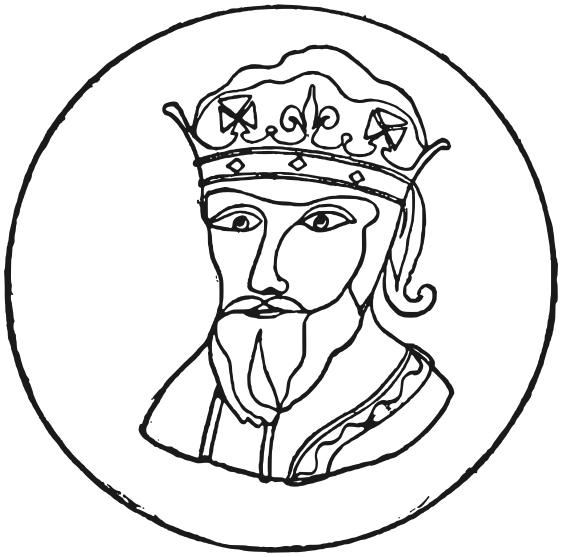
The Squire is the Knight’s son, twenty years old, embroidered like a meadow and singing all day. While the Haberdasher was setting his puzzle, the Squire stood at the back drawing a portrait of the late King Edward the Third in a single continuous line, never lifting his pen and never going over a line twice.
The portrait is reproduced here. Where must the line begin, and where must it end?
No. 24. The Friar’s Puzzle
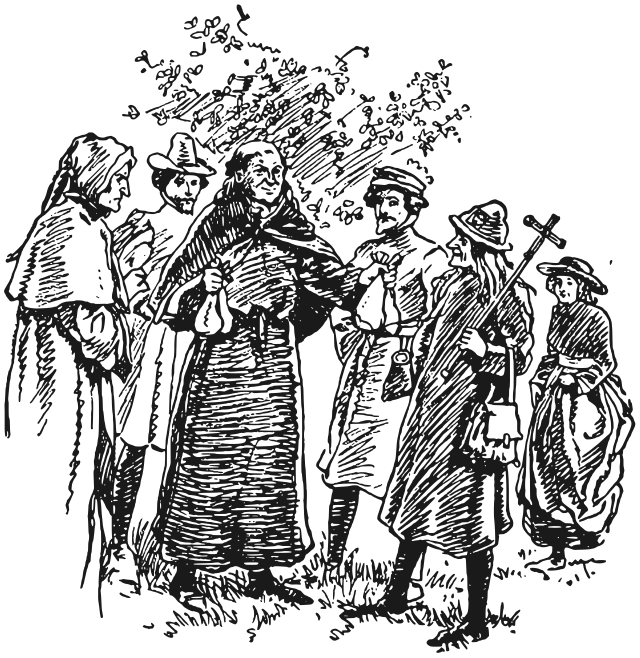
Friar Hubert is the best beggar in his house and has a sweet line in explaining why silver does the soul more good than tears. He produced four money bags.
If he receives five hundred silver pennies in alms, in how many different ways can he divide them among the four bags? The order of the bags does not matter, so 50, 100, 150, 200 counts the same as 200, 150, 100, 50, and any bag may be left empty.
Carry forward the number of ways.
No. 25. The Parson’s Puzzle
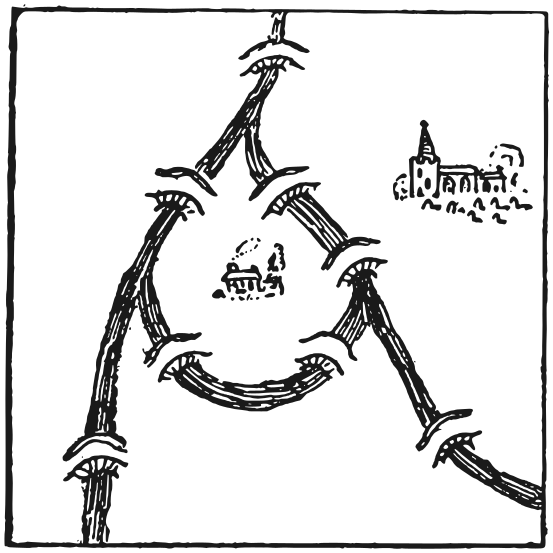
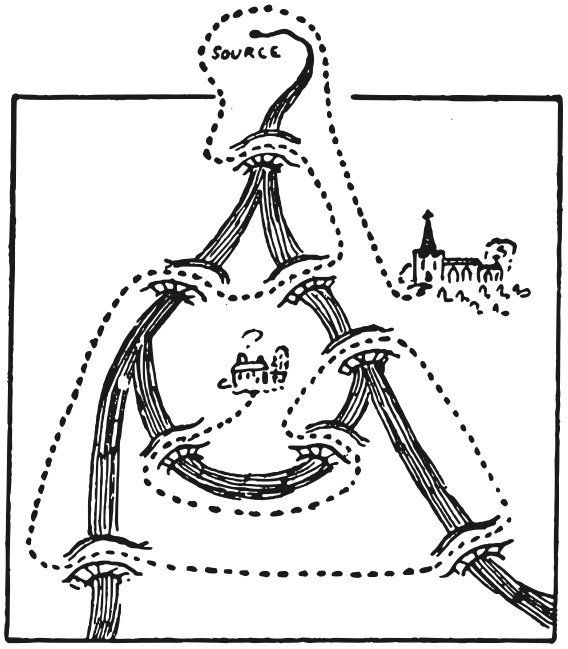
The Parson is the one genuinely good man in the company, and his parish is wide, with the houses far apart. He showed a plan of part of his parish. A river runs through it, joining the sea some hundreds of miles to the south, and where it branches there is an island with his parsonage on it. The church stands on the far bank. There are eight bridges in the parish, all shown on the plan.
On his way to church he visits his parishioners and likes to cross each of the eight bridges exactly once. He never takes a boat, never swims or wades, never tunnels and never flies, and he never leaves the parish. How does he do it?
No. 26. The Haberdasher’s Puzzle
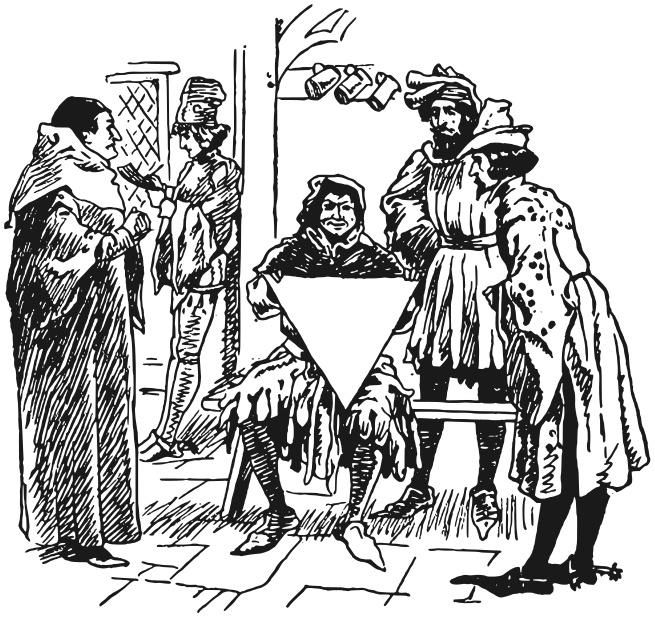
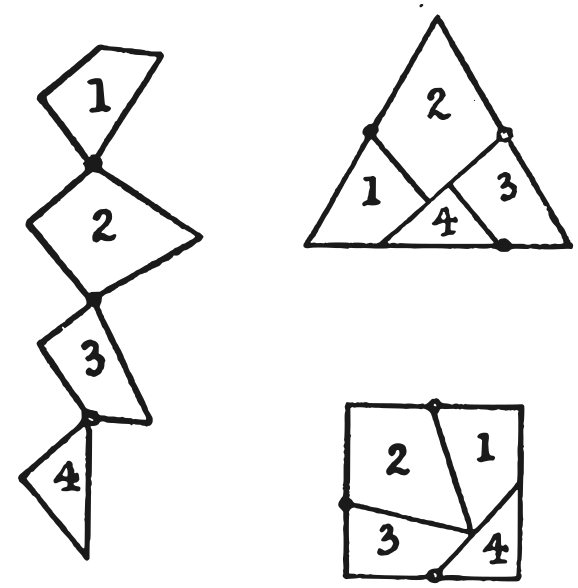
The Haberdasher held out for a long time and then set a puzzle as a practical joke, because he had no idea of the answer himself. He produced a piece of cloth cut as a perfect equilateral triangle.
Cut it into four pieces that fit together, without turning any piece over, to make a perfect square. Some of the cleverer pilgrims managed it in five pieces. When they pressed the Haberdasher for his four-piece answer, he admitted he had none and narrowly escaped a beating.
No. 27. The Dyer’s Puzzle
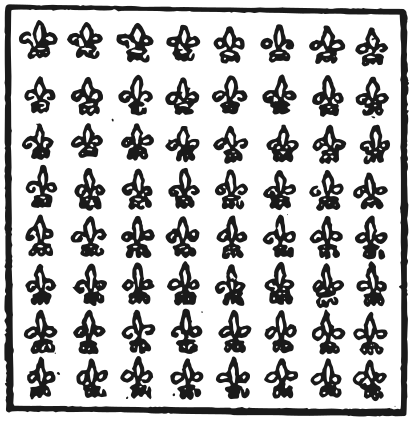
Chaucer tells us nothing at all about the Dyer, and for most of the journey he could not think of a puzzle either. Then one morning, woken early by cockerels, he brought out a square of silk embroidered with sixty-four fleurs-de-lis in eight rows of eight.
Remove six of the flowers so that every row and every column still holds an even number of them. The whole company did it at once, each in a different way, which rather deflated him. Then the Clerk of Oxenford whispered in his ear, and the Dyer added a second question: in how many different ways can it be done?
Carry forward the number of ways.
No. 28. The Great Dispute between the Friar and the Sompnour
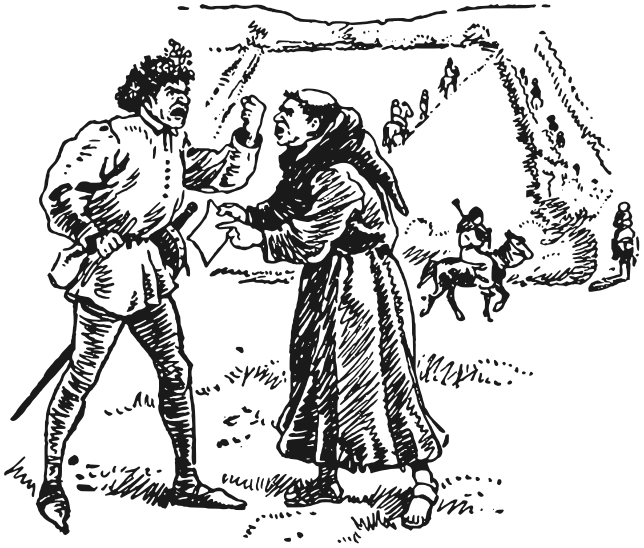
At one point the road ran along two sides of a square field, a hundred yards to a side, and some of the pilgrims cut straight across it from corner to corner. The Friar said there was no point trespassing, because the diagonal is exactly as long as the two sides.
His argument went like this. Cross the field by a staircase of steps parallel to the sides: four steps of 25 yards across and 25 yards down, or five steps of 20 and 20, or a hundred tiny steps, and the path always measures exactly 200 yards, the same as going round the edge. Make the steps smaller and smaller until you need a microscope to see them, and the staircase becomes the diagonal. So the diagonal is 200 yards too.
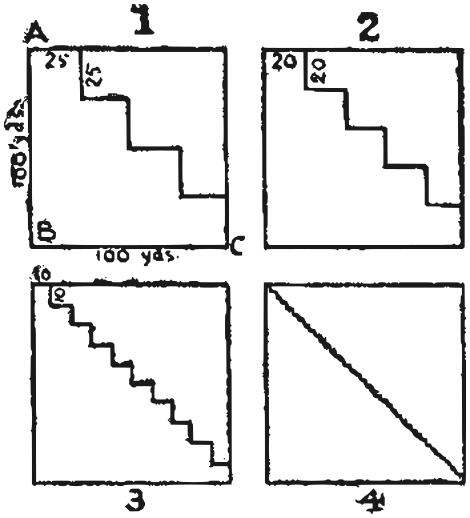
The Sompnour knew this was nonsense but could not say why, lost his temper, and had to be pulled away before he hit the Friar. Where is the flaw?
Carry forward the true length of the diagonal, to the nearest yard.
No. 29. Chaucer’s Puzzle
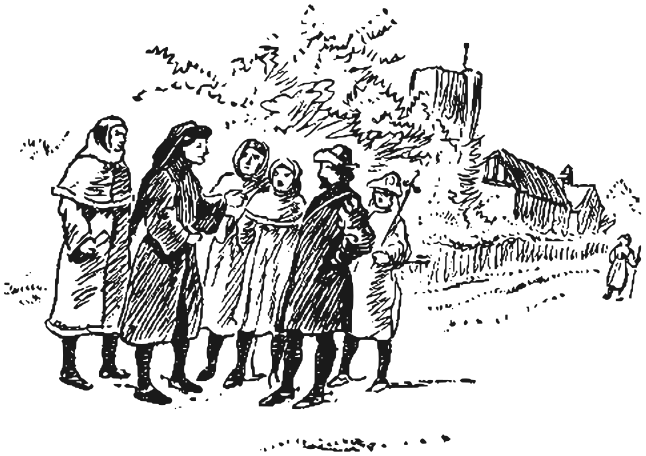
Chaucer himself rides with the company, staring at the ground as if looking for a hare. He told of travelling to Italy in 1372 and visiting the poet Petrarch, who took him up a mountain to show him a curiosity: at the top of this mountain, a mug holds less ale than it does in the valley below.
Which mountain was it?
No. 30. The Puzzle of the Canon’s Yeoman
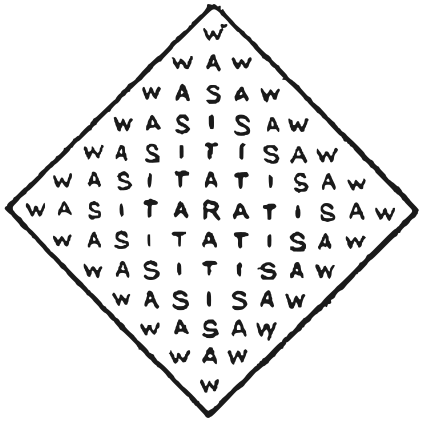
The Canon’s Yeoman caught up with the company on the road, having ridden hard to join such jolly people. He called his puzzle the rat-catcher’s riddle, and it was the diamond of letters shown here.
In how many different ways can you read the words WAS IT A RAT I SAW? Start from any W and step each time to a letter next to the one before, across or up or down but not diagonally. You may go backwards and forwards, and use a letter more than once, but not the same letter twice in a row.
Carry forward the number of readings.
No. 31. The Manciple’s Puzzle
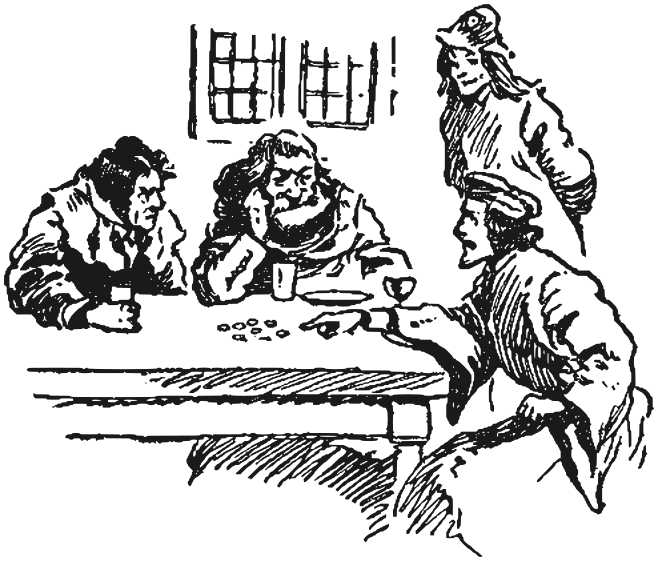
The Manciple buys food for a society of lawyers and has made fools of more than thirty of them. At one halt the Miller and the Weaver sat down to eat, the Miller with five loaves and the Weaver with three, and the Manciple asked to share. All three ate the same amount. When he had finished, the Manciple put down eight coins and told the other two to divide them fairly between themselves.
The Reve and the Sompnour said five to the Miller and three to the Weaver. The Carpenter, the Monk and the Cook said four each. The Ploughman said seven to the Miller and one to the Weaver, and everybody laughed at him. Who was right?
Carry forward the number of coins the Miller should receive.
The company is in sight of the cathedral, and the Host calls for the reckoning again. Nine of the puzzles in this chapter gave a number to carry forward.
Take the Friar’s ways and take away the Monk’s.
Divide by the coins the Manciple owes the Miller.
Take away the Canon’s Yeoman’s readings and the Dyer’s ways.
Multiply by the Franklin’s bottles that never moved.
Divide by the length of the diagonal.
Add the number of digits in the Doctor’s denominator, and take away the Shipman’s orders.
Both divisions come out exactly if the answers are right. The result is another year, one that matters to anyone who has read this far.
The Monk’s Puzzle
The corners are the useful choices: once they are filled, each middle kennel has just one possible number. For example, corners holding 2 and 3 dogs force the kennel between them to hold . Call the four corner counts , , and , going round the square. Once the corners are fixed, every middle kennel is forced: the kennel between the corners and must hold dogs so that its side comes to ten, and similarly for the others. The only condition is that none of these is negative, so Opposite corners and never appear together. Fix them, and let be the larger of the two. Then may be anything from to , and so may , independently, which gives choices. For example, when , the opposite corners can be , , , or , five pairs; each leaves nine choices for each remaining corner, or 81 together. The number of pairs whose larger member is exactly is (the pairs and ), so the total is the eleven terms being 121, 300, 405, 448, 441, 396, 325, 240, 153, 76 and 21. The Monk’s pack may number anything from 20 dogs, when all the dogs sit in the corners, to 40, when the corners are empty.
Answer 2926 ways
The Shipman’s Puzzle
Read the chart carefully, straight lines and long curves together, and every island turns out to be joined to every other island by exactly one route, ten routes for the ten pairs of islands. Each island therefore sits on four routes.
That fact settles where every year’s voyaging ends. Each time the Magdalen passes through an island she uses two of its routes, one to arrive and one to leave. By the end of the year all four routes at every island have been used, an even number. If she finished at an island other than her home port, that island would have one route used for an arrival with no departure to match it, and her home port one departure with no arrival, making both counts odd. So every year ends where it began.
Counting the orders is a matter of patient enumeration, and a search of every possible sequence finds 528 of them.
Dudeney gives 264, exactly half. He must have counted a year’s voyages and the same voyages sailed in reverse as one plan, which is a fair reading of “in how many different ways”, but as orders of voyage they are different, and there are 528.
Answer 528 orders, or 264 counting reverses as one
The Puzzle of the Prioress
The Clerk was wrong and the Abbot was right. Dudeney’s four pieces are shown on the left of Figure 2.1. Turned and slid into place, without any of them being turned over, they fill the square on the right exactly, with the numbered pieces matching.
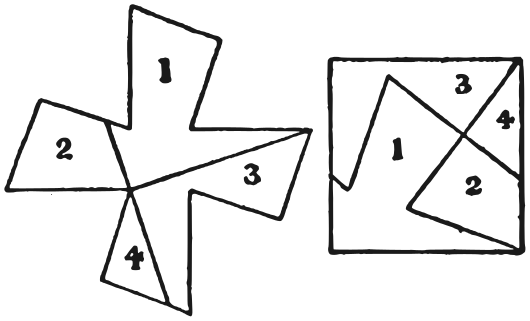
Answer four pieces, as in the figure
The Puzzle of the Doctor of Physic
Spheres of every size have the same shape, so their volumes go as the cube of any length, and the circumference will do. The two phials hold, in some unit, . The Doctor wants two different circumferences and , in feet, with Whole numbers will not do, since 1 and 2 are the only positive whole numbers whose cubes sum to 9, so and must be fractions. This is a hard problem, and the method that cracks it is older than Dudeney: draw lines on the curve .
A straight line meets this curve in at most three points. If two of them have rational coordinates, so does the third, because the three -values are the roots of a cubic with rational coefficients and two of the roots are known. Here is how to obtain the first tangent without calculus. At try the line , . The changes have ratio because the coefficients of the linear terms in the two cubes, and , then cancel. Substitution gives For the sum to remain 9, . Besides , counted twice, this gives , and hence , . The double occurrence of the starting point is what makes this line the tangent. At any point the same cancellation uses the direction .
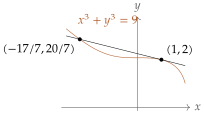
The tangent at a rational point counts that point twice, so it too gives a new rational point. Starting from :
the tangent at meets the curve again at , and indeed ;
the line through and meets it at ;
the tangent at meets it at a point with both coordinates positive.
That last point is Dudeney’s answer: Both are a little over one foot and just under two feet respectively, and their cubes add up to exactly nine.
Negative coordinates are no use to the Doctor, but they are the stepping stones. Fermat, in the seventeenth century, took a longer route through a bigger negative point and arrived at a positive answer whose denominator has twenty-one digits, which Dudeney mentions. Dudeney’s improvement was to find the smaller negative point first. Among all the points that chords and tangents produce from in three rounds, thirty-two in all, a computer listing shows his to be the positive one with the smallest denominator. Proving that no simpler answer exists anywhere on the curve needs the theory of elliptic curves, which is beyond this book.
Answer and feet
The Ploughman’s Puzzle
Begin with a five-pointed star. Its five points and the five places where its lines cross give ten trees, and each of the star’s five lines passes through two points and two crossings: five rows of four.
Plant a sixteenth tree at the centre. The line from each point of the star through the centre passes on through the crossing on the far side, so it already holds three trees. Add a fourth on each of these five lines, close to the centre on the side of the point, and there are five more rows. Those five new trees form a small pentagon, and its distance from the centre can be chosen so that each side of the small pentagon, extended, passes exactly through two crossings of the star. That gives the last five rows, fifteen in all (Figure 2.3).
If the points of the star lie at distance 1 from the centre, the crossings lie at distance on the opposite sides, and the small pentagon must sit at distance .
The layout in the Ploughman’s picture, by contrast, gives only twelve rows. Dudeney believed fifteen could not be beaten, but said he could not prove it.
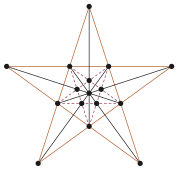
Answer 15 rows, as in the figure
The Franklin’s Puzzle
The trick is in the word move. If the finished square stands on the same sixteen spots as the old one, no magic square adding to 30 can leave more than five bottles where they were.
But nothing says the finished square must occupy the same sixteen spots on the table. Build it one column further to the left, and six bottles, the ones marked 3, 5, 6, 9, 10 and 15, can stay exactly where they were while only ten are moved (Figure 2.4).
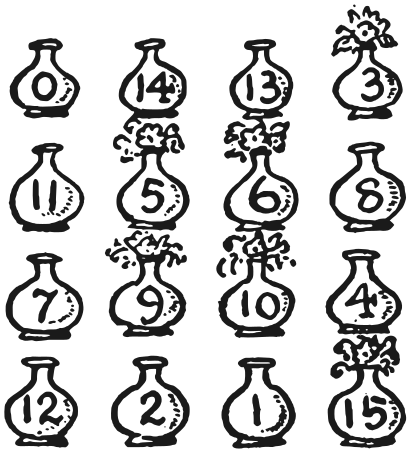
The rows are , , and ; the columns , , and ; the diagonals and . Each is 30.
Answer six bottles unmoved
The Squire’s Puzzle
A drawing can be made in one stroke, without going over any line twice, only if the number of points where an odd number of lines meet is zero or two. Every time the pen passes through a point it uses two lines, one in and one out, so only the start and the finish can have an odd count. If there are two such points, the stroke must begin at one and end at the other.
The King’s portrait has exactly two odd points. Dudeney placed one near the outer corner of the King’s left eye and the other just below it, on the left cheek. The stroke starts at one of these and ends at the other; begin anywhere else and the drawing cannot be finished.
Answer start at an odd point by the eye
The Friar’s Puzzle
Ignoring the order of the bags, the Friar wants the number of ways to write 500 as a sum of at most four whole numbers. For a smaller example, five pennies in at most two bags can be , or : three ways. Such unordered sums are called partitions. Write for the number of partitions of into at most parts. A partition into at most parts either uses fewer than parts, or uses exactly , in which case taking one penny out of every bag leaves a partition of into at most parts. So The first term counts sums using fewer bags; the second counts those using all the bags, after removing one penny from each. Start with (one empty sum), for , and for . Building the table from these starting values gives . For a thousand pennies the same table gives , the figure Dudeney also quotes.
The numbers also fit a neat formula: is the whole number nearest to when is even, and nearest to when is odd. For the expression is . The formula has been checked against the recurrence for every up to 1,200.
Answer 894,348 ways
The Parson’s Puzzle
Read the plan as it stands and the walk is impossible. Treat each stretch of land between the river’s arms as a region and each bridge as a way between two regions, as Euler did for the bridges of Königsberg. A walk that uses every bridge once can pass through a region only by arriving and leaving, so every region except the start and the finish must have an even number of bridges. The Parson’s plan divides the land into four regions: the west bank, the east bank where the church stands, the island with the parsonage, and the land to the south between the lower arms. The island has five bridges and the west bank three; the east bank and the southern land have four each. So a walk over all eight bridges must begin in one of the two odd regions and end in the other. The parsonage is on the island, which is fine, but the church is on the east bank, which is not the west bank, so no such walk reaches the church.
The loophole is in the Parson’s words: the plan shows only part of his parish. If the river rises inside the parish, he can walk round its source, and then the west and east banks become a single region. Its bridges now number seven, counting the top bridge twice because both of its ends are in the same region, and the island still has five. The two odd regions are now the island and the joined bank, so a walk from the parsonage to the church over every bridge once exists, and Figure 2.5 shows one.
He cannot walk round the river’s mouth, which is hundreds of miles away and certainly outside any parish.
The Haberdasher’s Puzzle
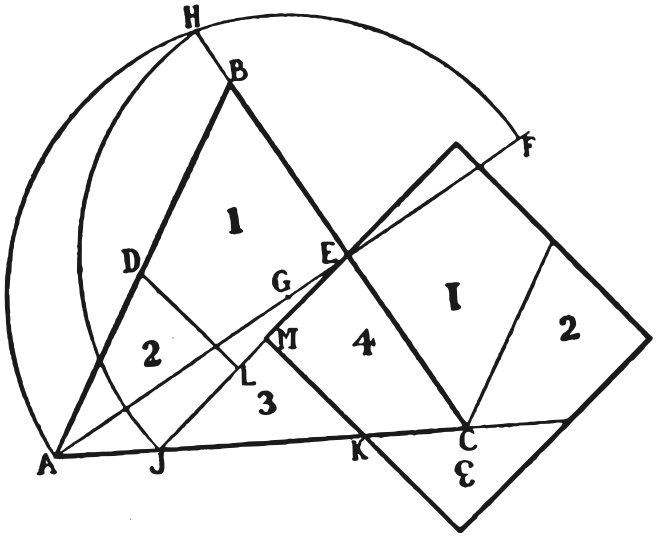
The square must have the same area as the triangle. An equilateral triangle of side 2 has area , so the square’s side must be . The heart of Dudeney’s construction is a classical way of making that length with ruler and compasses.
Let the triangle be . Bisect at and at . Extend beyond to so that , and draw a semicircle on . Extend to meet the semicircle at . By the following calculation, . Let be the midpoint of , the centre of the semicircle. Since is perpendicular to , Pythagoras gives . Here and , so With the triangle of side 2, and , so and , exactly the side of the square.
Now swing an arc from with radius to meet at , and mark on with . Drop perpendiculars from and from onto the line , meeting it at and . The three cuts are , and (Figure 2.6). Keep the pieces hinged at , and , swing them round, and they close up into the square.
Dudeney showed this dissection to the Royal Society in 1905, and had it made in mahogany with brass hinges, so that the chain of four pieces folds one way into the triangle and the other way into the square.
Answer four hinged pieces
The Dyer’s Puzzle
Every row and every column starts with eight flowers, an even number, so the six flowers removed must leave an even number behind in each line, which means an even number removed from every row and every column.
Look at how the six removals can fall among the rows. They could be spread two, two and two; or four and two; or all six in one row. Suppose some row loses four. Those four flowers sit in four different columns, and each of those columns needs a second removal to make its count even. Only two removals remain, and they can serve at most two columns, so this is impossible. The same argument rules out six in a row, and by symmetry the columns must also be two, two and two.
So the removals occupy three rows and three columns, two in each. Choose the three rows in ways and the three columns in 56 ways. Inside the resulting three-by-three block we need two removals in every row and every column, which is the same as choosing the one cell in each row and column to keep, a permutation of three columns: ways. The total is
Answer 18,816 ways
The Great Dispute between the Friar and the Sompnour
Every staircase really is 200 yards long, and the staircases really do get closer and closer to the diagonal: with a hundred steps no point of the staircase is more than a yard from it. The Friar’s mistake is to assume that when one path crowds ever closer to another, its length must approach the other’s length too. Length does not behave like that. A staircase gets its extra length from turning corners, and however small the steps, it turns a right angle at every one of them, so the total length of the steps never shrinks. The paths approach the diagonal in position without approaching it in length, and so nothing can be concluded about the length of the diagonal from the staircases. Measured directly, the diagonal is yards.
Dudeney put it by saying that no number of steps ever becomes a straight line. That is true for any finite number of steps; the sharper point is that even in the limit, length is not carried across.
Answer the diagonal: about 141 yards
Chaucer’s Puzzle
Dudeney’s answer is that any mountain will do under an idealised model of a spherical Earth, ignoring its rotation and the surface tension of the ale. In that model a full mug does not hold a flat disc at the brim. Its liquid surface lies on a sphere centred on the middle of the Earth, so the ale bulges very slightly above the rim. At the top of a mountain the mug is farther from the Earth’s centre, the sphere is larger and therefore flatter, and the bulge above the rim is smaller. So the mug holds less at the summit than in the valley.
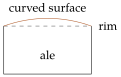
How much less is another matter. For a mug ten centimetres across, the bulge above the rim holds less than a thousandth of a cubic millimetre, and climbing a four-kilometre mountain changes it by less than a thousandth of that. Surface tension, which curls the ale at the edge of the mug, matters enormously more. As a puzzle it is a fine joke; as a reason to drink in the valley it is weak.
Answer any mountain, by a hair
The Puzzle of the Canon’s Yeoman
The diamond is built so that every letter at a given number of steps from the central R is the same: A one step out, T two, I three, S four, A five and W six. A reading of WAS IT A RAT I SAW therefore walks inwards from a W on the rim to the central R, one step closer each time, and then outwards again to a W. The rule against using the same letter twice in a row is automatic, because each step changes the distance from the centre.
The inward half, read backwards, is simply an outward path from the centre, and the two halves can be chosen independently. So the answer is the square of the number of outward paths of six steps. Count them. The first step can go in any of four directions, onto one of the four arms of the diamond. From a letter on an arm there are three ways onward that keep moving outward: one continuing along the arm and two turning off it. From a letter off the arms there are two. If and count the paths of steps ending on and off an arm, then , , and So and runs , giving outward paths, and readings.
In general, for a sentence of letters the count is .
Answer 63,504 readings
The Manciple’s Puzzle
The eight loaves were shared equally among three people, so each ate of a loaf. The Miller brought loaves and ate , so he gave the Manciple of a loaf. The Weaver brought and ate , so he gave only . The Manciple paid eight coins for of a loaf, three coins a loaf, which is seven coins for the Miller’s and one for the Weaver’s . The Ploughman, whom everyone laughed at, was the only one who was right.
Answer seven coins to the Miller, one to the Weaver
The Reckoning
The nine numbers carried forward are 2,926 from the Monk, 528 from the Shipman, 12 from the Doctor, 6 from the Franklin, 894,348 from the Friar, 18,816 from the Dyer, 141 from the dispute, 63,504 from the Canon’s Yeoman and 7 from the Manciple. Worked in order, Geoffrey Chaucer died in 1400, with the Canterbury Tales unfinished, which is why, as Dudeney pointed out, nobody knows what puzzles the rest of the pilgrims would have set.
Sources. The puzzles are retold from Nos. 17 to 31, and the illustrations reproduced from, Henry Ernest Dudeney, The Canterbury Puzzles and Other Curious Problems (1907; revised edition 1919), in the text of Project Gutenberg eBook 27635, from which his remarks are also quoted. Dudeney’s Royal Society demonstration of the Haberdasher’s dissection, on 17 May 1905, is as he reports it in his solution. The year of Chaucer’s death follows the Encyclopædia Britannica entry on Geoffrey Chaucer. Every numerical answer in this chapter is found again by the programs in the verify folder accompanying this book.