Library · The Canterbury Puzzles · Chapter 4
The Merry Monks of Riddlewell
On this page
The monks of Riddlewell Abbey had a rule, invented by their Abbot David, that every brother must set a riddle for the others on the day it fell to him. The records of the abbey keep eight of them. They are set in the refectory, by the fish-pond, round the fire and, in one case, as the defence of a monk caught helping himself to the best wine.
As in the other chapters, the puzzles come first, then the Reckoning, then the solutions.
No. 41. The Riddle of the Fish-pond
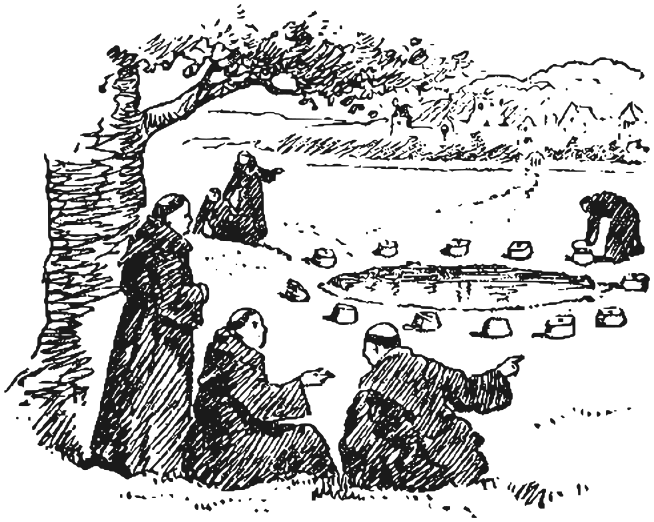
After a poor day’s fishing that yielded exactly twelve fish, Brother Jonathan set twelve baskets at equal distances round the pond, one fish in each, and proposed a game.
Start at any basket and walk round the pond, always in the same direction. Pick up a fish, carry it past two other fish, and drop it into the next basket you reach. Carry on in the same way, picking up a single fish each time and passing it over two fish before putting it down. It makes no difference whether the two fish you pass are in one basket or two, or how many empty baskets you go by. After six fish have been moved, six baskets must hold two fish each and six must be empty, and you must finish back where you started. Do it in as few times round the pond as possible.
Carry forward the fewest times round the pond.
No. 42. The Riddle of the Pilgrims
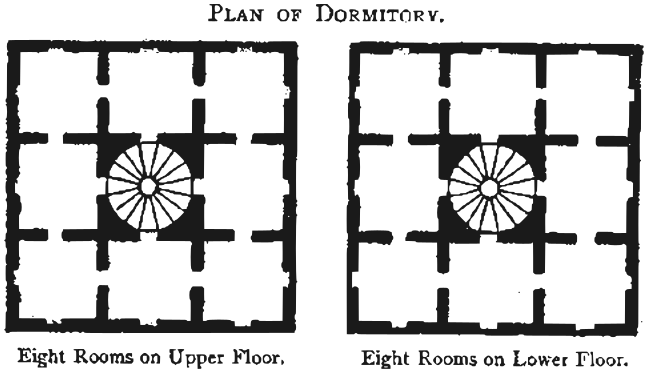
The Abbot announced at dinner that a party of pilgrims was on its way and must be put up in the square dormitory, which has two floors of eight rooms each, arranged round a central staircase.
His rules: eleven people must sleep on each side of the building, counting both floors; twice as many must sleep upstairs as downstairs; every room must have somebody in it; and no room may hold more than three. The monks worked out an arrangement. Then the pilgrims arrived, and there were three more of them than announced. The monks managed to fit them in without breaking any of the rules. How many pilgrims were there?
Carry forward the number of pilgrims announced, and the number who arrived.
No. 43. The Riddle of the Tiled Hearth
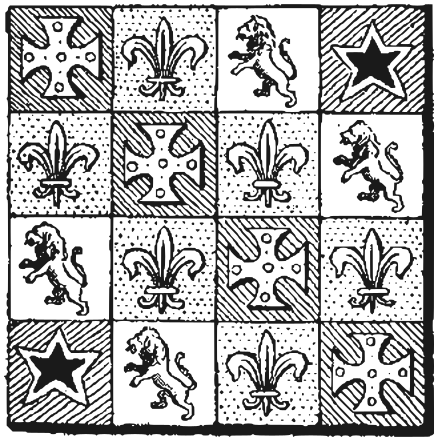
The great hearth, where the Yule logs burn, is floored with sixteen tiles in a square, and they had cracked in the heat. New tiles were ordered in four patterns, the cross, the fleur-de-lis, the lion and the star, with plain tiles also available. The Abbot suggested the arrangement in the picture.
Brother Richard then set the riddle. Lay the sixteen tiles so that no tile is in line with another of the same pattern, whether along a row, down a column or on any diagonal, using as few plain tiles as possible. Only one monk got it right.
Carry forward the fewest plain tiles.
No. 44. The Riddle of the Sack Wine
Brother Benjamin said he was hopeless at riddles but had a question he could not settle. He took a glass of sack from a bottle holding a pint of wine and poured it into a jug holding a pint of water. Then he filled the glass from the jug and poured that back into the bottle.
Has he taken more wine out of the bottle than water out of the jug, or more water out of the jug than wine out of the bottle? The monks came closer to a real quarrel over this than over anything else in the abbey’s history.
No. 45. The Riddle of the Cellarer
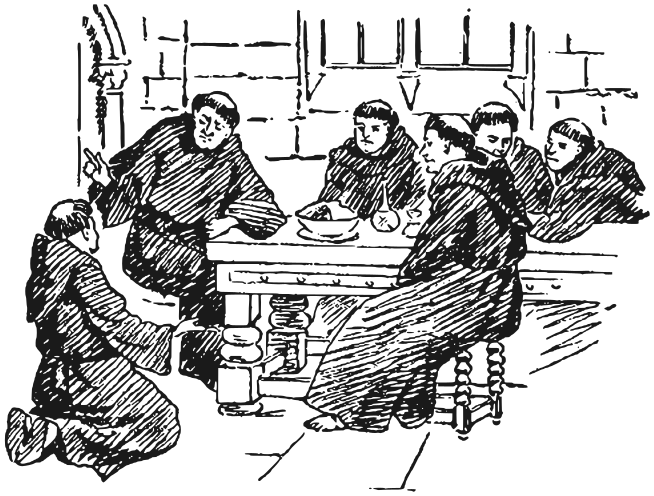
John the Cellarer had been caught stealing from the cask of best Malvoisie, kept for special occasions. Brought before the Abbot, he confessed everything. The cask had held a hundred pints, and he had taken one pint every day of June; today was the thirtieth.
“Then you have stolen thirty pints,” said the Abbot.
“No,” said John, “because every time I took a pint of wine, I put back a pint of water.” Exactly how much wine did he steal? The record says only that John went unpunished.
Carry forward the pints of wine he stole, to the nearest pint.
No. 46. The Riddle of the Crusaders
A visiting knight told of a band of Crusaders who could draw themselves up in a perfect square. On the road a stranger joined them, and then they could form exactly thirteen equal smaller squares. The Abbot worked out at once that there had been 324 men, a square of 18 by 18, and that the 325 who marched on made thirteen squares of 25.
Then he raised the stakes. How many men would there have been if, after the stranger joined, they could form exactly 113 equal squares instead of thirteen?
Carry forward the side of the first square of Crusaders, and the side of each of the 113 small squares.
No. 47. The Riddle of St. Edmondsbury
Father Peter told of a year when St. Edmondsbury was overrun by mice, and every cat in the district was brought in to deal with them. At the end of the year each cat had killed the same number of mice, and the total was exactly 1,111,111.
“One cat killed the lot,” suggested Brother Benjamin. Father Peter said he had distinctly said cats. “Then 1,111,111 cats killed one mouse each.” Father Peter said he had distinctly said mice, and added that each cat had killed more mice than there were cats. How many cats were there?
Carry forward the number of cats.
No. 48. The Riddle of the Frogs’ Ring
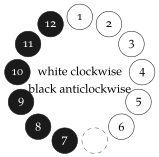
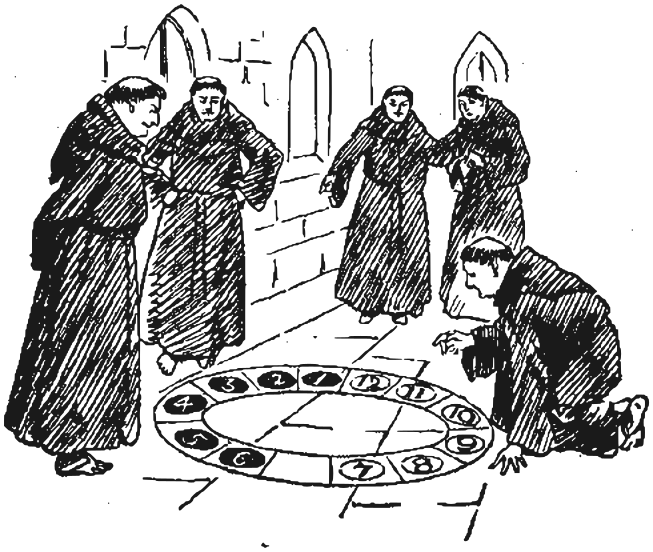
One Christmas the Abbot offered a silver-mounted drinking jug for the best new riddle, and it was won, to everyone’s astonishment, by Brother Benedict. He chalked a ring of thirteen spaces on the floor of the hall and put twelve wooden discs, called frogs, in twelve of them, leaving one space empty. Frogs 1 to 6 were white and frogs 7 to 12 black.
The starting positions are shown in Figure 4.1. The white frogs move clockwise and the black frogs anticlockwise. A frog moves either one step into an empty space, or jumps over a single frog of the other colour into the empty space beyond it, as in draughts. The aim is for the white and black frogs to change places completely, with the 1 finishing where the 12 now is and the 12 where the 1 now is. How few moves will do it?
Carry forward the fewest moves.
After Compline the Abbot calls for the reckoning. Six of the riddles gave numbers to carry forward.
Multiply the Cellarer’s stolen pints by the fewest plain tiles.
Take away the side of a small square of Crusaders, and multiply by the cats.
Take away the frogs’ moves.
Add the pilgrims who arrived and the pilgrims who were announced, and take away the times round the fish-pond.
Add the side of the first square of Crusaders.
If every answer is right, the result is a year that belongs to this book.
The Riddle of the Fish-pond
Number the baskets 1 to 12 in the direction Brother Jonathan walks. Moving a fish from basket 1 to basket 4 carries it past the fish in baskets 2 and 3, which is exactly the rule. Brother Jonathan’s answer is and then on round to basket 1, where he began. The first three moves take him once round the pond. By then baskets 4, 8 and 12 hold two fish each and 1, 5 and 9 are empty, so the next fish, from basket 3, passes the two fish in basket 4 and lands in basket 6; and so on. The whole walk, back to the start, is three times round.
Two rounds are not enough.
As Dudeney said, four rounds come readily, and three take some finding.
Answer three times round the pond
The Riddle of the Pilgrims
Each floor has eight rooms round the stairwell: four at the corners and four in the middles of the sides. A side of the building takes in two corner rooms and one middle room on each floor. Add up the four sides and every room is counted once, except the eight corner rooms, which are counted twice. With eleven people to a side, if is the number of pilgrims and the number sleeping in corner rooms, Upstairs holds twice as many as downstairs, so is a multiple of three. Every room holds between one and three people, so is between 16 and 48 and between 8 and 24, which leaves the possibilities or . The Abbot’s other rules cut these down further: fitting twice as many upstairs as downstairs, with every room occupied and none holding more than three, works for 27 pilgrims and for 30, and for no other number.
The monks prepared for the pilgrims announced and then managed three more, so they prepared for 27, and 30 arrived. Figure 4.2 shows both arrangements.
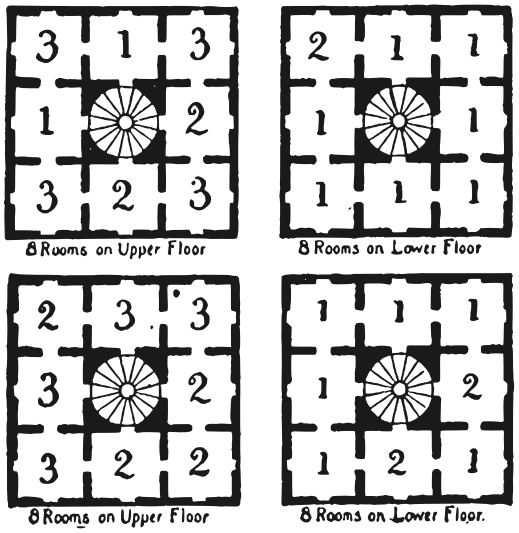
Answer 30 pilgrims (27 announced)
The Riddle of the Tiled Hearth
A pattern with no two tiles in line is the same as a set of chess queens that cannot attack each other, and on a four-by-four board at most four such queens fit. There are exactly two ways to place four, mirror images of each other, and between them they use eight squares; the other eight squares are the corners and the centre four, which all lie on the two long diagonals. Suppose two of the patterns each had four tiles. They would have to take those two arrangements, leaving the two long diagonals for the other two patterns, and each of those could then have at most one tile on each diagonal, two tiles each. That makes at most twelve patterned tiles and four plain.
Doing better means using only one pattern four times. With four of one pattern and three of each of the others, thirteen patterned tiles and just three plain ones can be fitted, as in Figure 4.3. No arrangement manages fourteen.
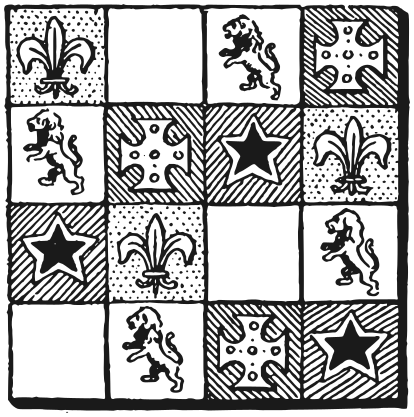
Answer 3 plain tiles
The Riddle of the Sack Wine
Neither. Brother Benjamin took exactly as much wine out of the bottle as water out of the jug, whatever the size of the glass and however well the jug was stirred. The quickest way to see it ignores the mixing altogether. At the end the bottle and the jug each hold a pint again, since a glassful went out of each and a glassful came back. So whatever wine is now missing from the bottle is sitting in the jug, and it must be taking up exactly the space of the water that has left the jug for the bottle.
For a numerical example, suppose the glass holds a quarter of a pint and the jug is fully stirred before the return pour. After the first pour the bottle has three quarters of a pint of wine and the jug a pint of water with a quarter of a pint of wine. The glass then takes a fifth of the jug’s contents back, a fifth of a pint of water and a twentieth of a pint of wine. The bottle has lost of a pint of wine, and the jug has lost of a pint of water.
Answer the same amount each way
The Riddle of the Cellarer
Each time John drew a pint from the hundred-pint cask, he took a hundredth of whatever wine was in it, and the pint of water he poured back kept the cask full. So each day the wine in the cask was multiplied by , and after thirty days it was He stole the rest, about pints, a little less than the Abbot’s thirty because the later pints he drew were partly water. The exact figure has fifty-eight decimal places, and Dudeney printed all of them:
The monks’ record gives no answer, which Dudeney put down to their having no tables of logarithms. A man who could involve the monastery in a fraction of fifty-eight decimals, he added, deserved severe punishment.
Answer about 26.03 pints
The Riddle of the Crusaders
If the first square had men on a side, then men make 113 equal squares, each with men on a side, so This is a form of what is called Pell’s equation, and its smallest solution can be found by plain trial: trying in turn, the first value for which is a perfect square is , when .
So the first square was 776 men by 776, a force of 602,176, and after the stranger joined them they formed 113 squares of 73 by 73. For thirteen squares the Abbot’s own answer is the same kind of thing, much smaller: .
Answer 602,176 men, a square of 776
The Riddle of St. Edmondsbury
If there were cats and each killed mice, then with . So the question is how 1,111,111 factorises. It is , and both of these are primes.
With exactly two prime factors there is only one way to split the total into more than one cat each killing more mice than there were cats: 239 cats, each killing 4,649 mice.
Numbers made entirely of ones, like 1,111,111, are called repunits, and their factors are notoriously irregular. Dudeney recorded that one of them, the repunit of nineteen ones, had lately been proved prime.
Answer 239 cats
The Riddle of the Frogs’ Ring
The white frogs can only ever move clockwise and the black frogs anticlockwise, and a frog can jump only a frog of the other colour, so frogs of the same colour never pass each other: each colour keeps its order round the ring. That makes the position very constrained, and it can be searched completely. The fewest moves is 118.
Here is a complete shortest sequence, independently found by the search. Each number names the frog to move. With only one empty compartment and a fixed direction, its legal move is unambiguous. Read each row from left to right, then continue on the next.
| moves | frogs moved |
|---|---|
| 1 to 12 | 7, 6, 5, 7, 8, 9, 6, 5, 4, 3, 7, 8 |
| 13 to 24 | 9, 10, 11, 6, 5, 4, 3, 2, 1, 6, 5, 4 |
| 25 to 36 | 3, 2, 1, 6, 5, 4, 3, 2, 1, 6, 5, 4 |
| 37 to 48 | 3, 2, 1, 6, 5, 4, 3, 2, 1, 6, 5, 4 |
| 49 to 60 | 3, 2, 1, 6, 5, 4, 3, 2, 7, 8, 9, 10 |
| 61 to 72 | 11, 12, 7, 8, 9, 10, 11, 12, 7, 8, 9, 10 |
| 73 to 84 | 11, 12, 7, 8, 9, 10, 11, 12, 7, 8, 9, 10 |
| 85 to 96 | 11, 12, 7, 8, 9, 10, 11, 12, 7, 8, 9, 10 |
| 97 to 108 | 11, 1, 6, 5, 4, 3, 2, 7, 8, 9, 10, 11 |
| 109 to 118 | 5, 4, 3, 2, 9, 10, 11, 3, 2, 11 |
Dudeney also printed a 118-move sequence. In his sequence, the stretches are each played five times over, the white frogs and the black frogs taking turns to file past one another. He also gave a general rule: with frogs of each colour the puzzle takes moves, which for is .
Answer 118 moves
The Reckoning
The numbers carried forward are 3 times round the fish-pond; 27 pilgrims announced and 30 arrived; 3 plain tiles; about 26 pints stolen; Crusaders in a square of 776 and small squares of 73; 239 cats; and 118 moves of the frogs. Worked in order, The Canterbury Puzzles was first published in 1907.
Sources. The riddles are retold from Nos. 41 to 48, and the illustrations reproduced from, Henry Ernest Dudeney, The Canterbury Puzzles and Other Curious Problems (1907; revised edition 1919), in the text of Project Gutenberg eBook 27635, from which his remarks are also quoted. The picture of Brother Benedict’s ring of frogs is missing from that transcription; the starting order is taken from the scan of the 1908 edition in the Internet Archive (117770747). Every numerical answer in this chapter is found again by the programs in the verify folder accompanying this book.