Library · Geometric Probability · Chapter 6
Buffon’s coin (franc-carreau)
Problem 6.1
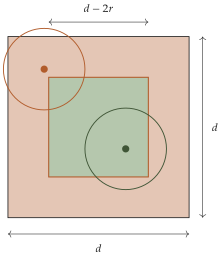
A floor is tiled with squares of side . A coin of radius is tossed at random onto the floor. What is the probability that the coin lands entirely within one tile (i.e., does not overlap any tile boundary)?
Solution. By translation symmetry, the position of the coin is determined by the location of its centre relative to the nearest tile corner; we may take this centre to lie uniformly in a single tile.
The coin lies entirely within the tile iff its centre lies in the inner square . This inner square has side and area . The parameter tile has area , so
This is historically the first geometric-probability problem ever posed — Buffon (1733) called it le jeu du franc-carreau, a children’s game played by tossing a coin at floor tiles and winning if the coin lay within one tile. Buffon’s needle (Chapter 53) appeared as a more celebrated sequel some years later.
import numpy as np
r, d, N = 0.2, 1.0, 10**7
u, v = np.random.rand(2, N) * d  # coin centre in tile
in_tile = (u >= r) & (u <= d-r) & (v >= r) & (v <= d-r)
print(f"sim: {in_tile.mean():.5f}   exact: {(1 - 2*r/d)**2:.5f}")
# sim: 0.36003   exact: 0.36000