Library · Geometric Probability · Chapter 55
The lighthouse and the Cauchy distribution
Problem 55.1
A lighthouse stands at perpendicular distance from a straight shore. Its beam points in a uniform random direction on (angles measured from the perpendicular to the shore). What is the distribution of the distance from the point at which the beam strikes the shore to the foot of the perpendicular from the lighthouse?
Solution. Let be the random angle, uniform on with density . Elementary trigonometry gives the distance along the shore:
Since is monotone increasing on with , takes every real value. To find its distribution, use the change-of-variable formula. For any , Differentiating, the density of is This is the density of a Cauchy distribution centred at with scale . In summary,
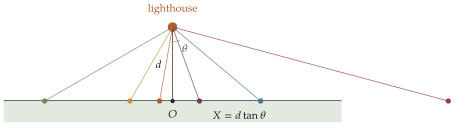
The Cauchy distribution has the unusual property that its mean and variance are both undefined: diverges at both , and the same for . Thus the “average spot where the beam lands” is not well-defined, even though the problem looks perfectly symmetric. A famous consequence: the sample mean of iid Cauchy random variables is also Cauchy (not Gaussian), so the law of large numbers fails — averaging many observations does not reduce uncertainty.
This problem is a favourite of probability texts (Ross, A First Course in Probability) and a standard entry in early tutorials on the change of variables. The geometric interpretation — the beam of a uniformly rotating lighthouse — makes the otherwise pathological Cauchy law intuitive.
import numpy as np
d, N = 1.0, 10**7
theta = np.random.uniform(-np.pi/2, np.pi/2, N)
X = d * np.tan(theta)
# For d = 1, the CDF at t = 1 equals 1/2 + arctan(1)/pi = 3/4.
print(f"sim P(X<=1): {(X <= 1).mean():.5f}   exact: 0.75")
# sim P(X<=1): 0.75021   exact: 0.75