Library · Geometric Probability · Chapter 14
n random points on a circle, all in a semicircle
Problem 14.1
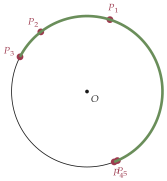
Let be points chosen independently and uniformly on a circle. What is the probability that all of them lie within some semicircle?
Solution. Fix a labelling of the points. Call the event “there exists some semicircle containing .” For each , let denote the event “the semicircle whose starting endpoint is at (measured clockwise) contains all the other .”
Claim. The events are mutually exclusive and .
Exclusive: if occurs, there is an arc of length containing all points. The unique minimal such arc has both endpoints equal to points of the configuration; the starting-endpoint (in cyclic order) is determined, and only that occurs.
Covering: if occurs, some occurs by the same construction.
Probability of each . By rotational symmetry, fix at angle . The other points must all lie in the semicircle from to (clockwise). Each is independently uniform on the full circle, so the probability it lies in a chosen semicircle is . Hence
Assemble. By mutual exclusivity, So
For , this gives . Taking the complement recovers the Wendel probability of Chapter 25: the probability that three random points on a circle form a triangle containing the centre is . For : . The formula was posed as Putnam 1992 A-5 and is a favourite of problem-set compilers.
import numpy as np
for n in [3, 4, 5]:
    theta = np.sort(np.random.rand(n, 10**6) * 2*np.pi, axis=0)
    gaps = np.vstack([np.diff(theta, axis=0),
                      2*np.pi - theta[-1] + theta[0]])
    p = (gaps.max(axis=0) > np.pi).mean()
    print(f"n={n}: sim={p:.5f}   exact={n / 2**(n-1):.5f}")
# n=3: sim=0.74926   exact=0.75000
# n=4: sim=0.49987   exact=0.50000
# n=5: sim=0.31298   exact=0.31250