Library · Geometric Probability · Chapter 16
Two random arcs on a circle
Problem 16.1
Two arcs, each of length (with ), are placed independently at uniformly random positions on a circle of unit circumference. What is the probability that they overlap?
Solution. Parametrise each arc by the position of its centre on the circle; measure positions as fractions of the total circumference, so each centre is uniform on , and positions are taken modulo .
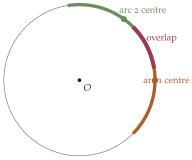
By rotational symmetry, fix the first arc’s centre at : it then covers the set (mod ). Let be the uniform position of the second arc’s centre; the second arc covers (mod ).
The two arcs overlap iff their centres are within of each other on the circle, i.e., iff (mod ), which is the set of total length . (Here we use so the two pieces do not overlap.)
Hence
Variation. If there are independent arcs of length , the probability that no two overlap is for small (union bound). The exact formula is more involved. A classical generalisation is Stevens’s 1939 theorem: iid arcs of length on a unit circle cover the entire circle with probability a remarkable closed form.
import numpy as np
a, N = 0.2, 10**7
# First arc centred at 0; second arc centred at uniform u on unit circle
u = np.random.rand(N)  # fraction of circumference
# Circular distance between centres
d = np.minimum(u, 1 - u)
p = (d <= a).mean()
print(f"sim: {p:.5f}   exact: {2*a:.5f}")
# sim: 0.39998   exact: 0.40000