Library · Geometric Probability · Chapter 12
Two random chords crossing
Problem 12.1
Pick four points independently and uniformly on a circle, and draw the two chords and . What is the probability that the chords cross?
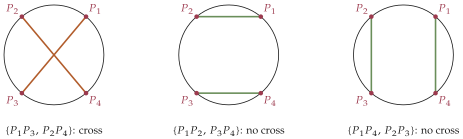
Solution. Forget how the four points are labelled and consider only the unordered set of four points on the circle. There are three ways to pair four points into two chords:
Fix four points on the circle in cyclic order . Exactly one of the three pairings produces crossing chords — the pairing , where each chord joins opposite points in cyclic order. The other two pairings yield non-crossing chords.
By symmetry, given four uniform random points, each of the three pairings is equally likely to be the original labelling . (Permuting the labels leaves the joint distribution of the four points invariant.) Hence
import numpy as np
# 4 uniform points on circle; chord AB = P0P1, chord CD = P2P3.
# Segments cross iff endpoints of one separate endpoints of the other.
theta = np.random.rand(4, 10**6) * 2*np.pi
x, y = np.cos(theta), np.sin(theta)
def side(p, q, r):
    return (q[0]-p[0])*(r[1]-p[1]) - (q[1]-p[1])*(r[0]-p[0])
A, B, C, D = [(x[i], y[i]) for i in range(4)]
cross = (np.sign(side(A, B, C))*np.sign(side(A, B, D)) < 0) & \
        (np.sign(side(C, D, A))*np.sign(side(C, D, B)) < 0)
print(f"sim: {cross.mean():.5f}   exact: {1/3:.5f}")
# sim: 0.33286   exact: 0.33333