Library · Geometric Probability · Chapter 20
A random chord via a uniform midpoint
Problem 20.1
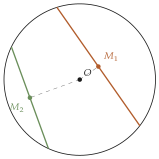
A chord of the unit disc is determined as follows: pick a point uniformly at random in the closed unit disc, and take the chord perpendicular to passing through (where is the disc’s centre). What is the expected length of this chord?
Solution. Let denote the distance from the disc’s centre to the midpoint . A chord at perpendicular distance from the centre has length For uniform in the unit disc, is the area of the radius- disc over the area of the unit disc, namely ; differentiating, has density on .
Therefore Substitute , :
Compare with the “uniform endpoints” sampling of a chord (Chapter 13): there, two iid uniform points on the boundary circle give an expected chord length of , smaller than the obtained here. The two sampling schemes are both “uniform” in distinct senses — they are not the same probability measure on the space of chords.
This is the third sampling rule from Bertrand’s classical paradox, which asks a related question: what is the probability that a random chord of the unit circle exceeds ? The answer under “uniform midpoint in disc” sampling is matching the classical Bertrand value under that sampling rule.
import numpy as np
# Sample midpoint M uniform in unit disc; r = |OM| has density 2r.
r = np.sqrt(np.random.rand(10**7))
chord = 2 * np.sqrt(1 - r*r)
print(f"sim E[chord]: {chord.mean():.5f}   exact: {4/3:.5f}")
# sim: 1.33349   exact: 1.33333