Library · Geometric Probability · Chapter 23
Random chord through an inner concentric disc
Problem 23.1
A chord of the unit circle is determined by two points chosen independently and uniformly on the circle. What is the probability that the chord passes through a concentric disc of radius ?
Solution. Let the endpoints be at angles . Define , reduced to (the smaller of the two arcs). The midpoint of the chord lies at distance from the centre, with since .
The chord intersects the concentric disc of radius iff , i.e., , i.e., , i.e., .
For uniform on , the reduced angular separation is uniform on . Hence and therefore
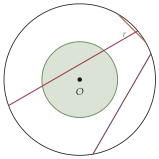
For (the inscribed-equilateral-triangle-side case from Bertrand: a chord is longer than the side of the inscribed equilateral triangle iff its midpoint distance ): . For (the chord-longer-than-the-radius case, equivalently longer than the side of the inscribed regular hexagon): . For : . For : (the chord is always within the unit disc). For : (a chord almost never passes exactly through a single point).
import numpy as np
r = 0.4
theta = np.random.rand(2, 10**7) * 2*np.pi
# Midpoint distance from centre for endpoints at angles theta[0], theta[1]:
mid = np.abs(np.cos((theta[0] - theta[1]) / 2))
print(f"sim: {(mid < r).mean():.5f}   exact: {1 - 2*np.arccos(r)/np.pi:.5f}")
# sim: 0.26215   exact: 0.26198