Suppose that 4X1=5,5X2=6,6X3=7,…,126X123=127,127X124=128. What is the value of the product X1X2…X124?
Problem 2
Let x1,x2,⋯,x2014 be real numbers different from 1, such that x1+x2+⋯+x2014=1 and 1−x1x1+1−x2x2+⋯+1−x2014x2014=1. What is the value of 1−x1x12+1−x2x22+1−x3x32+⋯+1−x2014x20142?
Problem 3
Let u,v,w be real numbers in geometric progression such that u>v>w. Suppose u40=vn=w60. Find the value of n.
Problem 4
Let the sum ∑n=19n(n+1)(n+2)1 written in its lowest terms be qp. Find the value of q−p.
Problem 5
Five distinct 2-digit numbers are in a geometric progression. Find the middle term.
Problem 6
Let x1 be a positive real number and for every integer n≥1 let xn+1=1+x1x2…xn−1xn. If x5=43, what is the sum of digits of the largest prime factor of x6?
Problem 7
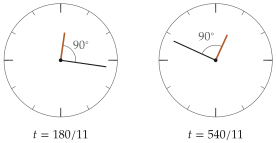
On a clock, there are two instants between 12 noon and 1 PM, when the hour hand and the minute hand are at right angles. The difference in minutes between these two instants is written as a+cb, where a,b,c are positive integers, with b<c and b/c in the reduced form. What is the value of a+b+c?
Problem 8
If k=1∑N(k2+k)22k+1=0.9999 then determine the value of N.
Problem 9
Find the largest positive integer n for which the inequality ∑k=12n(−1)kk2<100 holds.
Problem 10
Let Sn=∑k=0nk+1+k1. What is the value of ∑n=199Sn+Sn−11?
Problem 11
Let f(x)=sin3x+cos103x for all real x. Find the least natural number n such that f(nπ+x)=f(x) for all real x.
Problem 12
Suppose x is a positive real number such that {x},[x] and x are in a geometric progression. Find the least positive integer n such that xn>100. (Here [x] denotes the integer part of x and {x}=x−[x].)
Problem 13
What is the value of 1≤i<j≤10i+j=odd∑(i+j)−1≤i<j≤10i+j=even∑(i+j)?
Problem 14
If k=1∑40(1+k21+(k+1)21)=a+cb where a,b,c∈N, b<c, gcd(b,c)=1, then what is the value of a+b?
Problem 15
A group of women working together at the same rate can build a wall in 45 hours. When the work started, all the women did not start working together. They joined the work over a period of time, one by one, at equal intervals. Once at work, each one stayed till the work was complete. If the first woman worked 5 times as many hours as the last woman, for how many hours did the first woman work?
Problem 16
The sequence ⟨an⟩n≥0 is defined by a0=1,a1=−4 and an+2=−4an+1−7an, for n≥0. Find the number of positive integer divisors of a502−a49a51.
Problem 17
A sequence a1,a2,a3,… of real numbers satisfies an−an+1an+3−an+2=an+an+1an+3+an+2 for all n≥1. Suppose a55=6, a66=2 and a77=1. Let N denote the sum a12+a22+⋯+a20262. What is the sum of the digits of N?
Solutions
Solution: PRMO 2012, Q9
Key idea
Each Xi is a logarithm, and the product telescopes to log4128.
From 4X1=5 we get X1=log45=ln4ln5, and in general Xi=ln(i+3)ln(i+4).
Multiplying them all, every logarithm cancels against the next: X1X2⋯X124=ln4ln5⋅ln5ln6⋯ln127ln128=ln4ln128=log4128.
Finally 128=27 and 4=22, so log4128=27.
Answer7/2
Solution: PRMO 2014, Q19
Key idea
1−xx2=1−xx−x, so the sum asked for is the difference of the two sums given.
The identity to spot is 1−xx−x=1−xx−x(1−x)=1−xx2, valid whenever x=1, which the problem guarantees.
Summing it over all 2014 values, i=1∑20141−xixi2=i=1∑20141−xixi−i=1∑2014xi=1−1=0.
Neither the number 2014 nor the individual values played any part; any list with the two stated sums equal gives zero.
Answer 0
Solution: PRMO 2017, Q5
Key idea
Taking logarithms turns the geometric progression into an arithmetic one and the three equal powers into three reciprocals, after which the middle term is the harmonic mean.
A geometric progression has v2=uw. Neither u nor w can be zero: the equality u40=w60 would make both zero, contradicting u>w. Thus uw=v2>0, so u and w have the same sign. The common value K=u40=w60 is positive. It cannot equal 1, because then ∣u∣=∣w∣=1 and the common sign would give u=w. Also n=0, since v0=1 could not equal K. Write L=logK=0 and take logarithms of absolute values: 40log∣u∣=nlog∣v∣=60log∣w∣=L, so log∣u∣=40L,log∣v∣=nL,log∣w∣=60L.
A geometric progression has v2=uw. Taking absolute values of both sides preserves that, since ∣v2∣=∣v∣2 and ∣uw∣=∣u∣∣w∣, so ∣v∣2=∣u∣∣w∣ and the logarithms are in arithmetic progression: 2log∣v∣=log∣u∣+log∣w∣,n2L=40L+60L. Cancelling L and adding the fractions, n2=1203+2=241,n=48.
In words, n is the harmonic mean of 40 and 60, which is what an arithmetic progression of logarithms always produces from equal powers.
Answer 48
Solution: PRMO 2017, Q6
Key idea
n(n+1)(n+2)1 is half the difference of two consecutive terms of n(n+1)1, so the sum collapses to its first and last pieces.
The key identity is n(n+1)(n+2)1=21(n(n+1)1−(n+1)(n+2)1), which one checks by putting the right-hand side over a common denominator: the numerator is 21((n+2)−n)=1.
Summing from n=1 to 9, every interior term cancels against its neighbour and only the ends survive: n=1∑9n(n+1)(n+2)1=21(1⋅21−10⋅111)=21⋅11054=11027.
Since 110=2⋅5⋅11 shares no factor with 27, the fraction is already in lowest terms, so p=27, q=110 and q−p=83.
Answer 83
Solution: PRMO 2017, Q16
Key idea
With ratio p/q in lowest terms the first term must be a multiple of q4 and the last of p4, and the two-digit range leaves only q4=16, p4=81.
Let the ratio be r. It is rational, since consecutive terms are integers, so write r=p/q in lowest terms with p=q. Reversing the progression if necessary, take p>q, so the terms increase.
For the fifth term ar4=ap4/q4 to be an integer with gcd(p,q)=1, the first term a must be a multiple of q4, say a=cq4. The five terms are then cq4,cq3p,cq2p2,cqp3,cp4, all integers automatically.
Now impose the two-digit range. The smallest term is at least 10 and the largest at most 99, so cq4≥10,cp4≤99,hence(qp)4≤1099<10. Since 1099<16=24, that gives p/q<2. In particular q cannot be 1, since p>q would then make p/q at least 2; so q≥2. And cp4≤99 with c≥1 gives p4≤99, so p≤3. The only coprime pair with 3≥p>q≥2 is (p,q)=(3,2), and then cq4=16c≥10 and cp4=81c≤99 force c=1.
The progression is therefore 16,24,36,54,81, five distinct two-digit numbers, and its middle term is 36.
Answer 36
Solution: PRMO 2019, Q3
Key idea
The product of the first n terms is xn+1−1, and it is also xn(xn−1), so the sequence obeys xn+1=xn2−xn+1 and the value of x1 never has to be found.
Write Pn=x1x2⋯xn, so that the rule reads xn+1=1+Pn. For n≥2 this gives Pn−1=xn−1, and therefore Pn=Pn−1xn=(xn−1)xn. Substituting back, xn+1=1+xn(xn−1)=xn2−xn+1(n≥2).
That is all we need. From x5=43, x6=432−43+1=1849−42=1807. Factorising, 1807=13×139, and 139 is prime, since it is divisible by none of 2, 3, 5, 7, 11 and 132=169 already exceeds it. The largest prime factor is 139, whose digits sum to 1+3+9=13.
Recovering x1 is possible but unnecessary, and that is the lesson. Running the one-step rule backwards, x5=43 gives x4=7, then x3=3, x2=2 and x1=1, each from a quadratic with one positive root. None of that was needed, because the rule steps from x5 to x6 directly. Whenever a recursively defined sequence is pinned down by one of its later values, look for a rule connecting consecutive terms before trying to unwind the whole thing back to the start.
Answer 13
Solution: PRMO 2019, Q7
Key idea
The minute hand gains on the hour hand at a steady 5.5 degrees per minute, so the two right-angle instants are where that gain reaches 90∘ and 270∘.
Measure time t in minutes after noon, when both hands point at 12. The minute hand turns 360∘ per hour, so it is at 6t degrees; the hour hand turns 30∘ per hour, so it is at 21t degrees. The angle the minute hand has gained is 6t−21t=211t, which increases steadily from 0 to 330∘ as t runs from 0 to 60.
The hands are perpendicular when this gain is 90∘ or 270∘, both of which occur in range: 211t=90⟹t=11180,211t=270⟹t=11540. Their difference is 11540−180=11360=32+118. So a=32, b=8, c=11, and since gcd(8,11)=1 and 8<11 this is the required reduced form. Hence a+b+c=51.
Answer 51
Solution: IOQM 2020, Q3
Key idea
The numerator 2k+1 is the gap between two consecutive squares, and once that is noticed each term becomes a difference of two reciprocal squares, so the sum collapses.
A sum like this one is not meant to be evaluated term by term, and the shape of the numerator is the hint. Since k2+k=k(k+1), the denominator is k2(k+1)2, and the numerator 2k+1 is exactly (k+1)2−k2. Writing the term with that in mind, (k2+k)22k+1=k2(k+1)2(k+1)2−k2=k21−(k+1)21, where the last step is just splitting the fraction and cancelling.
Each term is now the difference of two consecutive members of the sequence 1/k2, so when we add them from k=1 to k=N every interior quantity is created once and destroyed once, and only the two ends survive: k=1∑N(k2+k)22k+1=1−(N+1)21.
Setting this against the given value 0.9999, which is 1−100001, we need (N+1)2=10000, so N+1=100 and N=99.
Answer 99
Solution: IOQM 2025 Part SEP, Q28
Key idea
Pair the terms two at a time: (2j)2−(2j−1)2=4j−1, so the whole sum is n(2n+1).
Group the 2n terms in consecutive pairs. For each j the pair contributes −(2j−1)2+(2j)2=(2j−(2j−1))(2j+(2j−1))=4j−1, so k=1∑2n(−1)kk2=j=1∑n(4j−1)=4⋅2n(n+1)−n=2n2+n=n(2n+1).
The inequality n(2n+1)<100 therefore holds for n=6, where the value is 78, and fails at n=7, where it is 105. Since n(2n+1) increases with n, the answer is 6.
Answer 6
Solution: PRMO 2013, Q2
Key idea
Rationalising each term makes Sn=n+1, and then 1/(Sn+Sn−1) telescopes a second time.
Rationalise the general term of Sn: k+1+k1=(k+1)−kk+1−k=k+1−k. Summing from k=0 to n, everything cancels except the ends: Sn=n+1−0=n+1.
Now the outer sum. Since Sn+Sn−1=n+1+n, the same rationalisation applies again: Sn+Sn−11=n+1−n, and summing from n=1 to 99 telescopes once more: 100−1=10−1=9.
Two telescopes for the price of one rationalisation. The second is available only because the first collapsed Sn into a single square root, which is the point of the construction.
Answer 9
Solution: PRMO 2017, Q11
Key idea
Turning f(x+T)−f(x) into products shows that T must be a period of each wave separately, and then n has to be a multiple of both 6 and 20.
Write T=nπ and use the sum-to-product identities on the difference: sin3x+T−sin3x=2cos62x+Tsin6T,cos103(x+T)−cos103x=−2sin203(2x+T)sin203T. So the condition f(x+T)=f(x) for all x says 2sin6Tcos62x+T=2sin203Tsin203(2x+T)for all x.
Now compare least periods. A sine or cosine wave that is not constant has a least positive period, namely 2π divided by whatever multiplies x inside it, and two functions that are equal at every x are the same function and so have the same least period. That is the whole of the argument.
If the amplitude 2sin6T were not zero, the left side would be a wave of least period 6π; if 2sin203T were not zero, the right side would be a wave of least period 320π. But 6π=320π, so they cannot both be non-zero. And if just one were zero, that side would be identically zero and so would the other, forcing its amplitude to zero as well. So both amplitudes vanish: sin6nπ=0andsin203nπ=0.
The first says 6∣n. The second says 20∣3n, and since gcd(3,20)=1 that means 20∣n. Hence n is a multiple of lcm(6,20)=60, and n=60 works, because 60π is 10 periods of the first wave and 9 of the second.
Answer 60
Solution: PRMO 2017, Q14
Key idea
The progression condition is [x]2={x}x, which forces [x]=1 and makes x the golden ratio.
Write m=[x] and f={x}, so x=m+f with 0≤f<1. For f, m, x to be a geometric progression all three must be non-zero, so m≥1 and f>0, and the middle term squared is the product of the outer two: m2=f(m+f),that isf2+mf−m2=0. Solving for the positive root, f=2−m+5m2=m⋅25−1.
Now use f<1, and no decimal is needed. If m≥2 then f≥2⋅25−1=5−1>1, since 5>2. So m=1. Then f=25−1,x=1+f=21+5=φ, the golden ratio, whose defining property φ2=φ+1 is exactly the progression condition in disguise.
Finally we need the least n with φn>100. Multiply a term Aφ+B by φ. Since φ2=φ+1, the result is (Aφ+B)φ=(A+B)φ+A. So the coefficient pair (A,B) becomes (A+B,A) at the next power. Starting from φ2=φ+1, the powers needed are kAB21132143255368571388211393421105534 In particular φ9=34φ+21 and φ10=55φ+34. Exact bounds on φ settle both. Since (511)2=25121<5 we have 5>511 and so φ>58; and 5<3 gives φ<2. Hence φ9=34φ+21<68+21=89<100,φ10=55φ+34>55⋅58+34=122>100. So φ9<100<φ10 and the answer is n=10.
Answer 10
Solution: PRMO 2018, Q16
Key idea
Attaching the sign (−1)i+j+1 to every pair turns the difference into a single sum; summing over ordered pairs rather than unordered ones then makes it collapse, because ∑(−1)i=0.
On the smaller list 1,2,3,4, the odd pair-sums are 3,5,5,7 and the even ones are 4,6. Their difference is 20−10=10=1+2+3+4. The ordinary total appearing here suggests that a signed count may cancel most of the pair contributions. The quantity asked for is T=1≤i<j≤10∑(i+j)(−1)i+j+1, since a pair with i+j odd contributes +(i+j) and one with i+j even contributes −(i+j). Writing ai=(−1)i, the sign is −aiaj, so T=−i<j∑(i+j)aiaj.
Now evaluate that sum by turning it into a sum over ordered pairs. For each unordered pair the two orderings contribute iaiaj and jajai, whose total is (i+j)aiaj. Hence i<j∑(i+j)aiaj=i=j∑iaiaj=i∑iai(S−ai),S=j=1∑10aj. Two evaluations finish it. First S=−1+1−1+⋯+1=0, because the ten signs cancel in pairs. Second ai2=1, so the bracket collapses and i<j∑(i+j)aiaj=0−i=1∑10i=−55.
Therefore T=55.
The value ∑iai=−1+2−3+⋯+10=5 never appeared, because it was multiplied by S=0. That is the whole reason the answer is the plain triangular number 55.
Answer 55
Solution: IOQM 2020, Q18
Key idea
The expression under the square root is a perfect square in disguise, because k1−k+11 happens to equal k1⋅k+11.
Whenever a sum of forty square roots is set as a competition problem, the roots are meant to disappear, so the first question to ask is whether the thing under each root is a square. Write u=1/k and v=1/(k+1), so that the expression is 1+u2+v2, and try to match it against (1+u−v)2. Expanding that guess, (1+u−v)2=1+u2+v2+2u−2v−2uv, so the guess is correct precisely when u−v=uv. That is exactly the identity we have, because k1−k+11=k(k+1)1=k1⋅k+11. The coincidence is what makes the problem work, and it is worth noticing that it holds only for consecutive integers.
Since 1+u−v is positive, the square root is exactly 1+k21+(k+1)21=1+k1−k+11, and the sum now separates into forty ones plus a telescoping tail: k=1∑40(1+k1−k+11)=40+(1−411)=40+4140.
Matching this against a+cb with b<c and gcd(b,c)=1 gives a=40, b=40 and c=41, so a+b=80.
Answer 80
Solution: IOQM 2020, Q20
Key idea
The working times form an arithmetic progression, and the total labour is fixed, so the number of women cancels out of the equation entirely.
Let there be n women, all working at the same rate. The phrase that the group can build the wall in 45 hours means that n women working together for 45 hours complete the job, so the wall represents exactly 45n woman-hours of labour, whatever n happens to be.
Now account for how those hours were actually supplied. The women arrive one at a time at equal intervals, and each stays until the end, so the first woman works the longest and each subsequent one works a fixed amount less. Their working times therefore form an arithmetic progression, with first term the time T worked by the first woman and last term the time worked by the last. We are told the first worked five times as long as the last, so the last term is T/5.
The total labour supplied is the sum of that progression, which for n terms is the number of terms times the average of the first and last: n⋅2T+T/5=45n. The factor n appears on both sides and cancels, which is the reason the problem never tells us how many women there were. What remains is 106T=45,soT=75.
The first woman worked for 75 hours.
Answer 75
Solution: IOQM 2023, Q10
Key idea
The combination an2+4anan−1+7an−12 is multiplied by exactly 7 at each step of the recursion, so the quantity asked for is a pure power of 7.
The first few terms are a0=1, a1=−4 and a2=9. The combination in the question begins a12−a0a2=16−9=7. The next term is a3=−4⋅9−7(−4)=−8, giving a22−a1a3=81−32=49. The individual terms are irregular, but this combination may have a much simpler rule. Substituting the recursion an+1=−4an−7an−1 into the expression we are asked about gives an2−an−1an+1=an2−an−1(−4an−7an−1)=an2+4anan−1+7an−12. Call the right-hand side Qn. It is worth tracking Qn rather than the original expression, because it behaves so tidily. Using the recursion once more, Qn+1=an+12+4an+1an+7an2=an+1(an+1+4an)+7an2, which is an+1(−7an−1)+7an2=7Qn, where the middle step used an+1+4an=−7an−1.
So each step multiplies Q by 7, and the starting value is Q1=a12+4a1a0+7a02=16−16+7=7. Hence Qn=7n for every n≥1, and in particular a502−a49a51=Q50=750.
The divisors of 750 are 70,71,…,750, so there are 51 of them.
Answer 51
Solution: IOQM 2026, Q16
Key idea
Clearing the fractions, almost everything cancels, and what is left says that the product of two terms two places apart never changes. That makes the sequence repeat every four terms.
Cross-multiplying, (an+3−an+2)(an+an+1)=(an+3+an+2)(an−an+1). Both sides contain an+3an and −an+2an+1, which cancel. What remains is an+3an+1−an+2an=−an+3an+1+an+2an, that is an+1an+3=anan+2. So the product of two terms two places apart is the same number k all the way along the sequence.
This k is not zero. If it were, then a55a57=0 with a55=6 would give a57=0, and a56a58=0 would make a56 or a58 zero as well, next to a57. Two neighbouring terms equal to 0 make a denominator an−an+1 in the statement vanish. So no term is zero, and an+4=an+2k=an, which means the sequence repeats with period 4.
Now 55=4⋅13+3, 66=4⋅16+2 and 77=4⋅19+1, so a3=6, a2=2 and a1=1. Then k=a1a3=6 and a4=k/a2=3. The sequence runs 1,2,6,3,1,2,6,3,…, and no two neighbours are equal or opposite, so every fraction in the statement is defined.
Since 2026=4⋅506+2, N=506(1+4+36+9)+1+4=25300+5=25305, and the sum of its digits is 2+5+3+0+5=15.