A triangle with perimeter 7 has integer side lengths. What is the maximum possible area of such a triangle?
Problem 2
Find the number of integer solutions to ∣∣x∣−2020∣<5.
Problem 3
The area of an integer-sided rectangle is 20. What is the minimum possible value of its perimeter?
Problem 4
In a triangle with integer side lengths, one side is three times as long as a second side, and the length of the third side is 17. What is the greatest possible perimeter of the triangle?
Problem 5
Find the number of positive integers n, such that n+n+1<11.
Problem 6
Find the number of triples of real numbers (a,b,c) such that a20+b20+c20=a24+b24+c24=1.
Problem 7
The sum of two real numbers is a positive integer n and the sum of their squares is n+1012. Find the maximum possible value of n.
Problem 8
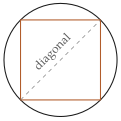
Find the largest integer n such that a square of side length n is contained in a circular disc of area 1000.
the square fits when its diagonal fits
Problem 9
If x1,x2,…,x49 are non-zero integers such that ∑i=149xi=0, then what is the minimum possible value of ∑i=149xi2?
Problem 10
A 2×3 rectangle and a 3×4 rectangle are contained within a square without overlapping at any interior point, and the sides of the square are parallel to the sides of the two given rectangles. What is the smallest possible area of the square?
Problem 11
Integers 1,2,3,…,n, where n>2, are written on a board. Two numbers m,k such that 1<m<n, 1<k<n are removed and the average of the remaining numbers is found to be 17. What is the maximum sum of the two removed numbers?
Problem 12
If the real numbers x,y,z are such that x2+4y2+16z2=48 and xy+4yz+2zx=24, what is the value of x2+y2+z2?
Problem 13
Each of the numbers x1,x2,…,x101 is ±1. What is the smallest positive value of 1≤i<j≤101∑xixj?
Problem 14
For any real number t, let ⌊t⌋ denote the largest integer ≤t. Suppose that N is the greatest integer such that ⌊⌊N⌋⌋=4 Find the sum of digits of N.
Problem 15
Let n be a positive integer such that 1≤n≤1000. Let Mn be the number of integers in the set Xn={4n+1,4n+2,…,4n+1000}. Let a=max{Mn:1≤n≤1000}, and b=min{Mn:1≤n≤1000}. Find a−b.
Problem 16
Let X be the set consisting of twenty positive integers n,n+2,…,n+38. The smallest value of n for which any three numbers a,b,c∈X, not necessarily distinct, form the sides of an acute-angled triangle is:
Problem 17
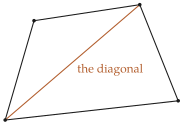
Four sides and a diagonal of a quadrilateral are of lengths 10,20,28,50,75, not necessarily in that order. Which amongst them is the only possible length of the diagonal?
four sides and one diagonal
Problem 18
If a,b,c≥4 are integers, not all equal, and 4abc=(a+3)(b+3)(c+3), then what is the value of a+b+c?
Problem 19
What is the largest positive integer n such that 29b+31ca2+29c+31ab2+29a+31bc2≥n(a+b+c) holds for all positive real numbers a,b,c.
Problem 20
What is the greatest integer not exceeding the sum ∑n=11599n1?
Problem 21
Positive integers x,y,z satisfy xy+z=160. Compute the smallest possible value of x+yz.
Problem 22
Let x,y be real numbers such that xy=1. Let T and t be the largest and the smallest values of the expression (x+y)2+(x−y)−2(x+y)2−(x−y)−2. If T+t can be expressed in the form nm where m,n are nonzero integers with GCD(m,n)=1, find the value of m+n.
Problem 23
The positive real numbers a,b,c satisfy: 2b+1a+3c+12b+a+13c=1a+11+2b+11+3c+11=2 What is the value of a1+b1+c1?
Problem 24
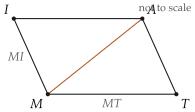
MTAI is a parallelogram of area 4140 square units such that MI=1/MT. If d is the least possible length of the diagonal MA, and d2=ba, where a,b are positive integers with gcd(a,b)=1, find ∣a−b∣.
Solutions
Solution: PRMO 2012, Q2
Key idea
Only two integer triangles have perimeter 7. Split each isosceles triangle into two right triangles to compare its base and height.
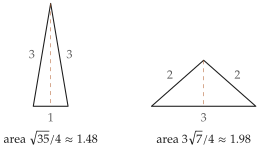
The sides are positive integers summing to 7, and there are exactly four ways to write 7 as a sum of three of them, up to order: (1,1,5),(1,2,4),(1,3,3),(2,2,3). The first two fail the triangle inequality, since 1+1<5 and 1+2<4. The other two are genuine triangles.
For (1,3,3), take the side of length 1 as the base. The altitude bisects it, so Pythagoras gives the height h: h2=32−(21)2=435,area=21⋅1⋅235=435. For (2,2,3), take the side of length 3 as the base. Its altitude gives h2=22−(23)2=47,area=21⋅3⋅27=437. No decimals are needed to compare them: 437=463, and 63>35. So the maximum area is 437.
This is one of several answers on this paper that are not whole numbers. The Mumbai regional papers of this period did not use the two-digit answer format that the national PRMO adopted later, and the questions were written accordingly.
Answer37/4
Solution: IOQM 2020, Q5
Key idea
Peel the two absolute values one at a time, working from the outside in, and count what the inner quantity is allowed to be before worrying about x itself.
Nested absolute values look forbidding, but they unwrap one layer at a time. The outer condition ∣x∣−2020<5 says that the quantity ∣x∣−2020 lies strictly between −5 and 5, which is to say that ∣x∣ itself lies strictly between 2015 and 2025.
Since ∣x∣ is a whole number whenever x is, the possibilities for ∣x∣ are the integers from 2016 up to 2024 inclusive, and there are 2024−2016+1=9 of them. It is only now, at the last step, that we return to x. Each admissible value v of ∣x∣ arises from exactly two integers, x=v and x=−v, and these are genuinely different because v is not zero.
The count is therefore 9×2=18.
Answer 18
Solution: IOQM 2025 Part SEP, Q7
Key idea
With the area fixed, the perimeter shrinks as the rectangle gets closer to square, so among the integer factorisations of 20 the best is the most balanced one.
An integer-sided rectangle of area 20 has sides d and 20/d for a divisor d of 20, and its perimeter is 2(d+20/d). The three shapes are 1×20(perimeter 42),2×10(24),4×5(18).
So the minimum is 18. The pattern is worth naming: for a fixed product the sum d+20/d is smallest when the two factors are closest together, which is the discrete shadow of the fact that among all rectangles of a given area the square has the least perimeter.
Answer 18
Solution: PRMO 2014, Q4
Key idea
For sides a, 3a and 17, the triangle inequalities give a lower and an upper bound on a. The upper bound decides the greatest perimeter.
Let the two proportional sides be a and 3a. All three triangle inequalities must hold. The inequality 3a+17>a is automatic for positive a. The other two give a+3a>17⟹a≥5,a+17>3a⟹2a<17⟹a≤8. Thus the allowed integer values are 5,6,7,8.
The perimeter 4a+17 increases with a, so take a=8: the sides are 8, 24 and 17, and indeed 8+17=25>24. The perimeter is 8+24+17=49.
Answer 49
Solution: PRMO 2017, Q7
Key idea
Isolating one square root and squaring twice turns the inequality into the linear condition 484n<14400.
The left side increases with n, so the answer is a count of an initial run. Rearranged, the condition n+n+1<11 says n+1<11−n, which needs n<11 and then squares to n+1<121−22n+n,22n<120,n<1160. Squaring once more, n<1213600. That bound lies between 29 and 30, since 29⋅121=3509<3600<3630=30⋅121.
So the condition holds exactly for n=1,2,…,29, which is 29 positive integers. The two boundary cases confirm it without decimals. Squaring, 29+30<11 says 59+2870<121, that is 870<31, and 870<961; while 30+31>11 says 61+2930>121, that is 930>30, and 930>900.
Answer 29
Solution: IOQM 2024, Q6
Key idea
Both sums equal 1, so subtracting them gives ∑a20(a4−1)=0; the first equation forces every ∣a∣≤1, which makes every term of that sum non-positive, so each term vanishes.
From a20+b20+c20=1 and every twentieth power being non-negative, each of a20,b20,c20 is at most 1, so ∣a∣≤1,∣b∣≤1,∣c∣≤1.
Now subtract the first equation from the second: a20(a4−1)+b20(b4−1)+c20(c4−1)=0. Each bracket is at most 0, because ∣a∣≤1 gives a4≤1, and each factor a20 is at least 0. A sum of three non-positive numbers is zero only if all three are zero, so for each variable either a20=0 or a4=1, that is a∈{0,1,−1}, and likewise for b and c.
Finally a20+b20+c20=1 says exactly one of the three is non-zero, and that one may be 1 or −1. Choosing which variable is non-zero gives 3 ways and choosing its sign gives 2, so there are 3⋅2=6 triples.
Answer 6
Solution: IOQM 2025 Part SEP, Q7
Key idea
For real numbers, (x+y)2≤2(x2+y2), which turns the two conditions into a quadratic inequality in n alone.
Let the numbers be x and y with x+y=n and x2+y2=n+1012. Since (x−y)2≥0, (x+y)2≤2(x2+y2),that isn2≤2n+2024. So n2−2n−2024≤0. The roots of n2−2n−2024 are n=22±4+8096=1±45, using 8100=902, so the inequality holds exactly for −44≤n≤46.
The largest possible n is therefore 46, and it is attained: equality in (x−y)2≥0 means x=y=23, and indeed 232+232=1058=46+1012.
Answer 46
Solution: IOQM 2025 Part SEP, Q28
Key idea
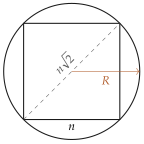
A square fits inside a disc exactly when its diagonal is at most the diameter, so n2≤2R with πR2=1000.
The side, diagonal and radius determine whether the square fits.
A square of side n fits inside a circular disc of radius R precisely when its circumscribed circle is no larger, that is when its diagonal n2 is at most the diameter 2R. So n≤R2=2R2=π2000, using πR2=1000.
No decimal is needed. From 3<π<722, 625<22/72000=2214000<π2000<32000<676, and 625=252 while 676=262. So the largest integer is n=25.
Answer 25
Solution: IOQM 2026, Q3
Key idea
Forty-nine odd numbers cannot add up to zero, so the xi cannot all be ±1, and one of them has to be at least 2 in size.
Each xi is a non-zero integer, so xi2≥1, and the sum of squares is at least 49. That bound would need every xi to be 1 or −1. But then all forty-nine are odd, and a sum of an odd number of odd numbers is odd, so it cannot be 0.
Hence some xi has ∣xi∣≥2 and contributes at least 4, while the other forty-eight contribute at least 1 each: i=1∑49xi2≥4+48=52.
The bound is reached. Take one 2, twenty-three 1s and twenty-five −1s. That is 49 numbers, their sum is 2+23−25=0, and their squares add up to 4+48=52.
Answer 52
Solution: PRMO 2015 Part A, Q9
Key idea
Once the 3×4 rectangle is placed, the two strips it leaves behind are each too thin for the 2×3 unless the square has side at least 5, and side 5 can be achieved.
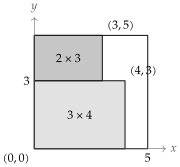
A side-5 square holds both rectangles, with the coordinate bounds used below.
A construction first, so that we know what we are aiming to prove is best possible. In a square of side 5, put the 3×4 rectangle in a bottom corner with its side of length 4 horizontal, so it occupies the region 0≤x≤4, 0≤y≤3. The band above it, 0≤x≤5 and 3≤y≤5, measures 5 by 2 and comfortably holds the 2×3 rectangle laid with its side of length 3 horizontal. Both fit, so a square of side 5 and area 25 suffices.
Now suppose a square of side s holds both, and let us see why s<5 is impossible. Certainly s≥4, since the 3×4 rectangle has a side of length 4 and the sides are parallel to the square’s. Assume 4≤s<5, and take the 3×4 rectangle to have its side of length 4 horizontal, which we may do by rotating the whole picture if necessary.
Consider the horizontal direction. The big rectangle occupies an interval of length 4 out of the available s<5, so the space strictly to its left and strictly to its right totals s−4<1. The 2×3 rectangle has both sides at least 2, so it cannot fit into either of those slivers, and therefore its horizontal extent must overlap that of the 3×4 rectangle.
Two rectangles with parallel sides that overlap horizontally and do not share interior points must be separated vertically. So the 2×3 rectangle lies entirely above or entirely below the 3×4 rectangle, and the vertical room left over is s−3<2. That is less than either side of the 2×3 rectangle, so no placement exists. Hence s≥5 and the least possible area is 25.
Answer 25
Solution: PRMO 2017, Q15
Key idea
The removed sum is 21n(n+1)−17(n−2), and the requirement that it lie between the smallest and largest possible pair sums traps n in {32,33,34}.
If the two removed numbers are m and k, the n−2 that remain have total 17(n−2), so m+k=2n(n+1)−17(n−2)=2n2−33n+68. Call this S(n); it is always an integer, since n and n−33 have opposite parities.
Two constraints pin down n. Both removed numbers lie strictly between 1 and n, so 2+3=5≤m+k≤(n−1)+(n−2)=2n−3.
The upper bound gives n2−33n+68≤4n−6, that is n2−37n+74≤0. Test integers rather than take a square root: at n=34 the value is −28 and at n=35 it is 4, so n≤34. The lower bound gives n2−33n+58≥0, where at n=31 the value is −4 and at n=32 it is 26, so n≥32 on the branch that matters (the other branch, n≤1, is far too small). Hence n∈{32,33,34}, and S(32)=18,S(33)=34,S(34)=51.
The largest is 51, and it is attainable: with n=34 remove 18 and 33, both strictly between 1 and 34, and the remaining 32 numbers average 32595−51=32544=17.
Answer 51
Solution: PRMO 2017, Q18
Key idea
Substituting u=x, v=2y, w=4z turns the two conditions into u2+v2+w2=uv+vw+wu, which forces u=v=w.
The coefficients 1,4,16 are squares: scaling the variables by 1,2,4 makes the first condition a sum of three ordinary squares. The mixed terms also acquire one common coefficient. With that in mind, set u=x, v=2y and w=4z. The first condition becomes u2+v2+w2=48. For the second, note that xy=2uv, 4yz=2vw and 2zx=2wu, so it becomes 2uv+vw+wu=24,uv+vw+wu=48.
The two right-hand sides are equal, and that is the whole problem: u2+v2+w2−uv−vw−wu=0, which is the same as 21[(u−v)2+(v−w)2+(w−u)2]=0. A sum of squares vanishes only when each term does, so u=v=w. Then 3u2=48 gives u=±4, and x=u=±4,y=2v=±2,z=4w=±1, with the same sign throughout. Either way x2+y2+z2=16+4+1=21.
The coefficients 1,4,16 and the pairing xy,4yz,2zx were designed to make that substitution work; spotting u,v,w is the entire difficulty.
Answer 21
Solution: PRMO 2019, Q13
Key idea
The sum of pairwise products is 21((∑xi)2−101), and ∑xi is forced to be odd, so the smallest positive value comes from the smallest odd square above 101.
Square the total. Since each xi2=1, (i=1∑101xi)2=i=1∑101xi2+2i<j∑xixj=101+2S, so, writing s=∑xi, we have S=(s2−101)/2.
Now s is a sum of 101 terms each ±1, so s≡101≡1(mod2): it is odd. For S to be positive we need s2>101, and the smallest odd square exceeding 101 is 112=121. That gives S=2121−101=10.
It remains to check that s=11 is achievable, and it is: take p of the values to be +1 and 101−p to be −1, so s=2p−101, and p=56 gives s=11. So the smallest positive value of the sum is 10.
Answer 10
Solution: IOQM 2021 Part A, Q8
Key idea
Unwrap the three floors from the outside in, at each stage asking for the largest input that still gives the required output.
We want the largest N with ⌊⌊⌊N⌋⌋⌋=4, and the way in is to name the intermediate quantities and work outwards to inwards.
Write k=⌊N⌋ and m=⌊k⌋, so the condition is ⌊m⌋=4. That holds exactly when 16≤m≤24, since 42=16 and 52=25. We want N as large as possible, so take m as large as possible, m=24.
Next, ⌊k⌋=24 holds exactly when 576≤k≤624, so the largest useful k is 624. Finally ⌊N⌋=624 holds exactly when 6242≤N≤6252−1, so the largest N is N=6252−1=390625−1=390624.
It is worth checking the chain forwards, since three nested floors are easy to slip on: ⌊390624⌋=624, then ⌊624⌋=24, then ⌊24⌋=4. The sum of the digits of N is 3+9+0+6+2+4=24.
Answer 24
Solution: IOQM 2023, Q1
Key idea
The set Xn contains the square roots of a block of 1000 consecutive integers, so Mn counts the integers in the interval from 4n+1 to 4n+1000, and the length of that interval shrinks steadily as n grows.
An entry 4n+k is an integer exactly when 4n+k is a perfect square, so Mn counts the integers j with 4n+1≤j≤4n+1000. The number of integers in an interval is controlled by its length, and here the length is ℓ(n)=4n+1000−4n+1=4n+1000+4n+1999, where the second form comes from multiplying and dividing by the conjugate. Written that way the behaviour is plain: ℓ(n) decreases as n increases, so the longest interval is at n=1 and the shortest at n=1000.
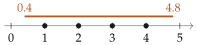
For a small picture, the interval from 0.4 to 4.8 has length 4.4 and contains the four integers 1,2,3,4:
Interval length controls the number of integer points, but the endpoints matter too.
In general an interval of length ℓ contains at least ⌊ℓ⌋ integers and at most ⌊ℓ⌋+1. For the upper bound, q integer points span at least q−1 units, so q−1≤ℓ. For the lower bound, the first integer at or after the left endpoint is less than one unit from it. That integer and the next ⌊ℓ⌋−1 integers all fit in the interval. If ℓ<1, the asserted lower bound is just zero.
For the maximum, take n=1. The interval runs from 5 to 1004, and the integers in it are 3 through 31, so M1=29. No n does better. For n≥2, ℓ(n)≤ℓ(2)=1008−9<32−3=29, using 1008<1024, and an interval shorter than 29 holds at most 29 integers. So a=29.
For the minimum, take n=1000. The interval runs from 4001 to 5000, and the integers it contains are exactly 64 through 70, since 632=3969<4001≤4096=642,702=4900≤5000<5041=712. So M1000=7. No n can do worse, because ℓ(n)≥ℓ(1000) for every n≤1000 and ℓ(1000)≥7. That last claim says 5000≥7+4001, which on squaring becomes 950≥144001, and squaring again gives 902500≥784196. An interval of length at least 7 always contains at least 7 integers, so b=7.
Hence a−b=29−7=22.
Answer 22
Solution: IOQM 2024, Q15
Key idea
The hardest triple is the one with two shortest sides and the longest side, so everything turns on the single inequality n2+n2>(n+38)2.
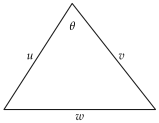
The largest angle is opposite the largest side w.
The requirement is that every choice of three elements of X, repeats allowed, forms an acute triangle, so one bad triple is enough to disqualify a value of n. For sides u≤v≤w, the angle θ opposite w is the largest. By the cosine rule, cosθ=2uvu2+v2−w2. All three angles are acute exactly when this largest one is acute, or cosθ>0. Thus the triangle is acute exactly when u2+v2>w2; and the condition also has to include u+v>w, which follows from it here. Among the numbers of X, the inequality is hardest to satisfy when u and v are as small as possible and w as large as possible, and since a,b,c need not be distinct that worst case is u=v=n,w=n+38. If that case is acute then so is every other, because increasing u or v only helps and decreasing w only helps.
So the condition is 2n2>(n+38)2,that isn2−76n−1444>0. The positive root of n2−76n−1444=0 is n=276+5776+5776=38+382, and this lies between 91 and 92 without any decimal work: 382<54 because 2⋅382=2888<2916=542, and 382>53 because 2888>2809=532. So the inequality holds exactly for n≥92. (It is worth pausing on the neat form 38(1+2), which is what the number 38 was chosen to produce.)
Hence the smallest value is n=92.
Answer 92
Solution: IOQM 2025 Part SEP, Q7
Key idea
The diagonal splits the quadrilateral into two triangles, so it must be smaller than the sum and larger than the difference of each of the two pairs it is paired with, and only one of the five lengths can manage that.
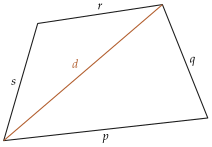
The same diagonal d must satisfy the triangle inequalities with p,q and with r,s.
If d is the diagonal, the other four lengths split into two pairs, one pair forming a triangle with d on each side of it. So we need to split {10,20,28,50,75}∖{d} into pairs {p,q} and {r,s} with ∣p−q∣<d<p+qand∣r−s∣<d<r+s.
There are only three ways to split four lengths into two pairs, so each candidate is a short check.
d=75: from {10,20,28,50} every splitting leaves a pair of sum 30, 38 or 48, all below 75. Fails.
d=50: from {10,20,28,75} the three splittings leave a pair of sum 30, 38 or 48 again, all below 50. Fails.
d=20: from {10,28,50,75} each splitting contains a pair differing by at least 22, namely one of {50,75}, {10,50} or {10,75}. Fails.
d=10: from {20,28,50,75} every splitting contains a pair differing by at least 22. Fails.
d=28: pair the rest as {10,20} and {50,75}. Then 10<28<30 and 25<28<125, both satisfied.
So the diagonal can only be 28.
Answer 28
Solution: PRMO 2018, Q18
Key idea
Dividing by abc turns the equation into (1+3/a)(1+3/b)(1+3/c)=4, and since each factor shrinks as its variable grows, the smallest variable is squeezed into {4,5}.
Divide both sides by abc: (1+a3)(1+b3)(1+c3)=4. Each factor decreases as its variable increases, which is what makes the search finite. Order the variables so that a≤b≤c; then the largest factor is the one with a, and (1+a3)3≥4. No cube root is needed: if a≥6 then 1+a3≤23 and (23)3=827<4, which fails. With a≥4 given, that leaves a∈{4,5}.
a=4
The remaining two factors must multiply to 4÷47=716. Since b is the smaller of the two, (1+b3)2≥716. Again no root is needed: b≥6 would give (1+b3)2≤49<716, since 9⋅7=63<64=16⋅4. So b∈{4,5}.
b=4: then 1+3/c=716÷47=4964, so c=549, not an integer.
b=5: then 1+3/c=716÷58=710, so 3/c=3/7 and c=7.
a=5
Now the other two factors multiply to 4÷58=25, and b≥5 with (1+b3)2≥25 forces b≤5, since b≥6 would give at most 49<25. So b=5. Then 1+3/c=25÷58=1625, giving c=316, not an integer.
So up to order the only solution is {a,b,c}={4,5,7}, which is not all equal as required, and indeed 4⋅4⋅5⋅7=560=7⋅8⋅10. Hence a+b+c=16.
Answer 16
Solution: PRMO 2018, Q23
Key idea
Cauchy-Schwarz in the form ∑a2/x≥(∑a)2/∑x applies exactly here, and the three denominators add to (a+b+c)(1/29+1/31), so the best constant is 899/60.
The left-hand side is a sum of squares over positive quantities, and there is an inequality that handles exactly that shape: for positive x,y,z, xa2+yb2+zc2≥x+y+z(a+b+c)2.
It is worth seeing where that comes from, because two terms already contain the whole idea. Clearing denominators in xa2+yb2≥x+y(a+b)2 turns it into (a2y+b2x)(x+y)≥(a+b)2xy, and expanding both sides leaves a2y2+b2x2≥2abxy, which is (ay−bx)2≥0. Applying the two-term version twice, first to the last pair and then to what is left, xa2+yb2+zc2≥xa2+y+z(b+c)2≥x+y+z(a+b+c)2, which is the three-term form. It is Cauchy-Schwarz wearing a convenient disguise, and equality needs ay=bx at each step, that is a:b:c matching x:y:z.
Here the three denominators are 29b+31c, 29c+31a and 29a+31b, and every one of a, b, c appears once with each coefficient, so they add to (a+b+c)(291+311)=(a+b+c)⋅89960. Therefore LHS≥60(a+b+c)(a+b+c)2⋅899=60899(a+b+c), and 899/60=14.98…
Equality, by the condition noted above, needs a:b:c to match the denominators, which happens at a=b=c; there the left-hand side is exactly 60899(a+b+c). So no constant larger than 899/60 can work, and the largest integer that does is n=14.
Answer 14
Solution: PRMO 2019, Q22
Key idea
1/n sits between the two telescoping differences 2(n+1−n) and 2(n−n−1), and 1599+1=1600 is a perfect square, which is why the bound is sharp enough to name the integer part.
We want nearby terms that cancel when added. The difference of adjacent square roots is promising: n+1−n=n+1+n1. Its denominator is close to 2n, so twice this difference should be close to 1/n. Using the next root gives one side of the bound and using the previous root gives the other:
2(n+1−n)=n+1+n2<2n2=n1,2(n−n−1)=n+n−12>2n2=n1(n≥2). Both are strict, and both telescope when summed.
Write S for the sum in question. From below, using the first estimate for every term, S>n=1∑15992(n+1−n)=2(1600−1)=2(40−1)=78. From above, keeping the first term separate because the second estimate needs n≥2, S<1+n=2∑15992(n−n−1)=1+2(1599−1)=21599−1, and that is smaller than 2×40−1=79, because 1599<1600.
So 78<S<79, and the greatest integer not exceeding S is 78.
The number 1599 was chosen with care, though not quite as tightly as it first looks. One term fewer breaks the argument: the lower bound would read 2(1599−1), which is below 78. One term more is still fine, since the upper bound becomes exactly 79 and the inequality is strict. Two terms more does break it, the upper bound passing 79. So the window is narrow, and the reason 1600 appears in the lower estimate is exactly that the sum runs to 1599.
Answer 78
Solution: PRMO 2019, Q26
Key idea
For fixed y≥2 the quantity x+yz falls as x rises, so x takes its largest value ⌊159/y⌋, and writing 159=qy+s collapses the whole expression to y(1+s)+q.
Since z≥1, the constraint gives xy≤159. Substituting z=160−xy, x+yz=x+y(160−xy)=160y−x(y2−1). For y=1 this is just x+z=160. For y≥2 the coefficient y2−1 is positive, so the expression decreases as x grows, and x should be as large as the constraint allows: x=⌊y159⌋.
Write 159=qy+s with 0≤s<y, so that x=q and z=160−qy=s+1. Then x+yz=160y−q(y2−1)=160y−y(qy)+q, and qy=159−s, so the whole thing collapses to y(1+s)+q. Because x is forced for each y, every row below is a single evaluation of this formula rather than a search over x. Running y from 1 to 24:
Larger y need no table. If s≥1 then y(1+s)+q≥2y+q≥2×25+1=51 for y≥25. If s=0 then y divides 159=3×53, so y is 53 or 159, giving 53+3=56 and 159+1=160. Every value beyond the table exceeds 50.
The minimum is therefore 50, at y=6, x=26, z=4: indeed 26×6+4=160 and 26+6×4=50.
Why y=6 and not some neighbour? Rearranging the constraint gives the identity x+yz=160+(y−1)(z−x), so we want (y−1)(x−z) large. Raising y helps the first factor and hurts the second, and y=6 divides 159 almost exactly, which keeps z small while x is still 26.
Answer 50
Solution: IOQM 2022, Q15
Key idea
With s=x+y and d=x−y, the constraint xy=1 says exactly s2−d2=4, which removes s entirely and leaves a one-variable function of d.
Set s=x+y and d=x−y. Then s2−d2=4xy=4, so s2=d2+4 and in particular s2−2=d2+2. Substituting into the expression, (x+y)2+(x−y)−2(x+y)2−(x−y)−2=d2+d+2d2−d+2. The two variables have become one, and d ranges over all real numbers, since for any d we may take s=±d2+4 and recover a genuine pair with xy=1.
To find the range, ask which values k are attained. The denominator never vanishes, since d2+d+2=(d+21)2+47>0, so clearing it is safe. Setting the expression equal to k and clearing the denominator, (1−k)d2−(1+k)d+(2−2k)=0, For k=1 this is the linear equation −2d=0, so that value is attained at d=0. For k=1 the equation is quadratic, and a real d exists exactly when its discriminant is non-negative: (1+k)2−4(1−k)(2−2k)=(1+k)2−8(1−k)2≥0. Expanding, 1+2k+k2−8+16k−8k2≥0, that is 7k2−18k+7≤0.
A quadratic is negative between its roots, so the attained values fill the closed interval between them, and T and t are precisely those roots. We do not even need to compute them separately, because the sum of the roots of 7k2−18k+7 is 718 by Vieta.
So T+t=718, giving m=18, n=7 and m+n=25.
Answer 25
Solution: IOQM 2024, Q11
Key idea
Adding the two equations makes each fraction complete itself: the sum becomes 2b+1a+1+3c+12b+1+a+13c+1=3, three positive numbers with product 1, so all three are 1.
Write x=a, y=2b, z=3c, all positive. The two conditions are y+1x+z+1y+x+1z=1,x+11+y+11+z+11=2.
Add them, pairing each fraction of the first with the fraction of the second that shares its denominator: y+1x+1+z+1y+1+x+1z+1=3. The three terms are positive and their product is 1, so by the arithmetic-geometric mean
inequality their sum is at least 3, with equality only when all three equal 1. Equality is exactly what we have, so x+1=y+1=z+1,that isx=y=z.
Substituting into the first equation, x+13x=1, so x=21. Unwinding, a=21,2b=21⇒b=41,3c=21⇒c=61, and therefore a1+b1+c1=2+4+6=12.
Answer 12
Solution: IOQM 2025 Part SEP, Q7
Key idea
With MI=1/MT the product of the two side lengths is 1, so the area alone gives the sine of the angle between them, and the diagonal is minimised by equal sides (a rhombus) and the obtuse angle.
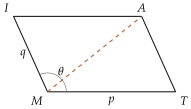
Adjacent sides p,q and their included angle θ.
Write p=MT and q=MI, so that pq=1, and let θ be the angle between those two sides at M. The area of a parallelogram is the product of two adjacent sides times the sine of the angle between them, so pqsinθ=sinθ=4140,cosθ=±419.
The diagonal MA is the sum of the two side vectors, so by the cosine rule MA2=p2+q2+2pqcosθ=p2+p21+2cosθ. Two independent choices now make this as small as possible. First, p2+1/p2≥2 by the arithmetic-geometric mean inequality, with equality when p=1. Second, cosθ should be the negative value −419, which is the obtuse choice.
Hence d2=2−4118=4182−18=4164, and since gcd(64,41)=1 we read off a=64, b=41 and ∣a−b∣=23.