Library · Between the Challenge and the Olympiad · Chapter 13
Circles, Coordinates and Trigonometry
On this page
- Problems
- Solutions
- Solution: IOQM 2025 Part SEP, Q28
- Solution: IOQM 2026, Q5
- Solution: PRMO 2012, Q7
- Solution: PRMO 2015 Part A, Q8
- Solution: IOQM 2024, Q7
- Solution: PRMO 2018, Q5
- Solution: PRMO 2018, Q7
- Solution: PRMO 2018, Q8
- Solution: PRMO 2019, Q19
- Solution: IOQM 2020, Q12
- Solution: IOQM 2023, Q14
- Solution: IOQM 2024, Q17
- Solution: IOQM 2026, Q19
- Solution: PRMO 2012, Q20
- Solution: PRMO 2017, Q26
- Solution: PRMO 2018, Q14
- Solution: PRMO 2019, Q11
- Solution: PRMO 2019, Q23
- Solution: PRMO 2019, Q25
- Solution: IOQM 2020, Q24
- Solution: IOQM 2021 Part A, Q9
- Solution: IOQM 2022, Q11
- Solution: IOQM 2022, Q23
- Solution: IOQM 2025 Part SEP, Q7
- Solution: PRMO 2013, Q17
- Solution: PRMO 2015 Part A, Q19
- Solution: PRMO 2017, Q27
- Solution: IOQM 2021 Part B, Q1
- Solution: IOQM 2023, Q15
- Solution: IOQM 2023, Q23
- Solution: IOQM 2023, Q25
- Solution: IOQM 2026, Q27
Problems
Problem 1
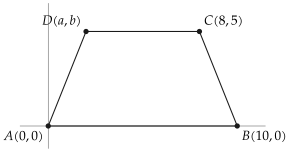
Let be a quadrilateral in the -plane with parallel to and . Suppose , , and . Determine the value of .
Problem 2
In triangle , we are given that . Let the perpendicular bisector of meet the circumcircle of triangle in , where we assume that and lie on the same side of the chord . Then what is the measure of in degrees?
Problem 3
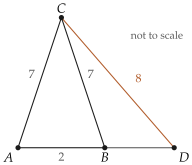
In , we have and . Suppose that is a point on line such that lies between and and . What is the length of the segment ?
Problem 4
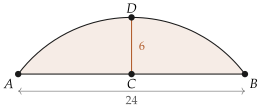
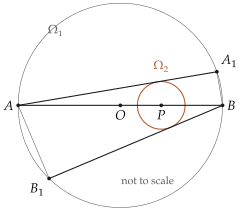
The figure below shows a broken piece of a circular plate made of glass. is the midpoint of , and is the midpoint of arc . Given that cm and cm, what is the radius of the plate in centimetres? (The figure is not drawn to scale.)
Problem 5
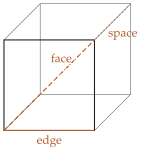
Determine the sum of all possible surface areas of a cube two of whose vertices are and .
Problem 6
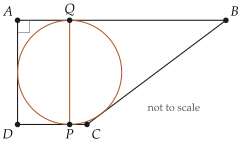
Let be a trapezium in which and . Suppose has an incircle which touches at and at . Given that and , find .
Problem 7
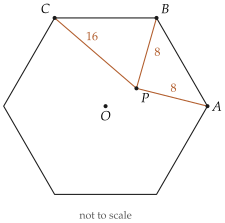
A point in the interior of a regular hexagon is at distances units from three consecutive vertices of the hexagon, respectively. If is the radius of the circumscribed circle of the hexagon, what is the integer closest to ?
Problem 8
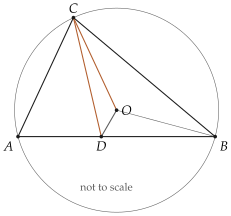
Let be a chord of a circle with centre . Let be a point on the circle such that and lies inside the triangle . Let be a point on such that . Find the measure of in degrees.
Problem 9
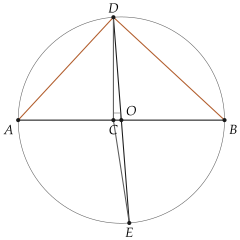
Let be a diameter of a circle and let be a point on the segment such that . Let be a point on the circle such that is perpendicular to . Let be the diameter through . If denotes the area of the triangle , find to the nearest integer.
Problem 10
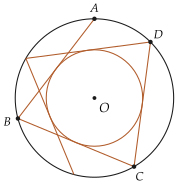
Given a pair of concentric circles, chords of the outer circle are drawn such that they all touch the inner circle. If , how many chords can be drawn before returning to the starting point?
Problem 11
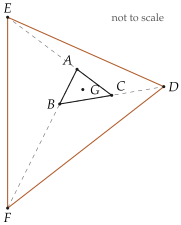
Let be a triangle in the plane, where is at the origin . Let be produced to such that , be produced to such that and be produced to such that . Let be the centroid of the triangle and be the centroid of the triangle . Find the length .
Problem 12
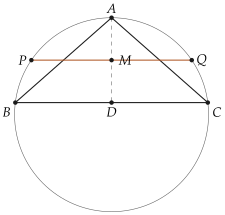
Consider an isosceles triangle with sides , . Let be the foot of the perpendicular from to , and let be the midpoint of . Let be a chord of the circumcircle of triangle , such that lies on and is parallel to . The length of is:
Problem 13
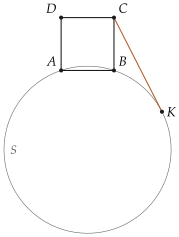
The side of a square is 1 and it is also a chord of a circle . The side does not intersect . The length of the tangent , drawn from to at the point is 2. If is the diameter of , then calculate .
Problem 14
Four points , , and lie on a straight line, in this order. A point , not on the line, satisfies . Let and be the midpoints of and , respectively. If , what is the value of ?
Problem 15
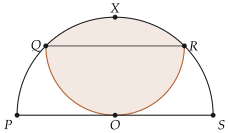
is a line segment of length 4 and is the midpoint of . A semicircular arc is drawn with as diameter. Let be the midpoint of this arc. and are points on the arc such that is parallel to and the semicircular arc drawn with as diameter is tangent to . What is the area of the region bounded by the two semicircular arcs?
Problem 16
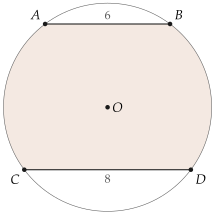
Let and be two parallel chords in a circle with radius 5 such that the centre lies between these chords. Suppose , . Suppose further that the area of the part of the circle lying between the chords and is , where are positive integers with . What is the value of ?
Problem 17
If then what is the integer nearest to ?
Problem 18
How many distinct triangles are there, up to similarity, such that the magnitudes of angles , and in degrees are positive integers and satisfy for some positive integer , where does not exceed ?
Problem 19
Let be a convex cyclic quadrilateral. Suppose is a point in the plane of the quadrilateral such that the sum of its distances from the vertices of is the least. If what is the maximum possible area of ?
Problem 20
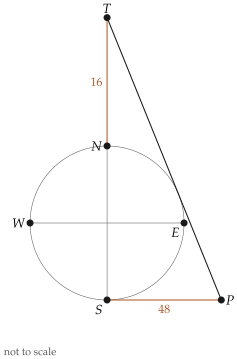
A village has a circular wall around it, and the wall has four gates pointing north, south, east and west. A tree stands outside the village, m north of the north gate, and it can be just seen appearing on the horizon from a point m east of the south gate. What is the diameter, in metres, of the wall that surrounds the village?
Problem 21
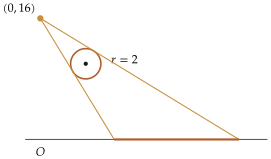
A light source at the point in the coordinate plane casts light in all directions. A disc (a circle along with its interior) of radius 2 with centre at casts a shadow on the axis. The length of the shadow can be written in the form where are positive integers and is square-free. Find .
Problem 22
Let and define for by Find the area of the quadrilateral formed by the points .
Problem 23
Let be a diameter of a circle and let be a point on , different from and . The perpendicular from intersects at and at . The circle with centre at and radius intersects at and . If the perimeter of the triangle is , find the length of the side .
Problem 24
In a triangle , the median divides in the ratio . Extend to such that is perpendicular . Given that , , find the integer nearest to .
Problem 25
Three sides of a quadrilateral are , and . The sides and enclose an angle of , and the sides and enclose an angle of . If the acute angle between the diagonals is , what is the value of ?
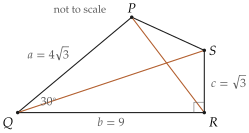
Problem 26
In triangle , , and . On the side there are two points and such that lies between and and is a square, where lies on and lies on the circle through with centre . If the area of is where and are positive integers with , what is the value of ?
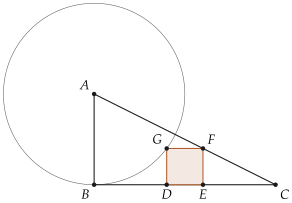
Problem 27
Let be a circle with centre . A chord , not a diameter, divides into two regions and such that belongs to . Let be a circle with centre in , touching at and internally. Let be a circle with centre in , touching at , the circle internally and passing through the centre of . The point lies on the diameter passing through the centre of and . If the radius of is 100 then what is the radius of ?
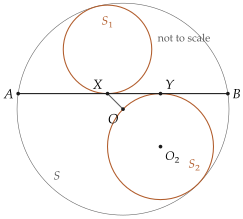
Problem 28
The circle touches the circle internally at . The centre of is outside . Let be a diameter of which is also tangent to . Assume . Let intersect at . If , what is the magnitude of in degrees?
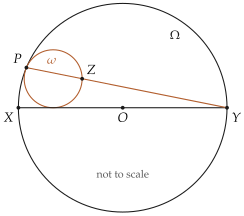
Problem 29
Let be a circle with centre and let be a diameter of . Let be a point on the segment different from . Suppose another circle with centre lies in the interior of . Tangents are drawn from and to the circle intersecting again at and respectively such that and are on the opposite sides of . Given that , and , find the radius of .
Problem 30
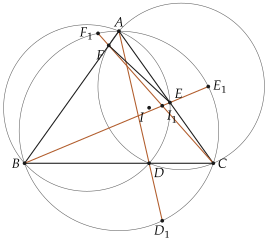
Let be an interior point on the side of an acute-angled triangle . Let the circumcircle of triangle intersect again at and the circumcircle of triangle intersect again at . Let , and intersect the circumcircle of triangle again at , and , respectively. Let and be the incentres of triangles and , respectively. Prove that , , , are concyclic.
Problem 31
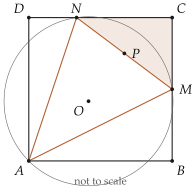
Let be a unit square. Suppose and are points on and respectively such that the perimeter of triangle is . Let be the circumcentre of triangle , and be the circumcentre of triangle . If for some relatively prime positive integers and , find the value of .
Problem 32
In the coordinate plane, a point is called a lattice point if both of its coordinates are integers. Let be the point . Find the number of right angled triangles in the coordinate plane where and are lattice points, having a right angle at the vertex and whose incentre is at the origin .
Problem 33
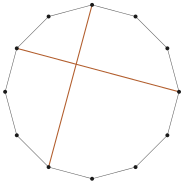
Find the least positive integer such that there are at least 1000 unordered pairs of diagonals in a regular polygon with vertices that intersect at a right angle in the interior of the polygon.
Problem 34
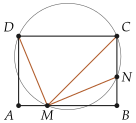
Let be a rectangle and let , be points lying on sides and , respectively. Assume that and , and that points lie on a circle. If where and are positive integers with , what is the value of ?
Problem 35
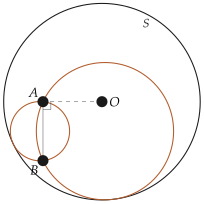
Let be a circle of radius 10 with centre . Suppose and are two circles which touch internally and intersect each other at two distinct points and . If what is the sum of the radii of and ?
Problem 36
The lengths of the sides of a convex quadrilateral are , , and , in this order. The length of each diagonal is . If is the difference between the largest angle and the second largest angle of the quadrilateral then determine the value of .
Solutions
Solution: IOQM 2025 Part SEP, Q28
Parallel to means is at the same height as , and the equal legs give without ever deciding the sign of .
Since lies along the horizontal axis and is parallel to it, the point has the same -coordinate as , so .
The condition now fixes : so and .
Both signs of give a legitimate quadrilateral, giving the isosceles trapezium and the parallelogram, and the question is untroubled by the ambiguity because it asks only for
Answer 20
Solution: IOQM 2026, Q5
is on the same arc as , so it sees at the same , and being on the perpendicular bisector it is equally far from and .
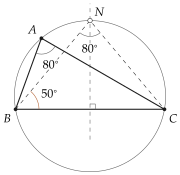
Every point on the perpendicular bisector of is the same distance from as from , so and triangle is isosceles.
The points and lie on the circumcircle on the same side of the chord , so they are in the same segment, and angles in the same segment are equal: The two base angles of the isosceles triangle share what is left, so
is the midpoint of the arc , and the question does not care where on that arc sits, which is why only the angle at was given.
Answer 50
Solution: PRMO 2012, Q7
The apex sits above the midpoint of , so both and are hypotenuses over the same height and Pythagoras gives in one line.
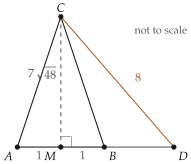
are hypotenuses over the same vertical leg
Let be the midpoint of . Since , the point lies directly above , and
Now put on the far side of , at distance from it, so . In the right triangle , so .
Answer 3
Solution: PRMO 2015 Part A, Q8
is the midpoint of the arc, so lies along the radius through , and the right triangle formed by the centre, and carries all three given lengths.
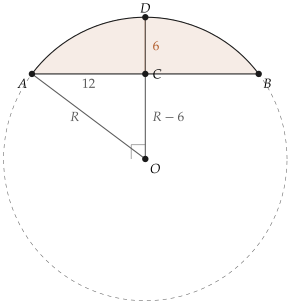
and the right triangle carries all three lengths
Let be the centre of the plate and its radius. Because is the midpoint of the chord , the line is perpendicular to , and because is the midpoint of arc , the same line extended passes through . So , and are collinear, and
Now apply Pythagoras in the right triangle , whose legs are and and whose hypotenuse is the radius : The terms cancel, which is the whole reason this configuration is set up the way it is, and what remains is linear:
The same relation is worth remembering in the form it usually appears: if a chord of length sits at distance below the arc’s midpoint, then . Here , which again gives .
Answer 15
Solution: IOQM 2024, Q7
The distance between the two given vertices is , and in a cube two vertices are at distance , or , so there are exactly three possible edge lengths.
The two points and differ by , whose length is
In a cube of edge , two distinct vertices are joined by an edge, a face diagonal or a space diagonal, and those have lengths , and . Each case is realisable, since a cube may be placed in space with any given segment as an edge, as a face diagonal or as a space diagonal. So: The sum of all possible surface areas is .
Answer 99
Solution: PRMO 2018, Q5
Two right angles at and make a diameter, so is that diameter too; the fourth side has length by equal tangents, and Pythagoras on it gives .
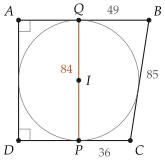
Since and , the side is perpendicular to both parallel sides. So is a common perpendicular between two tangent lines of the incircle, and its length is the diameter . The touch points on and on sit directly opposite each other on the circle, so as well, and the whole problem is to find .
Set up coordinates with at the origin, along the positive -axis and down the negative -axis. The incircle has centre and radius , so it touches at and at . Then places at , and places at .
Now use the fourth side. Equal tangents from and from give while the coordinates give . Hence and .
The numbers were chosen so that is a Pythagorean triple, which is what makes the final square root come out whole.
Answer 84
Solution: PRMO 2018, Q7
is equidistant from two consecutive vertices, so it lies on the line through the centre and the midpoint of that side; on that line the distance to the third vertex satisfies , and the rest is one quadratic.
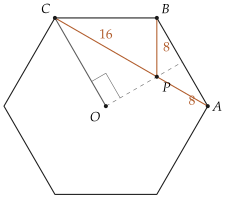
and there is perpendicular to , so
Let be the centre and the circumradius, and let the three consecutive vertices be , , with and . Place the hexagon with
Because , the point lies on the perpendicular bisector of , which passes through since . That line has direction , so for some , and .
Now compute the two given distances. Expanding, The second is the cleaner of the two: the cross terms cancel because and happen to be perpendicular. Substituting into the first gives , so
The numbers and have sum and product , so they are the roots of Thus , and since and also gives ,
Which of the two is the radius? If were then and would lie outside the hexagon, against the hypothesis. So and the nearest integer is : squaring the three quantities, and , while sits between them. As a check, is then from the centre while the hexagon’s inradius is , so is comfortably inside.
Answer 14
Solution: PRMO 2018, Q8
The isosceles triangles and turn the given into , which leaves at and makes equilateral; then is isosceles too, so and triangle is isosceles.
The angles at the base
Since , triangle is isosceles, and gives . Hence and since as well, too. The apex angle of the isosceles triangle is therefore , and the inscribed angle on the same arc is half of it:
Two isosceles triangles, and no trigonometry
The angle is whatever is left of once is taken off: But , so triangle is isosceles with a base angle of , and that forces the apex to be as well. It is equilateral, so
Now take triangle . Its angle at is , and since lies inside the triangle the ray falls between and , so Its angle at comes from triangle , where and , so and therefore . The angles at and at are equal, so triangle is isosceles and
Finishing
So , and triangle is isosceles with apex angle . Its base angles are equal, so
The equality is what the problem is built around, and it is not a coincidence of lengths. The at leaves exactly of behind, which is what an equilateral triangle needs, and after that every length in the picture is .
Answer 80
Solution: PRMO 2019, Q19
Both triangles have for a height or a base, so the common factor cancels and the ratio is just divided by twice the small offset .
Let be the centre, so is the midpoint of and also of the diameter . Write and , so that and the radius is . The offset of from the centre is
For the first triangle, is the height from onto the base , since :
For the second, split it at the centre. Since is the midpoint of , the triangles and have equal areas, so . In triangle take as the base, which lies along ; the height from is again . Hence
Dividing, the length cancels and never has to be computed:
The ratio is exactly , so the instruction to round is a courtesy rather than a necessity. Notice also what the answer is: , which is because splits the diameter into thirteen parts and leaves the centre half a part away from .
Answer 13
Solution: IOQM 2020, Q12
Each chord rotates the whole configuration by one fixed angle, so the question becomes arithmetic: how many of those turns make a whole number of revolutions.
By symmetry, every chord of the outer circle that touches the inner circle subtends the same angle at the common centre, which means the figure is really one rigid step repeated over and over. Identifying that step is the whole problem.
Look at the vertex , where the chords and meet at . Passing from one chord to the next rotates the configuration about the centre through the supplement of that angle, because the chord turns by the exterior angle rather than the interior one, so each step is a rotation through
After chords the accumulated rotation is degrees, and the chain closes up precisely when this amounts to a whole number of complete turns, that is when Dividing through by turns this into , and since and share no factor the smallest positive is . The path closes after twenty-four chords, having wound seven times around the centre on the way.
Answer 24
Solution: IOQM 2023, Q14
Writing the three new points as vectors from , the sum collapses to zero, so is the point itself and is just the distance from the origin to .
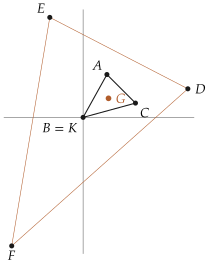
Treat the points as position vectors with at the origin, so that . Each construction is a statement about a vector.
Since , the point is the midpoint of , so . Since , the point lies on the extension of beyond with twice , so . Since , the point lies beyond with three times , so , using .
Now add: The centroid of is , which is the point . The three constructions were built to cancel, and no coordinates for and were ever needed.
Therefore is the distance from to the origin:
Answer 40
Solution: IOQM 2024, Q17
Place the picture on coordinates with at the origin; the circumcentre then sits on the axis of symmetry, and the chord through is found from one application of Pythagoras.
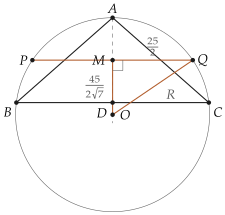
Since , the foot is the midpoint of , so and Put at the origin with along the horizontal axis, so
The circumcentre lies on the perpendicular bisector of , which is the vertical axis, so write it as . Equating and , so and . The centre sits just below , which is what one expects for a triangle this wide. The circumradius follows:
The chord is horizontal at height , so its distance from is Half the chord is then using . Hence .
Answer 25
Solution: IOQM 2025 Part SEP, Q28
Put the centre on the perpendicular bisector of at height ; the power of the point is then , and the tangent length gives at once, sign and all.
Place , , and . Since is a chord of , the centre lies on the perpendicular bisector , say at . There is no need to guess whether is positive or negative: leave it free and let the arithmetic decide. Because lies on , the radius satisfies
Let be the centre. The radius is perpendicular to tangent , so Pythagoras gives , also the power of . Since , computing this difference gives So and . The negative sign is the answer to the question we declined to prejudge: the centre does lie below , which is consistent with missing the circle, but that was a conclusion rather than an assumption.
Therefore , and the diameter satisfies
Answer 10
Solution: IOQM 2026, Q19
The right angle at over and the one over put on two circles, centred at and . Each gives an isosceles triangle, and the angles at then add up to exactly .
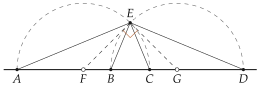
Since , the point lies on the circle with diameter , whose centre is . So . In the same way , and .
In triangle , write and for the angles at and . The angle at is , so .
The point lies on the segment , on the same side of as , so triangle has , and being isosceles it has too. Likewise lies on on the same side of as , and .
Now measure every angle at from the ray , counting towards as positive. The ray is at . The ray lies between and , at . The ray is past in the direction of , so it is at , which is negative when it has gone past . The angle between and is
Answer 90
Solution: PRMO 2012, Q20
Tangency to forces the small semicircle’s radius to equal the height of , so both are ; the region is then a quarter-segment plus a half-disc.
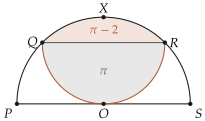
Put at the origin, so , and , and let , with , since and lie on the big arc.
The semicircle on has centre and radius , and it is drawn downwards. It touches the line exactly when its centre is at height equal to its radius: In particular that semicircle passes through , which is why the region in the question is named .
Now the area, in two pieces.
Above the chord
The points and sit at and on the big circle, so the arc spans a right angle. The segment between the chord and that arc is a quarter disc minus the triangle :
Below the chord
That is exactly the small semicircle, of radius :
Adding,
Answer
Solution: PRMO 2017, Q26
The two chords sit and from the centre, and the half-angles they subtend are complementary, so the two outer segments add to half a disc minus the two triangles.
The chord lies at distance from the centre, and at distance . Since the centre lies between them, the region asked for is the disc with the two outer segments removed.
Take the segment cut off by . Its chord subtends a central angle with and , with measured in radians. Subtracting the triangle from the sector gives the segment area using .
For the half-angle has and , and is again , so that segment has area .
Now the pleasant part: , so and the two segments together have area Subtracting from the whole disc,
So , , , whose greatest common divisor is , and
Answer 75
Solution: PRMO 2018, Q14
Complements turn both products into products of sines, and then folds each product into the next with only a power of left over.
Both products are products of sines
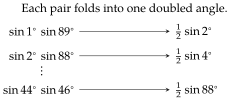
Complementary angles convert cosines to sines: . As runs from to so does , so the first product is unchanged by the swap: The angles in are , whose complements are , which are the multiples of up to . Hence So both products run over evenly spaced angles, and steps twice as fast as the even part of . That is the whole shape of the problem: doubling is the move.
Doubling, twice
The first factor shows the folding explicitly: . The next gives . Each doubled angle supplies a pair at opposite ends of the full list. Let be the product over the even angles below , and expand each factor with : The second product is , so between them the two products supply every factor of except the middle one, . Hence
Now do the same to , whose angles are the even angles doubled again: This time , and runs through , the even angles from to . The two products between them are the even angles from to , once each, with no middle factor to divide away this time:
The ratio
The two doublings compose, and cancels: Neither nor was ever evaluated, which is the point: only their ratio is asked for, and the ratio is a power of . So and exactly, so the nearest integer is .
Answer 19
Solution: PRMO 2019, Q11
Since , the left-hand side is at most , so equality forces both and , and the whole problem reduces to counting even divisors of .
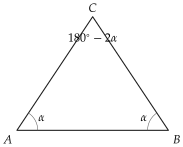
In any triangle all three angles lie strictly between and , so and . Using , and the right-hand side is exactly , which is at most . For the given equation to hold, both inequalities must be equalities. The first needs , since it is multiplied by the strictly positive ; the second needs .
Now means for a non-negative integer , and the constraint leaves only So is a positive integer dividing . Since we also have , which is even, and conversely any even with gives the integer angle .
So we need the even divisors of . Each is twice a divisor of , and has divisors, namely . The even divisors of are therefore giving the six triangles , , , , and , all with integer angles and all genuinely different in shape. Hence there are triangles up to similarity.
Answer 6
Solution: PRMO 2019, Q23
The minimising point of a convex quadrilateral is where the diagonals cross, so the four given lengths split into the two diagonals; the cyclic condition then forces the pairing through , and the area is largest when the diagonals are perpendicular.
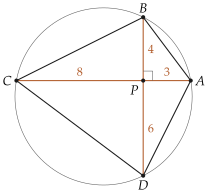
Where must be
For any point in the plane, the triangle inequality gives with equality exactly when lies on the segment , and likewise with equality exactly on . Adding, and both equalities hold together at the point where the diagonals cross, which exists and is interior because is convex. So is the intersection of the diagonals, and
Which lengths pair up
Because is cyclic and lies inside, the intersecting chords give Among the products available from the only equal pair is , so one diagonal is split into and and the other into and . Hence
The area
Let be the angle between the diagonals at . Splitting into the four triangles meeting at , each of which has two sides along the diagonals and the included angle or , The bracket factorises as , which is , so with equality exactly when the diagonals are perpendicular.
That case really occurs. Put at the origin with , , and . This is convex, and since the triangles and are similar, so and the four points are concyclic. Hence the maximum area is
Answer 55
Solution: PRMO 2019, Q25
The two tangent lengths along the sight line, one from the tree and one from the viewing point, add up to the whole line, and the power of a point turns that into a cubic whose one real root, , turns up on trying small values.
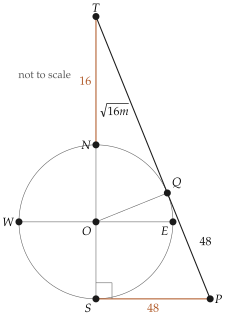
along the line gives
Let the wall have centre and radius , with the north gate and the south gate, so is a diameter. Put the tree at , with , and the viewing point at , with . Write
Three facts pin the picture down.
First, is tangent to the circle at . The gates point east and west as well as north and south, so runs east from and is perpendicular to the north-south diameter there, which is precisely the tangency condition. In particular the tangent length from is .
Second, the sight line touches the wall, at say, because the tree is just seen: any nearer to the village and the wall would hide it. Since is outside the circle, both tangents from have length , so . And the power of the point , computed along the line which meets the circle at and , gives
Third, , so .
Since lies between and , we have , that is Squaring, the cancels and . Writing and dividing by , Trying small values, works, since , and factoring it out leaves whose quadratic factor has discriminant and so no real root. Hence is the only possibility, giving , then , so and the diameter is
Answer 48
Solution: IOQM 2020, Q24
The shadow is cut off by the two tangent lines from the light source, and the difference of their -intercepts is easiest to get from the sum and product of their slopes, without ever solving for either one.
A point of the ground is in shadow exactly when the segment joining it to the light source meets the disc, so the shadow runs between the two points where the tangent lines from the source touch down on the -axis. Every line through the source has the form , and it is tangent to the disc when its distance from the centre equals the radius . To compute that distance, a normal vector to the line is , with length . The vector from the source to the centre is . Its component in the normal direction is therefore . So the tangency condition is Squaring and tidying, , which reduces to and then to
Rather than solve this, notice what the question needs. Setting in gives the intercept , so the shadow has length and both of those quantities come straight from the coefficients. The product of the roots is , and the difference satisfies , so .
The shadow therefore has length . Since is prime and so certainly square-free, and , giving .
Answer 21
Solution: IOQM 2021 Part A, Q9
The step from one point to the next preserves area, so every four-point window has the same area as the first one. The rule splits into two shears and a pair of stretches whose area factors cancel.
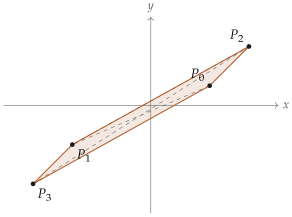
Start with the first four points
The large index suggests looking for something that stays unchanged. First compute a small window so that we know what kind of quadrilateral the rule produces: Read round its boundary as , as in the figure. Its opposite sides have the same vectors, and , so it is a parallelogram. Taking as the base gives length . A unit vector perpendicular to that base is , so the perpendicular height is the component of in that direction: Hence the first window has area
Why the next window has the same area
A vertical shear moves each vertical line up or down while keeping every point on that line together. For example, moves the line at upward by . To see why this keeps a triangle’s area, draw the vertical line through its middle vertex , meeting the opposite side at . The two pieces have the same vertical base . A vertical shear keeps that base’s length and keeps each horizontal height to it, so both triangle areas stay the same. If two vertices share a vertical line, that line is already a base and no split is needed. Splitting a polygon into triangles gives the same conclusion for its area.
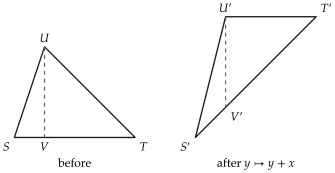
A horizontal shear preserves area by the same argument with horizontal bases and vertical heights. Stretching horizontally by a factor of doubles area; stretching vertically by halves it. Reflecting in an axis does not change area.
Now split our rule into those operations. Starting from , apply then stretch and reflect to get and finally apply the horizontal shear Their combined effect is exactly the given recurrence. The shears preserve area, and the two stretch factors multiply to , so the whole rule preserves area.
It sends the quadrilateral on to the one on . Repeating the rule ninety-six times therefore carries the first window to the requested window without changing its area. The answer is .
Answer 8
Solution: IOQM 2022, Q11
Reflection in the diameter gives , and Ptolemy on the cyclic quadrilateral then reads without any need to identify the triangle.
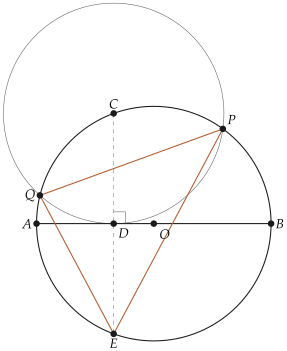
Because is a diameter and is perpendicular to it, is the perpendicular bisector of , so is the mirror image of and . The circle centred at has radius , so its intersections and with satisfy
All four of , , , lie on , and since the point is the midpoint of the arc not containing , so the four points lie in the order , , , around the circle. What we now need is a relation among the six distances between four points on a circle, and there is exactly one: the product of the diagonals equals the sum of the products of the two pairs of opposite sides. For our four points that reads The next paragraph proves it and nothing else, so a reader who knows it already may skip to the finish.
The four-point relation, proved where it is used
For a cyclic quadrilateral in that order, the claim is . Take the point on the diagonal with ; since that angle is smaller than , the ray runs inside the angle at and so does meet the segment .
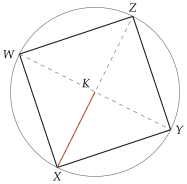
Triangles and now have two equal angles, the one just arranged and , both standing on the arc . So they are similar, and comparing the sides about the equal angles, Subtracting the arranged angle from the whole angle at gives , and stand on the arc , so triangles and are similar too, giving Adding the two, and using because lies on the segment, That is Ptolemy’s theorem, and applying it to gives the identity displayed above.
The finish
Writing for the common length and ,
The perimeter of triangle is therefore . Given that it equals , we get .
The argument never needed the position of , and it is worth being precise about what that does and does not mean. The relation holds wherever sits, so the perimeter is always ; but the triangle does change shape. It is equilateral only when , which puts on the perpendicular bisector of . That bisector is the line joining the centre of to , so the condition is that , the centre and be collinear, which happens exactly when is the midpoint of one of the arcs .
Answer 8
Solution: IOQM 2022, Q23
The median splits the triangle into two equal areas, and writing both areas with the angle-halves at turns that into , which pins at once.
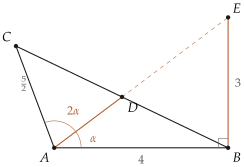
The right angle at in triangle does the first job. With and , the angle satisfies , so . Since lies on the ray , this is also , and the given ratio makes .
Now use the median. Because is the midpoint of , the triangles and have equal areas. Writing each with the common side and the angle at , and cancelling and , which are non-zero, together with ,
Finally apply the cosine rule in triangle , whose angle at is . Using the triple-angle formula, , so which collects over a denominator of as
No decimal is needed to round this. Since , the value lies strictly between and , so the nearest integer is .
Answer 29
Solution: IOQM 2025 Part SEP, Q7
The two given angles are enough to place all four vertices on coordinates, after which the angle between the diagonals is one dot product.
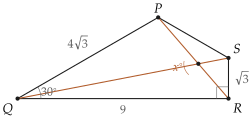
The paper does not state convexity; its keyed answer assumes the convex configuration drawn here. Name the quadrilateral with , and , so that the angle at is and the angle at is .
Put at the origin and at . The side leaves at to , so The side leaves at right angles to , on the same side as , so
Now the diagonals. They are and , with direction vectors Their dot product is , while their lengths are and . Hence so the acute angle is and .
Answer 60
Solution: IOQM 2025 Part SEP, Q7
Put at the origin; the two conditions, on and on the circle, become two equations in the side of the square, and one of the two roots is geometrically impossible.
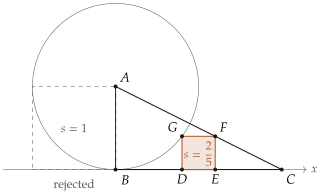
Place , and , so that lies along the horizontal axis and the circle through centred at is .
Let the square have side , with and on and the other two vertices directly above them,
Now use the two conditions. The line is , so on it gives And on the circle gives Together with , the second condition becomes that is , or . The roots are
The root puts , which is outside the segment , so it is rejected. With we get and , both between and and in the right order, and the area is
So , and .
Answer 29
Solution: PRMO 2013, Q17
passes through the centre and touches , so its radius is half of ’s; the then fixes the chord’s distance from the centre, and one tangency equation gives .
The size of everything
Let be the centre of and its radius. The circle touches internally, so its centre satisfies ; and it passes through , so . Hence
Set up coordinates with at the origin and the horizontal line , where is its distance from the centre, so that is the region above it. Since touches from below, its centre is lower: the second equation being .
Where the goes
The point is directly above , so lies along , which is horizontal. The point lies on the line through and , so the segment has slope in absolute value. The angle between and the horizontal is therefore Combined with this gives , so or .
The first fails, and squares settle it without decimals. With we have , so the point , which sits at -coordinate , has while the chord at that height reaches only to in the same units. As , the point misses the chord. So and this one does lie on the chord, since is comfortably below .
The circle
Its centre is directly above at height , and touching internally puts it at distance from : Expanding, the terms cancel and
Answer 60
Solution: PRMO 2015 Part A, Q19
The scaling centred at that carries to sends the point of tangency on to the far midpoint of arc , so bisects the right angle ; after that the tangent length from and the sine rule finish it.
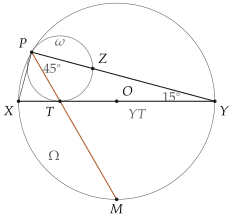
Let be the point where touches the diameter , and and the radii of and .
The first step is the standard lemma about a circle inscribed in a segment. Because the two circles are internally tangent at , they share a tangent line there, and their centres lie with on one line. The scaling centred at that multiplies all distances from by therefore carries the centre of to the centre of and the radius to the radius , so it carries to . Under it the tangent line at goes to a parallel tangent line of , and the image of is the point of where that parallel tangent touches. Since the image lies on the ray from through and beyond, is the endpoint of the diameter perpendicular to on the opposite side from , in other words the midpoint of the arc not containing .
Equal arcs and subtend equal angles at , so , and hence the line , bisects . But is a diameter, so , and therefore
Now bring in the given ratio. Let . The line meets at and at , and is tangent to , so the power of the point gives With we have , so , that is
Finally look at triangle . Its angle at is , its angle at is , and so its angle at is . The sine rule gives and substituting and cancelling , So is or , giving or .
The condition decides between them. In the right triangle with hypotenuse we have and , so means . Hence
The condition that lies outside is what makes small enough to sit inside one of the two half-discs and be tangent to at a single interior point, which is the picture the argument assumes throughout.
Answer 15
Solution: PRMO 2017, Q27
Each tangent line makes a right angle at the far end of the diameter, so the distance from to it is ; writing that equality for both tangents gives one linear equation in .
Let be the radius of and that of . Since is a diameter, the angle it subtends at any other point of is a right angle, so triangles and are right-angled at and .
The first tangent
In the right triangle , The line is tangent to , so the distance from to it equals . That distance is the leg of a right triangle with hypotenuse and the angle at : since lies on with , so .
The second tangent
Identically, in the right triangle we have , and , so
Solving
Equating the two expressions and cancelling ,
As a check, then comes out as from both formulas, and the circle of radius about a point from the centre does sit inside a circle of radius .
Answer 20
Solution: IOQM 2021 Part B, Q1
Reflecting in the line lands exactly on . After that two powers of a point put , , , on one circle without a single angle, and joins them because .
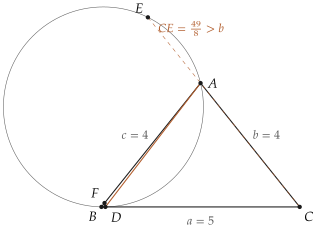
Write , , for the angles of the triangle, , , for its sides, and for its circumcircle.
This is a long problem, so here is the route before we set off. There are two incentres to place on one circle, and they are placed one at a time and by quite different means. We first show that lies on the circle through , and , which turns out to need no angles at all, only lengths; then we show separately that lies on that same circle, which is where the angles come in. Four claims do it:
and .
is the reflection of in the line .
, , , lie on one circle.
, , , lie on that same circle.
The last line of the solution collects them.
Setting up: two powers of a point
Read the power of with respect to the circle along its two lines through : and lies on the ray . The same reading at gives with on the ray . Both identities are used again at the end.
One consequence is worth recording now: and cannot both fall outside their sides. For falls beyond exactly when , and beyond exactly when ; adding those and using would give , which an acute triangle forbids. Here is a concrete reason to keep both configurations in view. Take which is an acute triangle with properly inside . Then and the power of gives so lies beyond on the ray . That is why nothing below assumes both and fall inside their sides.
The tool: a chord and its inscribed angle
In a circle of radius , a chord and any point of the circle satisfy . Two points of the circle on opposite arcs give angles that are supplementary rather than equal, but the sine does not notice, which is exactly why this survives every configuration. Every step below uses it and nothing sharper.
Claim 1: and
Take and , both chords of . The first subtends at , and the line is the line , so . The second subtends at , and the line is the line , so . Now use the circle : the chord subtends at and at , so those two sines agree; and the line is the line , so . Hence The mirror argument through the circle gives .
Claim 2: is the reflection of in
First, sides. The point lies on the ray , so it is on the same side of as ; the ray therefore leaves into that side, and lies on the arc containing . The same holds for . Meanwhile is interior to , so lies on the other arc.
Next, angles. Equal chords cut equal arcs, so gives , and gives . Each pair is measured on opposite sides of , so the line is the mirror image of the line in , and is the mirror image of .
Let be the reflection of in . Reflection fixes and carries the line to the line , so lies on ; likewise on . Hence
It remains to say that is the incentre and not something else. Since , the point is a midpoint of an arc , so the equal arcs give and the line is one of the two bisectors of the angle at ; likewise at . A bisector at meets a bisector at in the incentre or in one of the three excentres. Each excentre is outside : the excentre opposite a vertex of angle lies across the opposite side and sees it under . Points of the circle on that side see it under , a larger angle, so the excentre lies beyond the circle. Meanwhile the incentre is inside the triangle and so inside . And is inside : it sees under , whereas the points of on that side of see it under , and because the triangle is acute. A larger angle means nearer, so is inside. Therefore
Claim 3: , , , lie on one circle
The whole claim rests on one length identity, , so take that first. In the circle , of radius , the chords and subtend and at , so and the line is the line , so . In , Multiplying the first pair against the second,
Now lies on the line with , and and are on the same side of , both being on the side of . So , and the power of at the start of the solution turns that into That is the converse of the power of a point at , applied to the lines and : Not one angle was chased, so no configuration can spoil it.
Claim 4: the incentre lies on that circle too
The angle between the line and the line equals the angle between and : the chord of the circle gives , and the line is the line . As is on the side and is between and , this reads , and in the same way . The three angles at above add to a straight angle, so the second because the incentre lies on the bisectors from and from , which halves those two angles of triangle . Also is inside triangle , so and are on the same side of the line .
Two positions for remain, and they pair up exactly.
If and both lie inside their sides, the line cuts triangle off the corner at , so is on the far side of from , and hence from and . Here , which is supplementary to , and opposite angles of summing to make it cyclic.
If instead one of them lies outside, say beyond , then the ray is opposite to and , equal to ; so this time must be on the same side of as , and it is. Since is not between and but is between and , the line leaves and together and puts opposite, so it crosses at an interior point , and what is needed is . Writing , and using the transversal ratio on triangle cut by the line , using and from the two powers. Then says , that is , that is which is exactly what an acute angle at provides. So , and with it , lies on the same side of as , and equal angles on one side of make cyclic again.
Finishing
Claim 3 put on the circle through , and ; Claim 4 put on it. In particular are concyclic, which is what was asked, and rather more is true: lies on that circle as well.
The remaining tool
The transversal ratio used once above is the companion of Ceva proved in Chapter 7, and it follows the same way: drop perpendiculars from , and to the line , read each of the three ratios as a ratio of two of those distances, and multiply, whereupon everything cancels.
Answer proof
Solution: IOQM 2023, Q15
The perimeter condition is the classical one that forces ; then , so triangle is right-angled isosceles and , being the midpoint of its hypotenuse, sits at distance from .
Put at the origin with , and , and write on and on . Set and , the two legs and of the corner triangle. The perimeter condition is Squaring and cancelling from both sides leaves Rewriting this in terms of and turns it into , and since and , the addition formula gives Both angles are acute and their sum is less than , so and hence
Everything now follows from that one angle. Let be the circumcentre of and its circumradius. The central angle standing on the chord is twice the inscribed angle at , so Triangle is therefore right-angled at with the two equal legs . The circumcentre of a right triangle is the midpoint of its hypotenuse, so is the midpoint of , and in an isosceles right triangle the distance from the right-angle vertex to that midpoint is half the hypotenuse:
Hence , so , and .
Note that the positions of and never had to be found. The perimeter condition was worth exactly one angle, and that angle was worth the whole problem.
Answer 3
Solution: IOQM 2023, Q23
The incentre lies on the bisector of the right angle at distance , which fixes and, remarkably, makes both legs point along lattice directions; then turns into .
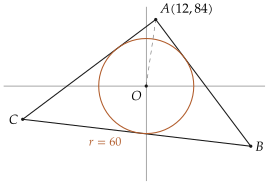
Since the angle at is right and the incircle touches both legs, the incentre lies on the bisector of that angle at distance from , where is the inradius. The incentre is the origin, so
Now find the directions of the legs, since and have to be lattice points and it is the directions that decide which lattice points are even available. The unit vector from towards is and the two legs make angles of with it on either side, since bisects the right angle. Turning a vector through sends it to , and through to . Applying both to , every meets another and disappears: That is the pleasant surprise of this problem: both directions are rational, and and are lattice vectors of length with no common factor to strip out, so the lattice points along each leg are spaced exactly one such vector apart. They are therefore with and positive integers, and every such choice puts and at lattice points with and .
One condition is left, that the incircle also touches . For a right triangle the inradius is half of (sum of legs minus hypotenuse), so with , that is, Squaring and cancelling ,
Both factors must be positive. If both were negative, writing and with and would need , because the unsquared equation requires . But gives so , a contradiction.
So the solutions correspond exactly to the ways of writing as an ordered product of two positive integers, and has divisors. Each gives a different pair , hence a different triangle, so the answer is .
Answer 18
Solution: IOQM 2023, Q25
Two crossing diagonals are determined by four vertices, and in terms of the four arcs they cut off, perpendicularity says exactly .
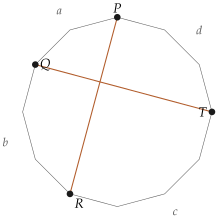
For a square there is one perpendicular crossing pair, its two diagonals. The same four vertices can be listed starting at any of the four corners, so counting a starting corner counts that one pair four times. This is the repetition to keep track of in a larger polygon.
Any two diagonals that cross inside the polygon are determined by the four vertices they use: for vertices in cyclic order the crossing pair is and . So we may count four-element subsets instead of pairs of diagonals.
Take such a subset and let be the four arcs it cuts, measured in steps around the polygon, so that with each part at least . Place the vertices at , , . A chord joining vertices and is perpendicular to the radius bisecting it, so its direction, as an angle taken modulo , is determined by modulo ; two chords are perpendicular exactly when their index sums differ by modulo . In particular must be even, say , or no two diagonals are ever perpendicular.
For our two chords the index sums are and , and So the perpendicularity condition is , and since this says
Counting is now easy. Choosing the starting vertex in ways and then the arcs, the pairs with and number , and likewise for . Each four-element subset is produced four times, once for each of its vertices playing the role of , so the number of perpendicular crossing pairs is
This increases with , so we need the least with . Since that is , giving while gives only . Hence
Answer 28
Solution: IOQM 2025 Part SEP, Q7
Equal chords and make the two angles into which splits the right angle at equal, so the rectangle’s shape follows from a right triangle.
The four points lie on one circle. Equal chords subtend equal angles, so gives The rays and follow the perpendicular sides of the rectangle, and lies between them. The two equal angles therefore add to , so each is .
Triangle is right-angled at , with . Hence The given equality , and the rectangle’s , now give Thus , and .
Answer 3
Solution: IOQM 2025 Part SEP, Q7
Put the common chord on a vertical line. The tangency condition then turns into one quadratic satisfied by both centres, and Vieta’s formula on that quadratic gives the sum of the radii at once, without either radius being found.
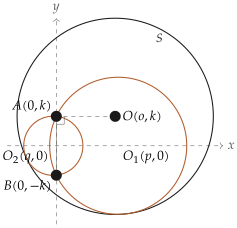
The two small circles meet at and , so is a chord of both, and the whole picture is symmetric about the line through the two centres, which is the perpendicular bisector of . That symmetry is what to put on the axes.
Let lie along the vertical line , with and . The centres and lie on the perpendicular bisector of , so write them as and , and then The condition says is perpendicular to the vertical line , so is at the same height as : write with .
Internal tangency of with means , that is Cancelling and rearranging, Square and use . Writing and keeping everything for the moment, which expands and rearranges to using on the term.
Before dividing by , check that it is not zero. If then collapses to , and , so . But and , so would make and the same point, and the two circles are given as meeting at two distinct points. Hence , and dividing by is legitimate: The identical computation for the second circle produces the same equation with in place of . So and are the two roots of one quadratic and they are distinct because the circles are. By Vieta,
Now add the two copies of : so , whatever the two circles happen to be.
Answer 10
Solution: IOQM 2026, Q27
The lengths say at once that the angle at is a right angle and that triangle is isosceles. The two parts of the right angle fix , and then the cosine rule gives the angle at as .
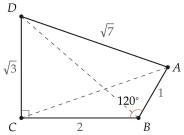
Call the quadrilateral , with , , , , and both diagonals .
Two things can be read off. First, , so . Second, , so triangle is isosceles and .
Finding . The diagonal splits the right angle at into and , so the cosine of one is the sine of the other, and . The cosine rule in triangle gives and in the isosceles triangle the perpendicular from meets at its midpoint, so . Squaring and adding, Multiplying by gives Expanding the two sides, Thus . Since is the square of a side length, .
The angles. Now , , and , and the cosine rule in triangle gives The angle at is . The angle at equals , a part of the right angle, so it is less than , and its cosine is , less than , so it is more than . The angle at is minus the angle at , so it is less than too.
The largest angle is , the second largest , and .
Answer 30