Library · Between the Challenge and the Olympiad · Chapter 12
Triangles: Lengths, Angles and Areas
On this page
- Problems
- Solutions
- Solution: PRMO 2014, Q10
- Solution: PRMO 2019, Q1
- Solution: PRMO 2012, Q8
- Solution: PRMO 2013, Q8
- Solution: PRMO 2014, Q3
- Solution: PRMO 2014, Q15
- Solution: PRMO 2018, Q2
- Solution: IOQM 2020, Q1
- Solution: IOQM 2020, Q4
- Solution: IOQM 2023, Q5
- Solution: IOQM 2024, Q4
- Solution: IOQM 2026, Q8
- Solution: PRMO 2012, Q10
- Solution: PRMO 2013, Q9
- Solution: PRMO 2013, Q12
- Solution: PRMO 2013, Q19
- Solution: PRMO 2015 Part A, Q11
- Solution: PRMO 2017, Q13
- Solution: PRMO 2017, Q17
- Solution: PRMO 2017, Q25
- Solution: PRMO 2018, Q10
- Solution: PRMO 2018, Q17
- Solution: PRMO 2018, Q21
- Solution: PRMO 2019, Q10
- Solution: IOQM 2020, Q7
- Solution: IOQM 2020, Q9
- Solution: IOQM 2020, Q19
- Solution: IOQM 2021 Part A, Q1
- Solution: IOQM 2021 Part A, Q5
- Solution: IOQM 2022, Q1
- Solution: IOQM 2022, Q2
- Solution: IOQM 2022, Q9
- Solution: IOQM 2024, Q12
- Solution: IOQM 2025 Part SEP, Q28
- Solution: IOQM 2026, Q13
- Solution: IOQM 2026, Q24
- Solution: PRMO 2012, Q14
- Solution: PRMO 2013, Q15
- Solution: PRMO 2014, Q12
- Solution: PRMO 2014, Q16
- Solution: PRMO 2015 Part A, Q16
- Solution: PRMO 2017, Q24
- Solution: PRMO 2018, Q13
- Solution: PRMO 2019, Q28
- Solution: IOQM 2020, Q16
- Solution: IOQM 2021 Part A, Q6
- Solution: IOQM 2022, Q3
- Solution: IOQM 2022, Q13
- Solution: IOQM 2023, Q13
- Solution: IOQM 2024, Q22
- Solution: IOQM 2026, Q30
- Solution: PRMO 2017, Q30
- Solution: PRMO 2018, Q29
- Solution: PRMO 2019, Q29
- Solution: IOQM 2020, Q22
- Solution: IOQM 2020, Q23
- Solution: IOQM 2022, Q12
- Solution: IOQM 2024, Q27
Problems
Problem 1
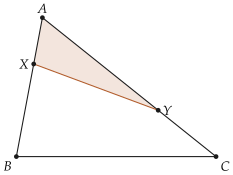
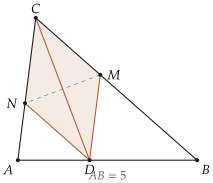
In a triangle , and are points on the segments and , respectively, such that and . If the area of triangle is then what is the area of triangle ?
Problem 2
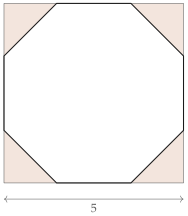
From a square with sides of length , triangular pieces from the four corners are removed to form a regular octagon. Find the area removed to the nearest integer?
Problem 3
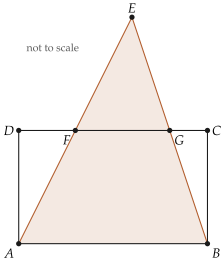
In rectangle , and . Points and are on line segment so that and . Lines and intersect at . What is the area of ?
Problem 4
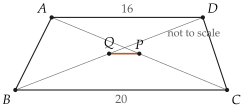
Let and be the parallel sides of a trapezium . Let and be the midpoints of the diagonals and . If and , what is the length of ?
Problem 5
Let be a convex quadrilateral with perpendicular diagonals. If and , then what is the value of ?
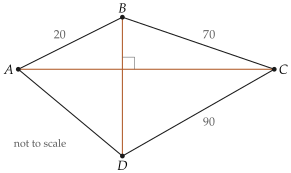
Problem 6
Let be a triangle with . Let and be the midpoints of legs and , respectively. Suppose that and . What is ?
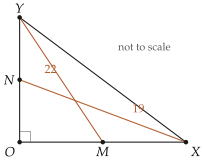
Problem 7
In a quadrilateral , it is given that . If is the radius of the circle inscribable in the quadrilateral, then what is the integer closest to ?
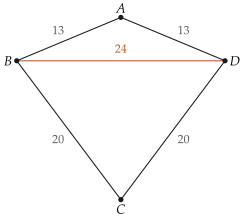
Problem 8
Let be a trapezium in which and . Let be the midpoint of the diagonal . If , what is the value of ? (Here denotes the area of the geometrical figure .)
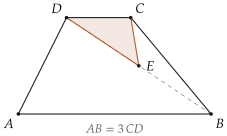
Problem 9
Let be a rectangle in which and where is the mid-point of the side . Find the area of the rectangle.
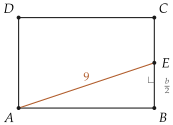
Problem 10
In a triangle , let be the midpoint of and be the midpoint of . The medians and intersect at . Let and be the midpoints of and respectively. If the area of triangle is , find the area of triangle .
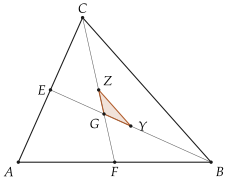
Problem 11
Let be a quadrilateral with , and . The measure of (in degrees) is:
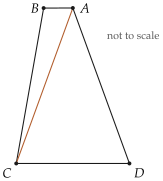
Problem 12
In trapezium , it is given that is parallel to . Assume that , and . If the largest angle of is and the smallest angle is , what is the value of ?
Problem 13
is a square and . Equilateral triangles and are drawn such that and are inside the square. What is the length of ?
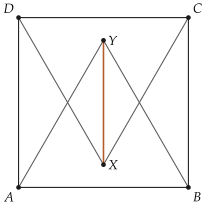
Problem 14
In a triangle , let , and be the orthocentre, incentre and circumcentre, respectively. If the points , , , lie on a circle, what is the magnitude of in degrees?
Problem 15
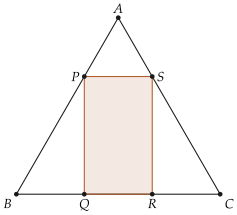
Let be an equilateral triangle. Let and be points on and , respectively, and let and be points on such that is a rectangle. If and the area of is , what is the length of ?
Problem 16
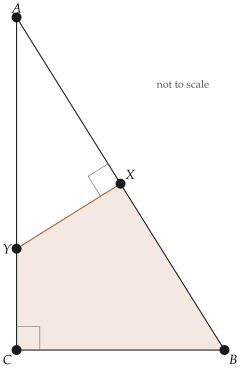
In a triangle with , the perpendicular bisector of intersects segments and at and , respectively. If the ratio of the area of quadrilateral to the area of triangle is and then what is the length of ?
Problem 17
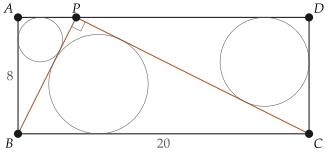
In rectangle , and . Let be a point on such that . If are the radii of the incircles of triangles , and , what is the value of ?
Problem 18
In a rectangle , is the midpoint of ; is a point on such that is perpendicular to ; and perpendicular to . Suppose . Find .
Problem 19
Suppose the altitudes of a triangle are 10, 12 and 15. What is its semi-perimeter?
Problem 20
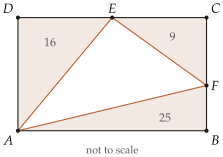
Let be a rectangle and let and be points on and respectively such that area, area and area. What is the area of triangle ?
Problem 21
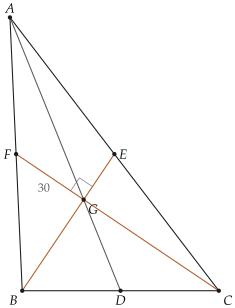
In a triangle , the median from to is perpendicular to the median from to . If the median from to is 30, determine .
Problem 22
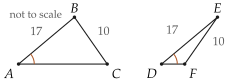
Triangles and are such that , , and . What is ?
Problem 23
Let be an acute-angled triangle and let be its orthocentre. Let , and be the centroids of the triangles , and , respectively. If the area of triangle is 7 units, what is the area of triangle ?
Problem 24
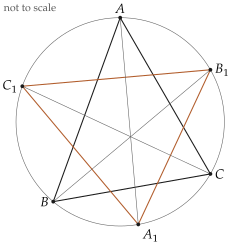
Let be a triangle and let be its circumcircle. The internal bisectors of angles , and intersect at , , and , respectively, and the internal bisectors of angles , and of the triangle intersect at , and , respectively. If the smallest angle of triangle is , what is the magnitude of the smallest angle of triangle in degrees?
Problem 25
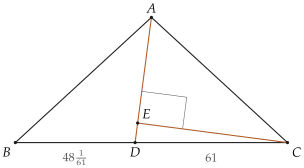
Let be a triangle with . Let be a point on the segment such that and . Let be a point on such that is perpendicular to and . Find .
Problem 26
Let be a triangle with , , . The internal angle bisector of intersects the side at . Points and are taken on sides and , respectively, such that and . If where and are relatively prime positive integers then what is the sum of the digits of ?
Problem 27
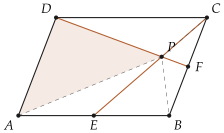
Let be a parallelogram. Let and be midpoints of and respectively. The lines and intersect in and form four triangles , , and . If the area of the parallelogram is 100 sq. units, what is the maximum area in sq. units of a triangle among these four triangles?
Problem 28
Three parallel lines are drawn in the plane such that the perpendicular distance between and is 3 and the perpendicular distance between and is also 3. A square is constructed such that lies on , lies on and lies on . Find the area of the square.
Problem 29
In parallelogram the longer side is twice the shorter side. Let be the quadrilateral formed by the internal bisectors of the angles of . If the area of is 10, find the area of .
Problem 30
A triangle with is inscribed in a circle . A tangent to is drawn through . The distance of from is and that from is . If denotes the area of the triangle , find the largest integer not exceeding .
Problem 31
In a parallelogram , a point on the segment is taken such that and a point on the segment is taken such that . If intersects at , find to the nearest integer.
Problem 32
Two sides of an integer sided triangle have lengths and where . If there are exactly 35 possible integer values such that are the sides of a non-degenerate triangle, find the number of possible integer values can have.
Problem 33
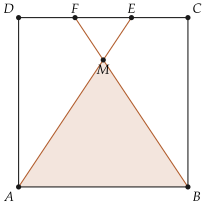
Consider a square of side length . Let be points on such that . Let the line and meet in . The area of is:
Problem 34
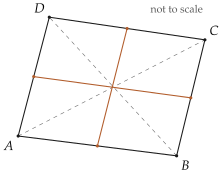
In a convex quadrilateral , the lengths of the diagonals are 12 and 16 and the line segments joining the midpoints of the opposite sides are of equal length. What is the maximum possible area of the quadrilateral ?
Problem 35
In an isosceles triangle , with . The point is on the side such that . If the area of triangle is , what is the length of segment ?
Problem 36
Let be a rectangle and let be a point on such that is perpendicular to . If and , compute the area of the rectangle .
Problem 37
and are the circumcentre and incentre of respectively. Suppose lies in the interior of and lies on the circle passing through , , and . What is the magnitude of in degrees?
Problem 38
Let be the midpoints of the sides of a convex quadrilateral and let be the midpoints of the sides of the quadrilateral . If is a rectangle with sides 4 and 6, then what is the product of the lengths of the diagonals of ?
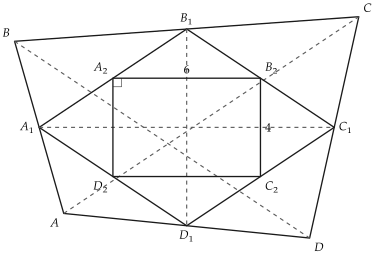
Problem 39
Let be a convex quadrilateral with . Let the incircles of triangles and touch at and , respectively, with lying in between and . If and then what is the sum of the radii of the incircles of triangles and ?
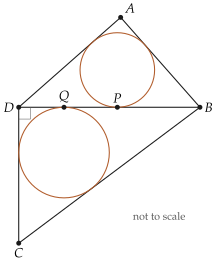
Problem 40
In a triangle , let denote the incentre. Let the lines and intersect the incircle at and , respectively. If , what is the value of in degrees?
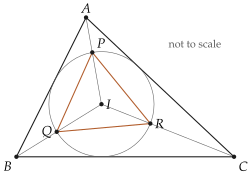
Problem 41
In acute-angled triangle , let be the foot of the altitude from , and be the midpoint of . Let be the midpoint of . Suppose . If , what is the magnitude of in degrees?
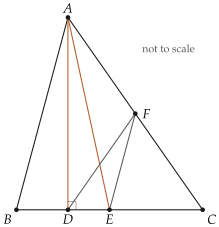
Problem 42
Let be an interior point of a triangle whose sidelengths are 26, 65, 78. The line through parallel to meets in and in . The line through parallel to meets in and in . The line through parallel to meets in and in . If , , are of equal lengths, find this common length.
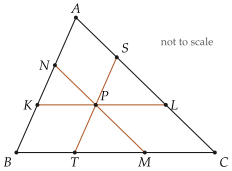
Problem 43
In a triangle , right-angled at , the altitude through and the internal bisector of have lengths 3 and 4, respectively. Find the length of the median through .
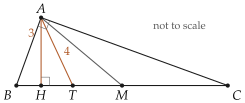
Problem 44
Let be a triangle with sides , , . Let denote the incircle of . Draw tangents to which are parallel to the sides of . Let be the inradii of the three corner triangles so formed. Find the largest integer that does not exceed .
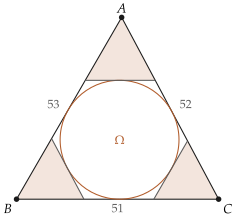
Problem 45
The sides and of a scalene triangle satisfy , where is the area of the triangle. If , , what is the length of the largest side of the triangle?
Problem 46
Let be positive real numbers such that , and . If the value of can be written as where are integers and is not divisible by square of any prime number, find .
Problem 47
In a trapezium , the internal bisector of angle intersects the base (or its extension) at the point . Inscribed in the triangle is a circle touching the side at and side at the point . Find the angle in degrees, if .
Problem 48
Let be a triangle and let be a point on the segment such that . Suppose , and and are in an arithmetic progression in that order where the first term and the common difference are positive integers. Find the largest possible value of in degrees.
Problem 49
The ex-radii of a triangle are and 14. If the sides of the triangle are the roots of the cubic , where are integers, find the integer nearest to .
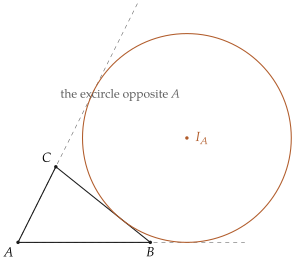
Problem 50
In a triangle , . Let be the point on such that . Suppose . If , where are relatively prime positive integers and is a prime number, determine the value of .
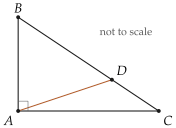
Problem 51
Let be a point in the interior of a triangle and let meet the sides in respectively. If where p, q are natural numbers and , find .
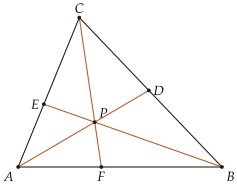
Problem 52
In triangle , it is given that and . Points and are chosen on sides and respectively such that . If , what is the value of ?
Problem 53
Consider the areas of the four triangles obtained by drawing the diagonals and of a trapezium . The product of these areas, taken two at a time, are computed. If among the six products so obtained, two products are 1296 and 576, determine the square root of the maximum possible area of the trapezium to the nearest integer.
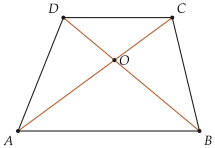
Problem 54
Let be an interior point of the side of a triangle . Let and be the incentres of triangles and respectively. Let and meet in and respectively. If , what is the measure of in degrees?
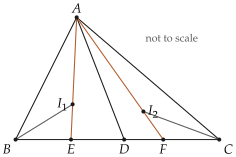
Problem 55
In a triangle , the median (with on ) and the angle bisector (with on ) are perpendicular to each other. If and , find the integer nearest to the area of triangle .
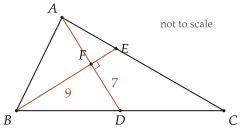
Problem 56
In triangle , let and be the feet of the perpendiculars from onto the external and internal bisectors of , respectively; and let and be the feet of the perpendiculars from onto the internal and external bisectors of , respectively. If , and , what is the area of triangle ?
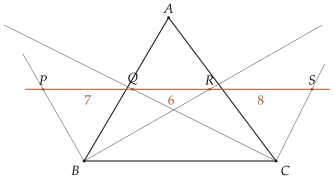
Problem 57
The incircle of a scalene triangle touches at , at and at . Let be the radius of the circle inside which is tangent to and the sides and . Define and similarly. If , and , determine the radius of .
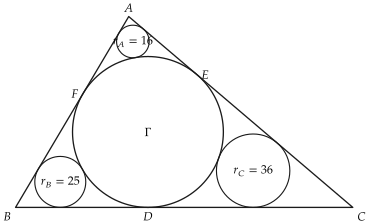
Problem 58
Given with and , let be points on sides respectively such that is an isosceles trapezium with and . Find the minimum possible value of where denotes the area of any polygon .
Problem 59
In a triangle , a point in the interior of is such that Suppose and . Let be the feet of perpendiculars from on to respectively. If is the area of the triangle where are integers with prime, then what is the value of the product ?
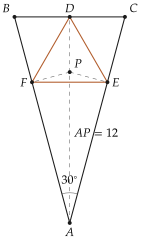
Problem 60
Let be a triangle, be the midpoint of side , be the circumcentre and be the orthocentre. If the triangle is equilateral with side length equal to 6 and the area of the triangle can be written as , where are positive integers and is not divisible by the square of any prime, find .
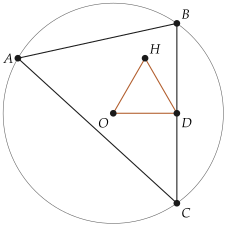
Problem 61
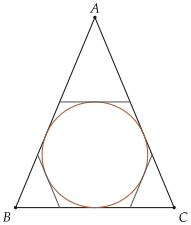
Let be an isosceles triangle with sides and . The tangents to the incircle, drawn parallel to the sides intersect the sides in points which form a hexagon. If the area of the hexagon is , where are positive integers with and , what is ?
Solutions
Solution: PRMO 2014, Q10
Two triangles sharing the angle at have areas in the ratio of the products of the sides around it.
Triangles and share the angle at , so using , which makes , and , which makes .
Hence
Answer 45
Solution: PRMO 2019, Q1
Each corner triangle is right-angled and isosceles, because the octagon’s angle leaves on either side, so one equation between the cut and what survives of the side fixes everything.
Let the piece cut from a corner have legs of length along the two sides of the square. The octagon is regular, so its interior angle at every vertex is , and at a vertex lying on a side of the square the remaining angle is . Each corner triangle therefore has a right angle at the square’s corner and two angles of , which makes it isosceles with legs and hypotenuse .
Two kinds of side now appear in the octagon: the four hypotenuses, of length , and the four leftovers of the square’s sides, of length . Regularity says these are equal:
The area removed is four half-squares of side : That last denominator rationalises beautifully, since , so the area removed is exactly The nearest integer is now settled without a calculator. Saying the area lies strictly between and is the same as saying lies strictly between and , which is the same as Both halves follow from squaring, since and . So the nearest integer is .
The rationalisation is worth the trouble. A decimal value of carried through the squaring loses precision exactly where the question is delicate, and leaves no doubt about which side of the answer falls.
Answer 4
Solution: PRMO 2012, Q8
Put the rectangle in coordinates; the two lines meet above the rectangle, at height .
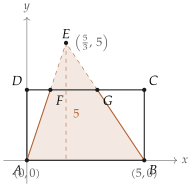
Take , , and . Then puts at and puts at .
The line has slope , so it is . The line runs from to , with slope , so it is . Setting the two equal, and then . So , above the rectangle.
Triangle has the base along the -axis and height , so its area is
Answer
Solution: PRMO 2013, Q8
Both midpoints lie on the midline of the trapezium, and their positions along it differ by half the difference of the parallel sides.
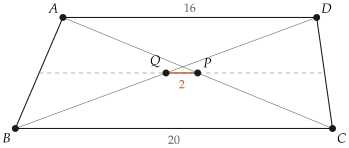
Put at the origin with along the -axis, so , , and the other two vertices sit at height : and , since is parallel to .
The two midpoints are They have the same height, so
The horizontal offset cancelled, as did the height: in any trapezium the segment joining the midpoints of the diagonals lies along the midline and has length half the difference of the parallel sides.
Answer 2
Solution: PRMO 2014, Q3
Perpendicular diagonals make the two pairs of opposite sides satisfy , since every side is a hypotenuse over the same two axes.
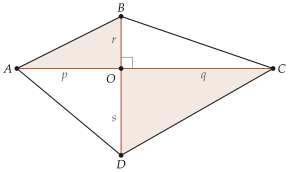
and are both
Let the diagonals meet at , and take them as the coordinate axes, so with . Each side is then the hypotenuse of a right triangle at :
Adding the first and third and comparing with the second and fourth, both totals are : So
Answer 60
Solution: PRMO 2014, Q15
The two medians to the legs give and , whose sum is , and .
Let and , so and in coordinates with the right angle at the origin, and .
Pythagoras on the two given segments: Adding them, And the hypotenuse is
Adding the two equations rather than solving them is what keeps this short: the answer needs only the symmetric combination , and neither nor is rational on its own.
Answer 26
Solution: PRMO 2018, Q2
A quadrilateral with an inscribed circle has area , and here the diagonal splits the kite into two isosceles triangles whose areas are immediate.
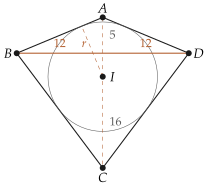
The question hands us the inscribed circle, so there is nothing to establish about its existence. The given lengths do satisfy the identity that any tangential quadrilateral must satisfy, as they had to. The two tangents drawn to a circle from a point outside it have equal length, so writing for the tangent lengths from , and here both sides come to . That is a necessary condition and no more; on its own it would not produce a circle, which is why it is worth having been given one.
For any tangential polygon, joining the centre to each vertex cuts it into triangles, each with a side of the polygon as base and the inradius as height. Adding the areas,
So all that remains is the area. The diagonal splits the quadrilateral into triangles and , both isosceles with base . Their heights come from Pythagoras on half the base: so the two areas are and , totalling . Hence and the nearest integer is .
Answer 8
Solution: IOQM 2020, Q1
Triangles standing on the same base have areas in the ratio of their heights, and a midpoint halves one of those heights.
Let us call the shorter parallel side , so that , and let be the distance between the two parallel lines. The trapezium’s area is then the familiar average of the parallel sides times the height, and everything now depends on getting a handle on the small triangle .
It helps to reach it in two steps rather than one. Consider first the triangle , which stands on the base of length with its apex sitting on the other parallel line, so that its height is the full and its area is . The triangle we actually want, , stands on that same base , and its apex is the midpoint of . Since lies on the line already, moving from to the midpoint of moves us exactly halfway down to that line, so the height of above is and
Comparing the two areas, . Notice that both and vanished from the answer, which is the signal that the ratio was never going to depend on the particular trapezium we drew.
Answer 8
Solution: IOQM 2020, Q4
The quadratic that the conditions produce is, after a single rearrangement, precisely the area that was asked for, so the sides themselves never need to be found.
Write for the two equal sides of the rectangle and for the third, so that the condition becomes . Because is the midpoint of and the rectangle has a right angle at , Pythagoras in the triangle gives Substituting , so that , and expanding,
Solving that for with the quadratic formula produces an unpleasant surd. Look instead at what the question actually asks for. The area of the rectangle is and the equation above tells us that . The area is therefore exactly.
The lesson generalises well beyond this problem. The side lengths here are irrational, yet their product is a whole number, and a question that asks only for the product is often built so that the product falls out of the relation directly. Reading the target carefully before grinding through the algebra saves the grinding.
Answer 19
Solution: IOQM 2023, Q5
Both and lie on the segments and themselves, and each is at one sixth of the median from , so triangle is a scaled copy of triangle with ratio .
The intersection of the medians is called the centroid. To justify the ratio we need, read , and as coordinate pairs. The midpoints are and . The point with position vector satisfies It therefore lies on both medians, so it is , and lies two thirds of the way along each median from the vertex. Also its perpendicular height above is one third of the height of : the heights of and above that line are zero, and taking an average of coordinates averages that perpendicular component too. Thus .
The median ratios now give Now locate , the midpoint of . Measuring from we have while , and since the point lies between and . In particular is on the ray , and The same computation on the other median puts on the ray with .
Triangles and therefore share the angle at , and their sides about that angle are in the ratios Two triangles with a common angle have areas in the ratio of the products of the enclosing sides, so
Finally, the three triangles , , have equal areas, each one third of , so and
Answer 10
Solution: IOQM 2024, Q4
Triangle is isosceles, which hands over , and the angle at splits into that piece and the one asked for.
In triangle the angles at and at are both , so the third one is
Now look at the angle , which the problem gives as . Since lies inside that angle, it splits into two parts, and therefore
The given is not needed for the answer. It fixes the shape of the quadrilateral, and a quick check confirms consistency: in triangle the angles would then be , and .
Answer 70
Solution: IOQM 2026, Q8
The line through parallel to cuts off a rhombus, and what remains is a triangle with sides and around a angle, which is half of an equilateral triangle.
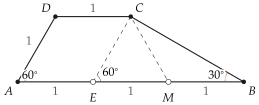
Take , so . Since is parallel to , the angles at and add to , and .
Mark on with . Then and are parallel and equal, so is a parallelogram, and since it is a rhombus. So , and is parallel to , which makes . The rest of the long side is .
Let be the midpoint of . Triangle has and a angle between them, so it is equilateral and . Now , and triangle is isosceles with apex angle , so its base angles are . In particular .
The angles at and also add to , so . The four angles are , , and , the largest is and the smallest , and
Answer 5
Solution: PRMO 2012, Q10
Both apexes sit on the vertical centre line, one at height and the other the same distance below the top.
Put , , , .
The equilateral triangle on with its apex inside has directly above the midpoint of , at height : The equilateral triangle on with its apex inside has the same distance below :
Both lie on the vertical line , so
That the two apexes overlap vertically, rather than missing each other, is because exceeds : each triangle reaches past the centre of the square.
Answer
Solution: PRMO 2013, Q9
, while is or according to which side of the orthocentre lies on. Concyclicity asks for equal angles in the first case and supplementary ones in the second, and both give the same .
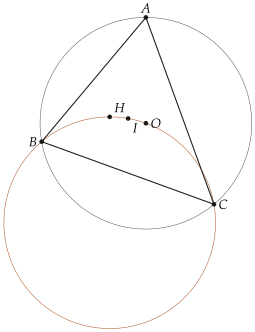
Start with the incentre, which is the easy one. It lies inside the triangle, so it is on the same
side of as , and the angles at and inside triangle are halved:
The orthocentre needs more care, because where it sits depends on the shape of the triangle. The line is perpendicular to and the line is perpendicular to , whatever the triangle looks like. Rotating both of a pair of lines through does not change the angle between them, so the angle between the lines and equals the angle between the lines and . Two lines make two angles, supplementary to each other, so and which one holds is decided by which side of the point falls on. If or is a right angle then is that vertex itself and , , , are not four points at all, so that case is out; otherwise is off the line .
Both cases give the same angle
Suppose first that is on the same side of as , hence on the same side as . Then and lie on the same arc over the chord , so they subtend equal angles there, and the angle at is the one measuring :
Suppose instead that is on the far side of from . Then is a cyclic quadrilateral with and at opposite vertices, so those two angles are supplementary, and now the angle at is the one measuring :
Both readings land on the same place, so the case split costs nothing. It is not idle, though: the second case really does occur. A triangle with and is obtuse at , its orthocentre falls beyond , and , , , are concyclic all the same.
Finally the central angle over is twice the inscribed one:
At something pretty happens: , and all lie on one circle through and , namely the circle centred at the midpoint of arc . When the triangle is acute this shows itself as , three equal angles on the same arc. When it is obtuse at or , the orthocentre changes sides and its angle drops to , which is exactly what a point on the other arc of the same circle should give.
Answer 120
Solution: PRMO 2013, Q12
The area fixes both sides of the rectangle, and its height then fixes where the upper left corner meets ; after that is one application of Pythagoras.
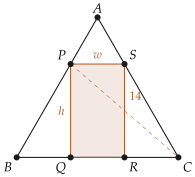
Write for the horizontal side, parallel to , and for the vertical one. The area gives
Now place the triangle: , and , where is the side. Then , , and .
The side runs from the origin with slope , so on it means , that is . The side is the line , so on it means
Finally, and , so
Answer 14
Solution: PRMO 2013, Q19
Triangle is similar to triangle , with ratio , so the area ratio says .
Write and , so by Pythagoras at .
The quadrilateral is what remains of the triangle after removing triangle , so
Now compare the two triangles. They share the angle at , and , so triangle is similar to triangle , matching with and with . The ratio of similarity is , and is the midpoint of , so . Hence So , that is and
Answer 36
Solution: PRMO 2015 Part A, Q11
In a right triangle the inradius is , and the legs of the middle triangle are precisely the hypotenuses of the two outer ones, so those lengths cancel and the position of never has to be found.
For a right triangle with legs and and hypotenuse , the inradius is . This is standard, and it comes straight from equal tangent lengths: the two tangents from the right-angle vertex both have length , so the remaining pieces of the legs are and , and these are also the tangent lengths onto the hypotenuse, giving .
Each of the three triangles here has a right angle. Triangle is right-angled at , triangle at , and triangle at by hypothesis. Applying the formula to each, Adding the three, the terms and each appear once positively and once negatively, so they vanish without ever being computed: Since lies on we have , and , so
It is worth seeing what has happened. The answer does not depend on where sits on , only on the rectangle. The condition was needed to make the middle triangle right-angled so the formula applies, but the two possible positions of , namely and , give the same total.
Answer 8
Solution: PRMO 2017, Q13
The midpoint of the hypotenuse is equally far from the three vertices of a right triangle. Here that makes isosceles, and the second perpendicularity relates its angles to the rectangle’s diagonals.
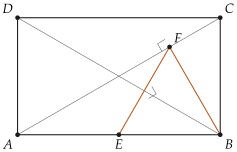
The condition makes triangle right-angled at . Its hypotenuse is , whose midpoint is . The circle with diameter passes through , so This gives an isosceles triangle before we do any length work.
The two diagonals of a rectangle make equal acute angles with its horizontal sides: right triangles and are congruent, with matching legs and . Write for that common angle. Since lies on , . The equal lengths give , so using the straight line .
On the other hand, and lies on the horizontal side , so Equating the two expressions,
Finally, in right triangle ,
Answer 24
Solution: PRMO 2017, Q17
The altitudes fix the shape, and Heron’s formula then fixes the size, but the semi-perimeter comes out as , which is not the whole number the answer sheet demands.
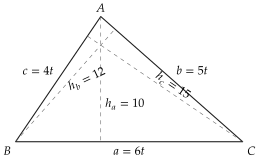
This question was discounted by the organisers, and working it through shows why.
Altitudes and sides are inversely proportional, since twice the area equals each side times its altitude. So multiplying through by . Write , , .
Now match the two expressions for the area. On one hand, For the next area computation, here is the needed formula. If are a triangle’s sides, is the angle between and , and , the cosine rule gives . Hence Factoring the difference of squares, Since area is positive, . This is Heron’s formula.
Here the semi-perimeter is , so the second expression for the area is Equating the two, , so and
The triangle exists and is perfectly ordinary; the trouble is that the paper asks for an answer between and to be written as an integer, and this semi-perimeter is irrational. The question needed altitudes chosen to make rational, and these are not they.
Answer none
Solution: PRMO 2017, Q25
Writing the three given areas in coordinates and expanding the third gives with , a quadratic in the area of the rectangle.
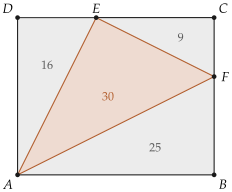
Put , , , , and let on and on .
The three given areas are right triangles with legs along the sides: So , and .
Expand the third: once and are put in. And is determined by the other two, since and give . Writing for the area of the rectangle, The three triangles already occupy , so is impossible and .
The fourth piece of the rectangle is the triangle , so
Answer 30
Solution: PRMO 2018, Q10
The centroid cuts each median in the ratio , so perpendicular medians from and give , which is the relation .
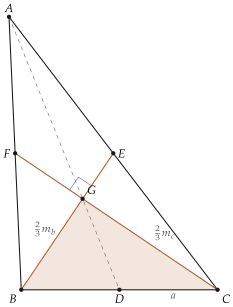
so
Write , and , and let , and be the lengths of the medians from , and . Let be the centroid. It lies on both medians and divides each in the ratio from the vertex, so and . The two medians are perpendicular at , so triangle has a right angle there and
The median formula comes from adding the cosine rule in the two triangles on either side of a midpoint. Let be the midpoint of . Since and the two angles at are supplementary, Adding cancels the angle and gives . Applying the same argument to the median from gives . Adding, so the perpendicularity condition reads , that is
The third median now follows at once. From we get , and gives . Hence , , and
Answer 24
Solution: PRMO 2018, Q17
Both third sides satisfy the same quadratic from the cosine rule, so they are its two roots, and Vieta gives their product without ever finding the angle.
Write and . The cosine rule in each triangle, with the equal angle , gives So and are both roots of the same quadratic where . Since they are different numbers, so they are the two roots, and Vieta gives
Now one identity finishes it: so .
The angle never had to be found, and indeed it is determined only afterwards, by . Two triangles with two sides and a non-included angle equal are the classic ambiguous case, and this problem is that ambiguity turned into an exercise.
Answer 30
Solution: PRMO 2018, Q21
Averaging the three points of each small triangle makes the differences exactly one third of , so the two triangles are similar in the ratio and drops out entirely.
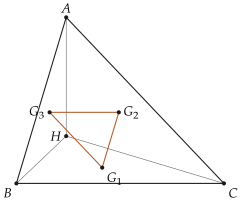
Treat the points as position vectors. Nothing here needs any theory of vectors: reading every letter below as a pair of coordinates and doing the arithmetic separately on the two coordinates gives exactly the same argument twice over.
The centroid of a triangle is the average of its vertices, so Subtracting in pairs, the and the shared vertex cancel:
So the triangle has every side one third of the corresponding side of , and is therefore similar to it with ratio . Areas scale by the square,
Notice what was never used: that is the orthocentre, or that the triangle is acute. Any point whatever gives the same three centroids’ triangle, since cancels in every difference. The orthocentre is there to make the configuration concrete, not because the answer depends on it.
Answer 63
Solution: PRMO 2019, Q10
Bisecting the angles and re-inscribing sends each angle to , so doing it twice sends to , an increasing map that carries the smallest angle to the smallest angle.
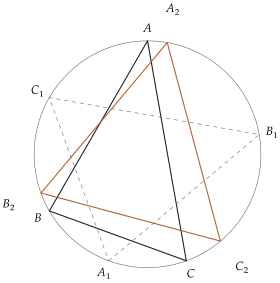
First find how the angles of relate to those of . The bisector from meets again at the midpoint of the arc not containing , and similarly for and . Write the arcs of subtended by the sides as usual: arc not containing measures , arc not containing measures , and arc not containing measures .
The inscribed angle of triangle at subtends the arc from to that does not contain , and that arc passes through . It is made of half of arc , namely , together with half of arc , namely . So the arc measures and the inscribed angle is half of it:
Applying the same formula a second time to the triangle ,
Now the bookkeeping. One application reverses the order of the angles, since is decreasing, but two applications restore it: increases with . So the smallest angle of comes from the smallest angle of , and with that angle equal to ,
The map also explains what repeated bisection does in the long run: every angle is dragged towards the fixed point , four times closer at each step, so the triangles rapidly become equilateral.
Answer 55
Solution: IOQM 2020, Q7
The perpendicular and the altitude from the apex create two right triangles that share the angle at , and the similarity between them converts the unknown length into a product of two lengths already in hand.
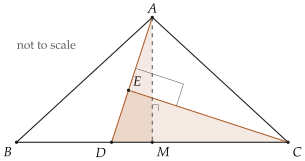
so
The given number is so deliberately ugly that it is worth treating as a promise: whoever set the problem intended it to cancel, and our job is to find the relation in which it does.
Begin by letting be the midpoint of . Because the triangle is isosceles with , the segment is the altitude from , so the angle at in triangle is a right angle. We now have two right triangles in the figure, with its right angle at , since , and with its right angle at . They share the angle at , which makes them similar, and similarity gives Every quantity in that relation except is either given or computable, which is exactly what we want.
Computing is where the awkward fraction earns its place. Writing the given length over a common denominator, , and since ,
The promised cancellation now arrives, since . With we get , and because lies between and on the segment, No trigonometry was needed anywhere, and the fraction that looked so hostile was the friendliest thing in the problem.
Answer 25
Solution: IOQM 2020, Q9
The two parallels make a parallelogram, but the angle bisector makes it something stronger, a rhombus, and the length asked for is its second diagonal.
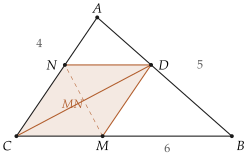
The two parallel conditions are there to build a quadrilateral, so let us build it. Since and , the quadrilateral has both pairs of opposite sides parallel and is therefore a parallelogram. That alone would not be enough to finish, and the extra ingredient is the bisector: is a diagonal of this parallelogram, and it bisects the angle at . Here gives , so triangle is isosceles and . Opposite sides of a parallelogram are equal, so all four sides are equal,
Finding that common side is now a short piece of standard work. The angle bisector theorem in triangle gives , so on the side we have and . Because , the triangle is similar to the triangle , and therefore
What remains is the diagonal of the rhombus, which is the third side of the triangle whose two equal sides are and whose included angle is . The cosine rule in the original triangle supplies that angle, and applying the cosine rule once more, now in triangle ,
Since and share no factor, we have and , so and the sum of its digits is .
Answer 2
Solution: IOQM 2020, Q19
For any point inside a parallelogram, the two triangles on opposite sides have areas adding to half the whole, so the four areas fall into two pairs each summing to fifty.
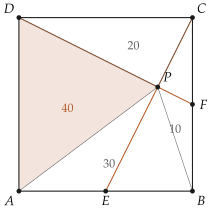
Start with the structural fact, because it organises everything that follows. If is any point inside the parallelogram and is its distance from , then its distance from the opposite side is , where is the distance between those two parallel sides. Hence using , and that is half the parallelogram, namely . The same argument applied to the other pair of sides gives . So the four areas split into two pairs, each pair totalling , and we only need to locate well enough to split each pair.
To locate , use the two sides at as a frame: take as origin and write each point as , recorded as . A point with second coordinate lies at the fraction of the way from to , so ; in the same way . In this frame , , , and the midpoints are and , exactly as if the parallelogram were a unit square. Parametrising the line as and the line as , equating the two coordinates gives The first says . Substituting into the second, Hence
With and , the area is of the parallelogram and is , and the pairs found at the start supply the other two: and . For a parallelogram of area the four triangles have areas , , and , so the largest is .
Answer 40
Solution: IOQM 2021 Part A, Q1
Write the side as a vector rather than an angle. Turning that vector through a right angle to reach the next vertex converts the two given distances into the two components, and the area is the sum of their squares.
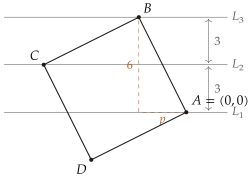
Put at the origin with as the -axis, so that is the line and is the line . Writing the side as a vector keeps the work to two coordinates, with no angle anywhere and no trigonometry.
Write the side as the vector . The second coordinate is forced, because lies on and is on , so is six units higher. After reflecting the figure in the vertical axis if necessary, take the turn from to anticlockwise. Reflection preserves lengths and area. To get from to we turn that vector through a right angle, and a quarter turn sends to . Hence
Now impose the one condition not yet used, that lies on . That says , so , and no angle was ever needed. The area of the square is the squared length of its side,
It is worth noticing that the answer depends only on , so the sign of , which is to say which way the square leans, makes no difference.
Answer 45
Solution: IOQM 2021 Part A, Q5
In any parallelogram the four internal bisectors meet at right angles, so is a rectangle, and its diagonal is the difference of the two side lengths.
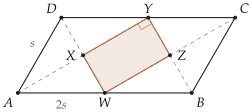
Adjacent angles of a parallelogram add to , so their halves add to . In the triangle cut off at a corner by two adjacent bisectors, the third angle is therefore a right angle, and since this happens at all four corners the quadrilateral is a rectangle.
Let and , with . As in the figure, is where the bisectors from and meet, where those from and meet, and where those from and meet; the angle at each is a right angle, by the paragraph above. Both and lie on the bisector from , which makes the angle with and with . In the right triangle this gives , and in the right triangle it gives , so In the same way and lie on the bisector from . The right triangle gives , and in the right triangle the angle at is , so and So the rectangle’s area is . The parallelogram itself has area .
The ratio is therefore independent of both the size and the angle, which is why the problem could give a bare number. With we get .
Answer 40
Solution: IOQM 2022, Q1
The distance from a vertex to the tangent at another vertex is that chord squared divided by twice the circumradius. Both distances then carry a factor of , and it cancels out of the area formula entirely.
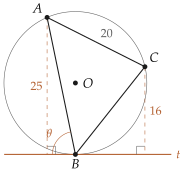
The key is a single fact about a tangent, and it is worth deriving rather than quoting. Let the tangent at be , and drop a perpendicular from to , of length . If is the angle between the tangent and the chord , then . But the tangent-chord angle equals the inscribed angle in the alternate segment, which is , and the extended sine rule gives . Substituting ,
Now put in the numbers. From we get , and from we get . Multiplying, That product is linear in , which is exactly what the area formula wants.
The area of a triangle in terms of its sides and circumradius is , so and has vanished, meaning the area is the same for every circle in which this configuration can be drawn. Hence , and the largest integer not exceeding it is .
Answer 10
Solution: IOQM 2022, Q2
Use and as a coordinate frame. Points of the diagonal have equal coordinates, and points of the line satisfy an intercept equation, so the two conditions meet in one line of algebra.
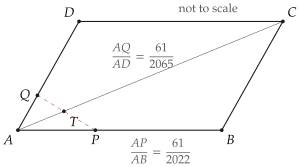
Take as origin and use the two sides as basis vectors, writing a point as . This is legitimate because the two sides of a parallelogram are independent directions, and it makes both conditions easy to state.
The diagonal runs to , so every point of it has . Write the common value at as , so that and the answer we want is .
The line joins to . A line meeting the axes of a frame at those two points can be written as . Dividing the two coordinates by their intercepts and adding eliminates , giving the equation Putting and factoring,
Therefore exactly, since . The question asked for the nearest integer as a courtesy; the value is a whole number on the nose, which is the usual sign that the ugly-looking and were chosen for it.
Answer 67
Solution: IOQM 2022, Q9
The triangle inequality gives a window of width , so the count pins down the minimum rather than itself.
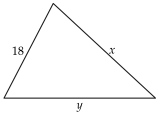
For , and to form a non-degenerate triangle we need . The number of integers strictly between those bounds is where the last step uses .
Setting this equal to gives , which says nothing about except that . That is the point of the problem: the count saturates once passes , so a whole range of produces exactly values of .
With the given restriction , the admissible values are , and there are of them.
Answer 82
Solution: IOQM 2024, Q12
Coordinates turn the two lines into and , whose crossing height is all the area formula needs.
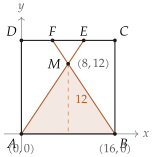
Put , , and , so that is the top side. The points and cut it into three equal parts, with nearer :
The line passes through the origin with slope , so it is . The line passes through with slope so it is . Setting the two equal, , so and .
The triangle has the side of length lying along the -axis, and is at height above it, so
The symmetry of the picture is worth noticing: and are placed symmetrically about the vertical midline, so had to land on that midline, and only its height was ever in question.
Answer 96
Solution: IOQM 2025 Part SEP, Q28
The midpoints of the four sides form a parallelogram whose sides are parallel to the diagonals, and the two segments in the question are its diagonals, so they are equal exactly when that parallelogram is a rectangle, which happens exactly when the diagonals of are perpendicular.
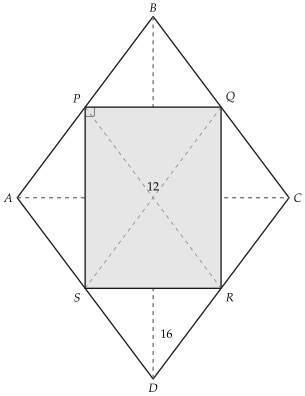
Let be the midpoints of . In triangle the segment joins the midpoints of two sides, so is parallel to and half its length; the same argument in triangle gives parallel to and half its length. So is a parallelogram, with one pair of sides parallel to and of length , the other pair parallel to and of length .
The two segments joining midpoints of opposite sides of are and , which are precisely the diagonals of this parallelogram. A parallelogram has equal diagonals exactly when it is a rectangle, and is a rectangle exactly when its two side directions, namely those of and , are perpendicular.
For a quadrilateral with perpendicular diagonals the area is half the product of the diagonals, since each of the four small triangles has one leg along each diagonal. Hence The condition forces this value rather than merely bounding it, so is both the maximum and the only possibility.
Answer 96
Solution: IOQM 2026, Q13
The work is in the angle at . One fold turns it into a -- triangle and gives exactly, and then turns out to be four times the area of .
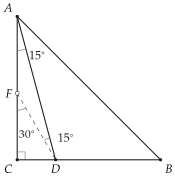
Let . Triangle has a right angle at and , so .
To find without tables, mark on with . Triangle has two angles of , so . Its exterior angle at is , so is a -- triangle, with and . Hence
The area of is , so . And , so and .
Answer 18
Solution: IOQM 2026, Q24
The foot of the perpendicular from to is the image of under the half-turn about the centre, so is the hypotenuse of a right triangle with legs and the gap between the two feet. That gives , and the area is .
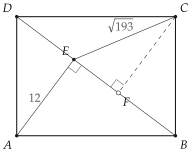
This question was discounted by the organisers, who gave every candidate full marks. Its answer is , which does not fit the two-digit answer sheet: the words asking for the sum of the digits of the area were lost in review. The mathematics is worth doing all the same.
Let and . The angle at is a right angle and is the altitude to the hypotenuse , so triangles and are similar and , that is
A half-turn about the centre of the rectangle swaps with and with . It carries to the foot of the perpendicular from to , so and , which puts at distance from . So , and in the right triangle , Then , so , and The rectangle is by . The intended answer, the sum of the digits of , would have been .
Answer none
Solution: PRMO 2012, Q14
and , and the two are equal exactly when , , , are concyclic.
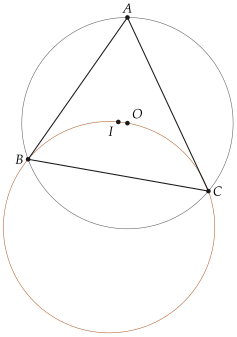
Both and lie inside the triangle, hence on the same side of as . So if they lie on a common circle through and , they subtend equal angles on the chord :
The central angle is twice the inscribed one, , and the incentre satisfies Setting them equal,
At both angles are , and one may check that the triangle is then acute for a range of shapes, so really can lie inside as the question requires.
Answer 60
Solution: PRMO 2013, Q15
Halving twice: the sides of are half the diagonals of , and the sides of are half the diagonals of .
The midpoint quadrilateral of any quadrilateral is a parallelogram whose sides are parallel to the diagonals of that quadrilateral and half as long: that is Varignon’s theorem, and it follows from the midline of each of the four triangles cut off by a diagonal.
There are three quadrilaterals here and it pays to keep their diagonals apart. Applying Varignon to , the sides of are half the diagonals of , namely Applying it again to , the sides of , which are the given and , are half the diagonals of . So the diagonals of have lengths and . The diagonals of never enter the argument.
Now use the shape. A parallelogram has perpendicular diagonals exactly when it is a rhombus, and is a rectangle exactly when the diagonals of are perpendicular. So is a rhombus, that is
The diagonals of this rhombus are perpendicular and bisect each other, so one of the four right triangles has legs and and hypotenuse . Pythagoras gives Since , the product of the diagonals of is
The answer is the sum of the squares of the two given sides, doubled twice and halved twice, and it is no coincidence that it equals exactly.
Answer 208
Solution: PRMO 2014, Q12
In the first triangle the distance from to the touch point is , and in the second the touch point is at distance from , so .
Write and for the two inradii and .
The first triangle
Triangle has its right angle at , so is its hypotenuse and The tangent length from is the semi-perimeter minus the opposite side : Adding the two, everything cancels but :
The second triangle
Triangle has its right angle at , and the two tangent lengths from the right-angle vertex of any triangle both equal the inradius. So
Putting them together
Along the order is , , , , so Hence
Notice how little was used: not the lengths or , not , only the two right angles and the two given numbers. The configuration has a free parameter, and the sum of the radii does not feel it.
Answer 799
Solution: PRMO 2014, Q16
, , lie on the incircle along the directions , , , so the arc subtends the central angle , and the inscribed angle at is half of it.
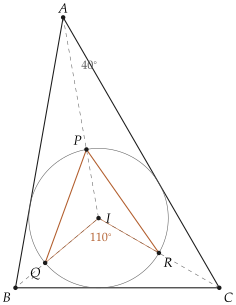
One point about the reading first. The paper says the lines , , meet the incircle, and each of those lines meets it twice, once on the side of towards the vertex and once on the opposite side. Throughout we take , , to be the intersections lying on the rays from towards , , respectively, which is the reading the official answer uses. It matters: the other choice for puts it on the short arc instead of the long one and turns the answer into .
The three points lie on the incircle, which is centred at , so is the centre of the circle through , , and the angle is an inscribed angle in it.
The central angle standing on the same arc is the angle between the radii and , that is the angle between the lines and : With this is .
The point lies in the direction of , which is on the other side of the circle from the arc just measured, so the inscribed angle theorem gives
Only mattered. The other two angles fix where and sit individually, but not the arc between them.
Answer 55
Solution: PRMO 2015 Part A, Q16
is the midpoint of the hypotenuse of right triangle , so and ; meanwhile the given equality of angles says exactly , which is what turns into .
Write and for the angles of the triangle at those vertices, and note first that being an altitude makes . In right triangle this gives , and in right triangle it gives . Since the triangle is acute, lies strictly between and ; first consider , which puts between and the midpoint . The other orders are treated below.
The quantity we are asked for is easy to convert. In the right triangle the point is the midpoint of the hypotenuse , so it is equidistant from all three vertices, and in particular . Triangle is therefore isosceles and So the whole problem is to find .
Now for the given condition, and the useful half of it is the right-hand side. Two facts about and pin down . Since and are the midpoints of and , the segment is a midline of the triangle and is parallel to , so the angle it makes with line at is . And since , triangle is isosceles with . Looking now at triangle , whose vertices and both lie on , its angle at is and its angle at is , so
The hypothesis therefore reads . Finally, lies on the far side of from , so the angle at splits as The two occurrences of cancel, which is the point of the whole configuration. Comparing with the expression found earlier,
If , the order along is . Triangle now has angles and , so . The given equality makes , and this time The earlier identity still applies, so the answer is again . If , then and both angles in the given equality are zero. Thus , with the same answer.
Nothing here needed the individual angles of the triangle, only the combination , and the given condition was designed precisely to hand that combination over.
Answer 40
Solution: PRMO 2017, Q24
The three equal lengths force , which here is ; but the segment parallel to a side is shorter than that side, and the shortest side is .
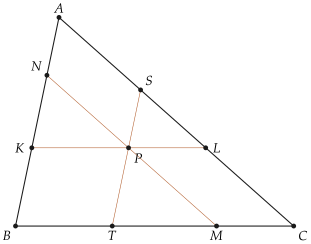
This question was discounted by the organisers. The formula it wants is easy to derive, and the derivation is exactly what shows the configuration cannot exist.
Let be the distance from to divided by the height from , and define and in the same way with and . Triangles and share the base , so , and likewise and . For an interior point the three triangles , , fill exactly, so with all three positive.
The line through parallel to cuts off at a triangle similar to , and its ratio of similarity is the ratio of the distances from , namely . Hence by the same argument at each vertex. If all three are equal to then so With , , this gives and , so
And there is the defect. For to be interior we need , that is for every side, so must be smaller than the shortest side. Here the shortest side is and exceeds it, which means : the point would have to lie outside the triangle, against the hypothesis.
So is the answer to a question about a configuration that does not exist for this triangle, and the discounting is right. A triangle admits such a point exactly when is less than its shortest side.
Answer none
Solution: PRMO 2018, Q13
Both the altitude and the bisector from the right angle have short formulas in the legs, and the two of them turn into a single linear equation for the hypotenuse.
Let the legs be and and the hypotenuse ; the median from is , since in a right triangle the midpoint of the hypotenuse is the circumcentre.
The altitude from the right angle has length , because the area is both and . So gives
The internal bisector from splits the right angle into two angles, so comparing areas again, So gives , and with ,
Now square and use Pythagoras. Since , so and the median is .
Answer 24
Solution: PRMO 2019, Q28
Each corner triangle is similar to with ratio for the corresponding altitude, and the reciprocals of the three altitudes sum to , so the three small inradii add up to exactly .
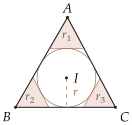
Let be the inradius of , and let be the altitude from . The tangent to parallel to lies at distance from , on the far side of the incircle, so it cuts off at a triangle whose sides are parallel to those of . That corner triangle is therefore similar to , and the ratio of similarity is the ratio of the distances from to the two parallel lines: Inradius scales the same way, so and likewise for the other two corners.
Adding the three, The bracket is the classical identity. Writing for the area and for the semi-perimeter, each altitude satisfies , so using . Substituting,
So the answer is the inradius of the original triangle, and nothing about the three corner triangles has to be computed separately. With sides the semi-perimeter is , and Heron’s formula gives so
The sum is exactly , not merely close to it, so the largest integer not exceeding it is . That exactness is worth insisting on: computed in decimals the three inradii add to , and a floor taken at that point would return . The identity above is what makes the answer safe.
Answer 15
Solution: IOQM 2020, Q16
Rearranged, the given condition says , and that is exactly the statement that the angle between those two sides is a right angle.
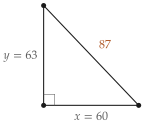
The equation relates two sides and the area, and the useful move is to gather the two sides on one side of it and the area on the other: Because the triangle is scalene we know , so we may divide both sides by , and this is precisely where the scalene condition earns its place in the problem. What survives is
Now recall that a triangle with sides and enclosing an angle has area . Comparing this with what we have just derived forces , so and the sides and are the two legs of a right angle. The condition that looked analytic was a disguised statement about shape.
The third side is then the hypotenuse, and with and , Since the hypotenuse is necessarily the longest side, the largest side of the triangle is .
Answer 87
Solution: IOQM 2021 Part A, Q6
Each equation is a cosine rule in disguise, for angles of , and . Those sum to , so the three quantities are distances from an interior point to the vertices of a -- triangle, and the expression asked for is four times its area.
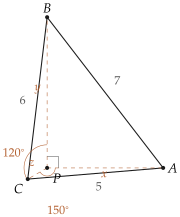
Look at the three equations as instances of . The first, , has no cross term, so and the opposite side is . The second, , has cross term , which matches , so and the opposite side is . The third has cross term , giving , so and the opposite side is .
Now count the angles: . Three angles at a point. So there is a point with , , , the three angles at as above, and the triangle having sides , and opposite them.
The area of is the sum of the three little triangles at : which evaluates to Multiplying by four gives exactly the expression we were asked for:
Heron’s formula finishes it. With sides the semiperimeter is , so , and the expression equals . Hence , , and .
Answer 30
Solution: IOQM 2022, Q3
The bisector and the parallel sides force triangle to be isosceles, after which is the base of the small isosceles triangle cut off at by the two tangent lengths.
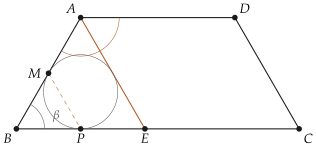
First establish the shape. Since in the trapezium, the angles and are alternate angles and so are equal. But bisects angle , so as well. Hence , and triangle is isosceles with . Everything now happens inside that triangle.
Write and scale so that , so . The incircle touches the two equal sides at and , and the tangent lengths from a vertex are equal, so where is the semiperimeter. Computing,
So is itself isosceles with apex angle at and legs , giving
Now impose , that is . Writing , so and . The repeated root is worth noticing: the condition is exactly extremal, so this configuration is the unique one of its kind.
Finally .
Answer 60
Solution: IOQM 2022, Q13
Because , , are in arithmetic progression, . Feeding that into the sine rule collapses the condition all the way down to .
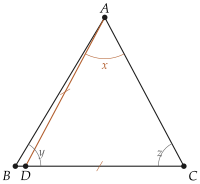
Write and with positive integers. The progression gives us one free gift before any geometry: .
Now express both lengths through the sine rule. In triangle the angles are at , at , and therefore at , so using . In triangle the angle at is , so
Setting and cancelling , Replacing and cancelling , which is not zero, where the last step is the product-to-sum identity. So , and since lies strictly between and ,
Everything is now arithmetic. Substituting the progression, . For to be an integer we need , hence , so write and get and .
To make as large as possible we take as small as possible, and gives , , . Check that this is a genuine triangle: the angle at is , and is indeed less than that, so falls properly inside . The largest possible is .
The relation is worth reading geometrically, because it says more than it looks. The angle at is , so says exactly that , which is to say : the condition , given the progression, is the condition that the triangle is isosceles at . And then makes triangle isosceles as well, so and , which is the same equation arrived at from the other end.
Answer 59
Solution: IOQM 2023, Q13
The reciprocals of the exradii add to the reciprocal of the inradius, which gives at once, and then each is a fixed multiple of , so the triangle is forced to be .
Write for the area and for the semiperimeter. The excircle opposite side is the circle outside the triangle touching and the extensions of and . Its centre has perpendicular distance from each of those three lines. The areas of triangles and , less the area of triangle , give : Thus ; the other two exradii follow by changing the vertex. The inradius is , by the area decomposition already used in Solution 11.7. Adding the reciprocals of the three exradii, With the given values, so and .
Now each side follows. From we get and therefore , , . The sides are in the ratio , and only the scale remains to be found.
Write , , , so that . Heron’s formula gives while we already know . Comparing, and the sides are , , .
The cubic with these roots has so . The nearest integer to is : the root is below because , and above because is less than .
Answer 58
Solution: IOQM 2024, Q22
The equal-sum condition says equals , and with that turns into , which Pythagoras converts into a quadratic in the ratio.
Write , and , so . From we have and , and the given condition reads In particular .
Now substitute into Pythagoras: Dividing by and writing , Since we need , which selects the plus sign:
Here and are coprime and is prime, as required, so
Answer 34
Solution: IOQM 2025 Part SEP, Q28
Write for the areas of , , ; then each of the three ratios along the three segments is one of , , .
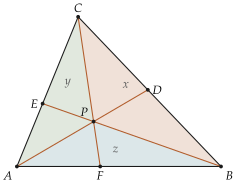
The three segments from the vertices have no common measure, since nothing fixes the shape of the triangle. They do, however, cut the triangle into three pieces around , and those three areas are the natural quantities, because every ratio in the question turns out to be a ratio of them.
Let , and . Triangles and share the vertex and have bases and on one line, so their areas are in the ratio ; the same holds with in place of . Adding the two, since the triangles and together make up . Cyclically,
Now use the data. Writing , the first given ratio says , so and . The second says , so . Hence and
Since , we get .
Answer 70
Solution: IOQM 2026, Q30
The sine rule in the two triangles standing on gives . That says the foot of the perpendicular from to is the midpoint of , so , and the angle at copies the angle at .
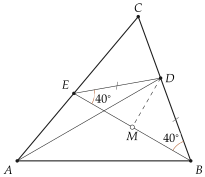
The angle is and , so .
In triangle the angles at and are and , so , and the sine rule gives . In triangle the angles at and are and , so , and . Since , dividing gives
Drop the perpendicular from to , with foot . The angle is , so , and is the midpoint of . So lies on the perpendicular bisector of , and . In the isosceles triangle the base angles are equal:
Answer 40
Solution: PRMO 2017, Q30
In a trapezium the two triangles on the parallel sides have areas and and the other two both have area , so the total is and only three distinct products exist.
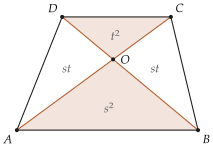
and the other two both carry
Let the diagonals meet at , and write and for the triangles on the two parallel sides. Triangles and are similar, and triangles and have equal areas, because when and one subtracts the common part . Writing for that common area, the standard relation holds, since
Put and , so and the four areas are , , , . The total area is
Now the products, taken two at a time. Only three distinct values arise: each occurring twice, the first as and again as .
Two of the six are and , so the pair we are given is one of these three values in some order. Take the possibilities in turn, always maximising .
and . Then and , so , and . The total area is .
and . Then and , so and . The total is .
and . Multiplying, , so ; dividing, , so and . The total is .
Swapping the roles of and changes nothing, since the total is symmetric.
Both runners-up fall short of , and exactly: because , and because while . The largest total area is therefore , and its square root is exactly
The first case is the one that lands on whole numbers, and that is no accident: and were chosen so that and come out integral.
Answer 13
Solution: PRMO 2018, Q29
The angle an incentre subtends at two vertices is plus half the third angle, so is , and the two angles at add to .
Since is the incentre of triangle , it lies on the bisector from , which meets at . So , , are collinear with between and , and
Now the standard incentre formula. In any triangle the incentre satisfies , because the angles at and inside triangle are half of the triangle’s, so Applying it in triangle , whose third angle is ,
The hypothesis therefore gives . Since lies inside , the two angles at are supplementary, so , and the same formula in triangle gives
Everything else about the triangle is irrelevant: the answer depends only on the angle at , and the two halves of the picture are linked by nothing more than the straight line .
Answer 30
Solution: PRMO 2019, Q29
A bisector that is also perpendicular to a median makes an isosceles triangle, so and the foot is the midpoint of ; that fixes the ratio and hence the fraction of that lies inside the triangle .
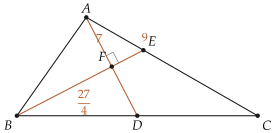
Let be the point where meets .
The isosceles triangle
Compare triangles and . They share ; the angles at are both right angles, since ; and the angles at are equal, because lies along the bisector of while and lie along the two arms, being a point of . So the two triangles are congruent, and In particular is the midpoint of , so . Write and . Since is the midpoint of ,
How far along the foot lies
The angle bisector from divides in the ratio of the adjacent sides, so Now take as the origin and write and for the position vectors of those vertices. Then and .
The point lies on , so for some ; and it lies on , so for some . Since and are not parallel, the coefficients must match: The second gives , and substituting into the first gives , so The value confirms independently that is the midpoint of , and is what we were after:
The area
Since is a median, it halves the triangle, so . And in triangle the segment is a base with as its perpendicular height. Hence and the nearest integer is .
Notice that the two given lengths enter separately and linearly: the area is for any triangle in which a median and a bisector cross at right angles.
Answer 47
Solution: IOQM 2020, Q22
Reflecting in a bisector of sends it to a point of line , and the foot of the perpendicular is the midpoint of that journey. So all four feet lie on the midline, where the three given lengths read off as , and the semiperimeter.
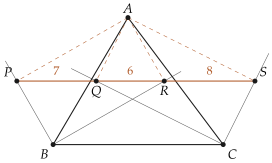
The four feet look unrelated until one notices what a perpendicular from to a bisector really is. Dropping a perpendicular from to a line and continuing the same distance beyond reflects in that line, and the foot is the midpoint of and its reflection. Now, reflecting in the internal bisector of angle maps the ray onto the ray , so the image is the point of line at distance from . Reflecting in the external bisector instead sends to the point of line at the same distance from but on the opposite side.
Each foot is therefore the midpoint of a segment joining to a point of line , which places it halfway between and that line, on the midline parallel to . The same reasoning at vertex places and on that same midline. All four points are collinear, which is why the problem could give us three consecutive gaps along a line.
Put coordinates on it. Take at the origin and at , and write and . The four reflections land on the -axis at from and at from the origin, so the four feet have -coordinates all at the same height. Taking differences, the distance between the two feet belonging to vertex is exactly , the distance between the two belonging to is exactly , and the distance from the leftmost to the rightmost is , the semiperimeter.
The order is : the successive differences of their horizontal coordinates are , and , each positive by the triangle inequalities. Reading the given data in that order, we get and hence . Heron’s formula finishes it:
Answer 84
Solution: IOQM 2020, Q23
Each small circle sits on a bisector with the incentre, so tangency gives . Half-angle algebra turns that into , and those three angles sum to a right angle.
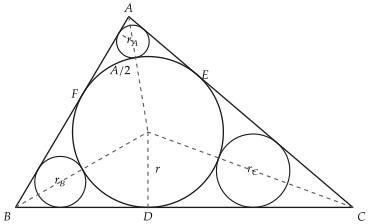
Fix attention on the circle at vertex . It touches both and , so its centre lies on the bisector of angle , which is where the incentre lies too. Along that bisector, a circle of radius inscribed in the angle sits at distance from , since the perpendicular from the centre to a side makes a right triangle with the half-angle at . The two circles touch each other externally, so the gap between their centres equals the sum of their radii:
Solving for the ratio gives , and the same holds at and at . So the three radii are known, but they are known one at a time, and the answer wants them combined.
Here is what to aim for. The one thing the three angles of a triangle satisfy is , so any hope of combining the three ratios rests on turning each of them back into an angle and using that sum. A ratio becomes an angle when it becomes a tangent, and the shape is exactly a squared tangent in disguise. Writing and using with , we get
The quarter of an angle looks like an odd thing to arrive at, but it is precisely what makes the sum work. Set and define , likewise from and . Since , Since , the tangent addition formula gives Here are positive and their sum is a right angle, so the denominators are non-zero. Multiplying through and moving the last term, hence . Translating that identity back through and its companions, that is,
The given radii are all perfect squares, which is the setter’s kindness:
Answer 74
Solution: IOQM 2022, Q12
One parameter controls the whole trapezium. Writing both areas in terms of it turns the question into maximising a quadratic.
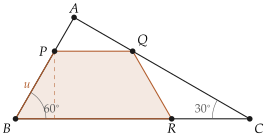
The angles are and , so . Put at the origin with at , so and , and the triangle has area .
Let along . Since and the trapezium is non-degenerate, . Since , that is parallel to , the point sits at the same height as , namely . Following the line down to that height puts at horizontal position . Finally lies on with , and since is at height the horizontal drop from to is , placing at in the isosceles trapezium. The other sign would put at and make , a parallelogram, rather than this isosceles trapezium.
So the trapezium has parallel sides and , and height , giving
The ratio we must minimise is therefore so minimising it means maximising the quadratic. Completing the square, Equality holds at , which lies in .
The minimum of the ratio is thus .
Answer 3
Solution: IOQM 2024, Q27
The three angles at add to and the three angles of the triangle to , so the common difference is ; and the angles of the triangle formed by the three perpendicular feet are exactly those differences, so is equilateral.
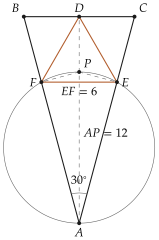
Call the common value , so Adding all three and using that the angles at an interior point total while the angles of the triangle total ,
The feet are on the sides, as the angle data ensure. Put , so . The three equations above give , , and . Also , so and . Thus the angles made by with both ends of each side are acute, and each perpendicular foot lies on its side.
Now consider the triangle formed by the perpendicular feet; this is called the pedal triangle. Since , the points lie on the circle with diameter , so . Similarly lie on the circle with diameter , so . Adding, On the other hand, splitting the angles of the triangle at and at , because . Comparing the two displays, and by symmetry each angle of the pedal triangle is the corresponding difference. The hypothesis therefore says all three angles of are equal, so is equilateral.
Its side is now a single computation. Since , the points lie on the circle with diameter , and in that circle the chord subtends the inscribed angle . By the extended sine rule in that circle,
An equilateral triangle of side has area so , and .
Answer 27
Solution: IOQM 2025 Part SEP, Q28
The step from the circumcentre to the midpoint of is exactly half the step from to the orthocentre, and in the same direction. So , and the whole triangle can be placed on coordinates.
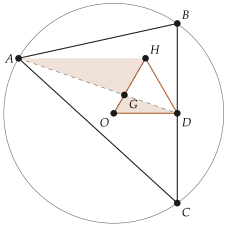
the shaded triangles are similar with ratio
The one fact, proved
Let be the midpoint of . The claim is that the journey from to is the journey from to , doubled: same direction, twice the length. Nothing about it is standard school material, so here is the proof, and it needs only the centroid.
Let be the centroid, which lies on the median with . Take the point on the line , on the far side of from , with . Now compare the triangles and . The angles at are vertically opposite, and the sides about them are in the ratio so the two triangles are similar with ratio . Hence is parallel to and twice as long, and since and sit on the opposite side of from and , the step from to runs the same way as the step from to , not the reverse.
That parallelism is what we want. is the circumcentre, so is perpendicular to the chord ; hence is perpendicular to , which puts on the altitude from . Repeating the argument with the midpoints of and puts on the other two altitudes, using the same point each time because and do not move. So is the orthocentre , and along the way we have shown In the language of vectors that reads , and the same computation packaged differently gives the familiar .
Placing the picture
Put at the origin and , which is legitimate because . Since is the midpoint of the chord , the line is perpendicular to , so it is the vertical line . The triangle is equilateral of side , so choosing one of the two possible positions; the other is its mirror image and gives the same area. By the fact above, .
The circumradius is then and , are the points of the line at distance from : so . The distance from to that line is , so
Hence , and .
Answer 92
Solution: IOQM 2025 Part SEP, Q28
Each tangent parallel to a side cuts off a small triangle similar to , and the similarity ratio is for the corresponding height , so the hexagon is what remains after removing three known fractions of the area.
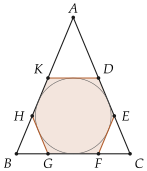
For the triangle with sides the semiperimeter is , so by Heron’s formula The heights are
Consider the tangent to the incircle parallel to the side of length . It and that side are the two tangents to the incircle perpendicular to , so they are apart, and the little triangle cut off at the opposite vertex is similar to with ratio The same computation on each side of length gives
The three small triangles meet the hexagon only along its sides, so which here is Over the common denominator the removed part is , so
Hence , , and .
Answer 55