Rachel was asked by her teacher to subtract 3 from a certain number and then divide the result by 9. Instead, she subtracted 9 and then divided the result by 3. She got 43 as the answer. What would have been her answer if she had solved the problem correctly?
Problem 2
It is given that the equation x2+ax+20=0 has integer roots. What is the sum of all possible values of a?
Problem 3
A man walks a certain distance and rides back in 343 hours; he could ride both ways in 221 hours. How many hours would it take him to walk both ways?
Problem 4
If 3x+2y=985 and 3x−2y=473, what is the value of xy?
Problem 5
A contractor has two teams of workers: team A and team B. Team A can complete a job in 12 days and team B can do the same job in 36 days. Team A starts working on the job and team B joins team A after four days. The team A withdraws after two more days. For how many more days should team B work to complete the job?
Problem 6
If 60% of a number x is 40, then what is x% of 60?
Problem 7
Three real numbers x, y, z are such that x2+6y=−17, y2+4z=1 and z2+2x=2. What is the value of x2+y2+z2?
Problem 8
If real numbers a, b, c, d, e satisfy a+1=b+2=c+3=d+4=e+5=a+b+c+d+e+3, what is the value of a2+b2+c2+d2+e2?
Problem 9
What is the smallest possible natural number n for which the equation x2−nx+2014=0 has integer roots?
Problem 10
If x(x4)=4, what is the value of x(x2)+x(x8)?
Problem 11
Let S be a set of real numbers with mean M. If the means of the sets S∪{15} and S∪{15,1} are M+2 and M+1, respectively, then how many elements does S have?
Problem 12
The equations x2−4x+k=0 and x2+kx−4=0, where k is a real number, have exactly one common root. What is the value of k?
Problem 13
Let a,b be integers such that all the roots of the equation (x2+ax+20)(x2+17x+b)=0 are negative integers. What is the smallest possible value of a+b ?
Problem 14
Suppose 1,2,3 are the roots of the equation x4+ax2+bx=c. Find the value of c.
Problem 15
A book is published in three volumes, the pages being numbered from 1 onwards. The page numbers are continued from the first volume to the second volume to the third. The number of pages in the second volume is 50 more than that in the first volume, and the number of pages in the third volume is one and a half times that in the second. The sum of the page numbers on the first pages of the three volumes is 1709. If n is the last page number, what is the largest prime factor of n?
Problem 16
Let f(x)=x2+ax+b. If for all nonzero real xf(x+x1)=f(x)+f(x1) and the roots of f(x)=0 are integers, what is the value of a2+b2?
Problem 17
Find the number of elements in the set {(a,b)∈N:2≤a,b≤2023,loga(b)+6logb(a)=5}
Problem 18
Let a=yx+zy+xz, let b=zx+xy+yz and let c=(yx+zy)(zy+xz)(xz+yx). The value of ∣ab−c∣ is:
Problem 19
Let f:R→R be a function satisfying the relation 4f(3−x)+3f(x)=x2 for any real x. Find the value of f(27)−f(25) to the nearest integer. (Here R denotes the set of real numbers.)
Problem 20
A function is defined on the set of positive integers such that if n is an odd integer, f(n)=n−1 and if n is an even integer, f(n)=n2−1. Determine the sum of all possible values of n such that f(f(n))=99.
Problem 21
If 2011+20112−11=m−n, where m and n are positive integers, what is the value of m+n?
Problem 22
If a=b−c, b=c−d, c=d−a and abcd=0 then what is the value of ba+cb+dc+ad?
Problem 23
Let x1,x2,x3 be the roots of the equation x3+3x+5=0. What is the value of the expression (x1+x11)(x2+x21)(x3+x31)?
Problem 24
Natural numbers k,l,p and q are such that if a and b are roots of x2−kx+l=0 then a+b1 and b+a1 are the roots of x2−px+q=0. What is the sum of all possible values of q?
Problem 25
Let a, b, and c be real numbers such that a−7b+8c=4 and 8a+4b−c=7. What is the value of a2−b2+c2?
Problem 26
Let a, b and c be such that a+b+c=0 and P=2a2+bca2+2b2+cab2+2c2+abc2 is defined. What is the value of P?
Problem 27
Suppose a,b are positive real numbers such that aa+bb=183, ab+ba=182. Find 59(a+b).
Problem 28
Suppose a,b are integers and a+b is a root of x2+ax+b=0. What is the maximum possible value of b2?
Problem 29
How many positive integers n are there such that 3≤n≤100 and x2n+x+1 is divisible by x2+x+1?
Problem 30
Let P(x)=x3+ax2+bx+c be a polynomial where a,b,c are integers and c is odd. Let pi be the value of P(x) at x=i. Given that p13+p23+p33=3p1p2p3, find the value of p2+2p1−3p0.
Problem 31
Determine the number of positive integral values of p for which there exists a triangle with sides a,b, and c which satisfy a2+(p2+9)b2+9c2−6ab−6pbc=0.
Problem 32
A function f is defined on the set of integers such that for any two integers m and n, f(mn+1)=f(m)f(n)−f(n)−m+2 holds and f(0)=1. Determine the largest positive integer N such that ∑k=1Nf(k)<100.
Problem 33
Let f(x) and g(x) be two polynomials of degree 2 such that g(−2)f(−2)=g(3)f(3)=4. If g(5)=2,f(7)=12,g(7)=−6, what is the value of f(5)?
Problem 34
Find the number of non-constant polynomials P(x), with real coefficients, such that P(x2)=P(P(x))
Problem 35
What is the sum of the squares of the roots of the equation x2−7[x]+5=0? (Here [x] denotes the greatest integer less than or equal to x. For example [3.4]=3 and [−2.3]=−3.)
Problem 36
Let f(x)=x3−3x+b and g(x)=x2+bx−3, where b is a real number. What is the sum of all possible values of b for which the equations f(x)=0 and g(x)=0 have a common root?
Problem 37
Let X={−5,−4,−3,−2,−1,0,1,2,3,4,5} and S={(a,b)∈X×X:x2+ax+b and x3+bx+ahave at least a common real zero}. How many elements are there in S?
Problem 38
A total fixed amount of N thousand pounds is given to three persons A,B,C, every year, each being given an amount proportional to her age. In the first year, A got half the total amount. When the sixth payment was made, A got six-seventh of the amount that she had in the first year; B got £1000 less than that she had in the first year; and C got twice of that she had in the first year. Find N.
Problem 39
Suppose that P is the polynomial of least degree with integer coefficients such that P(7+5)=2(7−5). Find P(2).
Problem 40
Let x,y,z be complex numbers such that y+zx+z+xy+x+yz=9y+zx2+z+xy2+x+yz2=64y+zx3+z+xy3+x+yz3=488 If yzx+zxy+xyz=nm where m,n are positive integers with GCD(m,n)=1, find m+n.
Problem 41
Let a,b,c be reals satisfying 3ab+2=6b,3bc+2=5c,3ca+2=4a. Let Q denote the set of all rational numbers. Given that the product abc can take two values sr∈Q and ut∈Q, in lowest form, find r+s+t+u.
Problem 42
For some real numbers m,n and a positive integer a, the list (a+1)n2,m2,a(n+1)2 consists of three consecutive integers written in increasing order. What is the largest possible value of m2?
Problem 43
Let P(x)=x2025,Q(x)=x4+x3+2x2+x+1. Let R(x) be the polynomial remainder when the polynomial P(x) is divided by the polynomial Q(x). Find R(3).
Problem 44
Complex numbers x,y,z satisfy the following system of equations: x2+y2+zx+y2+z2x2+y+z2=xy=yz=xz Determine the sum of all distinct possible values of ∣(x2−y)(y2−z)(z2−x)∣.
Solutions
Solution: PRMO 2012, Q1
Key idea
Undo Rachel’s operations to recover the number, then do the intended ones.
Let the number be N. Rachel computed (N−9)/3=43, so N−9=129 and N=138.
The intended calculation was 9138−3=9135=15.
Answer 15
Solution: PRMO 2013, Q3
Key idea
Every factorisation of 20 has a negated twin, and the two contribute opposite values of a.
If the roots are integers r and s then rs=20 and a=−(r+s). The factor pairs of 20 over the integers come in two families, positive and negative: (1,20),(2,10),(4,5)and(−1,−20),(−2,−10),(−4,−5), giving a=−21,−12,−9 and a=21,12,9 respectively.
Every value is matched by its negative, because negating both roots leaves the product unchanged and reverses the sum. So the six values cancel in pairs and their total is 0.
Answer 0
Solution: PRMO 2015 Part A, Q1
Key idea
The question gives a total for one walk plus one ride and a total for two rides, so the single ride is the quantity to isolate first, and everything else follows by subtraction.
Let w be the time for one walk of that distance and r the time for one ride. The two facts we are given translate directly: w+r=343=415,2r=221=25. The second gives r=45 at once, and then the first gives w=415−45=410=25. Walking both ways therefore takes 2w=5 hours.
The reason the arithmetic is so short is that the second condition was handed to us already solved for a single ride. A question phrased as three separate journey times often hides one equation that needs no work at all, and it pays to look for it before setting up anything larger.
Answer 5
Solution: PRMO 2015 Part A, Q15
Key idea
Adding and subtracting the two equations separates the powers of 3 from the powers of 2 immediately.
Adding the two equations gives 2⋅3x=1458, so 3x=729=36,x=6. Subtracting them gives 2⋅2y=512, so 2y=256=28,y=8. Therefore xy=48.
The only thing to be careful about is recognising 729 and 256 as exact powers rather than reaching for logarithms, which the competition never intends. Building up the small powers of 2 and 3 from memory is worth the five minutes it takes.
Answer 48
Solution: PRMO 2017, Q3
Key idea
Work in fractions of the job per day and add up what each stretch of time completes.
Team A does 121 of the job each day and team B does 361.
In the first four days, A alone completes 124=31. In the next two days both teams work, completing 2(121+361)=2⋅363+1=368=92. So after six days the fraction done is 31+92=95, leaving 94.
Team B alone needs 1/364/9=94×36=16 more days.
Answer 16
Solution: IOQM 2025 Part SEP, Q7
Key idea
"p percent of q" and "q percent of p" are the same number, pq/100, so the answer is handed over without finding x at all.
Both quantities in the question are 10060x: the first reads "60 percent of x" and the second "x percent of 60". Since we are told the first equals 40, so does the second.
If you would rather see the number, 60% of x is 40 gives x=3200, and then x% of 60 is 3200⋅10060=40, as promised.
Answer 40
Solution: PRMO 2013, Q11
Key idea
Adding the three equations completes three squares at once, and a sum of squares equal to zero fixes every variable.
Add the three equations: x2+y2+z2+2x+6y+4z=−17+1+2=−14. Move everything to one side and complete each square: (x+1)2+(y+3)2+(z+2)2=−14+1+9+4=0.
A sum of three real squares vanishes only when each does, so x=−1,y=−3,z=−2, and these do satisfy all three original equations. Hence x2+y2+z2=1+9+4=14.
Answer 14
Solution: PRMO 2014, Q5
Key idea
Every variable is the common value minus a known constant, so the sum of all five is 5t−15 and the last equation pins t down.
Call the common value t. Reading the chain from the left, a=t−1,b=t−2,c=t−3,d=t−4,e=t−5, so their sum is 5t−15. The final expression in the chain says t=(a+b+c+d+e)+3=5t−15+3=5t−12, hence 4t=12 and t=3.
The five numbers are therefore 2,1,0,−1,−2, and a2+b2+c2+d2+e2=4+1+0+1+4=10.
Answer 10
Solution: PRMO 2014, Q6
Key idea
The roots multiply to 2014=2×19×53 and add to n, so the smallest n comes from the most balanced factor pair, 38×53.
If the roots are integers r and s then rs=2014 and r+s=n. Since 2014>0 and n is a natural number, both roots are positive.
Factorising, 2014=2×19×53, so the factor pairs and their sums are (1,2014)→2015,(2,1007)→1009,(19,106)→125,(38,53)→91. The sum is smallest for the most balanced pair, which is the general rule for a fixed product, so n=91.
Answer 91
Solution: PRMO 2014, Q7
Key idea
x=2 solves x(x4)=4, and then both requested powers are powers of 2.
Work with the size of x rather than its sign, which settles both cases at once. Write t=∣x∣. Whatever x is, x4=t4, and if the power x(x4) is a real number then its size is ∣x∣ raised to that same exponent. So the equation forces tt4=4.
That has exactly one positive solution. For 0<t≤1 the left side is at most 1, so t>1; and for t>1 both t and t4 increase with t, so tt4 is strictly increasing and meets the value 4 once. Since (2)4=4, that once is at t=2.
So x=2 or x=−2, and both really do work. The first is immediate. For the second, the exponent x4 is 4, a whole number, so the power is defined without any question about what a negative base raised to a fractional power should mean, and (−2)4=4 as well.
Both signs give the same answer, because the two exponents in question are also even. With x=±21/2, x(x2)=221×2=2,x(x8)=221×16=28=256. Their sum is 2+256=258.
The exponents x2, x4, x8 are successively squared, so the three values are 21, 22 and 28: the answer grows alarmingly fast, which is the joke in the question.
Answer 258
Solution: PRMO 2014, Q8
Key idea
Each added element changes the mean by a stated amount, giving two linear equations in the size of S and its mean.
Let S have n elements and total nM.
First note that neither 15 nor 1 already lies in S, which is what makes the two unions bigger. If 15 were in S then S∪{15} would be S itself, with mean M rather than M+2. And if 1 were in S then S∪{15,1} would be S∪{15}, with mean M+2 rather than M+1. So the two unions have n+1 and n+2 elements.
Adding 15 gives a set of n+1 elements with mean M+2: nM+15=(n+1)(M+2)=nM+M+2n+2, so M+2n=13.
Adding 15 and 1 gives n+2 elements with mean M+1: nM+16=(n+2)(M+1)=nM+2M+n+2, so 2M+n=14.
Solving the pair, M=13−2n and 2(13−2n)+n=14, so 3n=12 and n=4,M=5. A check: a four-element set of mean 5 has total 20; adding 15 gives 35 over five elements, mean 7=M+2; adding 1 as well gives 36 over six, mean 6=M+1.
Answer 4
Solution: PRMO 2015 Part A, Q3
Key idea
Subtracting one equation from the other kills the x2 term, and what is left is linear, so the common root is pinned down before k is.
Suppose r satisfies both x2−4x+k=0 and x2+kx−4=0. Subtracting the second from the first removes the quadratic term: (−4−k)r+(k+4)=0,that is(k+4)(1−r)=0. So either k=−4 or r=1, and the two cases are worth separating carefully.
If k=−4 the two equations both read x2−4x−4=0. They are then the same equation and share both roots, which the problem has ruled out by insisting on exactly one common root.
That leaves r=1. Putting x=1 into the first equation gives 1−4+k=0, so k=3. It is worth confirming that this really does produce exactly one shared root and not two: with k=3 the equations factorise as (x−1)(x−3)=0 and (x−1)(x+4)=0, whose roots are {1,3} and {1,−4}. They meet in 1 alone, as required.
Answer 3
Solution: PRMO 2017, Q4
Key idea
The two quadratics are independent, so minimise each separately: a is a sum of two factors of 20 and b is a product of two numbers adding to 17.
If all roots are negative integers, write the roots of the first quadratic as −p and −q with p,q positive integers, and those of the second as −r and −s. Comparing coefficients, pq=20,a=p+q,r+s=17,b=rs. The two quadratics share no constraint, so a and b can be minimised separately.
For a: the factor pairs of 20 are (1,20), (2,10) and (4,5), giving a=21,12,9. The smallest is a=9, which is the general rule that a product splits most evenly nearest its square root.
For b, use positivity of the integers r,s and their sum 17: rs−16=rs−(r+s)+1=(r−1)(s−1)≥0. Equality is attained at (r,s)=(1,16), so the least b is 16.
Hence the smallest value of a+b is 9+16=25.
Note that the two halves pull in opposite directions: a fixed product wants a balanced split, a fixed sum wants a lopsided one. Both are the same fact about (r−s)2≥0 seen from different sides.
Answer 25
Solution: PRMO 2017, Q19
Key idea
The quartic has no cubic term, so its four roots sum to zero and the fourth root must be −6; the product of the roots is then the constant term.
Write the equation as x4+0⋅x3+ax2+bx−c=0, a monic quartic with four roots, three of which are 1, 2 and 3. Let the fourth be r: the factor theorem gives the three factors x−1,x−2,x−3, and the remaining monic factor is linear, x−r. In (x−1)(x−2)(x−3)(x−r), the x3 term takes a constant from one factor and x from the other three, so its coefficient is −(1+2+3+r). The constant term takes a constant from every factor, giving 1⋅2⋅3⋅r.
The coefficient of x3 is zero, and for a monic quartic that coefficient is minus the sum of the roots. So 1+2+3+r=0,r=−6.
The constant term of a monic quartic is the product of its roots. Here the constant term is −c, so −c=1⋅2⋅3⋅(−6)=−36,c=36.
Neither a nor b was needed, though they follow at once: the polynomial is (x−1)(x−2)(x−3)(x+6).
Answer 36
Solution: PRMO 2018, Q1
Key idea
The three first-page numbers are 1, one more than the first volume, and one more than the first two together, so their sum is a single linear equation in the length of the first volume.
Let the first volume have x pages. Then the second has x+50 and the third has 23(x+50).
The first page of volume one is numbered 1. The first page of volume two follows the whole of volume one, so it is x+1. The first page of volume three follows volumes one and two, so it is x+(x+50)+1=2x+51. Adding, 1+(x+1)+(2x+51)=3x+53=1709, so 3x=1656 and x=552. The three volumes then have 552, 602 and 903 pages, and the last page number is n=552+602+903=2057.
Factorising, 2057=11×187=11×11×17, so the largest prime factor is 17.
The condition that the third volume is one and a half times the second is what forces x+50 to be even, and 602 duly is. A problem that hands you a fractional multiplier is usually checking that you notice the parity it demands.
Answer 17
Solution: PRMO 2019, Q2
Key idea
Expanding both sides shows every term matches except the constants, so the functional equation says nothing more than b=2, and the integer roots then leave two possibilities for a with the same square.
Write f(x)=x2+ax+b and expand the two sides for nonzero x. On the left, f(x+x1)=(x+x1)2+a(x+x1)+b, which expands to x2+x21+2+a(x+x1)+b. On the right, f(x)+f(x1)=x2+ax+b+x21+xa+b=x2+x21+a(x+x1)+2b. Everything cancels except the constants, leaving 2+b=2b, that is b=2. Notice that a is untouched: the functional equation constrains only the constant term.
Now use the second condition. The roots of x2+ax+2=0 are integers with product 2, so they are 1 and 2, or −1 and −2. Their sum is −a, giving a=−3 or a=3. Either way a2=9, and a2+b2=9+4=13.
Answer 13
Solution: IOQM 2023, Q2
Key idea
Setting t=logab turns the condition into t+6/t=5, a quadratic whose two roots say that b is either a2 or a3.
The two logarithms in the equation are reciprocals of one another, since logba=1/logab. Writing t=logab, which is legitimate because a,b≥2, the condition becomes t+t6=5,that ist2−5t+6=0, so t=2 or t=3. In other words b=a2 or b=a3, and nothing else can occur.
Counting is now a matter of respecting the bound b≤2023.
For b=a2 we need a2≤2023, and since 442=1936 while 452=2025, the values a=2,3,…,44 all work. That is 43 pairs.
For b=a3 we need a3≤2023, and since 123=1728 while 133=2197, the values a=2,3,…,12 work, giving 11 pairs.
No pair is counted twice, because a2=a3 only for a=1, which is excluded. The total is 43+11=54.
Answer 54
Solution: IOQM 2024, Q5
Key idea
The three cyclic ratios multiply to 1. Naming them p,q,r makes a a sum, b a sum of pairwise products and c a product of pairwise sums, which one expansion connects.
Set p=yx,q=zy,r=xz,so that pqr=1. Then a=p+q+r straight away. For b, note that zx=r1 and xy=p1 and yz=q1, so b=p1+q1+r1=pqrqr+rp+pq=pq+qr+rp, using pqr=1. So a and b are the first two elementary symmetric functions of p,q,r, and the third is pqr=1.
Now c=(p+q)(q+r)(r+p), and there is a standard identity for that product: (p+q)(q+r)(r+p)=(p+q+r)(pq+qr+rp)−pqr. It is worth seeing why rather than taking it on trust. Write out the two expansions: (p+q)(q+r)(r+p)(p+q+r)(pq+qr+rp)=p2q+p2r+pq2+pr2+q2r+qr2+2pqr,=p2q+p2r+pq2+pr2+q2r+qr2+3pqr. The six mixed-square terms match; the second line has one extra pqr.
Hence c=ab−1 and ∣ab−c∣=∣ab−(ab−1)∣=1.
Answer 1
Solution: IOQM 2024, Q16
Key idea
Replacing x by 3−x gives a second equation in the same two unknowns f(x) and f(3−x), and eliminating the second one produces f outright.
The relation ties f(x) to f(3−x), so apply it at 3−x as well, noting that 3−(3−x)=x: 4f(3−x)+3f(x)=x2,4f(x)+3f(3−x)=(3−x)2. Treat f(x) and f(3−x) as two unknowns. Multiplying the first by 3, the second by 4, and subtracting removes f(3−x): 7f(x)=4(3−x)2−3x2=36−24x+x2, so f(x)=7x2−24x+36.
Now the required difference is exact, with no rounding needed: f(27)−f(25)=7(729−648+36)−(625−600+36)=756=8.
Answer 8
Solution: IOQM 2025 Part SEP, Q28
Key idea
Applying f twice changes the parity as it goes, so there are only two chains to follow and one of them ends in a non-square.
First exclude n=1: it gives f(1)=0, outside the domain of f, so f(f(1)) is undefined. For n≥2, take the two parity cases.
If n is odd then f(n)=n−1, which is even, so f(f(n))=(n−1)2−1=99,(n−1)2=100,n=11, taking the positive root since n is a positive integer. And 11 is indeed odd, so this is a genuine solution.
If n is even then f(n)=n2−1, which is odd, so f(f(n))=(n2−1)−1=n2−2=99,n2=101, which is not a perfect square. No solution here.
So the only value is n=11, and the sum of all possible values is 11.
Answer 11
Solution: PRMO 2012, Q12
Key idea
a+a2−1=2a+1+a−1, which turns the reciprocal into a difference of two square roots.
To remove the nested root, try a sum u+v. Its square is u+v+2uv, so we want u+v=2011,4uv=20112−1. Then (u−v)2=(u+v)2−4uv=1, giving u=1006 and v=1005. These numbers suggest the following identity, which also checks the calculation: (2a+1+a−1)2=22a+2a2−1=a+a2−1.
With a=2011 that gives 2011+20112−11=2012+20102. Rationalising the denominator, whose conjugate difference is 2012−2010=2, 22(2012−2010)=24024−4020=1006−1005.
So m=1006 and n=1005 is one answer, and m+n=2011.
Why those two integers are forced
Nothing so far rules out a second pair, and the question asks for m+n as though there were only one, so it is worth checking. Suppose the same number equals m−n for positive integers m and n, and put k=m−n, which is positive since m>n. Because (1006−1005)(1006+1005)=1, the number is the reciprocal of 1006+1005, and likewise (m−n)(m+n)=k gives m+n=k(1006+1005). Adding this to m−n=1006−1005, 2m=(k+1)1006+(k−1)1005. Squaring, the cross term is 2(k+1)(k−1)1006⋅1005, and 1006⋅1005=1011030 lies strictly between 10052 and 10062, so it is not a perfect square and its root is irrational. Everything else in the equation is a whole number, so (k+1)(k−1)=0, and with k positive that means k=1. Then 2m=21006, so m=1006 and n=1005 after all, and the answer stands.
The answer being the year is not a coincidence: for any a the same computation gives 2a+1−2a−1, whose two arguments add to a.
Answer 2011
Solution: PRMO 2012, Q13
Key idea
Adding the three equations gives 2a+c=0, and everything else is a multiple of a.
Add the three relations: a+b+c=(b−c)+(c−d)+(d−a)=b−a, so 2a+c=0, that is c=−2a. Then c=d−a gives d=c+a=−a, and b=c−d gives b=−2a+a=−a. The first relation is then satisfied automatically: b−c=−a+2a=a.
Since abcd=0 we have a=0, and ba+cb+dc+ad=−aa+−2a−a+−a−2a+a−a=−1+21+2−1=21.
Answer1/2
Solution: PRMO 2012, Q17
Key idea
The product is ∏(xi2+1) over ∏xi, and multiplying the cubic by its reflection in x↦−x produces a cubic whose roots are the xi2.
Write P(x)=x3+3x+5=(x−x1)(x−x2)(x−x3). Since xi+1/xi=(xi2+1)/xi, i=1∏3(xi+xi1)=∏ixi∏i(xi2+1).
The denominator is Vieta on x3+0x2+3x+5, which gives x1x2x3=−5.
For the numerator, reflect. Because P has odd degree, P(−x)=i∏(−x−xi)=−i∏(x+xi), so ∏i(x+xi)=−P(−x), and multiplying the two products pairs each root with its negative: i∏(x2−xi2)=P(x)[−P(−x)]=(x3+3x+5)(x3+3x−5), a difference of two squares. So i∏(x2−xi2)=(x3+3x)2−25=x2(x2+3)2−25. Both sides are polynomials in x2 that agree for every real x, so writing y=x2 they agree for every y≥0, and two polynomials that agree at infinitely many points are the same polynomial: i∏(y−xi2)=y(y+3)2−25.
Now put y=−1, which is legitimate because that is an identity between polynomials rather than a statement about a square. The left side becomes ∏i(−1−xi2)=−∏i(xi2+1), and the right side is (−1)(−1+3)2−25=−29. So the numerator is 29, and i=1∏3(xi+xi1)=−529=−529.
Answer−29/5
Solution: PRMO 2014, Q9
Key idea
The new product is l+2+l1, and for that to be a natural number l must divide 1.
Let a and b be the roots of the first quadratic, so a+b=k and ab=l, both natural numbers. In particular ab=l≥1, so neither root is zero and the reciprocals below are defined. The new quadratic has roots a+b1 and b+a1, so its coefficients are
Now q is required to be a natural number, and l is one, so l1 must be an integer: l=1. Then q=1+2+1=4, and p=2k, which is a natural number for every natural k, so such k,l,p,q really do exist.
The value of q is therefore forced, and the sum of all possible values is 4.
Answer 4
Solution: PRMO 2015 Part A, Q12
Key idea
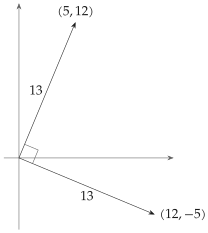
Eliminating one variable leaves 13a=12−5b and 13c=5+12b, and (12,−5) and (5,12) are two perpendicular vectors of the same length 13, so squaring and adding collapses everything.
Two equations in three unknowns cannot determine a, b and c separately, so the quantity asked for must be constant along the whole line of solutions. Let us find that line by solving for a and c in terms of b.
Multiply the second equation 8a+4b−c=7 by 8 and add the first, a−7b+8c=4: 65a+25b=60,so13a+5b=12. Substituting a=1312−5b back into the first equation and clearing denominators gives 8c=4−a+7b=1340+96b, hence 13a=12−5b,13c=5+12b.
Now square and add. The cross terms are −120b and +120b, which cancel: 169(a2+c2)=(12−5b)2+(5+12b)2=169+169b2=169(1+b2). Dividing by 169 gives a2+c2=1+b2, and therefore a2−b2+c2=1.
The cancellation was not luck. The coefficient pairs (12,−5) and (5,12) are perpendicular and both have length 13, which is exactly the condition under which the sum of the two squares loses its cross term and keeps a clean multiple of 1+b2. Ugly-looking coefficients in a problem like this are usually built to do something of that kind.
Answer 1
Solution: PRMO 2015 Part A, Q18
Key idea
With a+b+c=0 the denominator 2a2+bc factorises as (a−b)(a−c). The sum that remains is then the leading coefficient of the one quadratic taking the values a2, b2, c2 at a, b, c, and that quadratic is x2.
Start with the denominators, which look unpromising until the condition is used. Since c=−a−b, 2a2+bc=2a2+b(−a−b)=2a2−ab−b2=(2a+b)(a−b), and 2a+b=a+(a+b)=a−c. So 2a2+bc=(a−b)(a−c), and by the same computation with the letters rotated, 2b2+ca=(b−c)(b−a) and 2c2+ab=(c−a)(c−b). That P is defined tells us these are all non-zero, so a, b, c are three distinct numbers. What we must evaluate is P=(a−b)(a−c)a2+(b−a)(b−c)b2+(c−a)(c−b)c2.
At this point the condition a+b+c=0 has done its job and is no longer needed, because the sum above equals 1 for any three distinct numbers. Here is the reason, and the one fact behind it is that a quadratic is completely determined by its values at three different points: two quadratics that agree at three points have a difference of degree at most 2 with three roots, so that difference is the zero polynomial.
To make one term select the value at a, it should vanish at b and c, so give it the factors (x−b)(x−c); divide by (a−b)(a−c) to make its value at a equal 1. For a concrete example at the points 0,1,2, the polynomial −x(x−2) is 1 at 1 and 0 at the other two. Apply this same recipe at a,b,c and consider L(x)=a2(a−b)(a−c)(x−b)(x−c)+b2(b−a)(b−c)(x−a)(x−c)+c2(c−a)(c−b)(x−a)(x−b), which has degree at most 2. Each of the three fractions is designed to equal 1 at one of the three points and 0 at the other two, so substituting x=a makes the last two terms vanish and the first collapse to a2, and similarly at x=b and x=c. So L agrees with x2 at a, b and c, and by the fact just stated L(x)=x2 identically.
Comparing the coefficients of x2 on both sides gives exactly P=1, since the coefficient of x2 in L is the sum P and the coefficient of x2 in x2 is 1.
That way of assembling a polynomial from its values is called Lagrange interpolation. Here it explains why the sum is the coefficient of x2, rather than merely confirming its value.
Answer 1
Solution: PRMO 2017, Q2
Key idea
In terms of x=a and y=b the two given quantities are x3+y3 and xy(x+y), and those are exactly the pieces of (x+y)3.
Put x=a and y=b, both positive. The two conditions become x3+y3=183,x2y+xy2=xy(x+y)=182.
Now recall the expansion (x+y)3=x3+y3+3xy(x+y), which is built from precisely those two quantities: (x+y)3=183+3×182=183+546=729,sox+y=9.
From the second condition, 9xy=182, so xy=9182. Hence a+b=x2+y2=(x+y)2−2xy=81−9364=9729−364=9365, and 59(a+b)=59⋅9365=5365=73.
The factor 59 in the question is a courtesy: it turns an ugly fraction into a whole number, and its presence is a hint that a+b will have a 9 underneath.
Answer 73
Solution: PRMO 2018, Q9
Key idea
Substituting x=a+b and eliminating a leaves a=−(s+2)−2/(s−1), so s−1 must divide 2 and there are only four candidates.
Write s=a+b, so b=s−a, and substitute x=s into the equation: s2+as+b=0,that iss2+as+s−a=0. Collecting the terms in a gives a(s−1)=−(s2+s), and s=1 is impossible because it would force s2+s=2 to vanish. So a=−s−1s2+s=−(s+2)−s−12, using s2+s=(s−1)(s+2)+2.
For a to be an integer, s−1 must divide 2, so s∈{−1,0,2,3}. Working out a and then b=s−a in each case: s−1023a00−6−6b−1089b2106481 Each really works: for instance s=3 gives x2−6x+9=(x−3)2, whose root 3 is indeed a+b. So the maximum of b2 is 81.
Answer 81
Solution: PRMO 2019, Q8
Key idea
Dividing by x2+x+1 leaves x3 with remainder 1, so x2n leaves the same remainder as xr, where r is what 2n leaves modulo 3, and only r=2 works.
Everything turns on one factorisation: x3−1=(x−1)(x2+x+1), so x2+x+1 divides x3−1. It then divides x3m−1 for every m≥1 as well, since x3m−1=(x3−1)(x3m−3+x3m−6+⋯+1).
Write 2n=3m+r with remainder r, so 0≤r≤2. Then x2n−xr=xr(x3m−1) is divisible by x2+x+1, which says that x2n+x+1 and xr+x+1 leave the same remainder on division by x2+x+1. So one is divisible by it exactly when the other is, and since 2n is never a multiple of 3 there are only two cases to try: r=1:x+x+1=2x+1,r=2:x2+x+1. A polynomial of degree 1 is not divisible by one of degree 2, so r=1 fails; r=2 gives the divisor itself, so it succeeds. The condition is exactly 2n≡2(mod3). Now 2≡−1(mod3), so 2n≡(−1)n, which is 2≡−1 exactly when n is odd.
The odd n with 3≤n≤100 are 3,5,7,…,99, and there are 299−3+1=49 of them.
Answer 49
Solution: IOQM 2023, Q12
Key idea
The identity behind p13+p23+p33=3p1p2p3 allows only p1+p2+p3=0 or p1=p2=p3, and the parity of c rules the first out.
The relevant identity is x3+y3+z3−3xyz=(x+y+z)⋅21[(x−y)2+(y−z)2+(z−x)2], so the given condition holds exactly when p1+p2+p3=0 or p1=p2=p3.
Look at the first possibility. Adding the three values, p1+p2+p3=(1+8+27)+(1+4+9)a+(1+2+3)b+3c, that is, 36+14a+6b+3c. Every term except 3c is even, and c is odd, so 3c is odd and the whole sum is odd. An odd number is not 0. So this possibility cannot occur, and the parity condition on c, which looks decorative, is exactly what removes it.
That leaves p1=p2=p3, say all equal to k. Then P(x)−k is a monic cubic vanishing at 1, 2 and 3, so P(x)=(x−1)(x−2)(x−3)+k. Its constant term is c=P(0)=−6+k, which is odd precisely when k is odd, so such polynomials do exist. Reading off the values we need, p0=k−6,p1=p2=k, and therefore p2+2p1−3p0=k+2k−3(k−6)=18.
The answer does not depend on k, which is the sign that the question was built around the factorisation rather than around any particular polynomial.
Answer 18
Solution: IOQM 2024, Q10
Key idea
The whole expression is a sum of two squares, (a−3b)2+(pb−3c)2, so the equation pins the sides down to a=3b and c=pb/3, and only the triangle inequality is left.
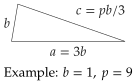
Group the terms so that the squares appear: a2−6ab+9b2=(a−3b)2,p2b2−6pbc+9c2=(pb−3c)2, and adding these accounts for every term of the given expression, since 9b2+p2b2=(p2+9)b2. So the equation reads (a−3b)2+(pb−3c)2=0. A sum of two real squares vanishes only when both vanish, so a=3b,c=3pb.
Now impose the triangle inequalities on the sides 3b, b, 3pb, and divide throughout by the positive number b: 1+3p>3⇒p>6,3+1>3p⇒p<12, while the third inequality 3+3p>1 holds automatically.
So p∈{7,8,9,10,11}, and every one of these does produce a genuine triangle: take b=3, so that the sides are a=9,b=3,c=p, and the two binding inequalities read 3+p>9 and 9+3>p, both of which hold for each of the five values. There are 5 of them.
Answer 5
Solution: IOQM 2025 Part SEP, Q7
Key idea
Putting n=0 collapses the functional equation into f(1)=f(m)−m+1, which says that f is linear.
Set n=0 in the relation. Since mn+1=1, f(1)=f(m)f(0)−f(0)−m+2=f(m)−m+1, using f(0)=1. Rearranged, f(m)=f(1)+m−1 for every integer m, so f is linear.
Now find the constant. Taking m=0 in that formula gives f(0)=f(1)−1, and f(0)=1, so f(1)=2 and f(m)=m+1. It is worth confirming this really satisfies the original relation, since we only used one special case of it: f(mn+1)=mn+2,f(m)f(n)−f(n)−m+2=(m+1)(n+1)−(n+1)−m+2=mn+2.✓
Finally, k=1∑Nf(k)=k=1∑N(k+1)=2N(N+1)+N=2N(N+3). For N=12 this is 212⋅15=90<100, while N=13 gives 213⋅16=104. So N=12.
Answer 12
Solution: IOQM 2025 Part SEP, Q7
Key idea
The combination f(x)−4g(x) vanishes at −2 and at 3, so it is a known multiple of (x+2)(x−3), and the data at x=7 fixes the multiple.
Set h(x)=f(x)−4g(x). It has degree at most 2, and the two given ratios say h(−2)=h(3)=0. A polynomial of degree at most 2 with those two roots is h(x)=k(x+2)(x−3) for some constant k.
Evaluate at x=7, where all three values are given: h(7)=f(7)−4g(7)=12−4(−6)=36,k⋅9⋅4=36,k=1.
Now evaluate at x=5: f(5)=4g(5)+h(5)=4⋅2+7⋅2=8+14=22.
Neither f nor g was ever determined, and neither needed to be. When two polynomials are tied together only through their ratio, the difference that the ratio kills is usually the object to work with.
Answer 22
Solution: IOQM 2026, Q11
Key idea
Comparing degrees forces P to be quadratic. The two sides then differ by a multiple of x2−P(x), so either P(x)=x2 or the other factor vanishes, and that happens only for P(x)=−x2.
If P has degree n≥1, then P(x2) has degree 2n and P(P(x)) has degree n⋅n. So n2=2n, and n=2. Write P(x)=ax2+bx+c with a=0.
Now subtract, keeping P(x) whole wherever it appears: P(x2)−P(P(x))=a(x4−P(x)2)+b(x2−P(x))=(x2−P(x))(a(x2+P(x))+b). This has to be the zero polynomial. A product of two non-zero polynomials is never the zero polynomial, since its leading term is the product of their leading terms, so one factor is zero.
Either P(x)=x2, or a(x2+P(x))+b=0 for every x. The second reads (a2+a)x2+abx+(ac+b)=0, so a2+a=0, which with a=0 gives a=−1; then ab=0 gives b=0, and ac+b=0 gives c=0. That is P(x)=−x2.
Both work: for P(x)=x2 each side is x4, and for P(x)=−x2 each side is −x4. There are 2 such polynomials.
Answer 2
Solution: PRMO 2012, Q18
Key idea
Writing n=[x] makes x2=7n−5, so each candidate n gives one positive x, and only four of them have the right integer part.
Put n=[x], so x2=7n−5. The right-hand side must be non-negative, and a negative x is impossible: it would force n≤−1 and then 7n−5<0. So x=7n−5 with n≥1, and the condition to check is n≤7n−5<n+1.
Squaring, that condition is n2≤7n−5<(n+1)2, which is a test on whole numbers and needs no square roots at all: n12345677n−5291623303744n214916253649(n+1)2491625364964✓××✓✓✓× The two failures at n=2 and n=3 are the cases where 7n−5 reaches (n+1)2 exactly, and beyond n=7 the root falls short of n for good, since n2−7n+5>0 from there on.
The four roots are 2, 23, 30, 37, and the sum of their squares is 2+23+30+37=92.
Answer 92
Solution: PRMO 2013, Q16
Key idea
Solving the quadratic for b and substituting turns the pair into r4−4r2+3=0, whose four roots give three values of b that cancel.
Let r be a common root. From g(r)=0 we get r2+br−3=0, and r=0 is impossible since it would give −3=0. So b=r3−r2.
Substituting into f(r)=r3−3r+b=0 and multiplying by r, r4−3r2+3−r2=0,that isr4−4r2+3=0, which factors as (r2−1)(r2−3)=0. So r=±1 or r=±3, and the corresponding values of b are r=1:b=2,r=−1:b=−2,r=±3:b=0.
Each really occurs: at b=2 the two polynomials share the root 1, at b=−2 they share −1, and at b=0 they share 3, since then f(x)=x(x2−3) and g(x)=x2−3.
The distinct values are 2, −2 and 0, and their sum is 0.
Answer 0
Solution: IOQM 2020, Q11
Key idea
Eliminating b between the two polynomials collapses everything to a(1−r2)=0, so either a vanishes or the shared root is ±1, leaving three small families to count.
Suppose some real number r is a zero of both polynomials, so that r2+ar+b=0andr3+br+a=0. Two equations in the unknowns a and b invite elimination, and the first is already solved for b, namely b=−r2−ar. Substituting that into the second and expanding, r3+(−r2−ar)r+a=r3−r3−ar2+a=a(1−r2), so the condition for a common root is a(1−r2)=0. That one line does most of the work: every solution falls into one of three families: a=0, or r=1, or r=−1. We count each in turn and then reconcile the overlaps.
The family a=0
The quadratic becomes x2+b, which has a real zero exactly when b≤0, the zeros being ±−b. The cubic becomes x3+bx=x(x2+b), which shares those zeros. So every b in {−5,−4,−3,−2,−1,0} succeeds, giving 6 pairs.
The family r=1
Substituting r=1 into either equation gives the same condition 1+a+b=0, so b=−1−a. Requiring b to lie in X restricts a to {−5,−4,…,4}, which is 10 pairs.
The family r=−1
Substituting r=−1 gives 1−a+b=0 in both, so b=a−1, and requiring b∈X restricts a to {−4,−3,…,5}, another 10 pairs.
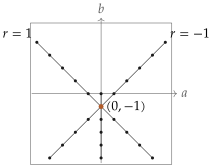
These families are not disjoint, and it turns out they meet in a single point. Setting −1−a=a−1 forces a=0 and b=−1, and that same pair (0,−1) also satisfies the condition of the first family. So (0,−1) lies in all three families and in each of the three pairwise intersections, and inclusion-exclusion gives
∣S∣=6+10+10−1−1−1+1=24.
Answer 24
Solution: IOQM 2020, Q21
Key idea
Each year’s share is an age divided by the total of the ages, and five years later every age has risen by five while the total has risen by fifteen. Three such comparisons pin down the ages, and the one absolute amount then fixes N.
Write a, b, c for the three ages in the first year and S=a+b+c for their total, so that in the first year A receives Na/S, and so on. Five years later, at the sixth payment, the ages are a+5, b+5, c+5 and their total is S+15.
The first clue is that A received half the total in the first year, so Na/S=N/2, giving a=S/2 immediately. The second clue compares A’s sixth payment with her first: S+15N(a+5)=76⋅SNa=76⋅2N=73N, so S+15a+5=73. Substituting a=S/2 and clearing denominators, 7(2S+5)=3(S+15), which simplifies to S/2=10 and hence S=20. So a=10 and b+c=10.
The third clue, that C received twice her first-year amount, isolates c: 35N(c+5)=2⋅20Nc=10Nc,so10(c+5)=35c, giving 25c=50 and c=2, and therefore b=8. Notice that all three of these clues were ratios, so N has cancelled every time and the ages were determined without it.
Only now do we use the one clue that mentions an actual sum of money. Working in thousands of rupees, B received one thousand less at the sixth payment than at the first: 3513N=208N−1=3514N−1. Hence 1=N/35 and N=35.
Answer 35
Solution: IOQM 2021 Part A, Q10
Key idea
The two surds multiply to something tiny: (7+5)(7−5)=2. So the required value is 4/α, and the degree-four equation α satisfies rearranges to express 4/α as a polynomial in α.
Building the polynomial
Write α=7+5. The first thing to notice is that (7+5)(7−5)=7−5=2,so7−5=α2. The condition P(α)=2(7−5) therefore reads P(α)=α4. That is not yet a polynomial condition, but it is close to one: multiplying by α gives αP(α)=4.
Next find what α satisfies. Squaring, α2=12+235, so α2−12=235 and squaring again gives α4−24α2+144=140, that is α4−24α2+4=0.
Now read that backwards as a statement about the number 4: 4=24α2−α4=α(24α−α3). Comparing with αP(α)=4 and cancelling α, which is certainly not zero, P(x)=24x−x3. This has integer coefficients and degree three, and P(2)=48−8=40.
Why degree three is really necessary
The question asks for the polynomial of least degree, so the construction alone does not finish it. Everything below is about ruling out degrees one and two, and the degree-zero case as well.
The whole difficulty is one fact: α satisfies no equation with rational coefficients of degree below four. That comes down to showing that x4−24x2+4 does not factor over the rationals. We will justify that implication after checking the factorisations.
It has no rational root. To see why only integer candidates are needed, write a rational root as h/k in lowest terms with k>0. Clearing denominators gives h4−24h2k2+4k4=0, so k divides h4. Coprimality forces k=1. Then h divides 4 by the same equation, and x=1,2,4 give −19, −76 and −124, with the negative values the same because only even powers appear. So the only possible factorisation is into two quadratics, and being monic with no cubic term they must take the form (x2+ux+v)(x2−ux+w)=x4+(v+w−u2)x2+u(w−v)x+vw. Matching coefficients gives u(w−v)=0, v+w−u2=−24 and vw=4, all rational.
If u=0, then v+w=−24 and vw=4, so v and w are roots of t2+24t+4, whose discriminant 576−16=560 is not the square of a rational.
If w=v, then v2=4 gives v=±2, and 2v−u2=−24 makes u2 equal to 28 or 20, neither the square of a rational.
So F(x)=x4−24x2+4 does not factor over the rationals. Suppose a non-zero rational polynomial Q of degree below 4 also vanished at α. Repeated polynomial division, just as in the Euclidean algorithm for integers, reduces degrees and finds a common divisor of F,Q. That divisor must be constant: any non-constant divisor of the unfactorable F has degree 4, too large to divide Q. Running the divisions backwards therefore gives rational polynomials U,V with UF+VQ=1. Substituting x=α gives 0=1, a contradiction. Thus no non-zero rational polynomial of degree below 4 vanishes at α.
Now suppose some P of degree at most two worked. Then xP(x)−4 would be a non-zero polynomial of degree at most three vanishing at α, which we have just ruled out. So degree three is least, and P(x)=24x−x3 is the polynomial the question asks for, with P(2)=40.
Answer 40
Solution: IOQM 2022, Q14
Key idea
Let s=x+y+z. Then y+z=s−x, and the identity s−xxk=s−xsk−(a polynomial) turns all three given sums into linear statements about the single quantity ∑s−x1.
Write s=x+y+z, so each denominator is s minus the corresponding numerator’s variable, and set T=∑s−x1, the sum running cyclically.
Take the three givens in turn. Since s−xx=s−xs−1, the first says sT−3=9,sosT=12. For the second, note x2=s2−(s−x)(s+x), so s−xx2=s−xs2−(s+x) and summing gives s2T−(3s+s)=64, that is s2T−4s=64. Using sT=12 this reads 12s−4s=64, so s=8,T=812=23. For the third, x3=s3−(s−x)(s2+sx+x2) gives s3T−(3s2+s2+∑x2)=488. With s=8 and T=23 this is 768−256−∑x2=488, so ∑x2=24.
Two of the three elementary symmetric functions follow at once. From ∑x2=s2−2∑xy we get ∑xy=264−24=20. For the third, evaluate T directly: putting everything over the common denominator ∏(s−x), T=∏(s−x)∑(s−y)(s−z)=s3−s2⋅s+s∑xy−xyzs2+∑xy=160−xyz64+20. Setting this equal to 23 gives 168=3(160−xyz), so xyz=104.
The requested quantity is now immediate, since yzx+zxy+xyz=xyzx2+y2+z2: 10424=133. Hence m=3, n=13 and m+n=16.
Answer 16
Solution: IOQM 2022, Q16
Key idea
Each equation solves for one unknown in terms of the next, so composing the three round the cycle gives a single quadratic in a.
Rearrange each equation to isolate a variable. From 3ab+2=6b we get 3b(a−2)=−2, so b=3(2−a)2. From 3bc+2=5c we get c(3b−5)=−2, so c=5−3b2, and from 3ca+2=4a we get a=4−3c2.
Now walk round the cycle. Substituting 3b=2−a2, 5−3b=2−a5(2−a)−2=2−a8−5a,soc=8−5a2(2−a). Then 3c=8−5a6(2−a) and 4−3c=8−5a4(8−5a)−6(2−a)=8−5a20−14a, so the last equation becomes a=20−14a2(8−5a). Cross-multiplying, a(20−14a)=16−10a⟹7a2−15a+8=0, which factors as (7a−8)(a−1)=0. The two promised values of the product come from these two roots.
If a=1 then b=32 and c=32, so abc=94. If a=78 then b=97 and c=43, so abc=78⋅97⋅43=32.
Both are already in lowest terms, so sr=94 and ut=32, giving r+s+t+u=4+9+2+3=18.
Answer 18
Solution: IOQM 2025 Part SEP, Q7
Key idea
Subtracting the outer two entries gives n2−2an−a+2=0, and integrality forces n to be an integer, after which 2n+1 must divide 9.
The three entries are consecutive integers, so the outer two differ by 2: a(n+1)2−(a+1)n2=2. Expanding, the an2 terms cancel and this becomes n2−2an−a+2=0.(∗)
Now, why must n be an integer? The middle entry m2 is an integer and so is the first, (a+1)n2. From (∗) we have n2=2an+a−2, so (a+1)n2=(a+1)(2an+a−2), which is an integer only if 2a(a+1)n is, so n is rational. Write n=h/k in lowest terms with k>0. Clearing denominators in (∗) gives h2−2ahk+(−a+2)k2=0, so k divides h2. Since h,k are coprime, k=1, and n is an integer.
With n an integer, solve (∗) for a: a(2n+1)=n2+2,a=2n+1n2+2. Multiply by 4 to clear the denominator neatly: 4(n2+2)=(2n+1)(2n−1)+9, so 2n+1 must divide 9. Hence 2n+1∈{±1,±3,±9} and n∈{0,1,4,−1,−2,−5}.
The negative values of n all make a negative, which is not allowed, so three cases remain: n014a212the three consecutive integers0,1,22,3,448,49,50 All three are genuine, and the largest middle entry is m2=49.
Answer 49
Solution: IOQM 2025 Part SEP, Q7
Key idea
Q(x) factors as (x2+1)(x2+x+1), and modulo each factor the enormous power of x collapses at once, because x2≡−1 and x3≡1.
First factor the divisor: x4+x3+2x2+x+1=(x2+1)(x2+x+1), which one checks by expanding. Now reduce x2025 modulo each factor.
Modulo x2+1 we have x2≡−1, so x2025=(x2)1012⋅x≡(−1)1012x=x. Modulo x2+x+1 we have x3≡1, because x3−1=(x−1)(x2+x+1), and 2025 is divisible by 3, so x2025=(x3)675≡1.
The remainder R has degree at most 3 and satisfies both congruences. Write R(x)=x+(x2+1)(αx+β), which automatically handles the first. For the second, work modulo x2+x+1, where x2≡−x−1 and therefore x2+1≡−x: x+(−x)(αx+β)=x−αx2−βx≡x+α(x+1)−βx=(1+α−β)x+α. This must be the constant 1, so α=1 and β=2. Hence R(x)=x+(x2+1)(x+2)=x3+2x2+2x+2, and R(3)=27+18+6+2=53.
Answer 53
Solution: IOQM 2026, Q21
Key idea
Subtracting the equations in pairs, each difference factorises with a factor x−y, y−z or z−x. So two of the unknowns are equal or all three equal 1, and a short check of each case leaves three values of the product.
Move the lone unknown in each equation to the right: x2−xy+y2=−z,y2−yz+z2=−x,z2−zx+x2=−y. Subtracting the third from the first, y2−z2−xy+xz=y−z, which factorises as (y−z)(y+z−x−1)=0. In the same way the second minus the first gives (z−x)(z+x−y−1)=0, and the third minus the second gives (x−y)(x+y−z−1)=0.
All three different. Then y+z−x, z+x−y and x+y−z all equal 1. Adding the first two gives 2z=2, so z=1, and in the same way x=y=1, which is not three different numbers. This case is empty.
All three equal, say to t. The first equation reads t2=−t, so t=0 or t=−1, and the product (t2−t)3 is 0 or 23=8.
Exactly two equal. Renaming x→y→z→x carries each equation to the next and leaves the product unchanged, so it is enough to take y=z with x different. Then (x−y)(x+y−z−1)=0 gives x=1, and the second equation becomes 1+2y2=y2, that is y2=−1. The other two equations then hold as well. No real number has square −1, which is why the question allows complex numbers, but nothing beyond y2=−1 is needed: (x2−y)(y2−z)(z2−x)=(1−y)(−1−y)(−2)=2(1−y2)=4.
Every value of the product is real, so the modulus is the ordinary size, and the distinct values are 0, 8 and 4. Their sum is 12, with or without the 0.