Books · Jane Street: Solutions
Chapter 3
Dancer Pairs
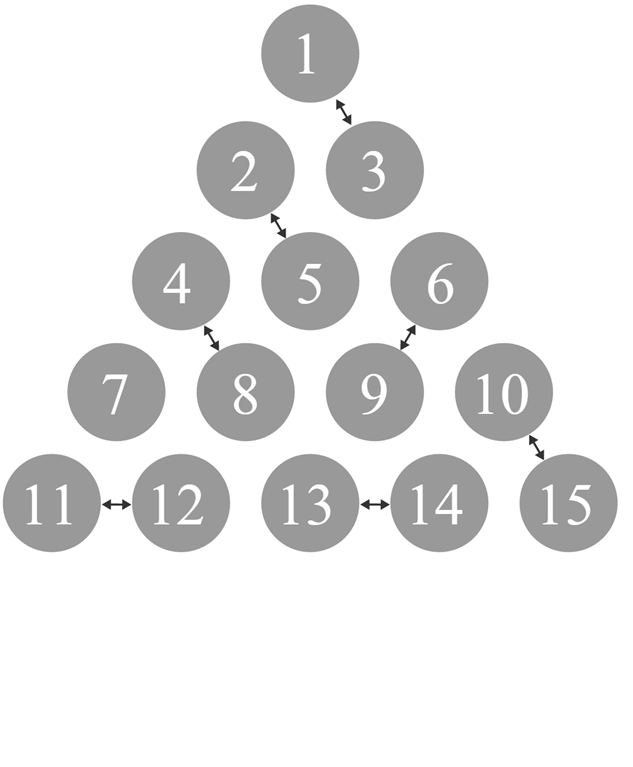
Fifteen dancers are standing in an equilateral triangle formation, with every dancer standing unit apart from her nearest neighbours. Each dancer chooses another who is unit away to pair up with, and all but dancer ends up as part of a pair. An example of one such arrangement is shown below. How many different sets of pairs are possible?
Solution
We use a backtracking algorithm in generate_all_pairings to generate all possible combinations. The backtrack function works as follows:
It takes the current index, the current pairing, and the set of used nodes.
If we have pairs, add the current pairing to our list of all pairings.
For each node from the current index onwards:
If the node is already used, skip it.
For each neighbour of the node: if the neighbour is not used and has a higher index (to avoid duplicates), create a new pairing with this pair, then recursively call
backtrackwith the updated pairing and used nodes.
We use
frozensets to represent pairs and combinations of pairs, allowing duplicates to be eliminated easily.
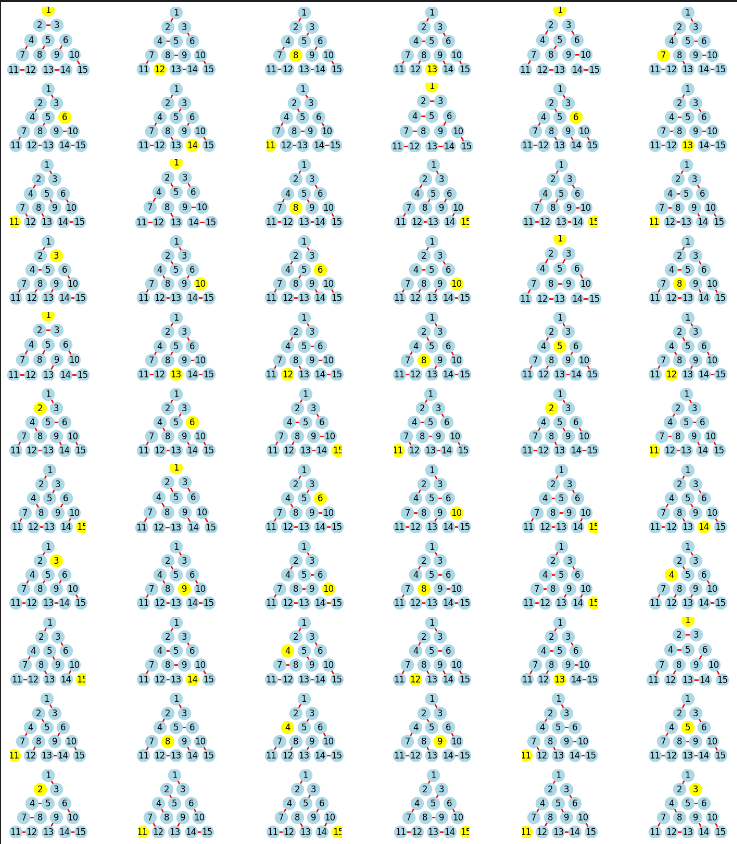
The code below shows that there are ways of pairing the dancers. A few sample pairings:
Python code
import networkx as nx
from itertools import combinations
import matplotlib.pyplot as plt
import math

def create_dancer_graph():
    G = nx.Graph()
    edges = [
        (1, 2), (1, 3),
        (2, 3), (2, 4), (2, 5),
        (3, 5), (3, 6),
        (4, 5), (4, 7), (4, 8),
        (5, 6), (5, 9), (5, 8),
        (6, 9), (6, 10),
        (7, 8), (7, 11), (7, 12),
        (8, 9), (8, 13), (8, 12),
        (9, 10), (9, 13), (9, 14),
        (10, 14), (10, 15),
        (11, 12), (12, 13), (13, 14), (14, 15),
    ]
    G.add_edges_from(edges)
    return G

def generate_all_pairings(G):
    all_pairings = []
    nodes = list(G.nodes())

    def backtrack(index, current_pairing, used_nodes):
        if len(current_pairing) == 7:
            all_pairings.append(frozenset(map(frozenset, current_pairing)))
            return
        for i in range(index, len(nodes)):
            node = nodes[i]
            if node in used_nodes:
                continue
            for neighbor in G.neighbors(node):
                if neighbor not in used_nodes and neighbor > node:
                    new_pairing = current_pairing + [(node, neighbor)]
                    new_used = used_nodes | {node, neighbor}
                    backtrack(i + 1, new_pairing, new_used)

    backtrack(0, [], set())
    return set(all_pairings)

G = create_dancer_graph()
all_combinations = generate_all_pairings(G)
print(f"Total number of combinations: {len(all_combinations)}")