Books · Solving Puzzles through Mathematical Programming
Chapter 2
The Calendar Puzzle
The Calendar Puzzle is the physical puzzle of fitting eight pieces around a date. A wooden board is laid out with the twelve months on its top two rows, the days through on its lower five rows, and six permanently blocked cells at the corners. Every morning, the user chooses a month and a day, sets those two cells aside, and tiles the remaining cells with eight polyominoes (seven pentominoes and one hexomino) to leave only the chosen month and day showing. The puzzle ships under the brand name A-Puzzle-A-Day; other calendar puzzles with minor variations (pentomino sets, day arrangements) are sold under DragonFjord and Calendarium. Our target is the original layout.
The puzzle is simple to describe and striking to solve. Every one of the possible (month, day) combinations is solvable: an exhaustive run of the model in this chapter finds at least one tiling for each date (indeed for all month-day cells, including the six that are not real dates). What varies widely is the number of solutions per date: some dates have dozens of tilings, others only one or two, with the boundary dates the most tightly constrained. The puzzle rewards both manual search (useful when solving once a day, by hand, with the physical pieces) and constraint programming (useful for auditing the board, counting solutions per date, or generating a printable picture).
Among the puzzles in this volume, the Calendar Puzzle is the cleanest example of an exact cover problem in disguise. The board is a fixed region, two cells are subtracted per day, and the eight polyominoes must cover the remaining cells exactly. No numeric clues, no adjacency rules, no colour constraints: only the geometry of the pieces and the geometry of the board. This makes the CP-SAT encoding extremely compact and the solver extremely fast.
The board and the pieces
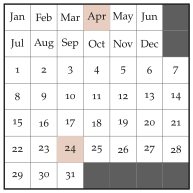
The physical board is a array of cells, of which six positions are permanently blocked: cells and on the top two rows (which carry the twelve months) and cells through on the bottom row (which carries days , , and then tails off). The remaining cells carry labels: the twelve months Jan, …, Dec and the thirty-one days . A date is chosen by designating one month cell and one day cell as the “reveal”, leaving cells to be covered.
The eight pieces are seven pentominoes (five cells each) and one hexomino (six cells), totalling cells. This is exactly the number of cells to cover, no cells to spare. Each piece may be rotated by , , , and reflected (flipped over), giving up to eight orientations per piece; some pieces with internal symmetry have fewer distinct orientations.
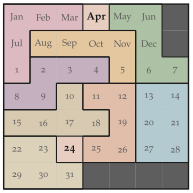
Figure 2.1 is the Calendar Puzzle for 24 April, and Figure 2.2 shows a valid tiling.
The programming model
The exact-cover formulation is direct. For each piece (), enumerate all orientations (rotations and reflections) and, for each orientation, all translations that fit inside the board. Each (piece, orientation, translation) triple defines a placement: a set of cells on the board that the piece would cover if the solver selects it.
Placement variables
For each placement associated with piece , introduce a Boolean variable with meaning “this placement of piece is selected.”
One placement per piece
For every piece , exactly one of its placements is selected:
Exact cover per cell
For every cell of the board with in the set of cells to be covered (i.e. not blocked and not equal to the chosen month or day), exactly one placement covers it: For every cell that must not be covered (the chosen month, the chosen day, and the six blocked positions), the same sum is required to be zero:
The two families can be unified as a single constraint where is for a must-cover cell and otherwise.
A solver in sixty lines
import numpy as np
from ortools.sat.python import cp_model

PIECES = [
    [(0,0),(0,1),(0,2),(1,2),(0,3)],
    [(0,0),(0,1),(0,2),(1,2),(2,2)],
    [(0,0),(0,1),(1,0),(2,0),(2,1)],
    [(0,2),(1,0),(1,1),(1,2),(2,0)],
    [(0,0),(1,0),(2,0),(0,1),(1,1),(2,1)],  # hexomino
    [(0,0),(1,0),(2,0),(2,1),(3,1)],
    [(0,0),(0,1),(0,2),(0,3),(1,0)],
    [(0,1),(1,0),(1,1),(2,0),(2,1)],
]

def rotations(p):
    out = [p]
    for _ in range(3):
        q = [(c, -r) for r, c in out[-1]]
        mr = min(r for r, _ in q)
        mc = min(c for _, c in q)
        out.append([(r - mr, c - mc) for r, c in q])
    return out

def reflections(p):
    mir = [(r, -c) for r, c in p]
    mc = min(c for _, c in mir)
    return [(r, c - mc) for r, c in mir]

def placements(piece, H=7, W=7):
    """All placements fitting the board."""
    seen, out = set(), []
    orients = (rotations(piece)
               + [reflections(r)
                  for r in rotations(piece)])
    for o in orients:
        for dr in range(H):
            for dc in range(W):
                pl = [(r + dr, c + dc) for r, c in o]
                if any(r >= H or c >= W for r, c in pl):
                    continue
                k = frozenset(pl)
                if k in seen: continue
                seen.add(k); out.append(pl)
    return out

BLOCKED = ((0, 6), (1, 6),
           (6, 3), (6, 4), (6, 5), (6, 6))

def solve_calendar(month_cell, day_cell):
    m = cp_model.CpModel()
    B = np.ones((7, 7), dtype=int)
    for r, c in BLOCKED:
        B[r, c] = 0
    B[month_cell] = 0
    B[day_cell] = 0
    all_pl, pv = [], []
    for piece in PIECES:
        pc = []
        for pl in placements(piece):
            v = m.NewBoolVar("")
            pc.append((v, pl))
            all_pl.append((v, pl))
        m.Add(sum(v for v, _ in pc) == 1)
        pv.append(pc)
    for r in range(7):
        for c in range(7):
            cov = [v for v, pl in all_pl
                     if (r, c) in pl]
            m.Add(sum(cov) == int(B[r, c]))
    s = cp_model.CpSolver()
    s.Solve(m)
    return [(pl, i)
            for i, pc in enumerate(pv)
            for v, pl in pc if s.Value(v)]
Each date solves in about milliseconds on a standard laptop. A nightly batch that emits the solution for every one of the possible dates completes in under a minute.
A hard instance: 29 February
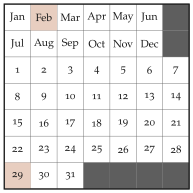
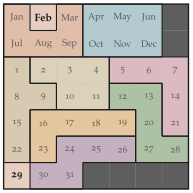
The leap-day date 29 February is interesting because it brings together two boundary cells: February in the top row and the cell in the bottom-left corner of the day block, diagonally far apart. Both cells are near the board’s geometric extremes, which constrains the tiling more than an interior choice would.
Sources. A-Puzzle-A-Day is a commercial wooden puzzle sold by DragonFjord Puzzles and several independent manufacturers, with variants dating from approximately . The puzzle reduces to classical polyomino packing, a topic with a long history in recreational mathematics running from Solomon Golomb’s 1954 pentomino coinage through Dana Scott’s exhaustive enumeration of pentomino tilings of an square minus the centre in 1958. Our solver enumerates about placements per board (the product of eight pieces, up to eight orientations, and several dozen translations) and CP-SAT handles the resulting in a fraction of a second.