Why the sphere beats the ball
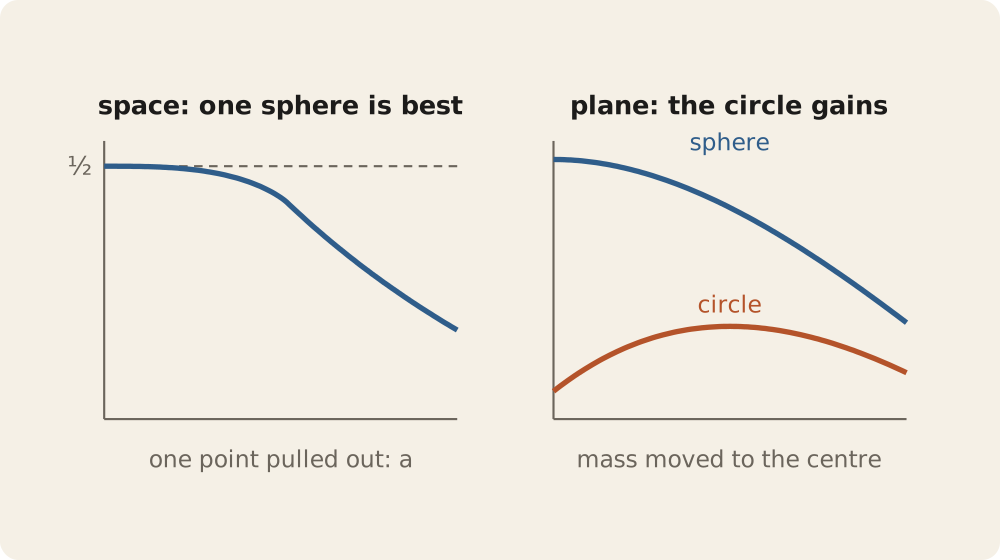
Three points on concentric spheres form an acute triangle with probability at most 1/2, equal only when the two outer radii agree; so the uniform sphere beats every rotationally invariant law in space, while in the plane moving mass inwards helps.
Partial progress on an open problem
Three random points form an acute triangle with probability 1/4 on a circle, 4/π² − 1/8 ≈ 0.280 in the disc, 1/2 on a sphere and 33/70 ≈ 0.471 in the ball (Hall, 1982). Filling in the circle helps, filling in the sphere hurts. Dan asked on MathOverflow (question 484567) why.
Theorem. Let A, B, C be independent and uniform on concentric spheres in ℝ³ of radii a ≥ b ≥ c > 0, and h = √max(0, b² + c² − a²). Then
P(ABC acute) = b/(2a) + c²/(6ab) − h³/(6abc) ≤ 1/2,
with equality exactly when a = b.
Corollary. For independent points with any common rotationally invariant distribution on ℝ³, the probability of an acute triangle is at most 1/2, with equality only for the uniform distribution on a sphere. So the ball must lose to the sphere, whatever its exact value; this settles the rotationally invariant case of MSE 5012846, whose general case is open.
The proof uses Archimedes’ hat-box theorem: with two vertices fixed, the third gives an obtuse angle exactly when it lies in a cap of its sphere, and the cap’s share is a clipped uniform tail. Each of the three obtuse probabilities is then the integral of a polynomial, and the bound is a one-variable monotonicity argument with b²c² − a²h² = (a² − b²)(a² − c²). In the plane the picture differs. Brandon Greenwell (arXiv:2608.06591, 2026) solved the planar version, three concentric circles, and showed the acute probability is again at most 1/2 for every rotationally symmetric law, but with equality only when one vertex is at the centre; he notes the fixed-radius formula for spheres was not known, and the theorem above supplies it in ℝ³. So the best planar law is degenerate and the circle’s 1/4 is far from it, while in space the sphere is the best. A vertex at the centre gives an acute triangle half the time in either dimension, better than the circle’s 1/4 but no better than the sphere’s 1/2, so a little mass at the centre helps the circle and hurts the sphere. A direct reason for the uniform disc’s gain is still missing.
Preprint v2, 10 October 2026 (v2 credits Greenwell’s planar result), not peer reviewed and not yet independently reviewed. The three cap integrals, the formula, the bound with its equality case and the plane/space comparison are formally verified in Lean 4 (lean/, standard axioms only); the hat-box theorem and the conditioning are quoted. The author used AI tools (Claude, Anthropic) in this work, as described in the paper’s acknowledgement, and is responsible for its content.