Wandering over the divisors of 10ⁿ
Players multiply by 2 or 5 or divide by 10, never repeating a divisor. The tournament's natural answer fails from 10⁶ on, and the second player beats whole families of openings on every board.
Partial progress on an open problem
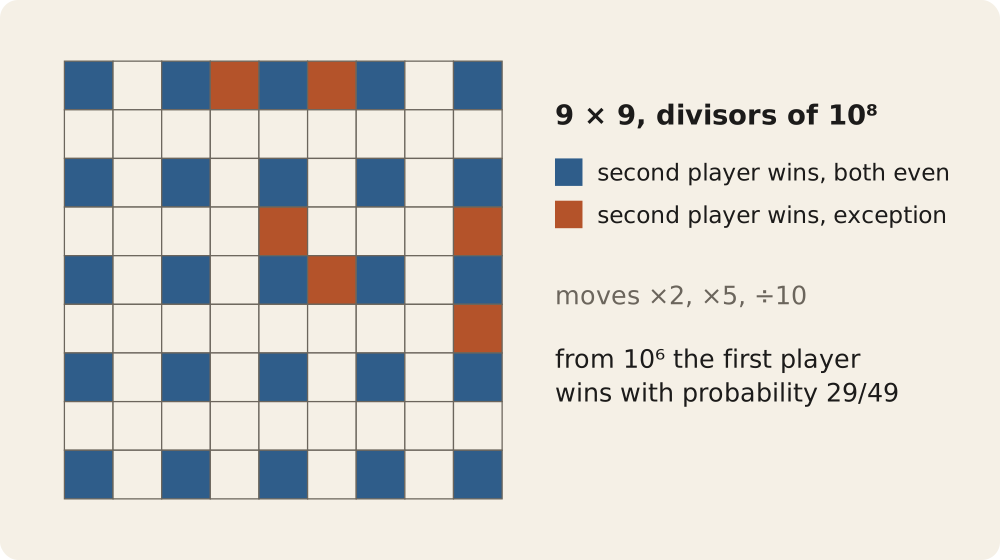
Wandering over the divisors of a power of ten
A referee names a divisor of 10^n; two players then take turns multiplying the last number named by 2 or by 5, or dividing it by 10, always naming a new divisor of 10^n; the player who cannot move loses. Writing 2^x 5^y as the square (x, y), this is a piece on the board {0, …, n}² with steps (1,0), (0,1) and (−1,−1). The game is problem 20 of the 23rd All-Ukrainian Tournament of Young Mathematicians (2020), posted by Witold on Mathematics Stack Exchange (question 3689425) and by Vepir on MathOverflow (question 363120), where it has had no answer since 2020.
The note proves:
- Theorem 1. For
n = 2, 4, 6, 8the second player wins from 4, 9, 20 and 31 squares. So from a random divisor of10^6the first player wins with probability 29/49, and the natural answer1 − (k+1)²/(2k+1)²to the tournament’s part (b) is false fromn = 6on. - Lemma 2. Sweeping an edge: once the piece reaches the right-hand edge with the column below it unused, the second player wins.
- Theorem 3. From a diagonal square
(k, k),k < n, the openings(1,0)and(0,1)lose; so(−1,−1)is the only possible winning opening. - Theorem 5. From a bottom-row square
(a, 0),1 ≤ a ≤ n,n ≥ 2, the opening(0,1)loses; so(1,0)is the only possible winning opening. - Theorem 7. The corners
(n, 0),(0, n)and the square(2, 0)lose for the first player whenn ≥ 2, and(2, 2)whenn ≥ 3.
It also records Vepir’s conjectured pattern for odd n (Conjecture 8, checked on every square up to 10 × 10, with 3m² − 4m + 5 losing squares on the 2m × 2m board), and approaches that fail: copying, square weightings (no weighting decides the winner on 5 × 5 or 7 × 7), and induction over rectangles.
Preprint, 10 October 2026, not peer reviewed. Lemma 2 and Theorems 3, 5 and 7 are formally verified in Lean 4 for every board size (lean/, standard axioms only). The exposition has not yet been independently reviewed. The author used an AI tool (Claude, Anthropic) in this work, as described in the note’s acknowledgements, and is responsible for its content.